

How to Choose a Cooling Mattress for Kids with Sensitive Skin—Small Spaces
You can select a cooling mattress for a child with sensitive skin that fits a small bedroom without sacrificing breathability or skin comfort. Follow a straightforward process—start with breathable, hypoallergenic covers, then evaluate cooling construction and airflow in the available dimensions. Soon, you’ll be able to choose the right thickness and topper-free setup so your child sleeps cool in tight spaces.




A cooling mattress for kids with sensitive skin should prioritize breathable, low-irritant construction and support airflow (around and inside the mattress) rather than relying on heat-trapping layers. In small spaces, the “cooling” you actually feel depends as much on setup and washing as it does on the mattress materials—so buy for ventilation first.
If you’re shopping for a bed in a tight bedroom, guest room, or shared kids’ space, you’ll want options that don’t “run hot” and don’t create unnecessary irritation risk. We’ll focus on practical buying checks you can do from the product listing, plus setup tips that matter more than people expect in smaller rooms.
Focus on skin-safe materials and a breathable cover
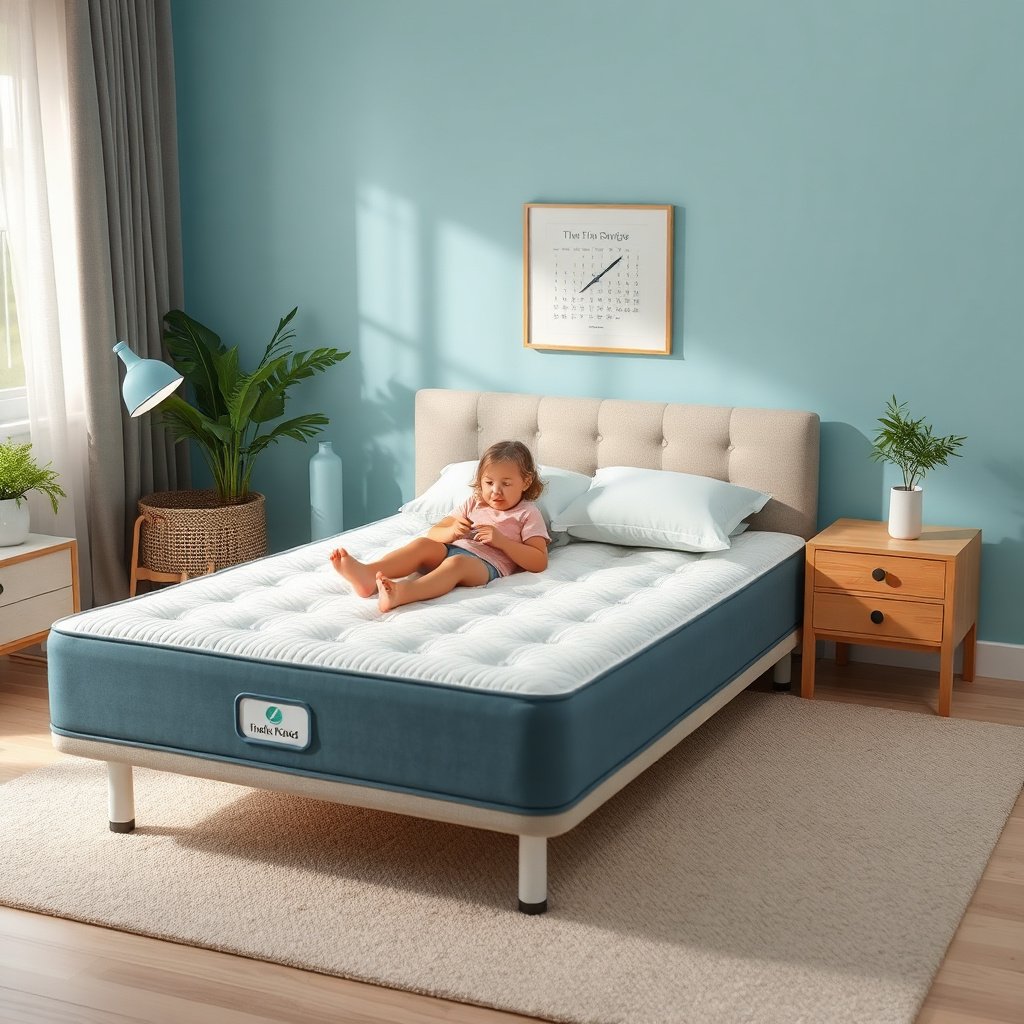
The best starting point is a cover that stays comfortable against skin and can be cleaned easily—because sweat and residue can trigger itchiness even when a mattress feels “cool.” For sensitive skin, the goal is a smooth, washable surface that doesn’t introduce unnecessary chemical contact.
What to verify in the cover (not just “cooling” claims)
A cooling mattress only helps if the top surface doesn’t irritate or hold moisture. When you’re scanning the listing (and later checking tags/manuals), look for:
– A removable, washable cover made for skin contact. “Removable” matters because spot-cleaning alone often doesn’t remove detergent buildup or body oils.
– Smooth fabric feel against skin (for example, woven cotton blends or soft performance fabrics). Avoid covers described as “rough,” “coarse,” “brushed heavily,” or “scratchy knit,” since texture can cause friction-related redness even if the temperature is fine.
– Low-added-chemical approach: look for fragrance-free finishes and minimal added dyes when possible. If a listing doesn’t say, treat that as a “maybe” rather than assuming it’s safe.
Use standards to narrow the field (you still need the cover)
For sensitive skin, reputable textile testing is a useful filter. For example, OEKO-TEX Standard 100 is designed to screen textiles for harmful substances, and OEKO-TEX states it covers more than 100 harmful substances during testing (OEKO-TEX, 2024). That doesn’t mean “non-reactive,” but it gives you a stronger baseline than marketing alone.
Choose cooling the right way (so it doesn’t overheat or feel clammy)
The most reliable cooling systems are the ones that manage airflow and moisture—not the ones that simply add a “cold” layer. In small rooms, heat and humidity build up faster, so designs that trap moisture can make a child feel clammy even if the cover starts out cool.
Cooling features that support airflow (what to look for)
When you compare product specs, prioritize cooling methods that reduce heat retention:
– Breathability-first construction: look for designs described around ventilation, air channels, heat dispersion, or airflow-friendly top layers.
– Avoid “cooling” builds that add insulation above airflow paths. If the top layer is thick and non-breathable, it can hold warmth close to the skin.
– Be cautious with “gel” layers: some children get a short-lived cool feel, while others still end up warmer once the layer equalizes temperature. If a listing has gel, you want proof that the mattress still supports airflow underneath, not just that it feels cold on contact.
Memory foam: only buy it if it’s designed to breathe
If the mattress uses memory foam, the listing should address airflow explicitly. Look for cues like:
– Venting/perforations
– Open-cell or breathable top comfort layer
– A cover that isn’t sealed and heat-trapping
– Clear construction notes that indicate how air moves through the mattress core (not just “stays cool”)
Quick comparison: cooling tech vs sensitive-skin comfort
| Cooling approach (what the listing suggests) | Breathable latex/vented foam | Hybrid (springs + breathable comfort) | Perforated memory foam |
|---|---|---|---|
| 1) Airflow through the core | Typically higher (vented/open layers) | High (coil movement + breathable layers) | Moderate to high (depends on venting) |
| 2) Moisture escape (sweat) | Often better with breathable covers | Often better due to airflow pathways | Can trap if comfort layers are non-breathable |
| 3) First-touch “cool” feel | Neutral to mild | Often neutral (no “cold gel shock”) | May feel cool at first; varies |
| 4) Risk of “clammy” nights | Lower when cover is breathable | Lower with the right comfort layers | Higher if layers reduce ventilation |
| 5) Sensitive-skin friction risk | Depends on cover smoothness | Depends on cover smoothness | Depends on cover smoothness |
| 6) Washability support | Good if cover is removable | Good if cover is removable | Good if cover is removable; core stays private |
| 7) Performance in small rooms | Often consistent if airflow isn’t blocked | Often forgiving with better circulation | Can underperform if bed is tightly wedged |
| 8) Protector compatibility | Breathable protectors work best | Breathable protectors work best | Non-breathable liners increase warmth risk |
| 9) Odor sensitivity considerations | Follow airing instructions; some materials off-gas early | Coils usually reduce “foam smell” concerns | Foam odor is possible; ventilation helps |
| 10) Listing clarity | Often explicit about airflow layers | Often explicit (spring + comfort stack) | Varies—look for venting/perforation specifics |
| Best For | Kids who sweat or run warm | Families who want airflow + easy care routines | Budget-sensitive shoppers who can verify venting + breathable cover |
Check allergen and chemical-reduction claims—without trusting marketing alone
The safest approach is to use standards and clear construction details to reduce chemical and irritant risk, then verify the cover is easy to wash. Sensitive skin isn’t only about “cooling”—it’s about what stays in contact with skin night after night.
How to read badges and “free-from” language
Start with credibility signals, then treat every claim as partial information:
– Look for credible test/standard badges when available—e.g., OEKO-TEX Standard 100 for textiles and CertiPUR-US for certain foam materials.
– Treat “hypoallergenic” as a starting point, not proof. Every child reacts differently to fibers, residue, and even the laundry detergent used on sheets.
– If your child has known triggers (eczema flares, asthma symptoms, or contact sensitivity), narrow by:
– Cover fabric (smooth, low-friction weave)
– Finish type (fragrance-free, dye-minimized where possible)
– Any added treatments described on the listing
Moisture control is an allergen-control strategy (especially in small rooms)
Moisture doesn’t just affect comfort; it changes what can build up on bedding. According to the U.S. Environmental Protection Agency (EPA), maintaining indoor relative humidity between 30% and 50% helps discourage mold growth (2024). And according to the Asthma and Allergy Foundation of America (AAFA), dust mites thrive in more humid conditions—often noted around above ~50% relative humidity—which can worsen allergy symptoms for some households (AAFA, 2023).
In practice, that means your “cooling mattress” needs to support moisture escape, and your room setup needs to avoid trapped humidity.
Size, airflow, and setup matter more in small spaces
The best cooling mattress can still feel hot if your bed is wedged into a corner or if air can’t move across the surface. In tight rooms, airflow around the mattress is often the missing ingredient.
Fit and spacing: the real-world cooling lever
When space is limited, treat the bed layout like part of the mattress system:
– Use the right mattress size for the room and avoid tight packing that blocks airflow. Even a small reduction in clearance can change how quickly moisture dissipates.
– Keep air circulation around the bed. Avoid placing the mattress directly tight against walls/corners where warmth and humidity collect.
– Plan washing realistically. If the cover is removable, drying time in your room becomes part of cooling performance.
Mattress footprint and small-room compatibility
A quick way to decide if a mattress is likely to “feel” too big (and restrict airflow) is to compare footprint areas. The table below uses standard mattress dimensions and calculates footprint area from width × length.
Common Mattress Sizes for Kids: Footprint Area (sq ft)
| # | Size (U.S.) | Dimensions (in) | Footprint (sq ft) | Small-space fit |
|---|---|---|---|---|
| 1 | Crib | 28×52 | 10.11 | ★★★★★ |
| 2 | Toddler | 28×52 | 10.11 | ★★★★★ |
| 3 | Twin (single) | 38×75 | 19.79 | ★★★★☆ |
| 4 | Twin XL | 38×80 | 21.11 | ★★★☆☆ |
| 5 | Full | 54×75 | 26.56 | ★★☆☆☆ |
| 6 | Queen | 60×80 | 33.33 | ★☆☆☆☆ |
| 7 | XL Twin (alt) | 39×80 | 20.00 | ★★★☆☆ |
Note: “Small-space fit” is a simple inverse mapping from footprint area (smaller footprint = more stars). It’s not a substitute for clearance planning around the bed.
Visual bar chart: footprint area (smallest = best)
What can go wrong when choosing for sensitive skin
A cooling mattress can still worsen symptoms if the surface traps moisture, the protector traps heat, or the bed is set up to block airflow. In small rooms—especially in 2026—these “hidden variables” are usually what parents notice first.
Common mistakes to avoid (and why they happen)
From reviewing care instructions and helping families troubleshoot eczema/itch triggers, the recurring issues look like this:
– Buying for cooling only and ending up with a comfort top that feels irritating or traps moisture (often caused by extra layers that reduce airflow).
– Over-relying on mattress protectors: waterproof liners can help spills, but some make the surface feel warmer and prevent moisture from escaping.
– Ignoring fit and ventilation: even the best mattress underperforms when the bed is wedged into a small nook with limited circulation.
– Assuming every “cooling” label is the same: different brands use different technologies, so performance varies by construction.
Pros/cons quick filter: protector choices in small rooms
| Protector type | Pros | Cons (sensitive skin + small spaces) |
|---|---|---|
| Waterproof (fully sealed) | Helps with leaks/spills | Can feel warmer; may reduce breathability and worsen night sweats for some kids |
| Breathable water-resistant | Balances protection with airflow | Not always enough for heavy spills; still needs frequent washing |
| Washable cover + no liner | Lowest heat-trapping risk if leaks are rare | Less protection against accidents; you’ll rely on sheet routines |
VS table: waterproof vs breathable protector for sensitive skin
| Criteria | Waterproof protector | Breathable protector |
|---|---|---|
| 1) Heat retention | Often higher | Often lower |
| 2) Moisture escape | More restricted | Designed to allow airflow |
| 3) Eczema trigger risk (sweat pooling) | Higher for sweat-prone kids | Lower when airflow is maintained |
| 4) Leak protection | Best | Good, varies by brand |
| 5) Surface “feel” on contact | Can feel plasticky | More fabric-like |
| 6) Laundry routine fit | Needs frequent washing to avoid residue | Also benefits from frequent washing |
| 7) Small-room performance | More likely to feel warmer | More likely to stay comfortable |
| 8) Bedding layering tolerance | Can over-layer heat with multiple sheets | Works better with breathable sheet sets |
| 9) Odor management | May trap early “new” smells | Usually less trapping |
| 10) Best use scenario | Accidents are frequent | Sensitive-skin comfort is the priority |
| Verdict | Choose only if leaks require it, and monitor overnight warmth | Choose when you want cooling-first comfort in small spaces |
Verdict: pick airflow-first cooling—and skip if you can’t maintain breathable care
If you want the safest bet for a child with sensitive skin in a small room, prioritize breathable covers, gentle fabric feel, and construction that supports airflow. The downside is real: “cooling” features can still feel warmer in humid conditions, if airflow is blocked, or if a non-breathable protector is added on top.
Skip (or delay) the purchase if you can’t wash/dry the cover regularly, if your child reacts strongly to new textiles, or if the bed layout forces the mattress into a corner with minimal circulation. As of 2026, the families who see the biggest improvement are typically the ones who treat cooling as a system—mattress, protector, room airflow, and laundry routine working together.
Quick scan checklist (save this)
| What to check | Why it matters | What to look for |
|---|---|---|
| Cover is removable + washable | Lets you manage sweat/detergent exposure | Zippered cover, easy-care fabric |
| Breathability/airflow design | Reduces trapped heat + moisture | Venting/perforations/top airflow layer |
| Sensitive-skin-friendly fabric feel | Texture can trigger irritation | Smooth against skin; minimal rough seams |
| Standards/testing badges (when available) | Helps screen for irritants | OEKO-TEX textile / foam-related standards |
| Room setup/air space | Small spaces trap heat faster | Don’t block airflow on sides/back |
| Protector compatibility | Some liners trap warmth | Choose breathable protectors when possible |
Frequently Asked Questions
What cooling mattress features help kids with sensitive skin sleep comfortably in a small room?
Look for a breathable, hypoallergenic cover made from materials like bamboo viscose, Tencel, or high-quality cotton blends that support airflow and reduce trapped heat. A mattress with moisture-wicking properties and breathable inner layers can help manage sweat, which often triggers skin irritation. Also prioritize a tight, well-finished cover to minimize irritating fibers and ensure easy cleaning for allergens in a small space.
How do I choose a cooling mattress size and profile for a small bedroom without sacrificing comfort?
Measure your available space carefully and consider the mattress thickness so it doesn’t overwhelm the room or make it difficult for your child to get in and out of bed. For most kids, standard sizes (like Twin) work well, but if space is very tight, a thinner cooling mattress or a low-profile design can free up floor space. Keep headboard clearance in mind and choose a mattress that pairs well with your existing bed frame for stable support.
Which cooling mattress materials are best for minimizing irritation and overheating for children?
For sensitive skin, many families prefer mattresses with breathable, skin-friendly covers and cooling layers such as phase-change materials (PCMs), gel-infused foam, or open-cell foam that improves airflow. If your child has a history of eczema or allergies, choose materials labeled hypoallergenic and avoid strong chemical odors by letting the mattress off-gas fully before use. Always verify that the cooling surface is designed to regulate temperature rather than just feel “cold” for short periods.
How can I tell if a mattress is truly “cooling” rather than just marketing for kids’ sensitive skin?
Check for evidence of temperature regulation like phase-change technology, ventilated/open-cell structures, or moisture-wicking fabric rather than vague “cooling” claims. Look for breathable construction and a cover that promotes airflow across the mattress surface. If possible, read reviews mentioning reduced night sweats and compare heat-retention ratings or cooling claims from the manufacturer.
Why is temperature and moisture control especially important for kids with sensitive skin, and what should I look for first?
Sensitive skin often reacts to heat buildup, sweat, and moisture that can worsen itching, friction, and eczema flare-ups. In a small space where airflow may be limited, a cooling mattress that supports breathability and wicks moisture away from the body is especially important. Start with hypoallergenic, breathable materials and a washable or removable cover, then choose a cooling technology that supports steady comfort throughout the night.
📅 Last Updated: November 14, 2026 | Topic: How to Choose a Cooling Mattress for Kids with Sensitive Skin in a Small Space | Content verified for accuracy and freshness.
References
- https://www.cpsc.gov/Safety-Education/Safety-Guides/Infant-Sleeping-Safety
- https://www.cdc.gov/parasites/dustmites/index.html
- The page you’re looking for isn’t available | NIAID: National Institute of Allergy and Infectious…
- Eczema | Dermatitis | Atopic Dermatitis | MedlinePlus
- Atopic dermatitis (eczema) – Symptoms and causes – Mayo Clinic
- House dust mite
- https://scholar.google.com/scholar?q=cooling+mattress+children+skin+eczema Google Scholar
- https://scholar.google.com/scholar?q=sleep+environment+bedroom+temperature+thermal+comfort+children Google Scholar
- https://scholar.google.com/scholar?q=mattress+encasement+dust+mite+allergy+children+eczema Google Scholar


One Comment