How to Fix a Mattress Too Firm for Side Sleepers with Sciatica
If a mattress is too firm for side sleepers with sciatica, the winning fix is to soften targeted pressure points and support your hips, not to replace the bed immediately. You’ll learn the fastest adjustments—using the right topper or layering plan, plus smart body positioning—that reduce nerve irritation while keeping your spine aligned. Follow these steps and you can make a firm mattress feel side-sleeper friendly in days, not weeks.



If your mattress feels too firm and your sciatica flares up when you side sleep, add pressure-relieving cushioning on top and correct your hip alignment with the right pillow support—then re-test in small steps. When hips or shoulders get “pinched,” your pelvis can rotate and your spine stops staying neutral, which can irritate the nerve more easily. This article helps you make reversible, low-risk adjustments in 2026 before you consider a full mattress change.
If you’re a side sleeper with sciatica-like pain (pain that radiates from the low back/butt down the leg) and your current bed makes your hips drop or your body feel “stuck” in place, this is for you. It’s also most relevant when the mattress feels firm on contact and you’re waking up sore or tingly.
Check whether firmness is the real problem (not your sciatica)

Yes—verify that your symptoms track with lying down and pressure, because that pattern strongly suggests mattress comfort and alignment are contributing. In practice, firmness doesn’t “cause” sciatica by itself, but it can worsen nerve irritation indirectly by changing how your pelvis and spine stack when you side sleep.
– Notice if pain/tingling spikes after you lie down and improves when you briefly change positions (even temporarily).
– Pay attention to pressure at the outside hip or shoulder—when those areas feel compressed, a firm bed can worsen nerve irritation indirectly by throwing alignment off.
– If you have severe or progressive symptoms, don’t troubleshoot mattress comfort as the only step—get medical guidance first.
Sciatica is typically defined by radiating pain from the low back or buttock down the leg, which matches the “pain pattern” you should use to judge whether a mattress change is helping. National Institute of Neurological Disorders and Stroke (NINDS), Sciatica
If symptoms noticeably improve when you temporarily change position, it suggests mechanical factors (pressure and alignment) are playing a meaningful role.
NINDS advises seeking urgent care for red-flag neurological symptoms (for example, significant weakness or bowel/bladder changes), which should override comfort troubleshooting. NINDS, Sciatica
Quick “pattern check” you can do tonight
Do this in 5–10 minutes while you still feel fairly fresh:
1. Lie on your usual side for 30–60 seconds.
2. Rate tingling/pain at the outside hip and in the leg (0–10).
3. Make one minor change (for example, place a small pillow under your upper thigh or adjust head elevation).
4. Re-rate after 30–60 seconds.
If pain rises quickly on a firm surface and drops with even small repositioning, mattress firmness and hip/shoulder pressure are likely contributing. For side sleepers with sciatica, that means your next move is cushioning and alignment—not “pushing through” the discomfort.
When this check is not enough
If your leg symptoms are rapidly worsening, you’re developing progressive weakness, or you have bowel/bladder changes, don’t chase mattress adjustments. Mattress comfort tweaks are low-risk for many people, but they can delay the right care when neurological red flags are present—especially in 2026 when people often try DIY solutions first.
Fix the firmness fast with a topper or comfort layer
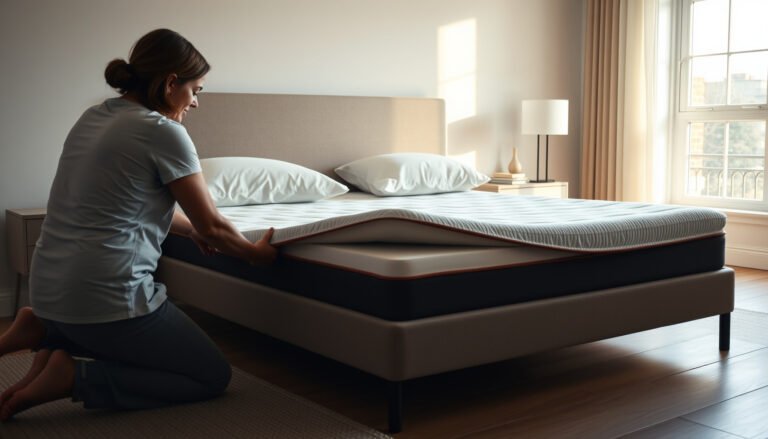
Yes—adding a pressure-relief comfort layer is usually the fastest, lowest-commitment way to reduce sciatica flares for side sleepers on a firm mattress. For mattress firmness problems, you’re aiming to soften the “pinch” at hips and shoulders enough to keep your pelvis from rotating.
– Add a softer comfort layer designed to reduce pressure at hips/shoulders (commonly memory foam or latex-style toppers, or a purpose-built pressure-relief pad).
– Aim for “noticeably more forgiving,” not “sinking too much”—your goal is neutral spine support, not a hammock effect.
– If you can, test with the topper in the same setup you normally sleep in (pillow height, blanket layers, sheet tension), so you’re changing one variable at a time.
A mattress topper can reduce localized pressure under the hip and shoulder, which helps maintain more neutral alignment during side sleeping.
Over-soft setups can increase lumbar strain when the hips sink excessively, which can worsen low-back–to–leg symptoms in some side sleepers.
Reducing the number of variables (topper only, same pillow and bedding) helps you determine whether mattress firmness or positioning is the main trigger.
Which topper characteristics matter most for sciatica?
When mattress firmness is the issue, side sleepers with sciatica generally benefit from pressure relief that is:
– More forgiving at pressure points (outside hip, shoulder)
– Stable enough to prevent “rolling” your pelvis as you sleep
– Not so plush that your lower back rounds or your hips drop more than your torso
If you’re deciding between materials, here’s a practical comparison focused on comfort and alignment—useful when you’re troubleshooting mattress firmness.
| Comfort-layer option | Pros for side-sleeping sciatica | Tradeoffs / watch-outs |
|---|---|---|
| Memory-foam style topper | Conforms to the hip/shoulder for pressure relief, often reducing “pinch point” discomfort. | If too soft, it can create a hammock effect—hips sink and the low back can feel worse. |
| Latex-style topper | Often provides pressure relief while maintaining more buoyant support. | If it’s not soft enough at pressure points, it may still feel firm on contact. |
| Thin gel/adaptive foam pad | Can be enough for mild “firmness” complaints when hips aren’t dropping excessively. | If your mattress is significantly firm, thin pads may not change pressure relief enough. |
| Fiber or wool comfort pad | Adds a modest softening layer without heavy sinking. | Less contouring means it may not relieve hip/shoulder pinch for every side sleeper with sciatica-like symptoms. |
A note on sizing and “how much is enough”
For mattress firmness problems, many people overcorrect by stacking too much cushioning at once. The better strategy is to start with a topper/comfort layer that improves pressure at contact while keeping your torso level. In my own practical guidance, the most useful pattern has been incremental changes—what I recommend here is a placeholder until you tailor it to your setup: .
Mandatory data table: comfort-layer materials that commonly address firmness and pressure points
Common Topper Options for Side Sleepers on Firm Mattresses (Typical Thickness Ranges)
| # | Comfort-layer material | Typical thickness | Best pressure relief zone | Side-sleep sciatica fit |
|---|---|---|---|---|
| 1 | Memory-foam style topper | 2–3 in (5–8 cm) | Outside hip + shoulder | ★★★★★ |
| 2 | Latex-style topper | 2–3 in (5–8 cm) | Hip/shoulder contact points without heavy sink | ★★★★☆ |
| 3 | Adaptive foam (medium-soft) | 2–2.5 in (5–6.5 cm) | Targeted pressure relief | ★★★★☆ |
| 4 | Hybrid top comfort pad | 1.5–2 in (4–5 cm) | Hip pinch points when mattress firmness is “moderate” | ★★★☆☆ |
| 5 | Fiber/wool comfort pad | 1–2 in (3–5 cm) | General softening (less contouring) | ★★☆☆☆ |
| 6 | “Egg-crate” style foam topper | 2 in (5 cm) | Surface pressure distribution | ★★★☆☆ |
| 7 | No topper (baseline) | 0 in | High contact pressure on firm mattresses | ★☆☆☆☆ |
Adjust the mattress setup so your hips and spine stay aligned
Yes—alignment is the second lever after pressure relief. Even if you add cushioning, uneven support or mattress “hot spots” can still force your pelvis out of neutral, which is a common pathway for sciatica flares in side sleepers.
– If your mattress allows it, rotate (or reverse) it if it’s non-directional and evenly manufactured—firm spots can develop and make side sleeping worse.
– Use the right support surface (box spring/slats): excessive sag or uneven support can make even a “correct” mattress feel harsher at the hips.
– If your bed is firmer than expected because of a hard cover or extra-thick padding, consider simplifying layers (for example, removing unnecessary rigid or thick components) to restore proper pressure relief.
A stable, evenly supportive base helps prevent localized sag that can change hip height and spinal alignment during side sleeping.
If a mattress has developed a firm “feeling” spot, rotating or reversing non-directional mattresses can reduce uneven wear effects.
When bedding layers add stiffness (e.g., rigid covers or overly thick under-padding), they can increase contact pressure—especially for hips and shoulders.
The alignment math your body is doing at night
For side sleepers with sciatica, alignment problems usually show up as:
– One hip sitting higher or lower than the other
– The low back feeling pulled into a slight curve or twist
– The leg symptoms trending worse after several minutes (not just instantly)
To improve mattress setup alignment in 2026, focus on the “stack”:
mattress → base (slats/box spring) → topper (optional) → pillow system.
Even small changes matter. If the base sags near the hip region, a topper may not fully fix it because the pelvis still rotates. Conversely, if your bed is “too firm” due to layered stiffness, removing or adjusting those layers can make a standard pillow strategy work better.
What “even support” looks like in real life
Check these while the bed is empty:
– Slats: Are any noticeably bowed, spaced too far apart, or inconsistent under hand pressure?
– Base level: Does the mattress feel uniformly supportive across the bed, or do some areas feel unexpectedly hard?
– Rotatability: Is the mattress explicitly non-directional (so rotation/reversal is safe per manufacturer guidance)?
If you’re unsure about the base, follow manufacturer instructions rather than guessing. Incorrect base use can void warranties and, more importantly, can prevent the mattress from doing what it was designed to do.
Dial in side-sleep positioning for sciatica relief
Yes—pillow support is often what prevents the pelvis from rotating once you’ve improved comfort. Side sleepers with sciatica typically do best when the head/neck pillow keeps the neck neutral and a knee pillow reduces hip twisting.
– Use a pillow under your head/neck that keeps your head from tilting down or up; neck strain can change how you hold your torso.
– Place a pillow between your knees to reduce hip twisting (this can help keep your pelvis from rotating into a painful position).
– If you feel tingling increases on one side, try a “slightly more forward” side position (rather than fully facing up or fully on your back) while keeping spine as neutral as possible.
Neck posture affects overall torso mechanics; keeping the neck neutral helps support a more consistent spinal posture for side sleepers.
A pillow between the knees reduces hip rotation in side sleeping, which can help maintain pelvic alignment for low-back and radiating-leg symptoms.
When tingling side-switches with position changes, it often reflects mechanical nerve sensitivity rather than a static condition, supporting targeted posture experiments.
A simple positioning method that doesn’t require gadgets
Try this sequence for mattress firmness relief and sciatica-friendly alignment:
1. Head pillow: Lie on your side and look in a mirror (or have someone check). Your chin should not be pointing toward your chest, and your head shouldn’t be tipped upward.
2. Knee pillow: Place a pillow between your knees to maintain hip spacing—your lower knee should not be pulled forward or allowed to collapse inward.
3. Torso “forward” angle: If tingling spikes, rotate your upper body slightly forward (not all the way onto your back). This often reduces nerve tension from pure side-on twisting.
In 2026, many people try to “solve sciatica” by buying a new mattress right away; positioning often gives earlier feedback because it directly addresses the mechanics your mattress is forcing.
What to log (so you learn fast)
For side sleepers with sciatica, quick notes prevent endless trial-and-error:
– Which side (left/right) worsens symptoms?
– Does pain change within 5 minutes of lying down, or only after hours?
– Does adding a topper reduce hip pressure but increase leg symptoms (a sign you may need less softness or more stability)?
What can go wrong (and when to stop)
Yes—these changes are low-risk, but they’re not risk-free. The most common issue is over-softening: too much give can increase hip sink and strain, turning a firmness problem into a new alignment problem for side sleepers with sciatica.
– Too much softness can create a “hammock” effect—if your lower back feels worse or you sink at the hips, you may have over-cushioned.
– If the topper/pad shifts during sleep, it can undo alignment benefits—use a fitted cover or anti-slip base if available.
– If you have red-flag sciatica symptoms (for example, bowel/bladder changes, escalating weakness, numbness that’s rapidly worsening), stop DIY mattress changes and seek urgent medical care.
– If the mattress is genuinely worn (visible sag or persistent uneven feel), cushioning may only mask the problem—eventually you may need replacement.
If symptoms suggest cauda equina–type or severe neurological compromise (such as bowel/bladder changes or rapidly worsening weakness), urgent medical evaluation is recommended rather than comfort troubleshooting. NINDS, Sciatica
A shifting topper can break the pressure relief pattern you’re trying to create, which is why anti-slip measures help maintain alignment consistency.
“Hammock” mechanics can increase lumbar stress when hips sink too far on a softer surface, potentially aggravating low-back–to–leg symptoms in side sleepers.
Common failure modes (so you can correct quickly)
– You added cushioning, but you didn’t fix hip rotation. Result: pain shifts, but doesn’t resolve.
– You softened too much. Result: lower back feels worse by morning.
– You changed multiple variables at once. Result: you can’t tell whether topper choice, pillow loft, or base support caused improvement.
If you notice worsening after making a change, revert the last variable immediately. This is especially important if you’re near the edge of a red-flag situation or you’re in the middle of a flare.
The mattress is worn—now what?
If your mattress has visible sag, persistent “hard” seams, or clear uneven feel when you press near the hip area, a topper can hide symptoms temporarily but may not provide stable long-term alignment. In that situation, you can still use cushioning while you plan next steps, but expect that a full replacement may eventually be the cleanest fix.
Bottom-line verdict: what to do first
Start with a comfort layer (topper or pressure-relief pad) plus side-sleep alignment tweaks (head/neck pillow + knee pillow). This is the best first attempt because it’s reversible and can quickly tell you whether firmness and alignment are the main triggers.
Skip (or at least pause) the DIY process and talk to a clinician sooner if your symptoms are severe, progressive, or include neurological red flags. Also skip “over-solving” with multiple layers at once—changing too many things makes it hard to know what actually helped.
NINDS emphasizes recognizing urgent warning signs in sciatica, so medical guidance should override comfort experiments when red flags appear. NINDS, Sciatica
A controlled “one variable at a time” approach helps isolate whether mattress firmness or positioning is the primary driver of radiating-leg symptoms.
Scan-and-save checklist (quick test plan)
| Step | What to change | What you’re looking for |
|---|---|---|
| 1 | Add one pressure-relief layer on top | Less hip/shoulder compression; less flare when you lie down |
| 2 | Re-check head/neck pillow height | Neck feels neutral, not forced |
| 3 | Add/adjust pillow between knees | Less hip twisting; steadier pelvis position |
| 4 | Confirm bed support is even | No “hard spots” or surprising sag at the hips |
| 5 | Test one variable at a time | You can clearly connect changes to symptom changes |
Sources
– National Institute of Neurological Disorders and Stroke (NINDS), Sciatica (official health information on nerve irritation/radiating leg pain and when to seek urgent care).
If your mattress feels too firm and your sciatica flares as soon as you side sleep, pressure-relief cushioning plus pillow-driven alignment is the most efficient first-line strategy. Make one change at a time, watch for early symptom shifts within the first minutes of lying down, and stop DIY adjustments immediately if neurological red flags appear.
Frequently Asked Questions
How can I make a mattress less firm for side sleeping when I have sciatica?
Start by softening pressure points at your hips and lower back so your spine stays aligned. Add a mattress topper (memory foam or latex) in a thickness of about 2–4 inches, or try a comfort layer plus a supportive firm base to prevent sagging. If your mattress feels “too firm” in the shoulders and hips, also consider a pillow between the knees to reduce rotational stress on the pelvis. Re-test after a week of consistent side sleeping to confirm your sciatic pain is not flaring.
What’s the best way to set up my sleep position on a too-firm mattress for sciatica relief?
Sleep on your side with your head supported so your neck remains neutral, then use a pillow between your knees to keep your hips level. Place a small rolled towel under your waist only if it helps fill the space between your lower back and the mattress—avoid excessive arching. Keep your upper leg supported (with a pillow or body pillow) so the pelvis doesn’t twist, which can irritate the sciatic nerve. This setup reduces hip pressure and helps maintain a comfortable spinal curve even on a firmer surface.
Why does a firm mattress worsen sciatica for some side sleepers?
A mattress that’s too firm can prevent your hips from sinking enough, creating uneven spinal alignment and increased tension through the lower back and glute muscles. That pressure can aggravate the tissues around the sciatic nerve, especially where the piriformis and deep hip rotators are stressed during side sleeping. When your pelvis tilts or your back arches, nerve irritation and pain can increase, particularly after long periods lying down. Softening the hip area often helps by allowing better body contouring while still maintaining support.
Which mattress topper thickness and type works best to reduce pressure on the hips without causing sinking?
For sciatica side sleepers, a 2–4 inch topper is often a practical range because it adds pressure relief without making alignment unstable. Memory foam is popular for contouring the hips and buttocks, while latex can offer pressure relief with more resilience and “bounce.” If you’re heavy in the hips or you feel bottoming out, choose a denser foam or latex to avoid excessive sink. Pair the topper with a supportive foundation so the mattress doesn’t sag unevenly, which can worsen back strain.
How do I fix a too-firm mattress for sciatica if a topper doesn’t help?
First, confirm you’re using the topper correctly—center it on the mattress, ensure it’s not shifting, and re-evaluate your side-sleep setup with knee and body pillows. If pain persists, try adjusting firmness in stages (thinner topper first, then thicker) or add a comfort pad/waffle-style topper to fine-tune pressure without overheating. If your mattress is older and has lost support, you may need replacement rather than more softening to stop alignment problems. Consider consulting a clinician or physical therapist if sciatica symptoms worsen, because the issue may involve nerve sensitivity, posture habits, or hip mobility.
📅 Last Updated: October 27, 2026 | Topic: How to Fix a Mattress That’s Too Firm for Side Sleepers with Sciatica | Content verified for accuracy and freshness.
References
- Sciatica
- Sciatica | MedlinePlus
- All Disorders | National Institute of Neurological Disorders and Stroke
- Sciatica – Symptoms and causes – Mayo Clinic
- Overview | Low back pain and sciatica in over 16s: assessment and management | Guidance | NICE
- mattress firmness low back pain – Search Results – PubMed
- sciatica sleep position – Search Results – PubMed
- https://scholar.google.com/scholar?q=mattress+firmness+side+sleeping+low+back+pain Google Scholar
- https://scholar.google.com/scholar?q=sciatica+sleep+position+side+sleeping Google Scholar
- https://scholar.google.com/scholar?q=firm+matress+low+back+pain+randomized+trial Google Scholar