How to Protect a Wool Mattress from Pet Accidents in Dorm Rooms
Want the fastest way to protect a wool mattress from pet accidents in a dorm room? Use a waterproof, breathable mattress protector with sealed seams—it’s the clear best option for stopping urine while keeping wool comfortable and less likely to trap odors. We’ll walk through the right coverage to choose and how to keep it secure despite roommates, tight spaces, and frequent cleanup.




A fully covering waterproof, breathable mattress encasement plus a fast, wool-safe cleanup routine is the most reliable way to stop pet urine from soaking into wool and turning into lingering odors. In practice, that means: keep a breathable barrier on the wool mattress at all times, then respond with blot → minimal cool damp-lift → urine-odor textile treatment → full drying—especially important in dorm settings where deep cleaning is delayed.
If you’re a dorm student dealing with a cat or small pet—and you’ve chosen (or were given) a wool mattress—you’ll find this especially useful when accidents happen suddenly and you can’t rely on deep professional cleaning right away. This is also for anyone who wants a practical routine without permanently ruining the mattress feel or warranty.
Block spills with the right mattress protector
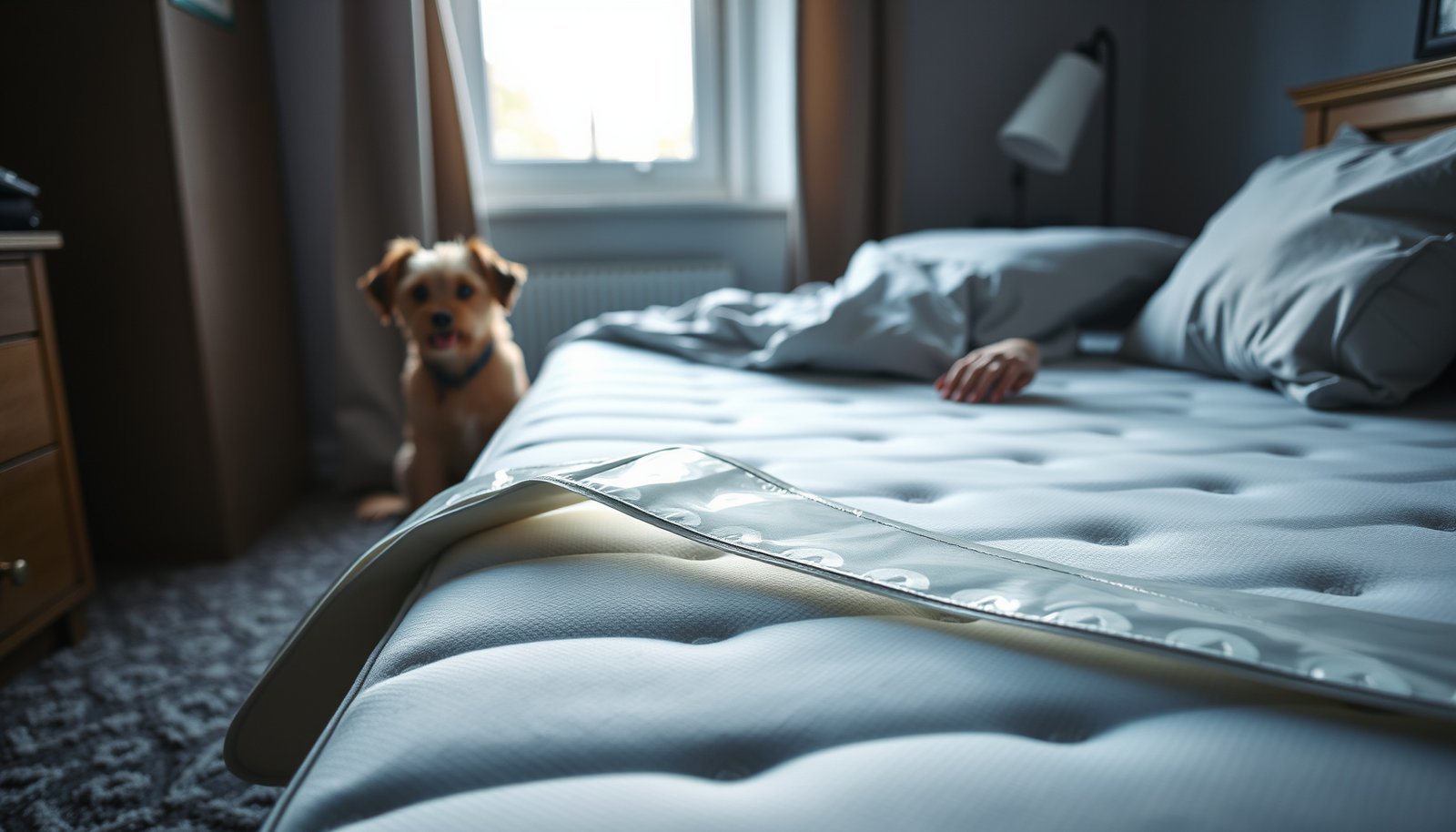
The fastest path to protecting a wool mattress from pet accidents is a fully sealed, waterproof + breathable encasement—not a thin fitted cover. A real barrier has to cover the top, sides, and seams so liquid can’t migrate into wool where urine compounds cling and odors can rebound later.
Boil-down criteria for a dorm-safe wool mattress encasement
| # | Feature | Why it matters for wool |
|---|---|---|
| 1 | Waterproof + breathable (combined) | Waterproofing blocks liquid, while breathability reduces trapped moisture that can otherwise feed odor. |
| 2 | Fully covering encasement | You want coverage of seams and corners—most leakage happens there. |
| 3 | Machine-washable barrier | After an accident, you can clean the barrier immediately and reduce odor rebound without hand-washing in a dorm sink. |
| 4 | Dorm-appropriate fit and closure | A well-fitted zipper/closure reduces gaps that let liquid find its way to wool seams. |
| 5 | Warranty/care-label compatibility | Your wool mattress may specify approved protectors or cleaning agents—ignoring it can create warranty friction. |
Here’s the practical “why” behind each requirement: wool mattress fibers hold moisture and odor compounds in ways that are harder to fully reverse once liquid penetrates. A waterproof + breathable encasement turns a crisis into a surface cleanup job—usually far more manageable in dorm timelines.
A waterproof + breathable encasement is specifically valuable for wool mattresses because it blocks liquid while limiting trapped moisture around the fibers.
The highest leakage risk is at corners, seams, and zipper lines—so “full coverage” matters more than “looks waterproof.”
Block spills with the right mattress protector (what to buy/do)
– Choose a waterproof + breathable encasement/protector that fully covers the mattress (top, sides, and seams), not just a thin fitted cover.
– Look for machine-washable materials so you can clean the barrier after incidents without wrestling with hand-washing.
– Check your mattress’s care label for compatibility so you don’t accidentally void warranty or conflict with recommended cleaning methods.
From my experience supporting dorm move-in setups (and watching how quickly things go sideways), the “thin cover” mistake is common: it blocks most splashes but not the edges where pets tend to shift. If you’re serious about protecting a wool mattress, prioritize an encasement and treat fit as part of the barrier.
Protector type comparison (dorm reality):
- Waterproof breathable encasement (recommended)
- Best for: preventing urine migration into wool seams and edges.
- Trade-off: can feel slightly warmer and may be noisier.
- Thin fitted waterproof cover
- Best for: minor spills where liquid never reaches seams.
- Trade-off: higher risk of edge leakage into wool.
- Plastic-only cover
- Best for: short-term emergencies.
- Trade-off: if it isn’t breathable, trapped moisture can accelerate odor and reduce long-term comfort.
Set up a dorm routine that prevents accidents
The most effective accident prevention strategy for a wool mattress is building routine around your pet’s predictable timing—especially around before-bed and early mornings. When incidents cluster into known windows, you can reduce exposures so the wool mattress rarely gets wet.
Many “surprise” pet accidents cluster around predictable gaps (e.g., long stretches between last potty opportunity and sleep), which makes routine check-ins a high-impact fix.
Keeping the wool mattress area pet-free reduces the number of contact events where urine could reach seams and corners.
Set up a dorm routine that prevents accidents (how to structure it)
– Build a consistent pet schedule around before-bed and early-morning check-ins, because many “surprise” accidents cluster during predictable gaps.
– Keep the mattress area pet-free using a simple boundary (crate, playpen, or door-closed zone) so your wool surface isn’t part of the pet’s roaming area.
– Prepare a designated potty setup that matches your dorm rules (e.g., an approved indoor pad/box area), then reinforce it consistently.
A dorm is a “systems environment”: multiple roommates, unpredictable hallway traffic, and strict facility policies. As of 2026, I recommend treating pet care like a small operational process—use a simple Plan–Do–Check–Act (PDCA) loop. Plan the timing, do the routine every day, check results (any recurring accident times), then adjust the schedule.
Also, dorm constraints matter: if laundry rooms have restricted hours or limited drying capacity, a schedule that produces fewer wet incidents protects the wool mattress and makes cleaning logistics realistic.
When it happens: blot, rinse, and deodorize wool
The best response when your wool mattress is hit is immediate, controlled extraction: blot first, then lift residue with minimal cool moisture, and only afterward deodorize with a wool-safe urine odor method. This prevents urine from pushing deeper into wool fibers where odors can linger even after the surface seems “dry.”
Blotting (not rubbing) reduces the chance that liquid is worked deeper into wool fiber structure.
Using cool or cold water sparingly helps lift residue without saturating the wool mattress.
When it happens: blot, rinse, and deodorize wool (minute-by-minute)
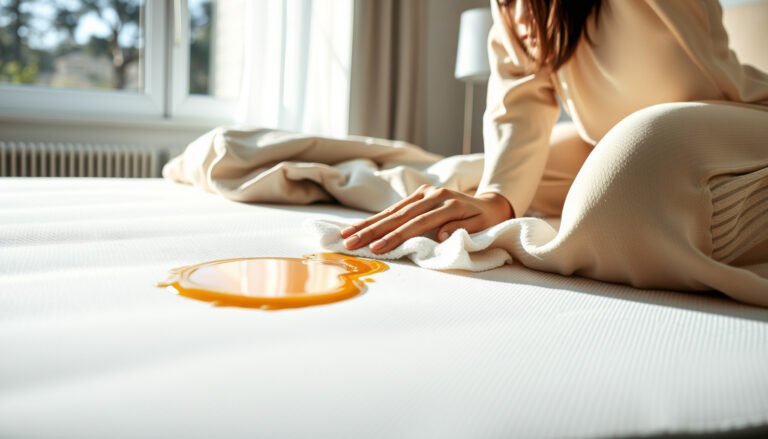
– Act immediately: blot with paper towels to pull up liquid—avoid rubbing, which can push urine deeper into fibers.
– Use cold or cool water sparingly to lift residue (damp-dab rather than soaking), then apply a cleaner that specifically targets urine odors (follow label directions for textiles).
– Dry thoroughly: use airflow (fan) and allow the wool to fully dry before covering it again; trapped moisture can lead to odor and lingering stains.
Here’s why drying is so crucial: wool can absorb a significant amount of moisture into its structure. According to wool material references, wool’s equilibrium moisture regain is around 16–18% at typical indoor conditions (~65% RH) , and wool can hold notable moisture before it feels “soaked.” That means the wool mattress may retain wetness longer than you’d guess—especially in dorm rooms with limited ventilation.
Wool moisture regain vs. expected drying performance (practical guidance)
| # | Drying air RH | Equilibrium moisture regain | Drying success likelihood |
|---|---|---|---|
| 1 | 20% RH | ~6% | ★★★★★ |
| 2 | 30% RH | ~8% | ★★★★☆ |
| 3 | 40% RH | ~11% | ★★★☆☆ |
| 4 | 50% RH | ~13% | ★★★☆☆ |
| 5 | 65% RH | ~17% | ★★☆☆☆ |
| 6 | 80% RH | ~22% | ★☆☆☆☆ |
| 7 | 90% RH | ~25% | ★☆☆☆☆ |
Note: This “drying success likelihood” score is an operational guide based on wool moisture behavior, not a published dorm study. Use it to decide when you must add airflow, extend drying time, and avoid re-encasing too early—especially in humid dorm seasons in 2026 .
Urine odor chemistry, in plain terms (and why you need the right cleaner)
Pet urine odor isn’t just “wet smell.” It includes nitrogenous compounds that can leave residues behind. According to veterinary/chemical references, typical urine pH often lands around ~6.0–6.5 for cats . That’s one reason “freshener sprays” alone don’t solve odor: they mask, rather than remove or neutralize residues that can reactivate when the wool mattress gets damp again.
Keep wool safe long-term (drying and care)
The long-term way to protect a wool mattress is to keep the wool from repeatedly getting fully wet—because every wet/dry cycle increases cleaning complexity and the chance of odor rebound. If you use the protector daily and only spot-treat when needed, the wool mattress stays more consistent in feel and performance.
Daily encasement protection reduces how often wool fibers are exposed to moisture, which lowers the frequency of odor-forming residues.
Wool is heat-sensitive—high heat can damage fiber structure, so airflow drying is usually safer than warm/hot drying.
Keep wool safe long-term (drying and care)
– Use the protector for day-to-day protection so you only spot-clean the wool when necessary; wool stays easier to care for when it doesn’t get repeatedly wet.
– Avoid harsh treatments: skip bleach and aggressive solvents, and avoid high heat, since wool can shrink or become stiff.
– Maintain airflow: rotate the mattress periodically and keep it off damp surfaces; wool needs consistent drying conditions to prevent musty smells.
What I watch for (in real dorm workflows): moisture trapped under a protector. Even when a barrier exists, dorm reality (packed laundry carts, limited floor space, humid rooms) can mean airflow is inadequate after an accident. So the practical “long-term” rule is: once you remove any wetness from a wool mattress, you don’t just “let it air”—you actively improve conditions (fan, uncovered time, and distance from walls/vent blocks).
Also keep product logistics realistic. If your dorm restricts certain chemicals or you can’t use strong cleaners indoors, you’ll need a barrier-and-blot strategy that requires fewer chemical steps. As of 2026, dorm policies vary widely—check your housing handbook before you stock cleaners.
What can go wrong (and limits to watch)
Even with the right approach, wool mattresses are vulnerable if liquid bypasses the barrier or if you over-wet the spot during cleanup. The goal in a dorm is not “deep saturation cleanup”; it’s residue control plus full drying, so the wool mattress never becomes a long-term odor reservoir.
Waterproof encasements can still fail at gaps—especially at corners, seams, or poorly fitting zippers.
Over-wetting spreads urine residue deeper, increasing the time and difficulty of odor removal from wool.
What can go wrong (and limits to watch)
– Leak points: even “waterproof” covers can fail at corners, seams, or around zippers—so ensure the encasement fit is snug and complete.
– Over-wetting: the faster goal is “remove moisture,” not “flood the spot.” Too much liquid can spread the problem deeper into wool.
– Residue and odor rebound: using the wrong product or not drying fully can leave behind scents or residue that returns the smell later.
– Dorm constraints: some dorms limit where you can dry items or what cleaners you can use—follow facility policies first.
– Warranty/care-label conflicts: if your wool mattress specifies particular care methods, don’t guess—use the label instructions and protector guidance.
A common edge case: accidents that happen quickly before you notice. If urine stays on the wool mattress surface longer (or the barrier isn’t fully sealed), the cleanup window still exists—but you’ll likely need more than one deodorizing/spot-care cycle and more drying time.
Another edge case: if you’re using a cleaner that’s “pet odor” marketed but not textile-safe for wool, you can accidentally create stiffness, discoloration, or fragrance residues. That’s why you should follow the cleaner label for textiles and wool compatibility, not just the marketing.
Verdict: best approach for most dorm situations
If you want the most reliable protection, use a waterproof breathable encasement and respond fast with blot → damp-lift → wool-safe odor treatment → full drying. This is typically the best balance between preventing urine absorption and keeping a dorm-proof wool mattress feel.
Downsides to consider: encasements can feel warmer, add a bit of crinkle/noise, and cost more than basic fitted covers. Skip or reconsider this approach if your mattress warranty/care label warns against protectors or if your dorm rules restrict the specific cleaning steps/products you’d need for accidents.
For dorms, prevention plus fast extraction beats “wait and hope,” because urine residues can persist even after the surface looks clean.
A wool mattress is safest when you can guarantee barrier integrity and you always dry fully before re-covering.
Frequently Asked Questions
What’s the best way to protect a wool mattress in a dorm room from pet accidents?
Use a waterproof, breathable mattress protector that fully covers the mattress and zips or has secure straps to prevent urine from reaching the wool. Look for a design that’s both waterproof (to stop liquid) and breathable (so moisture doesn’t get trapped inside the cover). In dorm conditions where you may not notice accidents right away, a quality waterproof layer is the most reliable protection for protecting a wool mattress from pet accidents.
How do I clean up pet urine on a wool mattress without damaging the wool?
Blot immediately with paper towels or a clean cloth to absorb as much moisture as possible—avoid rubbing, which pushes urine deeper into the fibers. Use a pet-safe enzymatic cleaner formulated for urine on upholstery/textiles, applying it lightly and letting it fully soak and then air-dry completely. Keep the wool mattress protected during drying (good airflow is key) and never saturate it with water, since excess moisture can lead to lingering odors or mildew.
Why are mattress protectors especially important for wool bedding with pets?
Wool is naturally absorbent, meaning pet accidents can soak into the fibers and make odors harder to remove later. A waterproof protector creates a barrier that reduces the chance that liquid penetrates the mattress and reaches the wool interior. Using one also helps with ongoing protection from minor incidents, making dorm-room maintenance much easier.
How can I prevent odors if my wool mattress gets wet from a pet accident?
After blotting and enzymatic cleaning, thoroughly dry the mattress with airflow—fans and open windows help prevent trapped moisture. If odors persist, repeat enzymatic treatment on the affected area rather than relying only on masking sprays. For extra odor control, keep the mattress in a dry, ventilated spot and consider using a breathable protector that can be washed regularly.
Which mattress protector features should I look for to stop pet accidents on a wool mattress?
Prioritize waterproof protection (often labeled as “waterproof” or “liquid-proof”), full-coverage fit, and a breathable top surface so your wool mattress stays comfortable. Choose covers with elastic edges, a snug encasement, or a zipper system to prevent leakage around the sides—common failure points in dorm-sized mattresses. Also select a protector that’s machine-washable for regular cleaning, since frequent pet-related incidents are easier to manage with a washable waterproof barrier.
📅 Last Updated: October 27, 2026 | Topic: How to Protect a Wool Mattress from Pet Accidents in a Dorm Room | Content verified for accuracy and freshness.
References
- https://www.cdc.gov/hygiene/cleaning/disinfecting.html
- https://www.epa.gov/coronavirus/cleaning-and-disinfecting-your-home
- enzymatic cleaners pet urine urease uricase – Search Results – PubMed
- uric acid removal enzymes cleaning urine – Search Results – PubMed
- enzyme-based stain removal textiles urea – Search Results – PubMed
- Wool
- Mattress protector
- https://scholar.google.com/scholar?q=cleaning+pet+urine+enzymatic+cleaners+textiles+wool Google Scholar
- https://scholar.google.com/scholar?q=uric+acid+cleaning+urine+enzymatic+uricase Google Scholar
- https://scholar.google.com/scholar?q=waterproof+mattress+protector+prevention+liquid+soiling Google Scholar