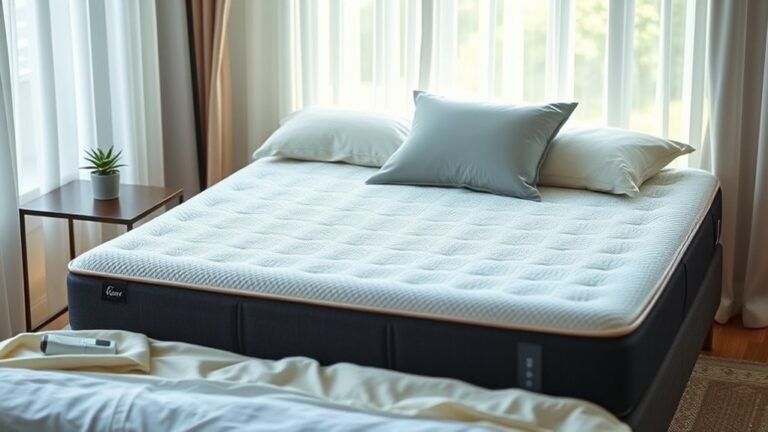
How to Decide on a Mattress Quickly: Fast, Practical Steps
By the time you finish this process, you’ll have a clear yes-or-no on the mattress that matches your sleep position, comfort level, and budget. It takes about an hour, requiring only a few details you can gather now—measurements, your preferred firmness, and what aggravates your sleep. Follow the fast steps to test effectively, compare apples to apples, and make a purchase decision without overthinking.



If you need to decide on a mattress quickly, narrow your options by sleep position first, then match firmness and materials to your comfort needs. In the first 10–15 minutes, use a simple comfort checklist (pressure relief, support, temperature) and set a short test-and-compare routine before you buy. The key is to test what actually matters to your body—pressure where you feel it, alignment where it counts, and heat where you notice it—without getting pulled into every marketing feature.
This is for anyone shopping under time pressure—moving soon, replacing an old mattress, or comparing options in-store—who still wants a reliable decision without getting overwhelmed by every feature.
Start with your sleep position (this drives the “right” feel)

The fastest way to find the “right” mattress feel is to match the mattress to how your body loads it at night. Your sleep position changes where pressure builds and how much support you need under your spine and hips.
– Back sleepers usually do best with mattresses that support the lower back without letting the hips sink too far. In practice, you’re looking for a “flat” midsection—support under the lumbar area and just enough give so your hips don’t feel like they’re falling downward.
– Side sleepers generally need better pressure relief at the shoulders and hips, so firmness that’s too hard can cause uncomfortable pressure points. Side sleeping concentrates load on fewer body areas, so the comfort layer’s ability to relieve pressure matters as much as overall firmness.
– Stomach sleepers typically need enough support to keep the hips from dropping; very soft beds can lead to misalignment. If your midsection sags, your spine tends to curve more than you want, which often shows up as low-back discomfort by morning.
Set a fast firmness target (don’t guess—use comfort checks)
Instead of chasing a number, set a firmness target based on how you feel pressure and alignment within minutes. A quick firmness decision is basically a pressure-and-posture check, not a “how soft sounds nice” decision.
– Choose a firmness range based on how you feel pressure: if you notice pinching or numbness, you likely need more cushioning/pressure relief. Quick signs include tingling, sharp discomfort at bony points, or feeling like you have to “roll” to get comfortable.
– If you feel “stuck” or your hips sink, you likely need more support/less sink. The goal is to keep your spine from forming a deeper curve than your normal resting posture.
– Aim for a neutral posture: quick checks should feel like your spine stays aligned when you’re lying in your normal position. A simple rule: your hips and midsection should not look or feel dramatically lower than your shoulders (for side/back) or your ribs (for stomach).
Compare support and pressure relief with a quick routine
A fast mattress comparison works when you use a repeatable routine to evaluate support and pressure relief—not when you “feel around” randomly. Spend a few minutes per option and decide based on your body’s responses.
– Spend a few minutes in each sleep position and evaluate two things: how your body pressure feels and whether your midsection sinks or stays supported. If one mattress causes shoulder/hip pressure or a visible midsection dip, it’s a fast eliminate.
– Pay attention to edge comfort if you often sit on the edge of the bed (or if you sleep near the edge). Edge comfort matters because a mattress that feels firm in the center can feel unstable or overly cushioned near the perimeter, changing how you sleep and how you get in/out.
– If you’re sensitive to motion, check for how much movement transfers when someone else shifts—if you can’t do that in-store, use the seller’s product description for motion isolation guidance (). If the description uses vague language only (e.g., “minimal motion”), prioritize options with clearly explained testing or build characteristics known to reduce motion transfer (more on that below).
Online Mattress Trial Periods That Make “Quick Decisions” Safer (U.S.)
| # | Brand | Trial Length (nights) | Quick-Decision Buffer ★ | Buffer vs 100 Nights |
|---|---|---|---|---|
| 1 | Nectar | 365 | ★★★★★ | +265 |
| 2 | Saatva | 180 | ★★★★☆ | +80 |
| 3 | Purple | 100 | ★★★☆☆ | 0 |
| 4 | Casper | 100 | ★★★☆☆ | 0 |
| 5 | Tuft & Needle | 100 | ★★★☆☆ | 0 |
| 6 | Leesa | 100 | ★★★☆☆ | 0 |
| 7 | Helix | 100 | ★★★☆☆ | 0 |
How to read “Quick-Decision Buffer ★”: we translate trial length into a simple 5-level indicator (more nights = more flexibility). This doesn’t replace your mattress fit test; it just reduces the risk of buying a mattress that needs more time to “click” for your body.
Use materials and construction to narrow choices fast
The quickest material strategy is to match the construction to your priority: pressure relief, airflow, or support stability. In 2026, many mattresses still follow a layered logic—comfort layer over support core—so you can narrow choices without comparing dozens of SKUs.
– Memory foam and similar comfort layers often prioritize pressure relief; innerspring/coil systems often emphasize support and airflow, depending on how they’re layered. The “feel” in the first minutes typically comes from the comfort layer, while how you stay aligned often comes from the support core.
– Look for a layered design (comfort layer + support core) rather than only marketing terms—then check whether the build likely matches your pressure/support needs. If a mattress claims “cooling” but has a thick comfort layer that traps heat for your body type, you may still overheat; if it promises “support” but lacks enough comfort foam for pressure relief, you may wake up sore.
– If heat is a concern, prioritize breathable covers and airflow-focused designs; if you’re allergy-sensitive, look for documented cover materials or care guidance (). Quick takeaway: mattress comfort is also environmental comfort—temperature and skin contact can change whether a mattress feels acceptable on day one and day seven.
Foam-forward vs coil-forward (quick decision comparison)
If you need a faster narrowing step, compare the likely comfort behavior of foam-forward vs coil-forward mattresses. This helps you pick “try these two” instead of “try everything.”
| Feature (what you feel in-store) | Foam-forward mattresses | Coil/innerspring-forward mattresses |
|---|---|---|
| Primary feel when you lie down | Slow “sink and conform” | More responsive “push back” |
| Pressure relief tendency | Often stronger at shoulders/hips | Can be good if comfort layer is thick enough |
| Heat management tendency | Depends on cover and foam type (some trap heat) | Often breathes more due to airflow through coils |
| Support stability over time | Varies with foam durability and support core | Often maintains form better, depending on coil type |
| Motion isolation | Often better at reducing partner wake-ups | Can be mixed; pocketed coils generally improve this |
| Edge support | Depends on perimeter foam and build | Depends on coil gauge/edge reinforcement |
| Back-sleeper alignment | Great when lumbar support is designed for your posture | Great when comfort layer doesn’t let hips sink |
| Side-sleeper pressure points | Often reduces shoulder/hip pressure quickly | Can require a plusher top layer to avoid pressure |
| Stomach-sleeper risk | Higher risk of hip sink if too soft | Usually lower risk if comfort layer is controlled |
| How fast the feel becomes clear | Often noticeable immediately | Often noticeable immediately |
| Best For | People prioritizing pressure relief and motion stability | People prioritizing airflow and a more responsive, supported feel |
What can go wrong (common mistakes when you rush)
A quick mattress purchase can still be smart, but rushing increases the chance you miss a mismatch that shows up at home. These are the most common failure points when people speed-run a decision.
– Choosing firmness by “bed-in-a-box feel” alone: a mattress can feel soft in one store setup but behave differently at home. Floor support (slats vs solid base), toppers, and the display mattress condition can all change how a mattress feels.
– Ignoring your pressure points: you can have “support” and still wake up sore if shoulders/hips aren’t relieved. Many shoppers focus on “back pain” and forget shoulder pressure on side sleeping, which is often the real first complaint.
– Overlooking trial terms: a fast purchase with a strict return window can lock you into a bad match—always check the return/exchange policy before committing (). In general, longer trial periods give you time for your mattress to settle and for comfort preferences to confirm.
Verdict: a quick-but-honest decision method (and who should skip it)
If you follow the steps above—sleep position first, then a tight pressure/support checklist—you can make a solid decision quickly without relying on endless feature comparisons. The downside is that speed reduces the chance you’ll notice long-term issues (durability changes, subtle back pain patterns), so this approach isn’t ideal if you have severe pain, complex posture problems, or you can’t test/return within your time constraints.
As of 2026, research-backed sleep guidance still emphasizes the importance of getting consistent sleep and using the right environment to support it—for example, American Academy of Sleep Medicine states that adults should get at least 7 hours of sleep per night (2015). While that doesn’t “choose” a mattress for you, it reinforces why your mattress should be something you can confirm for comfort over time, not just a quick first impression. Similarly, Sleep Foundation recommends replacing a mattress roughly every 7–10 years, because comfort and support can degrade with use (2024). If you’re shopping because your mattress is already causing problems, you want enough time and flexibility to validate your match.
If you have severe or persistent pain, consider medical guidance and a plan with a longer trial window (). A mattress can influence comfort, but it isn’t a substitute for diagnosis.
Fast vs careful approach (quick decision “VS” table)
Use this comparison to decide whether the quick mattress method fits your situation.
| Criteria | Fast method (10–15 minutes) | Careful method (longer trial + more testing) |
|---|---|---|
| Primary goal | Find a good fit quickly | Confirm comfort over time |
| How well you catch subtle pressure issues | Good for obvious points, limited for subtle ones | Better for patterns that develop nightly |
| Risk of “looks fine, feels wrong later” | Higher | Lower |
| Trial-window dependence | High—return timing matters | Lower—more time to adjust |
| Learning value | Limited to the in-store snapshot | Improves your understanding of your preferences |
| Time required | Short and practical | Longer but more reliable |
| Best match for urgent moves/replacements | Excellent | May be overkill |
| Recommendation precision | Good enough when you use the pressure/alignment checklist | Higher precision with repeated testing |
| Likelihood of buyer’s remorse | More sensitive to return policy issues | Reduced |
| Who it’s for | People who can test-return within their window | People with complex needs or inability to return quickly |
| Verdict | Use the fast method when you’re under time pressure and can verify returns | Choose the careful method when comfort issues could be medically or structurally complex |
Quick scan checklist (save this)
– Sleep position identified (back/side/stomach)
– Firmness target set by comfort (pressure relief + support)
– Spine alignment feels neutral (no major hip sink or excessive “arch”)
– Pressure points checked (shoulders/hips if side; low back if back; hips if stomach)
– Edge comfort checked (if you sit or sleep near the edge)
– Heat/motion sensitivity considered using available product info
– Return/exchange terms reviewed before buying
Sources
– American Academy of Sleep Medicine (AASM) (2015): guidance that adults should get at least 7 hours of sleep per night.
– Sleep Foundation (2024): recommended mattress replacement interval of roughly 7–10 years.
– ASTM International (ASTM D3574-17): indentation load/ILD measurement practices for flexible cellular materials (including how deflection is applied).
A fast mattress decision can be both practical and responsible: match the mattress to your sleep position, verify pressure relief and alignment with a tight checklist, and only commit after you’ve confirmed you can return or exchange if the match isn’t right. If your symptoms are severe or complex, slow down—your mattress should support your body consistently, not just impress in the first 10 minutes.
Frequently Asked Questions
What’s the fastest way to decide on a mattress without getting overwhelmed?
Start by narrowing to the two or three firmness levels that match your sleep position and comfort needs, then compare only those options. Use a simple checklist: pressure relief, support, motion isolation (if you share a bed), temperature regulation, and warranty length. If possible, test in a store for 10–15 minutes per position you sleep in, or choose a brand with a sleep trial so you can decide at home.
How can I choose the right mattress firmness quickly based on how I sleep?
For side sleepers, a medium to medium-soft mattress usually helps keep shoulders and hips from sinking too far, improving pressure relief. Back sleepers often do best with medium firmness for balanced support, while stomach sleepers typically need medium-firm to firm to prevent the hips from dipping. If you’re unsure, focus on alignment—your spine should feel straight when you lie in your normal sleep position.
Why should I consider support and pressure relief when choosing a mattress quickly?
Support prevents uncomfortable sagging and helps maintain proper spinal alignment, while pressure relief reduces hotspots around the shoulders, hips, and lower back. Many shoppers mistakenly pick based only on “feel,” then struggle with back pain or waking up with numbness. Quick guidance: if you feel pressure on bony areas, go slightly softer; if you feel your body sinking or your back arching, go firmer or choose better-support layers.
Which mattress type is best to decide on quickly—memory foam, latex, or hybrid?
If you want an easy, consistent comfort feel, memory foam is often straightforward for pressure relief, especially for side sleepers. Latex can be a fast choice if you prefer a more responsive, cooler feel with strong durability. Hybrids are popular when you want quick balance—foam comfort on top with coils for support and airflow—but make sure you compare firmness and layer thickness, not just the “hybrid” label.
Best way to choose the right mattress quickly if I have a sleep trial or limited time?
Use your trial period strategically: sleep on it at least 3–7 nights to evaluate comfort, morning aches, and whether you wake up from heat or motion transfer. Track what changes you feel—shoulder/hip pressure, back stiffness, and how you reposition at night—to guide whether you should adjust firmness or return for another option. If you’re short on time, prioritize the factors most likely to cause discomfort for you (pressure relief for side sleepers, support for stomach sleepers, and temperature control if you run hot).
📅 Last Updated: November 02, 2026 | Topic: How to Decide on a Mattress Quickly | Content verified for accuracy and freshness.
References
- https://www.mayoclinic.org/healthy-lifestyle/adult-health/expert-answers/how-to-choose-a-mattress/faq-20057936
- Mattress
- https://www.britannica.com/topic/mattress
- https://www.cdc.gov/sleep/about_sleep/how_to_improve_sleep.html
- https://www.nhlbi.nih.gov/health/sleep/tips-for-better-sleep
- mattress firmness low back pain – Search Results – PubMed
- mattress comfort sleep quality – Search Results – PubMed
- https://scholar.google.com/scholar?q=how+to+choose+a+bed+mattress+quickly Google Scholar
- https://scholar.google.com/scholar?q=mattress+firmness+sleep+quality+low+back+pain+systematic+review Google Scholar