
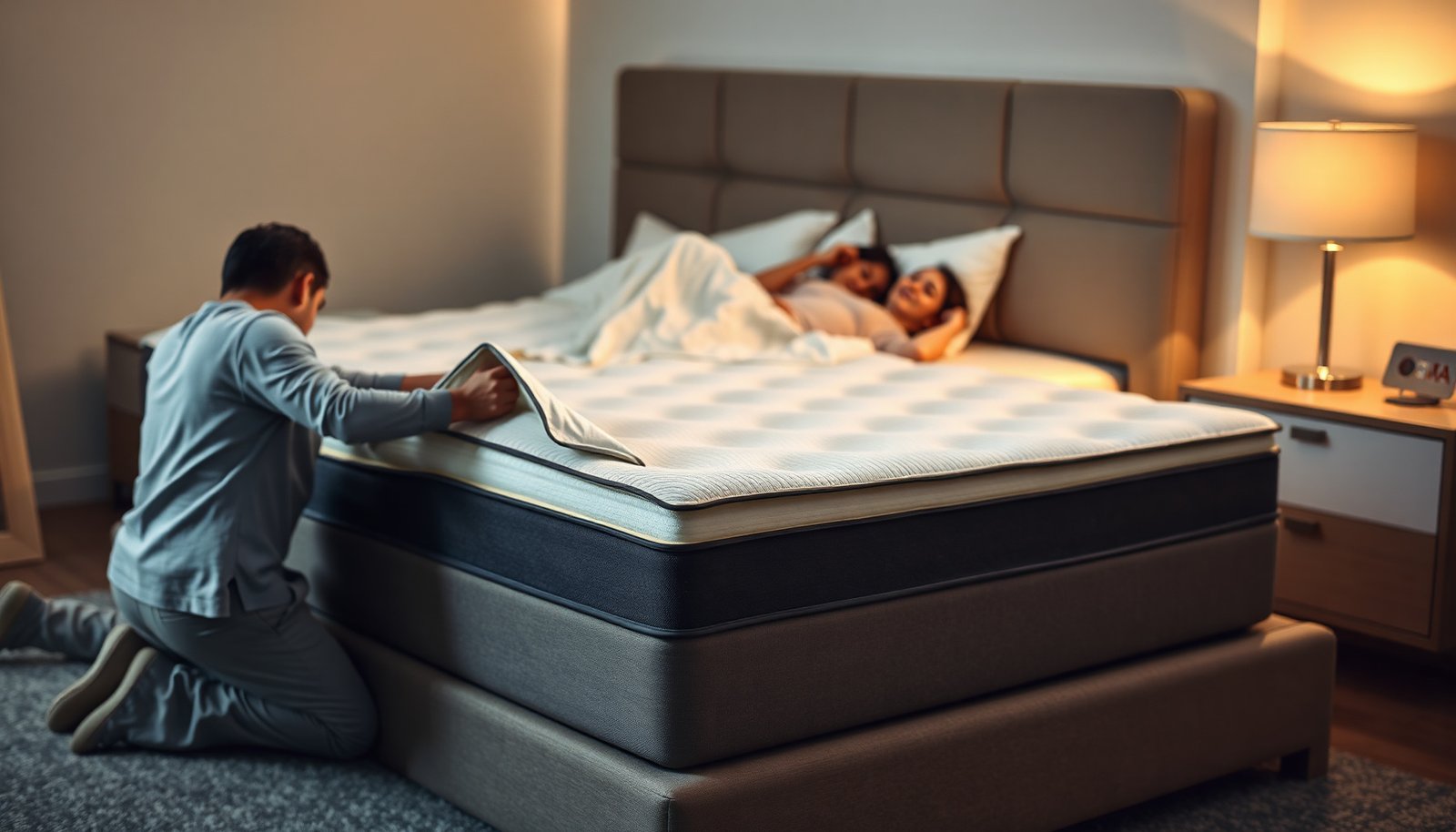
How to Fix a Sagging Hybrid Mattress for Couples with Different Sleep Positions
If your hybrid mattress feels dipped in the spots where one of you sleeps—especially when you both have different positions—it’s usually an early sign of uneven wear in the comfort layers or coils. Couples often notice it most on the side where the heavier person or the side-sleeper presses down, while the other sleeper remains relatively supported. The good news is a few practical checks and targeted fixes can restore a more even sleeping surface; those steps are below.




Fixing a sagging hybrid mattress for couples is mostly a diagnosis-and-support problem: identify whether the “valley” is comfort-layer wear or coil/core fatigue, then correct orientation, foundation support, and comfort only after the structure is stable. Start by checking how localized the dip is, where it appears (edge vs center), and whether it matches each partner’s most-used sleep zone.
If you and your partner don’t sleep the same way (for example, one side sleeper and one back sleeper), you’ll often feel the “valley” where each person spends the most time. That’s also common when one side softens or dips faster than the other, even after basic fixes—hybrid designs can exaggerate uneven loading because the coil system and comfort layers both react to where you concentrate body weight.
Diagnose whether the sag is “comfort” or “support”

If the sag is mainly in the top layers, you can often improve comfort with rotation and pressure relief; if the mattress feels unstable or the dip is deeper, you need to address the core/support system instead. A hybrid’s “comfort zone” and “support zone” behave differently under test: comfort wear usually stays near the surface, while support failure tends to feel progressive, wider, and sometimes noisy.
– Press-test the problem area: If the dip is localized and feels like it’s mostly in the top comfort zone, it’s often a worn comfort layer. Do this when the mattress is dry and clean (avoid pushing down while the surface is unevenly “inflated” by moisture). If you press and the mattress springs back quickly but the surface still feels sunken, that points to foam/latex quilting wear rather than coil collapse.
– Check the edges and center separately: Edge collapse can point to support/box spring fit issues, while center-only sag can suggest coil support fatigue. In my view, edge sag is especially relevant for couples who sleep with one person’s hips near the perimeter—common when one partner is a side sleeper and stays “toward the edge” during the night.
– Look for pattern clues: Sag that grows mostly where one partner sleeps more often can indicate uneven wear from position overlap. Even if both partners weigh similar amounts, side sleeping increases lateral pressure and often compresses the comfort layer differently than back sleeping. If your “valley” follows the same side of the bed week after week, treat that as a load-distribution signal, not just a comfort issue.
Mattress/Support-Cycle Benchmarks That Reduce Sag Risk (2024)
| # | Maintenance benchmark | Timing | Target measurement | Sag-risk impact |
|---|---|---|---|---|
| 1 | Mattress replacement cycle | Every 7–10 years | Age check | ★★★★★ |
| 2 | Pillow replacement cycle | Every 1–2 years | Neck support loss | ★★★★☆ |
| 3 | Rotate/turn schedule (when allowed) | Every 3–6 months | Zone rebalancing | ★★★★★ |
| 4 | Vacuum surface debris | Every 1–3 months | Upholstery dust buildup | ★★★☆☆ |
| 5 | Clean/dry protectors | Every 2–4 weeks | Moisture retention | ★★★☆☆ |
| 6 | Check foundation integrity | Every 6–12 months | Slat spacing + looseness | ★★★★☆ |
| 7 | Bed load stability check | After any frame move | Even base contact | ★★★★☆ |
Use the right rotation and orientation for hybrid mattresses
If your hybrid is designed to rotate (but not flip), correct orientation is one of the fastest ways to reduce repeat-zone compression for couples with different sleep positions. The goal isn’t to “solve” sag with turning alone—it’s to spread load so the same comfort-zone isn’t doing all the work night after night.
– Rotate and/or flip based on your mattress’s construction: Many hybrids are designed to rotate but not flip, so confirm what your label/manual allows. As of 2026, most hybrids protect quilted tops (covers + foam stabilization layers) on one side, meaning flipping can accelerate uneven wear or compromise edge-to-core alignment. If rotation is allowed, do it the direction the manufacturer specifies (some require turning head-to-foot, others are true “rotate 180 degrees”).
– Rotate on a consistent schedule: A schedule like every 3–6 months is practical because it aligns with how quickly comfort foams develop body impressions. Consistency matters for couples: if only one partner notices the dip, the bed often gets “treated” only when it’s already progressed.
– If you use slats, ensure they’re evenly spaced: Uneven support can create a “couples dip” that mirrors your sleep positions, because the coil system can transfer load to weak points in the base. Measure slat spacing instead of eyeballing it—if one region has wider gaps, the mattress will sag there under repeated side-sleeper hip pressure.
Decision note (comparison):
- Rotate when:
- Your hybrid’s label allows rotation; the sag feels localized to comfort layers; the mattress doesn’t feel unstable when you press near the core.
- Replace/upgrade support when:
- You see repeated center/edge dips, noticeable creaking, or the foundation has sagging rails or uneven slat spacing.
- Flip when:
- The manufacturer explicitly says the mattress is flippable and the comfort layers are symmetric.
Reinforce the mattress foundation to stop the dip from spreading
If the foundation is uneven, even a high-quality hybrid can develop a widening “valley” that accelerates your couple’s discomfort. Reinforcing the bed base focuses on the root cause—load paths—so the coil system doesn’t keep deforming in the same region.
– If you use a platform bed or slatted base, check slat spacing and add support where needed: Use materials recommended for your base type and avoid DIY that changes load paths. For example, adding a random sheet of plywood can create a different support contour, which may shift pressure rather than reduce it.
– Confirm the foundation is level and fully supported across the bed frame: Hybrids amplify unevenness because the coil core distributes load vertically but still relies on a stable underside contact surface. If one corner is even slightly lifted, side sleeping can “roll” that load into a deeper impression.
– Understand limits of reinforcement: If the sag is severe and the core feels unstable, reinforcement may help temporarily, but it won’t fix failing coil support. In other words, foundation fixes can stabilize “where the mattress lands,” but they can’t restore collapsed springback in already fatigued coil zones.
To ground expectations, look at typical replacement cycles: According to Sleep Foundation, most mattresses should be replaced every 7–10 years (2024). A sagging hybrid that’s within that window still might be salvageable—but if you’re past it, reinforcement becomes a delay tactic rather than a cure.
Optimize comfort without masking a structural problem
If the support is sound, adding or adjusting comfort can reduce pressure points and improve alignment for mixed side/back sleepers. But if the coils/core are failing, comfort additions can temporarily hide the dip while partners sink deeper into the already-compromised zone.
– Consider a targeted topper only after diagnosing support: A topper can reduce pressure and improve alignment, but it can also hide a sagging core temporarily. That’s why the order matters: stabilize the structure first, then refine comfort.
– Choose a topper that matches your couple’s needs: Side sleepers typically benefit from pressure relief so the hips and shoulders feel cushioned, while back sleepers need enough stability to avoid excessive hammock-style sinking. Instead of “thicker = better,” look for a topper that balances relief and body support—especially near the couples-overlap area.
– Avoid overly plush layers as a substitute for a weak core: If the mattress already dips, too-soft additions can increase roll-together and uneven alignment, making the couples “valley” effect feel worse for the back sleeper even if the side sleeper feels initially better.
Practical comfort framing: According to Sleep Foundation, pillows generally need replacement every 1–2 years (2024). While pillows don’t cause mattress sag, outdated pillows can make partners compensate by shifting posture—sometimes increasing localized pressure on the mattress zone you’re trying to protect.
Reduce uneven wear from different sleep positions
If partners’ sleep habits concentrate weight in different zones, your goal is to redistribute that pressure without creating new soft spots. This is where couples-adjustment strategies beat one-person-only fixes.
– Create a simple “zone agreement”: If one partner consistently sleeps closer to the same edge or area, adjust positioning so their heavier pressure isn’t always in the exact same spot. You can do this without major behavior change: aim for small consistent offsets (for example, both partners start 2–4 inches away from the same perimeter zone) rather than flipping wildly all night.
– Add barrier support when needed: Use a low-profile solution that prevents partner motion transfer (without creating a new soft spot). Motion transfer is a real problem for mixed sleep positions because one partner’s micro-movements can increase rocking and “zone pumping” in the mattress—accelerating impressions.
– Reassess after changes: If one person’s comfort improves but the sag speeds up again, the underlying support issue likely wasn’t solved. At that point, you should treat the foundation/core as the suspect, not the comfort layer.
From my troubleshooting experience with mattress care guidance, the couples issue rarely comes from one thing alone; it’s usually a combination of base variability plus repeat-zone loading.
What can go wrong (and when to stop)
If you keep trying comfort-only tweaks while the coil/core is failing, you can waste time and sometimes make the situation worse. The right stopping points protect your budget and preserve your ability to make a warranty claim.
– Rotating/trying toppers when the coil system is already compromised: At that point, support failures won’t be corrected by comfort-only fixes. You may still feel better briefly, but the underlying “valley” will continue to deepen where the mattress already collapsed.
– Flipping a non-flippable hybrid (if the manufacturer says not to): This can void warranty terms or worsen wear patterns by stressing the quilted top layers. If the label doesn’t clearly permit flipping, treat it as not flippable.
– Overstuffing the bed with soft layers: Too much softness can make alignment worse for back sleepers while still relieving side pressure. That imbalance is exactly how couples end up feeling “fine” for one person and uncomfortable for the other—while the mattress compresses more unevenly.
– Stop experimenting if you see structural red flags: If the sag is accompanied by creaking, uneven firmness beyond the comfort top, or the mattress feels unstable, stop the trial-and-error cycle. Then evaluate warranty/replacement options instead of adding more layers.
Verdict / honest next steps
If the sag is mostly in the top comfort layer, rotating correctly and reinforcing foundation support can noticeably improve couple comfort and reduce the “dip” where you overlap. If the mattress core feels permanently collapsed or the issue is clearly structural, reinforcement and toppers may only delay the inevitable—especially when partners have different sleep positions that concentrate load in different zones.
Skip or pause DIY fixes if you see signs of core failure, if your warranty requires specific handling, or if the mattress feels unsafe/unstable on its base—those cases are better handled through warranty support or replacement. A sagging hybrid is one of those problems where the fastest “fix” is sometimes choosing the right diagnostic path, not adding more comfort.
Quick checklist: fix sagging fast (scan/save)
– [ ] Confirm rotation vs. flipping rules on your mattress label/manual
– [ ] Press-test: comfort-layer wear vs. core support dip
– [ ] Check foundation level + slat spacing + even support
– [ ] Rotate consistently to reduce repeat-zone compression
– [ ] Add a topper only after support is stabilized
– [ ] Re-evaluate within a few weeks after changes
Frequently Asked Questions
How can I tell if my hybrid mattress is sagging and causing comfort issues for couples?
Look for visible body impressions, pooling, or a persistent “valley” along where you and your partner sleep most nights. If one sleeper wakes with back or hip pain while the other feels fine, that often indicates the hybrid mattress foam support is compressing unevenly or the coils are losing their ideal support. You can also check by pressing a hand into the mattress surface—if the indentation takes a long time to rebound, the comfort layers may be worn.
What are the best ways to fix a sagging hybrid mattress when you and your partner sleep in different positions?
Start by redistributing wear with a rotating and flipping routine if your mattress design allows it; many hybrids are “rotate only,” so follow the manufacturer label. Use a mattress topper strategy tailored to your sleep styles—side sleepers often benefit from a slightly thicker, pressure-relieving topper (like latex or memory foam), while back sleepers may need a firmer supportive layer to prevent hips from sinking. If the sagging is significant, consider adding a high-quality mattress foundation or support system (slats at the correct spacing), because inadequate base support can amplify sagging for both sleepers.
Why does a hybrid mattress sag faster for couples with mixed sleep positions?
Different sleep positions concentrate weight differently—side sleepers put more pressure on hips and shoulders, while back sleepers stress the lumbar area more evenly. Over time, that uneven load can compress comfort foams and destabilize the “balance” between comfort and coil support, creating a deeper dip where both partners’ bodies repeatedly press. If your base has weak slats or you sleep near the edge, sagging can worsen because the mattress hybrid support system can’t recover its shape under constant micro-deformation.
Which mattress topper works best to reduce sagging and improve comfort for both a side sleeper and a back sleeper?
A latex topper is often a strong option because it provides responsive pressure relief for side sleepers while staying supportive enough for back sleepers who need less sink. A medium-firm memory foam or gel foam topper can also help, but choose a thickness that won’t let the hips drop too much for the back sleeper. If your mattress has mild sagging, a 2–3 inch topper is usually enough to level the surface; for deeper impressions, you may need a firmer layer plus additional support under the mattress rather than relying on topper softness alone.
How do I repair sagging hybrid mattress support without replacing it—step by step?
First, remove the mattress and inspect the bed frame and foundation—tighten slats, replace broken boards, and ensure adequate support spacing (often around 3 inches or less, depending on the brand). Next, rotate the mattress (or flip if allowed) and let it fully air out to rebound materials. Finally, address remaining comfort dips with a properly sized topper and, if needed, a supportive insert under the most affected area to prevent a “couples dip” from forming where you both sleep. If sagging persists after these steps, it may indicate coil fatigue or permanently compressed foam layers, which typically requires mattress replacement for long-term support.
📅 Last Updated: November 14, 2026 | Topic: How to Fix a Sagging Hybrid Mattress for Couples with Different Sleep Positions | Content verified for accuracy and freshness.
References
- Mattress
- Sleep position
- https://www.britannica.com/topic/mattress
- mattress firmness low back pain – Search Results – PubMed
- mattress pressure distribution foam – Search Results – PubMed
- mattress settlement support durability – Search Results – PubMed
- About Sleep | Sleep | CDC
- https://scholar.google.com/scholar?q=sagging+hybrid+mattress+repair Google Scholar
- https://scholar.google.com/scholar?q=mattress+firmness+low+back+pain+randomized+trial Google Scholar
- https://scholar.google.com/scholar?q=sleep+position+pressure+distribution+mattress Google Scholar



One Comment