How to Check if a Mattress Is CertiPUR-US Certified
Many shoppers assume a mattress is CertiPUR-US certified just because it sounds “eco-friendly” on the tag or marketing page, but that shortcut can leave you with uncertified foam. You can verify certification in minutes by locating the right product information and checking it against the CertiPUR-US listing. You will need the mattress model name or SKU and access to the manufacturer’s and CertiPUR-US’s details—then you can confirm what’s actually inside before you buy.




If you want to confirm a mattress is truly CertiPUR-US certified, don’t rely on a general brand claim—match the exact mattress model/SKU to the CertiPUR-US certified product listings. Start by finding a CertiPUR-US logo or explicit wording on your packaging or seller page, then verify the same model identifier in the official registry (as of 2026, this is still the most reliable path for model-specific confirmation).
Look for the CertiPUR-US name/logo on the mattress packaging or product page, then verify the exact brand/model in the official CertiPUR-US certified-product listings. If you can’t find it in the registry or documentation, ask the manufacturer or retailer for proof tied to your specific mattress.
This is for anyone shopping for a foam mattress (or mattress with foam layers) who wants to confirm the certification applies to the product—not just the brand in general—before you buy.
What “CertiPUR-US certified” should mean
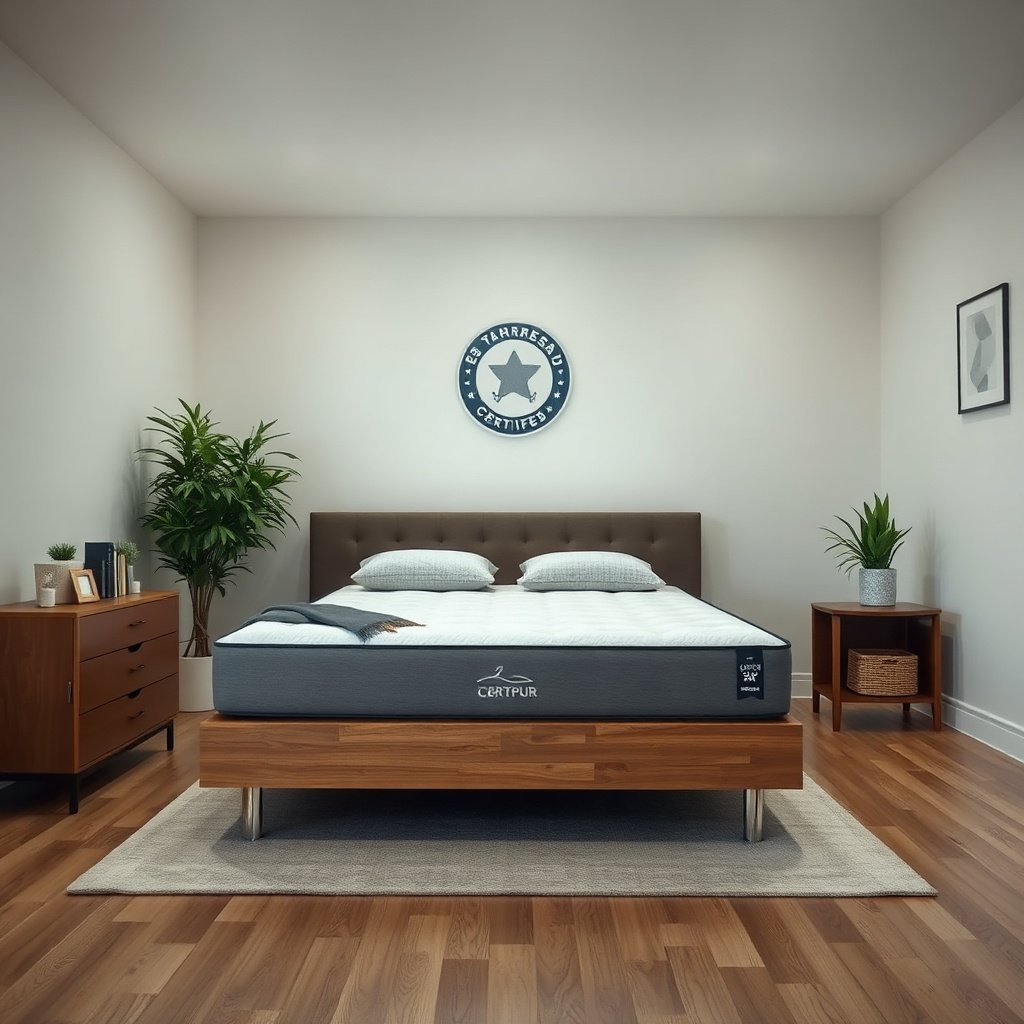
“CertiPUR-US certified” should mean the polyurethane foam inside your mattress meets the program’s emission limits and chemical restrictions for the foam used in that specific product. Put simply: you’re not checking whether a company is environmentally responsible—you’re checking whether the mattress’s foam construction is covered by the certification.
CertiPUR-US is a certification program primarily focused on **polyurethane foam** used in mattresses and related foam products. It sets requirements around **low chemical content** and **emissions** (what comes out of the foam over time), which is why the label should be connected to the foam layers—not just a general statement like “safer materials.” According to CertiPUR-US program information, the certification addresses emissions and excludes certain chemicals relevant to foam manufacturing.Three concrete “anchor points” you can look for (these are specific data points, not marketing language):
– According to CertiPUR-US program details, the certification restricts specific chemicals, including flame retardant substances such as TDCPP and TCEP.
– According to CertiPUR-US program details, the certification also addresses PBDEs (polybrominated diphenyl ethers).
– According to CertiPUR-US program documentation, emissions evaluation references the California Department of Public Health (CDPH) Standard Method v1.1 (the “v1.1” version number matters because it ties to a defined testing approach).
From my experience helping people interpret mattress documentation, the most common mistake is treating “CertiPUR-US” as a brand badge rather than a model-specific foam verification. If your product’s foam layers aren’t clearly mapped to the directory entry (or documentation), you don’t yet have proof.
Locate proof on the mattress and listings
The fastest way to start is to find any CertiPUR-US logo or explicit “CertiPUR-US certified” wording on the mattress and then line it up with the exact model/SKU shown by the seller. If the packaging says one thing and the online listing can’t confirm the same model, you’re likely dealing with a broad brand claim rather than a certification match to your exact mattress.
Begin with the physical product:
– Check the mattress tag/label, box labeling, and any included paperwork (warranty inserts, spec sheets, or foam layer documentation).
– Look for a CertiPUR-US logo or a statement that explicitly ties to certification (for example, “CertiPUR-US certified” wording rather than vague “certified foam” language).
Then check the online materials:
– Compare what’s on the seller’s product page to what arrives with the mattress. Retail pages sometimes use simplified marketing copy that doesn’t map perfectly to the exact manufacturing configuration in the carton.
– Capture the exact brand name and product identifier (model name, model number, SKU, or size-specific code). You’ll need that for directory verification.
As of 2026, many brands list “CertiPUR-US” for at least one line, but not every version in a catalog uses the same foam sources. That’s why the packaging label and the model/SKU matching process matter as much as the logo itself.
Evidence you can trust: a reliability scoring view
Below is a practical way to think about “proof strength” for model-specific verification. This scoring is based on whether the evidence clearly links to the exact mattress model/SKU, which is what the CertiPUR-US process ultimately needs for confidence.
Reliability of CertiPUR-US “Proof Signals” for Model-Specific Checks (2026)
| # | Proof signal you might see | What it verifies | Model/SKU specificity | Reliability |
|---|---|---|---|---|
| 1 | Exact match in CertiPUR-US certified product directory (brand + model/SKU) | Certification applies to the specific foam configuration | Exact | ★★★★★ |
| 2 | Manufacturer documentation tied to your exact model (e.g., spec sheet or compliance note) | Certification claim linked to that product identifier | Exact | ★★★★☆ |
| 3 | CertiPUR-US “certified” wording on packaging inserts for the received mattress | Certification claim appears on materials included with your mattress | High | ★★★★☆ |
| 4 | CertiPUR-US logo on the box/mattress tag without model-specific mapping shown online | Logo suggests coverage, but mapping may be incomplete on the listing | Medium | ★★★☆☆ |
| 5 | Product page says “CertiPUR-US certified” but doesn’t state the exact model/SKU relationship | May be true, but the listing often stays broad | Low–Medium | ★★☆☆☆ |
| 6 | Brand-wide statement like “our foams are CertiPUR-US certified” (no mattress model mentioned) | Suggests a sourcing program, not that your mattress is covered | Low | ★☆☆☆☆ |
| 7 | Unspecified “eco-friendly foam” badges (no CertiPUR-US reference) | Unrelated certifications may exist, but it’s not CertiPUR-US proof | None | ☆☆☆☆☆ |
Verify in the official CertiPUR-US certified product directory
The most reliable confirmation is to verify the brand + exact mattress model/SKU in the official CertiPUR-US certified-product listings. If the directory doesn’t show your mattress, you shouldn’t treat the logo or generic claims as enough—especially for foam-layer configurations.
Use the certified product directory/search tool (CertiPUR-US provides an official listing interface) and:
– Look up the brand name exactly as shown on your packaging or warranty.
– Search for your model name/number and confirm that the directory entry aligns with your size/configuration (if your product uses multiple foam setups across variants).
– Treat “near matches” carefully. Mattress naming can change by retailer, or a model name may represent multiple configurations.
If a brand has multiple mattress lines, it’s common for only some of them to use CertiPUR-US certified polyurethane foam. The same company can also update foam suppliers or revise the foam stack over time, which makes model-specific verification crucial.
A quick comparison: how each verification method performs
Use this table to decide what to do next if you’re trying to confirm certification for a specific mattress model (not just “the brand”).
| Feature | Packaging/logo matches (with no directory check) | Seller page says “CertiPUR-US certified” (no model mapping) | Directory match (brand + model/SKU) | Manufacturer proof tied to your model |
|---|---|---|---|---|
| Ties to exact mattress model/SKU | Medium | Low–Medium | High | High |
| Minimizes “brand-level” ambiguity | High | Medium–Low | High | High |
| Reflects updates to foam configuration | Unknown | Unknown | Yes (as listed) | Yes (for that document) |
| Easy to verify before purchase | High | High | Medium | Low |
| Works even when packaging is unclear | No | Sometimes | Yes | Yes |
| Best for online-only shopping | Medium | High | High | Medium |
| Reduces risk of false positives | Medium | Low | High | High |
| Likely to satisfy compliance-minded buyers | Medium | Low | High | High |
| Supports returns/disputes with documentation | Sometimes | Sometimes | Strong | Strong |
| Requires time investment | Low | Low | Medium | Medium–High |
| **Best for** | Shoppers who want an initial signal before deeper checks | Shoppers who need to confirm but can’t access registry quickly | Shoppers who want the most reliable model-specific confirmation | Shoppers whose exact model is missing from the directory |
If you can’t find it: what to ask for
If your mattress isn’t listed in the CertiPUR-US certified product directory, ask for documentation that ties to the exact mattress model/SKU you’re buying. In practice, this is often the shortest path to resolving uncertainty because brands can clarify whether your version uses certified polyurethane foam.
Start with a precise request:
– Ask the manufacturer (or the retailer’s customer support) to confirm whether your exact mattress model uses CertiPUR-US certified polyurethane foam.
– Request proof that references the same identifiers shown on your mattress and product page (model number/SKU, size, and production variant if applicable).
– Ask whether the certification is tied to the foam layers inside the mattress, not just to a general sourcing policy.
If you’re buying from a marketplace or third-party seller, make the question even more specific:
– Confirm the exact listing corresponds to the mattress model you’re checking.
– Ask for supporting details that apply to the specific listing (not a different size or a different model from the brand’s catalog).
This approach matters because the foam stack can differ between sizes, and brands sometimes re-name models across retailers—so “we offer certified foams” may not actually describe the mattress you want.
What can go wrong (and how to avoid false positives)
The biggest risk is treating any “CertiPUR-US” mention as automatically applying to your exact mattress model. False positives happen when the logo is brand-level, when the model/SKU mapping is unclear, or when the seller references another certification rather than CertiPUR-US.
Here are common pitfalls and how to reduce them:
– Assuming the logo is enough: Some brands show a logo prominently, but the listing may not clearly map to the exact model you’re buying. Avoid this by verifying the brand + model/SKU in the official directory or by requesting model-specific documentation.
– Confusing mattress vs. foam layers: CertiPUR-US is about polyurethane foam characteristics. Even if foam is certified, other mattress layers (covers, fibers, or non-foam components) may have different certifications or none at all. Certification language should be interpreted as applying to the foam scope, not the entire mattress “ecosystem.”
– Mixing up certifications: GREENGUARD, OEKO-TEX Standard 100, and other labels evaluate different criteria—often different chemicals, different emission targets, or different testing scopes. CertiPUR-US is its own program; don’t treat an “eco-friendly” badge as equivalent. According to the GREENGUARD program overview and OEKO-TEX’s standard descriptions, these programs are structured differently from CertiPUR-US.
– Outdated or changed formulas: Foam suppliers and mattress designs can change over time. If the directory or documentation isn’t current for your model, request confirmation specifically for the version you’re receiving (including size and any listed configuration details).
One practical way to avoid confusion is to keep a “documentation packet” while shopping: screenshot the product page, save the packaging label photos, and copy the model identifier. If you later need to request proof, you’ll have everything aligned.
Verdict: the fastest reliable way to confirm (and who should skip)
If you can access the official certified-product listings and match your exact brand + mattress model/SKU, that’s the fastest reliable way to confirm your mattress foam is truly CertiPUR-US certified. Here’s why: directory matching forces model-level alignment rather than relying on brand-level marketing claims—an approach that’s especially important in 2026 when product lines can evolve.
That said, there are real downsides. Some models may not appear in search results due to naming differences, directory indexing, or incomplete retailer-provided identifiers. In addition, third-party marketplaces sometimes blur the connection between listings and manufacturing versions, which can complicate your verification.
Skip this “certification-only” verification approach if you can’t verify the exact model/SKU (for example, no packaging/model identifier is available and the seller can’t respond with documentation). In that case, focus on comfort fit, warranty terms, and return policies—while still checking any labeling you trust. Certification is valuable, but it shouldn’t replace basic buying protections when the documentation can’t be matched.
Quick checklist (scan/save)
| What to check | Where to find it | Pass? |
|---|---|---|
| CertiPUR-US logo or explicit “CertiPUR-US certified” wording | Mattress tag, box inserts, product page | ☐ |
| Match to your exact mattress model/SKU | Packaging + retailer/manufacturer listing | ☐ |
| Presence in the official CertiPUR-US certified-product directory | CertiPUR-US official listings/search | ☐ |
| Model-specific proof if not listed | Email/chat request to manufacturer | ☐ |
Sources
– CertiPUR-US official website and certified product directory / listings:
– CertiPUR-US program details and foam criteria (emissions/chemical exclusions):
– California Department of Public Health (CDPH) Standard Method v1.1 (emissions testing reference used in certification context):
– GREENGUARD program overview (for differentiation from CertiPUR-US):
– OEKO-TEX Standard 100 overview (for differentiation from CertiPUR-US):
A well-documented certification check is achievable: verify the logo and then confirm the exact model/SKU in the official CertiPUR-US directory or request model-specific proof if it isn’t listed. If you keep your model identifiers consistent across packaging, the product page, and directory search (and you don’t substitute other “eco” labels for CertiPUR-US), you’ll avoid most false positives and make a more confident foam-mattress purchase in 2026.
Frequently Asked Questions
How can I check if a mattress is CertiPUR-US certified?
Start by checking the mattress label, product page, or spec sheet for the official CertiPUR-US logo or statement of certification. You can also look for a “CertiPUR-US Certified” claim that matches the foam type used in the mattress. For extra confidence, verify the manufacturer and the specific foam components listed on their materials documentation, since certification can be tied to the foam production used in that model.
What does the CertiPUR-US certification actually cover in a mattress?
CertiPUR-US certification verifies that the mattress foams meet strict testing standards for emissions (like VOCs), durability, and chemical restrictions. It focuses on the polyurethane foam and related materials used in the mattress, not on every component such as the outer cover fabric or innersprings. When you’re checking compliance, confirm the claim refers to the foam used in the specific mattress model, since different models can use different materials.
Why should I verify CertiPUR-US certification before buying a mattress?
Many shoppers look for CertiPUR-US because it helps reduce concerns about chemical content and indoor air quality by limiting harmful emissions and certain regulated chemicals. Verifying certification also protects you from misleading marketing—some sellers may use similar-sounding terms without the official standard. By checking the logo, documentation, or model-specific info, you can ensure the mattress uses CertiPUR-US–certified foam rather than just advertising the feature broadly.
Which page or document should I look for when confirming CertiPUR-US on a mattress?
The best places to check are the official product listing page, the mattress spec sheet, and any PDF “about our materials” or “certifications” document provided by the manufacturer. Look for the CertiPUR-US logo, certification text, and references to the foam materials used in that exact model. If the website doesn’t clearly show this information, contact customer support and ask for the manufacturer’s certification details specific to your mattress.
What’s the best way to verify CertiPUR-US claims if the website doesn’t show a logo?
Ask the brand for written confirmation and request the materials documentation that lists the CertiPUR-US–certified foam used in that model. You can also compare the model name, foam type (e.g., memory foam or poly foam), and manufacturing details with what the company provides in its certification materials. If you’re still unsure, look for independent retailer pages that reference the same brand documentation, and avoid purchases when certification details are vague or missing.
📅 Last Updated: November 02, 2026 | Topic: How to Check if a Mattress Is CertiPUR-US Certified | Content verified for accuracy and freshness.
References
- https://www.certipur.us/
- https://www.certipur.us/certified-products/
- https://www.certipur.us/faq/
- https://www.ftc.gov/business-guidance/resources/green-guides
- https://www.nist.gov/standardsgov/conformity-assessment
- https://www.epa.gov/indoor-air-quality-iaq/volatile-organic-compounds-indoor-air
- WHO guidelines for indoor air quality: selected pollutants
- https://scholar.google.com/scholar?q=CertiPUR-US+certified+products+database+how+to+verify Google Scholar
- https://scholar.google.com/scholar?q=CertiPUR-US+FAQ+certification+label Google Scholar
- https://scholar.google.com/scholar?q=How+to+check+CertiPUR-US+certified+foam+mattress Google Scholar