How to Choose a Cooling Mattress for Heavy People with Sciatica
Choosing a cooling mattress for heavy people with sciatica comes down to one decision: pick the model that keeps your spine aligned while pulling heat away without letting you sink. If you weigh more, prioritize a high-support foam or latex core with targeted pressure relief and a breathable cooling cover—those features reduce nerve irritation and nighttime stiffness faster than softer “cooling” beds. The right mattress isn’t the coolest on paper; it’s the one that holds firm support for your hips and shoulders while regulating temperature all night.




Choose a cooling mattress that stays supportive (won’t sag) while easing pressure around your hips and lower back. For sciatica, that usually means a medium-firm feel, a durable supportive core with a clearly stated weight limit, and cooling materials that don’t turn into a “soft spot” over time—so your spine can stay better aligned when you sleep. This guide shows what to prioritize for sciatica comfort and what to avoid.
This is for heavier sleepers who feel sciatica pain worsen with pressure, heat, or poor posture at night—and want a mattress that cools without sacrificing support.
Dial in firmness for spinal alignment (not just “soft” vs “firm”)
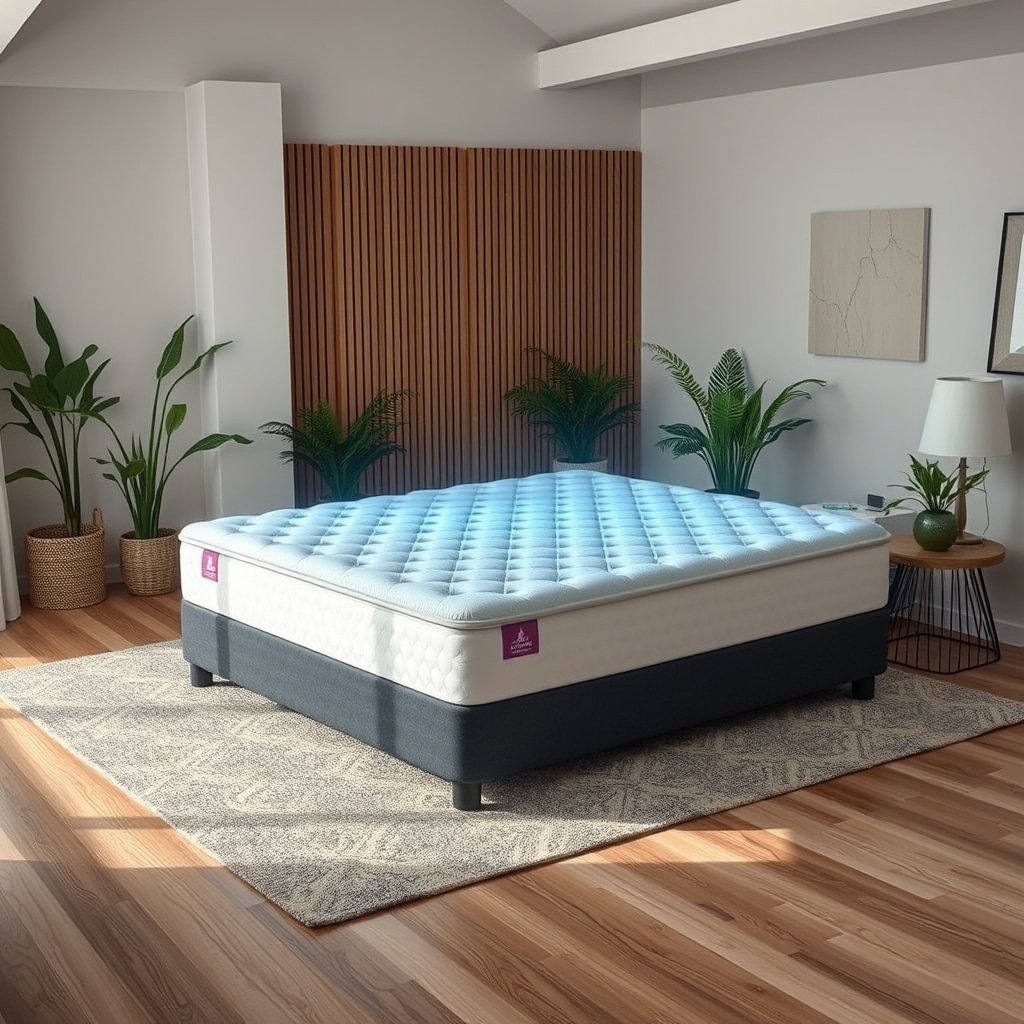
A medium-firm to firm mattress is the most reliable starting point for sciatica because it reduces hip sink and helps you avoid a bent or “drooping” lumbar position. The goal isn’t to feel plush—it’s to keep your pelvis level enough that your lower back doesn’t round or sag into the bed.
For sciatica comfort, mattress firmness matters mainly because it affects hip sink and lumbar alignment—not because it feels “soft” or “cozy.”
A mattress that allows the hips to sink too far can increase mechanical tension on the low back and nerve pathway for many sleepers.
“Firmness” varies by brand, so using the manufacturer’s guidance and trial terms is often more dependable than comparing labels.
– Aim for a medium-firm to firm balance: enough support to prevent hip sink, with enough give to reduce pressure on your lower back.
For heavier bodies, “medium-firm” is often the sweet spot where the bed contours enough for pressure relief but still resists the deep-body displacement that tends to aggravate sciatica.
– Avoid mattresses that feel great at first but quickly “hug” too deeply—sagging usually makes sciatica symptoms worse for many people.
If the surface softens faster than the support core, your sleep posture changes mid-week. That’s one reason sciatica can feel “better on day one” and then worsen after the mattress breaks in.
– Use the manufacturer’s stated comfort/firmness guidance and return policy to sanity-check comfort, since “firm” varies by brand.
Treat the trial period as part of the diagnosis: if you wake with increased low-back pressure or shooting symptoms, that’s your data—even if reviews say “perfect for back pain.”
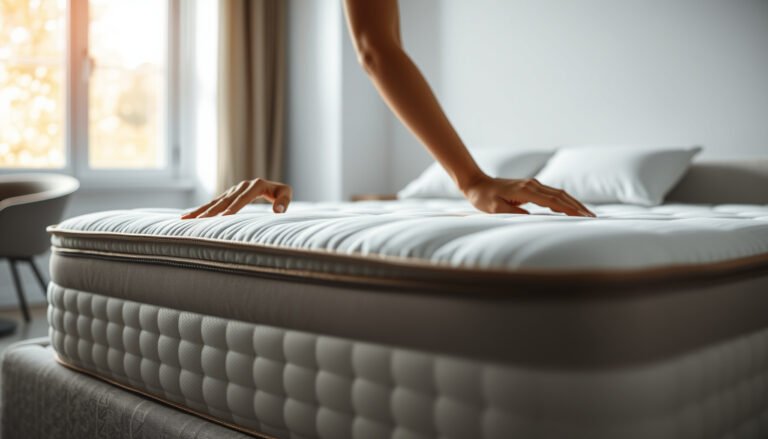
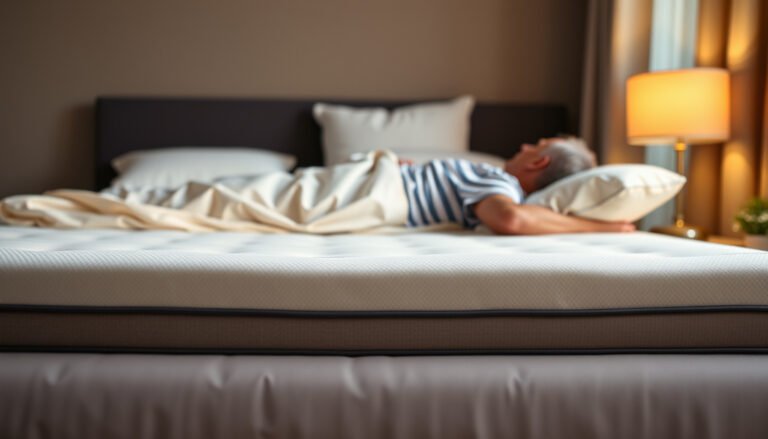
What to do in the store (or trial sleep): lie on your side and then on your back for 10–15 minutes each. You should feel hip cushioning without your pelvis dropping noticeably lower than your shoulders. If you have a supportive foundation but still feel “pinched,” pressure relief (next sections) may be the missing variable.
Prioritize cooling that won’t compromise support
A cooling mattress helps most when the cooling is paired with real support stability—otherwise heat buildup is only half the problem. For sciatica, the practical target is a breathable surface layer and airflow-friendly construction that doesn’t collapse under your weight.
Cooling performance depends on both heat movement (breathability/airflow) and heat storage (how materials insulate and hold warmth).
Cooling features that sit only on the top may not help if deeper layers still trap heat or allow hip sink.
When a mattress’s support core softens, pressure and alignment change—often worsening sciatica regardless of how “cool” the top feels.
– Choose breathable covers and airflow-focused designs (e.g., moisture-wicking fabrics, ventilated layers) so heat can escape rather than be trapped under you.
Look for covers described as breathable or moisture-wicking, and for designs with ventilated airflow channels—not just “cool-to-the-touch” marketing. Heat management becomes more important with heavier builds because you generally have more body mass generating heat and because deeper foam compression can reduce airflow.
– If you pick gel/phase-change/foam “cooling,” verify it’s paired with a stable support layer underneath—cooling features don’t help if the bed collapses under your weight.
Cooling foams can feel comfortable at first, but if the comfort layer is too plush for your weight range, you can lose alignment (which is often the bigger sciatica trigger).
– Watch for “cooling” that’s only a thin top layer; you want cooling where you actually feel it, plus support underneath.
If the first 1–2 cm cools you briefly but the mattress still compresses unevenly, you can end up with a warmer, misaligned sleep surface.
Cooling vs. support: why the physics matters (with real reference data)
The reason this pairing matters is straightforward: different materials move and store heat very differently, and phase-change/evaporative strategies rely on large energy exchanges.
According to NIST, the thermal conductivity of dry air is about 0.026 W/m·K at room temperature (300 K). According to NIST, liquid water’s thermal conductivity is about 0.60 W/m·K (300 K), meaning heat can move away from a warm surface far more effectively when a material enables conduction and convection. According to NIST, water’s latent heat of vaporization is about 2,256.9 kJ/kg at 100°C—this is the energy draw behind evaporative cooling approaches.
Thermal properties that explain mattress “cooling” behavior
| # | Cooling-relevant property | Value | Units | Why it matters on a mattress | Cooling strength |
|---|---|---|---|---|---|
| 1 | Thermal conductivity (dry air) | 0.026 | W/m·K | Air-filled spaces slow heat transfer; airflow/ventilation helps move heat away. | ★☆☆☆☆ |
| 2 | Thermal conductivity (liquid water) | 0.60 | W/m·K | Higher conductivity supports faster heat movement when a material enables conduction/convection. | ★★★☆☆ |
| 3 | Specific heat (dry air) | 1.005 | kJ/kg·K | Lower heat capacity means air temperature can change with modest airflow, aiding heat removal. | ★☆☆☆☆ |
| 4 | Specific heat (liquid water) | 4.186 | kJ/kg·K | Higher heat capacity means water-rich materials can buffer temperature changes but may feel warmer if motion is limited. | ★★★★☆ |
| 5 | Latent heat of fusion (water) | 333.55 | kJ/kg | Phase-change approaches store/release energy during melting/freezing, helping smooth temperature swings. | ★★★★☆ |
| 6 | Latent heat of vaporization (water) | 2256.9 | kJ/kg | Evaporative cooling pulls large energy from the skin/surface, which is why moisture-wicking + airflow can matter a lot. | ★★★★★ |
| 7 | Density of water at ~25°C | 998.2 | kg/m³ | Density relates to how much mass/phase-change material a component can hold in a given volume. | ★★★☆☆ |
Support for heavy people: check weight limits and build quality
A cooling mattress for heavier sleepers should be chosen like a load-bearing product, not a comfort-only item. Your biggest long-term sciatica risk is a support core that softens early, causing hip sink, uneven pressure, and posture changes during sleep.
A stated maximum sleeper weight is the most direct indicator of whether a mattress is engineered to resist sag under heavier loads.
Edge support affects your sleeping angle; weak edges can “steer” heavy sleepers into the center and change alignment.
Durable support construction (layer thickness and density) is often what determines whether pressure relief lasts for years.
– Confirm the mattress has a stated weight rating/maximum sleeper weight and that your size falls comfortably within it (not right at the limit).
If the documentation lists a maximum of , aim to be well below that—especially if you sleep close to the edge or frequently change positions.
– Look for durable support construction (thicker, higher-density support layers; overall build meant to resist premature softening).
Heavier bodies compress comfort layers more. That means the “durability match” matters: your comfort layer may be fine, but the support layer must be designed to maintain its shape under your load.
– Pay attention to edge support too: weaker edges can force you toward the center and change your sleeping angle.
For sciatica, that positional consistency matters. A mattress that collapses at the perimeter can pull your hips into a less neutral angle when you roll or sit near the edge.
Practical buying move: screenshot or save the manufacturer’s layer construction and warranty terms. If they don’t clearly specify a weight limit and core construction, treat that as a risk factor—especially for sciatica where small posture changes can feel significant.
Match pressure relief to sciatica (hips, lower back, and sleep position)
For sciatica comfort, the mattress should reduce pressure around the hips while keeping your lower back from bending out of neutral. That balance is usually different from what “pressure relief” means for other kinds of back pain.
Sciatica-related discomfort often tracks with how well the pelvis stays level and the lumbar spine avoids excessive flexion or “droop.”
Side sleeping typically demands more hip cushioning, while back sleeping often benefits from steadier lumbar support.
Mattress zoning can help, but only if the zoning is engineered for heavier loads and doesn’t collapse under them.
– For sciatica, you generally want pressure relief at the hips while keeping your lower back from bending or “drooping” into the mattress.
In practical terms: you want the hips to sink just enough to reduce pressure, then stop sinking. If your lumbar area sinks more than your mid-back, many sleepers feel worse within hours.
– Side sleepers often need more hip cushioning; back sleepers usually need better lumbar support; stomach sleeping often increases strain regardless of mattress—consider position changes alongside the mattress.
If you sleep on your stomach now, a mattress can only do so much. Consider adding a pillow under your knees or shifting to your side or back during the trial.
– If the mattress uses zoning (softer surface zones + firmer support zones), verify the zoning is designed to support heavier bodies—not just lighter ones.
Some zoning is primarily tuned for average-weight sleepers. For heavier users, “softer zones” can still be too soft. Check for documentation that discusses support behavior beyond marketing claims.
What I see matter most during a sciatica trial: the pattern of symptom change after position switches. Use that feedback to steer firmness and pressure relief selection.
Quick pros/cons comparison: the most common “wrong” cooling choices
| Option | Pros for heat | Likely sciatica risk | Best when |
|---|---|---|---|
| “Cooling” top layer + very plush feel | Feels cool initially | Hip sink and changing lumbar angle as it softens | You’re within the weight limit *and* the support core is firm enough |
| Cooling foam over a less-durable support core | Some surface temperature relief | Sag after months; symptoms often return as alignment shifts | Usually avoid for heavier sleepers |
| Breathable cover + supportive core (medium-firm) | Better ongoing heat escape | May feel less “cradling” at first | Often the best starting point for sciatica comfort |
What can go wrong (common mistakes)
Cooling mattresses can absolutely help, but the most expensive mistake is picking the wrong comfort-support balance. If you choose based on temperature control alone, sciatica can still worsen due to pressure and alignment changes.
If hip sink increases, sciatica symptoms can worsen even when a mattress feels cool.
Weight-capacity mismatches are a frequent cause of early sag—leading to posture changes and renewed nerve irritation.
“Cooling” is not standardized across products; surface cooling tech and deeper support behavior can conflict.
– Choosing a “cooling” mattress that’s too plush: heat relief won’t matter if the mattress allows hip sink or uneven alignment.
Plush comfort layers are not automatically bad. The issue is when the support core can’t hold your hips stable.
– Ignoring weight capacity and relying on reviews alone: many complaints come from sag after months, especially when the build isn’t meant for heavier users.
Reviews reflect a range of body types and sleep positions. For sciatica, the “right” alignment is narrower—so the mattress needs to perform consistently, not just initially.
– Assuming cooling tech is identical: a “cooling cover” and a “cooling foam” can behave very differently, and some cooling materials wear out faster than the support core.
Cooling covers may help with moisture movement and surface evaporation; cooling foams may feel cool via temperature modulation. But neither helps if the support system fails.
Edge case to consider: if your sciatica is unusually sensitive to pressure, you may need slightly more cushioning in the hip area *without* reducing overall firmness. That can be achieved with a breathable, pressure-relieving comfort layer over a stable support core—not by switching to an overall plush bed.
Verdict / tip: the safest way to shop + who should skip
If you’re heavy and have sciatica, the best approach is to shop for stable support that resists sag, targeted pressure relief around hips/lower back, and genuine breathability/cooling on top—then confirm fit with the trial/return policy. Downsides: some medium-firm supportive beds can feel “less cradling,” and cooling layers (especially certain foams) may reduce heat only moderately rather than eliminating it—so you may still need breathable bedding.
For sciatica, a mattress that maintains alignment over time usually matters more than short-lived “cooling” sensations.
Stable support plus breathability is typically the safest pairing when you’re heavy and pain-sensitive to pressure and heat.
Trial periods reduce risk because the “right” sciatica comfort can only be validated by how your symptoms respond night after night.
Skip this approach (or speak with a clinician first) if you have severe or worsening nerve symptoms, recent injury, progressive weakness, or you’re using a mattress mainly as a stand-in for medical care—mattresses can help comfort, but they don’t treat the underlying cause. Also skip ultra-soft mattresses and “cooling only” designs that lack clear support specs or weight ratings.
Bottom line: prioritize documentation (weight limits, construction, trial terms), then confirm sciatica symptom response in the first 1–2 weeks of sleeping on the bed.
Quick scan checklist (save this):
| Check | Why it matters | What to look for |
|---|---|---|
| Weight capacity / max sleeper weight | Prevents premature sag | A clear, stated weight limit within your range |
| Comfort feel (medium-firm leaning) | Helps alignment for sciatica comfort | “Medium-firm/firm” guidance, not “super plush” |
| Support-layer durability | Maintains pressure relief over time | Stable, thicker/higher-density support design (per spec) |
| Cooling method type | Heat management where it counts | Breathable cover + cooling layer options that won’t thin out quickly |
| Return/trial terms | Reduces risk from misfit | Trial length and easy return process |
| Edge support | Keeps posture consistent | Stronger perimeter support for your usual sleep area |
Sources
– Sciatica / nerve pain background: NINDS (National Institute of Neurological Disorders and Stroke) sciatica overview page.
– Sciatica / low back guidance (sleep posture and general recommendations): NHS sciatica and low back pain pages.
– Cooling materials and heat/phase-change physics references: NIST (National Institute of Standards and Technology) reference data for thermal conductivity, specific heat, and latent heat (water properties).
– Mattress pressure, low-back support, and posture considerations:
– Mattress weight limits, layer construction, and material cooling claims: Manufacturer documentation for each model you shortlist (weight rating, layer specs, warranty, and trial terms).
Frequently Asked Questions
What cooling mattress features should heavy people with sciatica look for?
Look for a supportive yet pressure-relieving design that keeps your spine neutral while reducing hip and lower-back pressure. Prioritize materials with cooling airflow or heat-wicking properties, such as gel memory foam, latex, or breathable covers. For sciatica, a medium-firm feel is often ideal because it supports heavier bodies without letting the hips sink too far. Also check for strong edge support so you can sit and move without the mattress collapsing around you.
How do you choose the right mattress firmness for heavy people with sciatica and back pain?
Start by aiming for medium-firm (often around 5–7 on a 10-point scale), since it typically balances support with pressure relief for the hips and lower back. Heavy people usually need mattresses with better high-density support cores to prevent excessive sag that can worsen nerve irritation. If you sleep on your side, choose a model that still cushions the shoulders and hips; if you sleep on your back, prioritize stability and spinal alignment. When possible, use a trial period to confirm your comfort and sciatica symptoms improve.
Which cooling mattress type is best for sciatica—gel memory foam, latex, or hybrid?
Hybrid cooling mattresses (foam over coils) are often a strong choice because they combine targeted pressure relief with responsive, breathable support. Gel memory foam can be good for contouring and cooling, but heavier sleepers should ensure the comfort layer is not too soft and the support foam is high-density. Latex is naturally breathable and resilient, which can help maintain alignment with less heat retention. The “best” option usually depends on whether you need more hip cushioning (foam) or more springy support (latex/hybrid) to reduce sciatica flare-ups.
Why is cooling important for sciatica mattresses for heavy sleepers?
Excess heat can increase discomfort and muscle tension, which may aggravate sciatica pain by making the lower back and glutes feel stiffer. Cooling mattress technology helps regulate temperature so you can sleep more deeply and stay in a comfortable spinal alignment position. Breathable covers, airflow-promoting layers, and materials designed to wick moisture are especially helpful for heavier bodies that may trap more heat. Better temperature control can also reduce tossing and turning, which is important for minimizing nerve irritation.
How do you choose a cooling mattress with enough support for heavy people to prevent sinking and nerve pain?
Focus on support-core durability, such as a thicker pocketed coil system or high-density foam layers that can handle higher body weight without sagging. Check for lumbar support and zoned support, which can reduce pressure around the lower back while keeping the hips from sinking. Mattress height and layer thickness matter too—adequate cushioning combined with a firm foundation helps maintain alignment for sciatica. Finally, verify weight capacity, read reviews from heavier customers, and look for a trial period so you can confirm the mattress stays supportive over time.
📅 Last Updated: October 26, 2026 | Topic: How to Choose a Cooling Mattress for Heavy People with Sciatica | Content verified for accuracy and freshness.
References
- https://www.mayoclinic.org/diseases-conditions/sciatica/symptoms-causes/syc-20377425
- Sciatica | MedlinePlus
- All Disorders | National Institute of Neurological Disorders and Stroke
- Low back pain
- https://pubmed.ncbi.nlm.nih.gov/?term=mattress+firmness+low+back+pain+systematic+review
- https://pubmed.ncbi.nlm.nih.gov/?term=pressure+redistribution+support+surface+body+mass+index
- https://pubmed.ncbi.nlm.nih.gov/?term=mattress+cooling+gel+foam+thermal+comfort+study
- https://scholar.google.com/scholar?q=sciatica+mattress+firmness+pressure+relief Google Scholar
- https://scholar.google.com/scholar?q=cooling+bedding+thermal+comfort+sleep+temperature Google Scholar
- https://scholar.google.com/scholar?q=obesity+sleep+support+surface+pressure+mapping+study Google Scholar