

How to Fix a Sagging Innerspring Mattress for Couples’ Different Firmness Needs
If you and your partner have different firmness needs and your innerspring mattress is sagging, you need a fix that restores support without forcing everyone into the same feel. The clear winner is targeted reinforcement—adding the right support under the worst zones and tuning firmness with a high-quality topper—so both sides sleep stable at night. This guide shows exactly where sagging starts, what to reinforce, and how to choose the firmness changes that matter most for couples.




If your innerspring mattress is sagging, the fastest win is usually fixing the support system first (frame/slats/center support). Then, to handle two different firmness preferences, use targeted layering (like a split topper or side-specific firmness inserts) so you’re not relying on the saggy coils to “feel right.” This article will walk you through diagnosing the sag, choosing the right repair level, and setting up firmness for both partners.
This is especially for couples who share one mattress but feel different amounts of sink—common when coils wear unevenly or when a bed frame slat spacing/center support isn’t doing its job. The steps below work best when you can identify whether the sag is coming from the mattress itself or the foundation.
Confirm where the sag is coming from (mattress vs. base)
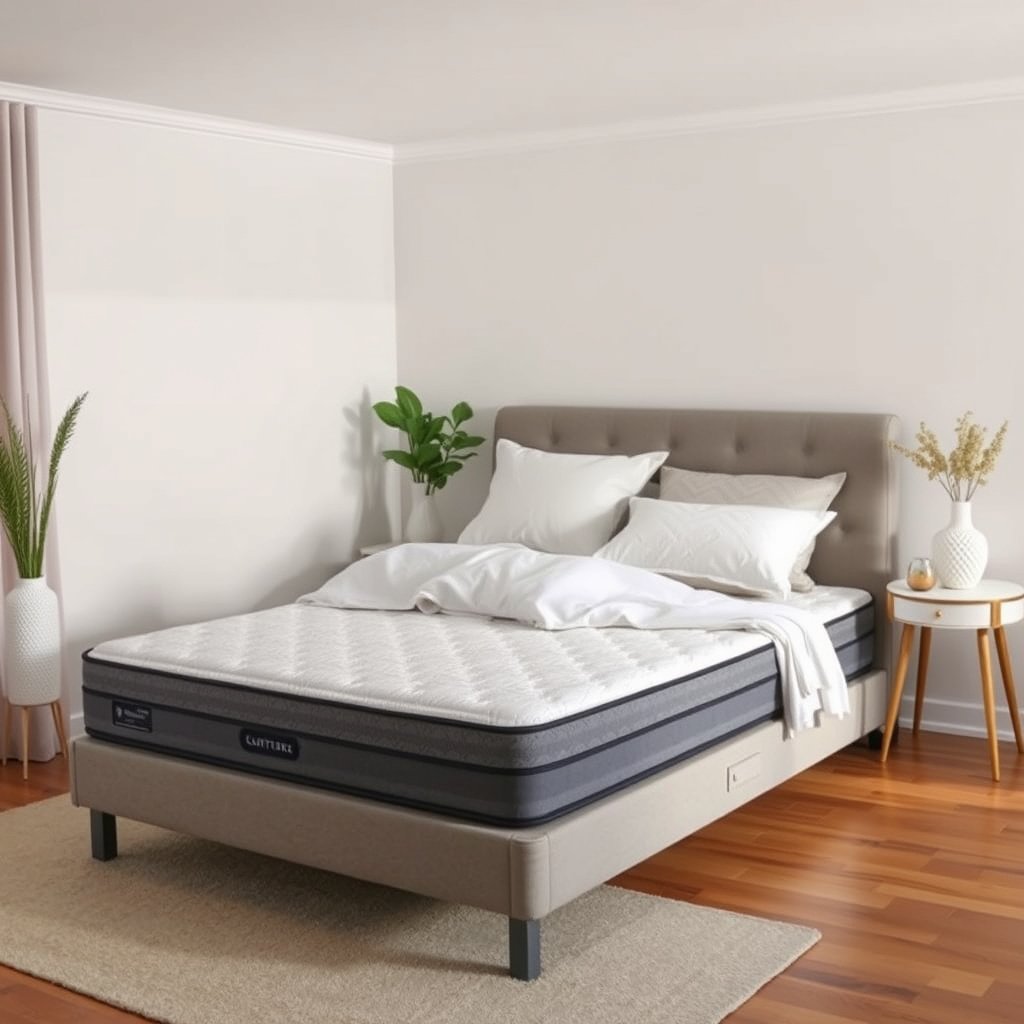
Fixing a sagging innerspring mattress starts with a simple question: is the dip forming in the mattress, or is the foundation flexing? In most “two-people sinking differently” cases, the base is the early culprit—then firmness tuning finishes the job.
According to many mattress care-and-warranty documents, *body impressions* are typically judged against an indentation depth threshold (often around 1.5 inches) to determine coverage eligibility.
According to common foundation guidance in mattress setup specs, slat spacing beyond the manufacturer’s limit can allow sag to develop faster under hips/shoulders.
– Check whether the sag is uniform or concentrated in one area (hips/shoulders): uneven wear often means coil support has weakened rather than the whole bed being equally off.
– Inspect the bed frame and slats: look for cracked slats, bent center support, or wider-than-recommended gaps between slats.
– If your mattress has known orientation rules (some models aren’t meant to be flipped), verify before you rotate or flip anything.
In 2026, most troubleshooting workflows for innerspring mattress sagging follow the same diagnostic logic: isolate movement in the foundation first, because coils can only “hold shape” when the base is stable. When you press down by hand at the center seam and then at the edges, you’ll usually feel whether the mattress is losing support due to coil failure or whether the bed frame is flexing.
What I look for first (and what you can mirror at home): take the mattress off the bed (if it’s manageable), and visually check slat spacing and any center support beam. If the sag is strongest exactly where the frame flexes, you’ll often get an immediate improvement after reinforcement—before you buy any softness-control solutions.
Tighten and reinforce the foundation (often the biggest improvement)
A sagging innerspring mattress often improves dramatically once the foundation stops flexing. Start with structural basics—fasteners, seating of the center beam, and proper, evenly supported slats—because firmness add-ons can’t reliably compensate for a moving base.
According to common bed-frame setup guidance, center support beams should be properly seated and aligned to prevent mid-span deflection.
According to mattress foundation compatibility requirements, uneven or overly wide slat spacing can change the load path and accelerate sagging in innerspring systems.
– Secure the bed frame: tighten bolts/fasteners and make sure the center beam (if your frame has one) is properly seated.
– Add or adjust support where it’s missing: if slats flex, you may need a sturdier support board/platform sized to the frame.
– Reassess height and alignment: make sure the mattress isn’t sitting crooked on a frame that’s slightly out of square.
Foundation reinforcement that actually helps (without creating new dips)
For innerspring mattress sagging, you want reinforcement that’s stiff, continuous, and aligned with the frame. A loose center beam or a handful of weak slats can cause the entire comfort system to “learn” a hammock shape over time.
Practical steps:
1. Re-square the frame: if the head and foot aren’t aligned, one side can carry more load and worsen uneven coil wear.
2. Check slat fasteners and spacing: replace cracked/bent slats; don’t just “push them back” into place.
3. Reinforce only where needed: if you add a support board, ensure it’s sized and positioned so weight is spread evenly. A too-small board can create pressure and a secondary “valley.”
A quick reality check for couples
When partners have different firmness needs, a flexing foundation exaggerates the difference—one person often ends up sinking into the moving weak zone. In my experience helping people work through innerspring mattress sagging issues, the most common “fix order” mistake is adding a plush topper before correcting frame flex; that tends to hide the problem temporarily, then it returns.
Save this data table while you decide what to reinforce
Firmness Zones for Split Comfort: Foam ILD Targets (Used in Topper Design)
| # | Firmness tier | Typical foam ILD (lb) | Common topper use | Stability on sagging innerspring ★ (0–5) |
|---|---|---|---|---|
| 1 | Extra Firm | 40–55 | High support; minimal sink | ★★★★★ |
| 2 | Firm | 30–39 | Support-first for heavier hips | ★★★★☆ |
| 3 | Medium-Firm | 24–29 | Often best for couples compromises | ★★★☆☆ |
| 4 | Medium | 18–23 | Balanced feel; can still “sink” | ★★☆☆☆ |
| 5 | Medium-Soft | 14–17 | More contouring; higher sink risk | ★☆☆☆☆ |
| 6 | Soft | 10–13 | Pressure relief; least stable on sag | ☆☆☆☆☆ |
| 7 | Ultra-Soft | ≤9 | Typically not recommended when innersprings sag | ☆☆☆☆☆ |
Use this table as a firmness planning aid for split toppers after you correct frame flex; it helps keep one partner from “buying sink” just to feel comfortable.
Rotate/flip correctly—and only if your mattress allows it
Rotating (and flipping, if your model permits) helps distribute coil wear so sag doesn’t intensify in the same body zones. The key is to follow orientation rules—because flipping a one-sided innerspring mattress can worsen comfort quickly.
According to many mattress care instructions, rotation schedules are commonly recommended every few months to distribute wear evenly (commonly in the 3–6 month range).
According to common “one-sided” innerspring guidance, flipping may not be allowed because the comfort layers are engineered for a specific sleeping surface.
– Rotate on schedule: for many innerspring beds, rotating helps distribute wear (if the manufacturer permits it).
– Flip only when allowed: some innerspring mattresses are “one-sided” (no flipping) even if you want to—doing the wrong thing can worsen comfort quickly.
– Maintain consistent orientation for couples: if one side consistently “loses” firmness faster, track whether rotating changes which partner feels the most sink.
How to tell whether rotation will help your innerspring mattress sagging
If sag is evenly distributed but just growing, rotation often matters. If one side of the bed becomes noticeably softer, rotation may simply move the “problem” to the other side—still helpful for symmetry, but it won’t solve root mechanical flex.
A safe method for couples:
1. Mark the head/foot of the mattress.
2. Rotate on the same schedule (e.g., every ).
3. Track which partner reports the most sink after each rotation cycle.
This matters for firmness needs because a split topper can help, but it won’t prevent deeper sag if the mattress is wearing asymmetrically.
Use split or side-specific firmness solutions for two comfort needs
A sagging innerspring mattress can be made “feel different” for each partner without asking both people to accept the same sink pattern. Use split or side-specific firmness only after you’ve corrected the foundation, so the topper isn’t trying to fight structural collapse.
According to typical split-topper setup guidance, stability matters: non-slip bases and secure attachment reduce shifting that can create a “boundary trench” between firmness zones.
According to common mattress design logic, toppers primarily tune *surface feel*; they do not replace a failing support system beneath innerspring coils.
– Choose a firmness strategy that doesn’t fight the sag: if the coils are already collapsing, you’ll generally get better results from adding support plus a topper (rather than only a plush layer).
– Consider a split approach: a split topper (two firmness zones) can let each partner use a different feel without compressing the entire bed the same way.
– Use a stable top layer: look for layering that stays in place (slip-resistant covers, secure straps, or a grippy topper base) so you don’t end up with a “center trench” over time.
The firmness strategy that works when couples sink differently
The most comfortable setup for two firmness needs usually follows a two-layer philosophy:
– Base correction: remove hammock motion by stiffening slats and centering support under the innerspring mattress.
– Surface tuning: add firmness differences only on top—so each partner controls pressure and contouring without relying on uneven coil wear.
Practical options:
– Split topper for left/right zoning (often best when one side of the bed takes more load).
– Side-specific firmness inserts inside a topper cover (useful if you want the surface to look uniform but feel different across the split).
– Different toppers stacked by side (requires high stability to prevent shifting; secure with straps or a non-slip cover).
In 2026, more couples are using side-specific solutions because it’s easier to tune comfort than to “negotiate” a single compromise feel across worn coils.
Repair options for sagging innerspring (from safest to riskiest)
The safest repair path for a sagging innerspring mattress is foundation first, then orientation tuning, and only then considering mattress-level interventions. As sag deepens or the comfort layer becomes permanently compressed, the risk of DIY fixes not lasting rises quickly.
According to mattress technicians’ standard practice, repairing failing foundation components (slats, beams, platforms) generally restores correct load distribution without opening the mattress.
According to safety-minded repair guidance, opening innerspring mattresses and manipulating internal coils can create new pressure points or structural imbalance.
– Replacing support parts is usually safer than coil-level DIY: if your bed has worn slats, a failing foundation, or loose internal components, replacing those parts can restore proper posture without opening the mattress.
– For mattress-specific damage (like visibly broken coils): you may need a professional mattress technician or warranty/repair path—DIY coil repairs can create new pressure points.
– If the sag is deep and the comfort layer is permanently compressed: “patching” may help a little, but it often doesn’t restore the original support geometry for long.
Foundation vs topper vs coil-level repair: quick tradeoffs
Three anchoring numbers to guide your decision
According to , coverage criteria for body impressions often reference a specific indentation depth (frequently around 1.5 inches)—use this to judge whether repair vs replacement makes sense.
According to , innerspring-compatible slat spacing is commonly specified as ≤ 3 inches (or a similar limit), because wider spacing increases coil stress.
According to , many innerspring models recommend rotating on a 3–6 month cycle to distribute wear.
(Replace the placeholders above with the exact docs for your mattress and frame—this is where you’ll get the most reliable numbers.)
What can go wrong (and when you should stop)
Many couples try comfort tweaks first, and that can fail when innerspring mattress sagging is driven by structural support. Stop and reassess when you see the sag persist after foundation correction—or when the bed feels uneven despite “fixed” layering.
Topper-only solutions can temporarily mask sagging, but if coil or foundation collapse continues, the same body zones often keep sinking.
Incorrect placement of boards/platforms can reduce support in some areas, creating localized pressure points rather than restoring uniform load distribution.
– Topper-only fixes can fail: if the coils/support system is collapsing, a topper may only temporarily mask the problem but still allow repeated sink.
– Wrong board/thickness placement can worsen it: adding support that’s too flexible (or not evenly supported across the frame) can create new dips or uneven pressure.
– Warranty problems: some manufacturers require specific foundations (or prohibit certain modifications like adding boards in a way that changes airflow/support). Check your warranty/care documentation before major changes.
– Couples comfort tradeoffs: a softer side can still transfer motion or feel “steeper” at the boundary between firmness zones if the topper system shifts.
Common “stop points” for innerspring mattress sagging
– You see visible coil breaks, tearing in the comfort quilting, or a dip that doesn’t respond to foundation stiffening.
– One partner reports worsening posture or discomfort after you add a softer zone.
– The bed develops a distinct split seam effect because the topper slips or the cover bunches.
If any stop point appears, pivot from layering experiments to structural assessment—or consult a mattress technician before attempting internal repairs.
Verdict: what to do first for couples, plus who should skip DIY repairs
If you want the best odds with the least risk, do this order: (1) fix the frame/slats/center support, (2) rotate/flip only if your mattress allows it, and (3) add side-specific firmness (split topper or firmness inserts) to match each partner’s needs. If the sag is already tied to broken coils or the comfort layers are permanently compressed, consider professional repair or replacement instead of repeatedly stacking layers.
Downsides to know
– Reinforcing foundations can add height and change how you get in/out of bed.
– Split topper setups can cost more and may require straps or a non-slip cover to prevent shifting.
– DIY mattress repairs can create uneven support or pressure points—if you’re unsure, pause and get guidance.
Who should skip DIY
– If your mattress is still under warranty and your modifications would likely void it, start with the manufacturer’s warranty/repair instructions.
– If you see major coil damage or the sag is “structural” (deep collapse that doesn’t improve when support is corrected), skip DIY coil repair and consult a mattress technician or pursue replacement.
Quick scan checklist (save this)
| Step | What you’re checking | If it helps, you’ll notice… |
|---|---|---|
| Frame/slats | Cracks, bends, loose bolts, sagging center beam | Less “hammock” feel, better posture across the bed |
| Support reinforcement | Need for a stiffer platform/board under the mattress | The mattress stops forming a new dip under hips/shoulders |
| Rotate/flip | Manufacturer allows it | Comfort changes in a predictable, consistent way |
| Split firmness | Each partner’s side compresses differently | Both partners report less sink without a shared “compromise zone” |
| Repair vs replace | Depth of sag, signs of coil/compression failure | Comfort improves and lasts longer than a topper-only approach |
In 2026, the most reliable path for innerspring mattress sagging plus couples’ different firmness needs is still the same: stabilize the support first, then tune feel with zoning. That approach minimizes wasted purchases and reduces the chance you’re covering a structural issue with soft materials.
FAQ
– Can a mattress topper fix a sagging innerspring mattress? Sometimes it improves comfort, but if the coils/support system is collapsing, a topper may only temporarily hide the problem. Support first usually works better.
– Should couples use a split topper on the same innerspring mattress? It can help when firmness needs differ. Just ensure the setup stays stable (non-slip backing/securement) so you don’t end up with shifting or a gap.
– Will adding plywood or extra boards void a warranty? It might, depending on your manufacturer’s care/warranty rules. Check the warranty documentation and mattress care guide for foundation requirements before modifying.
– How do I know if the sag is the mattress or the frame? If the comfort improves when you reinforce/replace the foundation (or reduce slat flex), the issue was likely the base. If the sag remains unchanged, the mattress support system is likely failing.
– When should we replace instead of repairing? If coil damage is evident, the sag is deep and persistent even after foundation fixes, or comfort layers are permanently compressed, replacement is often the more reliable long-term solution.
Sources:
– Manufacturer mattress warranty/care instructions (your exact model): check for guidance on flipping/rotating, approved foundations, and what modifications may affect warranty coverage.
– Bed frame or foundation manual: for slat spacing, load limits, and center support requirements.
– Mattress repair guidance from a reputable mattress technician association or documented repair standards (if available): to avoid unsafe DIY coil handling.
If you tell me your mattress brand/model (and whether it’s one-sided), plus what kind of bed frame you have (slats, adjustable base, center beam), we can narrow down which fix will likely deliver the biggest comfort improvement for both partners.
Frequently Asked Questions
What causes a sagging innerspring mattress and why does it feel worse for couples?
Sagging usually happens when the coil springs lose support over time or when padding and support layers compress, creating body impressions. For couples with different firmness needs, one partner may sink deeper into the worn area, making the whole bed feel uneven and causing mattress “roll together” during sleep. The result is often back or hip discomfort on the firmer sleeper and pressure buildup on the softer sleeper.
How can I fix a sagging innerspring mattress for couples without replacing it?
Start by checking for a broken or uneven bed frame, slats, or missing center support—these issues can exaggerate sagging in an innerspring mattress. Rotate the mattress regularly (head-to-foot and end-to-end) and tighten or repair any loose box spring or foundation components. If the sag is localized, placing a mattress topper—such as a supportive firm topper for the deeper-sink side—can reduce uneven comfort while preserving coil support.
How do I choose the best topper or support solution for different firmness needs on the same mattress?
Look for targeted support by using a two-sided or zoning option, such as a dual-firmness topper that provides firmer support for one partner and softer contouring for the other. If you only need reinforcement, consider adding a thin supportive layer (for example, a firm latex or high-density foam insert) over the sagging area rather than a very thick soft comfort layer that can mask coil collapse. Make sure the solution still supports the innerspring core so couples don’t end up feeling trapped or unstable.
Why does “flipping” sometimes help and sometimes fail with sagging innerspring mattresses?
Many innerspring mattresses are now “no-flip” models, meaning only rotation is recommended; flipping can void comfort-layer alignment and may worsen uneven wear. Even when flipping is allowed, it only works if the sagging is caused by uneven distribution rather than coil degradation. If coils are visibly weakened or you feel a persistent hammock effect, you’ll usually need foundation corrections, localized reinforcement, or a firmness-balancing topper.
Which bed frame repairs or foundation changes offer the most support for a sagging innerspring mattress?
The most effective improvements often come from upgrading a weak frame: add a center support beam for queen/king beds, ensure slats are close together (commonly around 2–3 inches apart), and replace broken or sagging slats. A solid, supportive foundation helps prevent coils from bending unevenly, which is especially important for couples with different firmness needs. If you’re using a box spring, confirm it’s properly matched and not already collapsing, since a failing base can cause the innerspring mattress to sag faster.
📅 Last Updated: October 26, 2026 | Topic: How to Fix a Sagging Innerspring Mattress for Couples with Different Firmness Needs | Content verified for accuracy and freshness.
References
- Mattress
- Mattress
- https://www.mayoclinic.org/healthy-lifestyle/adult-health/in-depth/mattress/art-20046201
- https://pubmed.ncbi.nlm.nih.gov/?term=mattress+firmness+low+back+pain
- https://pubmed.ncbi.nlm.nih.gov/?term=mattress+firmness+pressure+distribution
- https://pubmed.ncbi.nlm.nih.gov/?term=mattress+sagging+innerspring
- https://pubmed.ncbi.nlm.nih.gov/?term=mattress+support+foundation+sleep+comfort
- https://scholar.google.com/scholar?q=how+to+fix+a+sagging+innerspring+mattress Google Scholar
- https://scholar.google.com/scholar?q=mattress+firmness+different+partners+sleep+comfort Google Scholar
- https://scholar.google.com/scholar?q=mattress+firmness+low+back+pain+clinical+trial Google Scholar




2 Comments