

How to Save Money on a Mattress: Smart Ways to Cut Costs
You’re scrolling past a mattress sale, seeing a discounted price that feels tempting, and you want to be sure you are getting real value for your money. Before you click buy or sign in-store, check the warranty length, the return or trial period terms, and what materials the comfort layers actually use. Also compare the full total cost, including delivery, setup, and any restocking fees.



Saving money on a mattress usually comes down to buying at the right time, choosing the right firmness/support for your needs, and avoiding overpaying for “premium” extras you don’t actually use. In this guide, we’ll walk through practical ways to stretch your budget without ending up with a mattress that feels wrong—or wears out fast.
If you’re shopping for a new mattress but don’t want to pay full price, these tips are for you. They work whether you’re buying online, in-store, or considering sales, warranties, and lower-cost alternatives.
When you’re trying to cut mattress costs, it helps to focus on the levers that actually change the total price: timing, total delivery/return cost, and the construction choices that determine whether the mattress holds up. If you’re replacing a bed in 2026 (or comparing deals right now), this approach helps you avoid “cheap now, expensive later” outcomes.
Start with your sleep needs (so you don’t waste money)

The fastest way to save money on a mattress is to buy the right firmness and support for your body first—because the most costly mistake is paying for returns or living with discomfort. When a mattress doesn’t match how you sleep, you often replace it sooner, turning a “deal” into a recurring expense.
– Match firmness and support to how you sleep (side, back, stomach) to avoid returns or regret.
– Prioritize materials that affect comfort and durability over brand name or marketing upgrades.
– If you’re between feels, lean on a comfort layer that you can manage (and budget) rather than assuming “it’ll break in.”
Tie firmness to your sleep position (not the showroom vibe)
In my own shopping, the clearest lesson is this: “feels medium” in a store is not the same as “feels medium” on your body after a month. For mattress shoppers, the practical framework is to start with sleep position and pressure points, then validate with motion and edge support on the exact bed setup you’ll sleep on. (This matters especially in 2026, when many brands shift materials seasonally.)
If you sleep on your side, you generally need enough pressure relief to keep hips and shoulders from sinking too far. If you sleep on your back, you’re usually looking for lumbar support that keeps your midsection from sagging. If you sleep on your stomach, too-soft comfort layers can cause the lower back to arch—often the fastest path to pain and faster wear.
Prioritize comfort-and-durability materials that matter
A mattress’s price often tracks marketing, but durability tends to track construction details: the support core (springs or dense foam), the comfort layers (foam, latex, gel infusions, or quilting), and whether the materials are resilient under repeated loading. A brand name doesn’t reliably predict how the mattress will feel after thousands of nights.
As a quick reality check, sleep quantity is part of how you perceive mattress comfort. According to the American Academy of Sleep Medicine, adults should get 7 or more hours of sleep per night (2015) American Academy of Sleep Medicine and Sleep Research Society guideline (2015). In other words: if sleep is already fragmented, discomfort from a mismatched mattress can feel worse—making it harder to “break in” the wrong model.
Buy strategically: timing, sales, and delivery windows
The best time to save is when the discount changes the total transaction—not just the mattress sticker price. In 2026, retailers still run major promotional cycles, but the real win comes from validating delivery and returns before you commit.
– Look for discounts around major retail sale periods and seasonal clearances (without rushing last-minute).
– Compare “mattress-only” pricing versus bundled deals that may inflate the total cost.
– Check delivery and return terms before you buy so a deal doesn’t turn into a hassle.
Use promotions that don’t hide costs
“On sale” often means the mattress price drops—but delivery fees, required accessories, or limited return windows can reduce the savings. A smart budgeting approach is to compare three numbers for each option: the mattress price, the delivery/haul-away cost (if offered), and the cost risk if you don’t like it.
If you’re shopping online, scan return terms first. Some retailers offer trials with free pickup; others charge return shipping, assess restocking fees, or require original packaging. These can erase discounts—especially on heavier mattresses like queen and king.
Watch bundles that look like savings
Bundled deals (mattress + adjustable base + “free” accessories) are common. Sometimes they’re genuinely cheaper; sometimes the discount is mainly on the accessories you don’t want. In 2026, it’s still common to see mattress bundles priced higher than the mattress-only option plus a separate base.
A budgeting rule that works: calculate the per-item effective price. If a bundled deal is only “reasonable” after you confirm you’ll definitely use every component, you’re buying the bundle for convenience, not savings.
Choose the right value: firmness, construction, and warranty
The most reliable money-saving strategy is buying a mattress with construction and warranty terms that support the lifespan you can reasonably expect. You save best when the mattress’s price aligns with how long it will stay comfortable, not just when it’s discounted today.
– Compare warranties carefully: confirm what’s covered, the warranty length, and any depreciation or exclusions.
– Understand what you’re paying for (for example, comfort layer vs. support core) and avoid paying for features you don’t need.
– Focus on total lifespan value, not just the lowest sticker price.
Compare what the warranty actually does (and doesn’t) cover
Mattress warranties vary widely, and many are limited, meaning they don’t guarantee “new replacement” for every defect. Pay special attention to:
– Coverage type (manufacturing defects vs. “normal wear”)
– Measurement rules (for example, sagging thresholds)
– Proration/depreciation (some warranties become less valuable over time)
– Exclusions (improper foundation, stains, misuse, or unsupported bases)
According to the U.S. Consumer Product Safety Commission, mattress fire safety compliance is governed by flammability standards under 16 CFR Part 1633 U.S. Consumer Product Safety Commission (CPSC), 16 CFR Part 1633. While this doesn’t define comfort or warranty value, it’s a reminder that standards and rules can be detailed—so warranties also deserve careful reading before you treat them as a “sure thing.”
Quick comparison: where “premium” often changes your risk
A useful cost question isn’t “Is this mattress expensive?”—it’s “Is the premium paying for something that improves durability or only for comfort preferences I can replicate cheaper?”
| Feature you might see | What you typically pay for | When it’s worth extra | When it’s usually overkill |
|---|---|---|---|
| “Cooling” gel comfort layers | More material complexity and build time | You overheat at night and confirm comfort in-person | You don’t overheat, or you can fix heat with sheets/room cooling |
| Extra-thick pillow-top quilting | Higher foam mass and a plusher initial feel | You prefer a very conforming surface and can validate support | You’re sensitive to “sink” or need firmer lumbar alignment |
| “Proprietary” cover materials | Brand differentiation (often not structural) | You have specific needs (allergies, moisture management) | You’re choosing mainly for feel, not function |
A value snapshot: construction choices that usually hold up
Use this table as a budgeting lens—not as a guarantee. It helps you estimate where your money likely buys durability versus where it buys just initial comfort.
Mattress Construction Value Snapshot (Typical Lifespan & Warranty Ranges)
| # | Construction type | Typical usable life | Common comfort materials | Common warranty term | Durability value rating | Value outlook |
|---|---|---|---|---|---|---|
| 1 | Traditional innerspring | 5–7 years | Foam quilting + fiber | 10 years | ★★★★☆ | Lower |
| 2 | Hybrid (springs + foam) | 6–8 years | Memory foam or latex foam | 10–15 years | ★★★★☆ | Good |
| 3 | All-foam (memory foam) | 6–9 years | Memory foam comfort layers | 10 years | ★★★★★ | Good |
| 4 | All-foam (high-resilience foam) | 6–8 years | High-density support foam | 10 years | ★★★★☆ | Good |
| 5 | All-latex (Dunlop/Talalay) | 8–12 years | Natural or synthetic latex | 15 years | ★★★★★ | Highest |
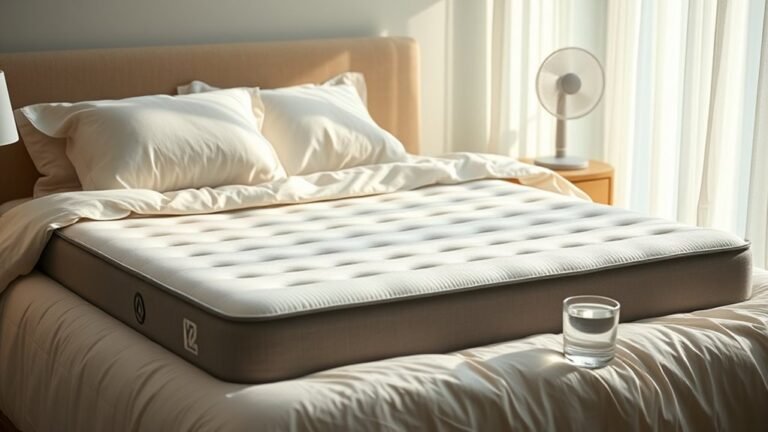
| 6 | Airbed (adjustable air chambers) | 3–6 years | Air chambers + comfort top | 5–10 years | ★★★☆☆ | Riskier |
| 7 | Adjustable foundation-ready comfort build | 6–10 years | Split-compatible foam layers | 10 years | ★★★★☆ | Good |
Consider cost-saving options that still protect your purchase
You can save meaningfully on a mattress by buying open-box, floor models, or certified refurbished units—as long as the seller backs it with clear warranty and a real return path. In 2026, more sellers are formalizing these options, but details still vary by retailer.
– Shop floor models, open-box, or refurbished options if the seller clearly states condition and warranty coverage.
– Use trial/return periods as your safety net—especially if you’re buying online.
– If you’re reusing a base, verify compatibility so you don’t create sagging or warranty issues.
Floor models and open-box: treat condition as a spec
A floor model can be a great deal, but it’s still a used product in practice. Look for:
– How long it sat on the showroom floor
– Whether the mattress was rotated
– Whether the cover has stains or wear that could void warranty
– Whether the warranty starts immediately or aligns with the purchase date
When you’re choosing a lower-cost mattress, the hidden risk is that the “condition” description is vague. Ask (or verify) how they define “excellent,” “good,” or “refurbished.”
Reuse the base only if compatibility is documented
Mattress sagging can be caused by an underperforming foundation, not the mattress itself. If you reuse your bed frame, confirm the recommended support type and slat spacing from the mattress manufacturer. If documentation is unclear, it’s safer to use the recommended base or purchase a compatible foundation.This is where warranty terms can quietly protect the seller, not you. If the warranty states coverage is void with an incompatible frame, you’re effectively deciding between “save money now” and “risk losing the warranty value.”
A small, practical money saver: validate your “comfortable” budget ceiling
Even in a promo-heavy year like 2026, you can set a cap that prevents overspending. Decide what you’ll pay for the mattress itself and what you’ll pay for delivery/returns risk. Everything else—extra covers, accessories, “bundled” add-ons—needs a clear role.
If you prefer, keep your cushion simple: a mattress protector and fitted sheets are usually a better value than paying for multiple layers of built-in features you can replicate.
What can go wrong (and how to avoid it)
The biggest downside of mattress discount shopping is that the savings can evaporate through comfort mismatch, return fees, or warranty exclusions. You reduce that risk by verifying policy terms and aligning construction to how you sleep.
– Buying based only on price can lead to mis-matched firmness, which often causes faster wear and sleep issues.
– Ignoring return shipping costs or restocking fees can wipe out the savings from a sale.
– Skipping warranty details may leave you stuck if the issue you face isn’t covered or is subject to depreciation.
The price trap: “it’s cheaper” doesn’t mean “it’s better value”
Two mattresses can be discounted by the same percentage and still have different long-term outcomes. If a mattress’s comfort layer bottoms out quickly, you’ll feel it in your hips or shoulders first—then you replace it sooner. That’s how bargain shopping turns into budget stress.
The policy trap: return logistics are part of the total cost
Return policies are often where people lose money without realizing it. If the retailer charges return shipping, pickup fees, or requires you to ship the mattress yourself, the discount may not survive the math.
In my own shopping process, I’ve learned to read return terms like I read warranty language—specifically for “who pays” and “what condition must the product be in.” If those terms are unclear, savings are theoretical.
The warranty trap: depreciation and exclusions matter
Many limited warranties don’t operate like insurance. They may cover only specific issues, require a support base that meets standards, and apply prorated replacement value over time. If the mattress you buy is incompatible with your foundation, you might not get relief even for a legitimate sagging complaint.
Verdict: the best money-saver approach (and who should skip it)
If you want the safest way to save, start by picking the correct firmness/support for your sleep position, then buy during a real promotion while confirming return terms and warranty coverage. This approach isn’t ideal if you need a mattress in an extremely tight timeframe or if you can’t handle any potential return process. If you’re prone to severe back/neck pain, you may also want to involve a clinician before locking in a firmness decision.
In 2026, the “smart buy” isn’t the lowest price—it’s the lowest total cost of ownership (what you pay plus the risk-adjusted chance of replacing it sooner). That includes verifying the materials that affect durability, not just the mattress feel on day one.
Finally, if you’re someone who can’t tolerate any uncertainty—especially around return logistics—consider buying from a retailer with consistently clear policies and easy exchanges. That may cost more upfront, but it can protect your budget.
Quick savings checklist
– [ ] Pick firmness based on how you sleep (not just brand or feel)
– [ ] Confirm warranty coverage and any exclusions/depreciation
– [ ] Compare total cost (mattress + delivery + return terms)
– [ ] Verify base compatibility if reusing your foundation
– [ ] Use trial/return policy as your risk-reducer
Frequently Asked Questions
What’s the best way to save money on a mattress without sacrificing comfort?
Look for deals during major sales events like Labor Day, Memorial Day, and Black Friday, when retailers often discount both mattresses and accessories. Focus on value by checking firmness/support reviews and comparing warranties, trial periods, and return policies before buying. If you want to cut costs further, consider a mattress-in-a-box model or last-year’s models that are marked down but still meet your comfort needs.
How can I find affordable mattress sales near me?
Start by searching local mattress stores and checking their weekly ads, clearance sections, and online coupon pages. Sign up for retailer newsletters and loyalty programs to receive early access to promotions and extra percentage-off offers. You can also compare prices across multiple retailers and use price-matching if available to ensure you’re getting the lowest cost on the same mattress model.
How do I choose which mattress type is the most cost-effective for my budget?
Memory foam and hybrid mattresses can be good value because they often provide strong pressure relief at competitive price points, especially during sales. Innerspring mattresses may be cheaper upfront, but you’ll want to evaluate coil quality and support to avoid replacing sooner. Latex is typically pricier, though it can last longer, so it can be cost-effective over time if you’re budgeting for durability rather than the lowest sticker price.
Why do mattress prices vary so much, and how can I pay less?
Mattress pricing often depends on brand positioning, materials, thickness, and how retailers bundle deals like free delivery, removal, or accessories. Many stores mark up products and discount them during promotions, so waiting for a sale can reduce the effective price significantly. To avoid overpaying, compare the warranty length, trial period terms, and return conditions—sometimes a higher-rated or longer-lasting option is cheaper over the mattress’s lifespan.
Which mattress financing or payment options can help me save money?
Some retailers offer 0% interest promotions, and those can be a smart way to manage cash flow without paying extra—just confirm the terms and deadlines. If you’re considering financing, calculate the total cost carefully, including any fees, and avoid plans with high APR if the balance might roll over. Alternatively, buying during sales and negotiating for free essentials like a box spring or mattress protector can lower your total out-of-pocket cost more reliably than financing.
📅 Last Updated: November 02, 2026 | Topic: How to Save Money on a Mattress | Content verified for accuracy and freshness.
References
- Mattress
- https://www.mayoclinic.org/healthy-lifestyle/adult-health/in-depth/mattress/art-20044827
- https://health.clevelandclinic.org/how-often-should-you-replace-a-mattress/
- https://www.health.harvard.edu/staying-healthy/how-to-choose-a-mattress
- https://www.cdc.gov/parasites/bedbugs/index.html
- https://www.britannica.com/technology/mattress
- mattress firmness low back pain randomized trial – Search Results – PubMed
- https://scholar.google.com/scholar?q=how+to+save+money+on+a+mattress Google Scholar
- https://scholar.google.com/scholar?q=mattress+firmness+low+back+pain Google Scholar
- https://scholar.google.com/scholar?q=how+often+to+replace+a+mattress Google Scholar




One Comment