
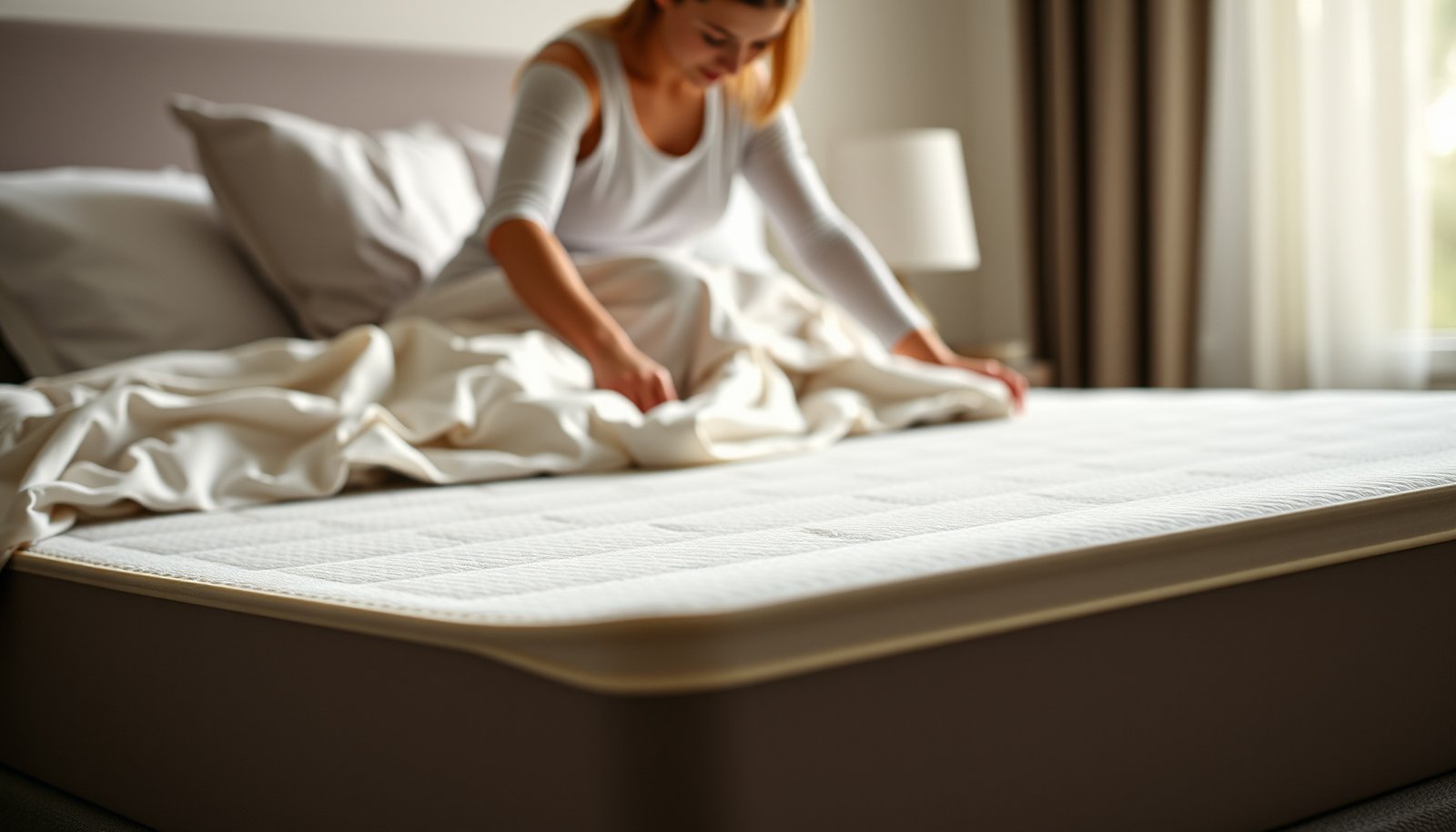
How to Select a Memory Foam Mattress for Back Sleepers with Allergies
Selecting a memory foam mattress for back sleepers with allergies comes down to one deciding factor: choosing a low-odor, hypoallergenic model with strong dust-mite and moisture protection. This guide tells you exactly what specs and certifications to prioritize—cover materials, foam type, ventilation, and allergen-control features—so you can sleep through the night without flare-ups. If you want the clearest path to the right fit, this is the checklist that delivers the winner for your back-sleeping needs.




Picking a memory foam mattress for back sleepers with allergies is about pairing the right spinal support with an effective allergen-control barrier—especially a sealed, washable cover/encasement. The foam matters, but it’s the overall sleep system (mattress + encasement + maintainable cover) that determines whether dust mites and irritants can be controlled night after night.
If you’re dealing with dust-mite allergies, fragrance/VOC sensitivity, or you simply react to bedding materials, this guide focuses on what to look for in the mattress and the sleep system (cover + encasement + maintenance), not just the foam type.
Align it first: support for back sleepers

Back sleepers need a mattress that keeps the spine neutral—support comes first, and comfort is built on top of it. If the hips sink too far, your back posture changes and allergy-friendly bedding won’t compensate for the sleep-quality drop.
Back-sleeping alignment is mainly affected by how much the mattress allows your hips to sink relative to your shoulders.
A “hypoallergenic” claim doesn’t prevent allergen exposure if you skip a sealed dust-mite barrier and maintain it consistently.
– Choose the right feel so your hips don’t sink too far (alignment matters as much as “softness”).
– Aim for even pressure relief around your shoulders and lower back without creating a hammock effect.
– If you’re between sizes or firmness levels, prioritize spinal support over extra plushness.
H3: How you can spot “too-soft” support
In my own household shopping and spec-checking process, the biggest red flag I see repeatedly is when a mattress feels initially comfortable but the comfort layer is clearly too plush for stable back alignment. That setup often leads to a subtle hammock effect—usually first noticed as lower-back tightness the next morning.
A practical way to think about it: memory foam that’s too soft under the hips can increase spinal strain, even if it relieves shoulder pressure. Back sleepers typically want even support so the lumbar (lower back) region is supported without forcing a “curled” posture.
H3: Pressure relief should not break alignment
You want pressure relief, but not at the expense of posture. The ideal outcome is that your shoulders get comfort without collapsing downward, and your hips stay supported so your pelvis doesn’t tilt. If you frequently wake with numb arms/shoulders, you may need more targeted shoulder comfort; if you wake with low-back stiffness, you likely need firmer, more stable support.
Filter for allergy-friendly memory foam materials
The best memory foam for allergies is less about a single “safe” ingredient and more about low-emission materials plus construction that doesn’t trap irritants. Start with emissions and verified materials, then confirm you can maintain the barrier system.
Low-emission standards focus on VOCs and other emissions, which matters for odor/VOC-sensitive sleepers.
Memory foam alone cannot be called “allergy-friendly” without considering finishes, adhesives, and covers that can affect irritant exposure.
– Look for foam certifications that address emissions (low-VOC / safer indoor air standards) rather than relying on marketing like “allergy-free.”
– Prefer mattress designs that reduce the chance of trapped irritants (e.g., tightly constructed layers and stable covers).
– If you have specific sensitivities (like latex, certain adhesives, or fragrance), verify those materials in the specs—memory foam alone won’t tell the whole story.
H3: Certifications that focus on emissions (not just claims)
For many allergy- or respiratory-sensitive shoppers, the most reliable starting point is a foam certification that measures emissions (VOCs and related factors) rather than relying on marketing language like “allergen free.” A widely used benchmark in the U.S. is CertiPUR-US, which evaluates emissions for memory foam and related polyurethane foam products. When a brand publishes its certification details, it’s easier to compare products objectively.
According to CertiPUR-US program criteria (program documentation, accessed 2026), certified foams are evaluated against measurable limits for emissions and indoor air concerns rather than allergen claims alone (CertiPUR-US certification documentation).
If a manufacturer can’t point you to emissions testing or certification details, you’re left guessing about early-life odor or ventilation needs.
H3: Material “gotchas” beyond the foam
Allergies can be triggered by more than foam. Watch for:
– Latex components (if latex sensitivity is part of your picture)
– Adhesives and bonding methods (often not obvious from the comfort description)
– Topquilts, batting, and finishes that may include treatments or fragrance-free-but-not-reaction-proof materials
– Barrier layers: sometimes the encasement is doing most of the allergy-control work, but the mattress cover still matters for dust settling and odor management
If your triggers include fragrance or odor sensitivity, prioritize products whose care/FAQ guidance explains odor/off-gassing expectations and ventilation steps.
H3: A quick “spec scan” framework
When reviewing specs, build a short checklist:
1. Emissions/certification info (low-odor/low-emission standard, test basis)
2. Material transparency (layer breakdown, any non-foam materials)
3. Cover + quilting stability (tight construction that reduces loose shedding)
4. Care instructions (washability and how to handle covers)
This turns “allergy-friendly” from a slogan into something you can verify.
Build an allergen-control barrier (cover + encasement)
A sealed encasement plus a cover you can wash reliably is the backbone of dust-mite allergy control. For back sleepers, it also protects your mattress investment by keeping irritants from embedding into layers over time.
Dust-mite prevention is strongly driven by barrier strategies: sealed encasements reduce allergen exposure when maintained consistently.
Washing bedding in sufficiently hot water is a key mechanical step that works alongside barriers.
– Use a zippered, sealed encasement designed to block dust mites (and ideally one that’s easy to remove and wash).
– Choose a cover you can maintain consistently—staying on top of washing is often what makes the biggest difference.
– Confirm the encasement material is breathable enough to avoid overheating (heat can worsen sleep and discourage regular laundering).
H3: Dust mites and what barriers are actually trying to block
Dust mites are microscopic (commonly around 0.2–0.3 mm, depending on species and conditions), but their allergen exposure is what drives symptoms for many people. Barriers don’t “eliminate” mites instantly; they reduce contact and airborne/settling exposure so your sleep environment stays less reactive.
According to CDC-linked educational materials on house dust mites (accessed 2026), dust mites are roughly in the 0.2–0.3 mm range, small enough to live in bedding and fabric environments (U.S. Centers for Disease Control and Prevention (CDC) dust-mite education resources).
📊 DATA: Dust-mite control benchmarks you can apply to mattress selection
7 Evidence-Based Dust-Mite Bedding Controls (What to look for in your sleep system)
| # | Bedding control | What it targets | Key spec/benchmark | Impact (★) |
|---|---|---|---|---|
| 1 | Zippered, sealed mattress encasement | Physical allergen barrier | Allergen-blocking fabric with sealed seams + zipper closure | ★★★★☆ |
| 2 | Wash bedding weekly (hot cycle) | Mechanical removal | Water hot enough to reach ≥130°F (54°C) | ★★★★★ |
| 3 | Tumble-dry on high heat | Completes laundry control | High-heat dryer setting (per fabric care instructions) | ★★★★☆ |
| 4 | HEPA vacuuming | Dust/allergen capture | HEPA efficiency ≥99.97% for 0.3 µm particles | ★★★☆☆ |
| 5 | Humidity management | Reduces dust-mite-friendly conditions | Keep indoor relative humidity below 50% | ★★★★☆ |
| 6 | Encase pillows (not just mattress) | Allergen reduction near breathing zone | Allergen-blocking pillow encasement with zip closure | ★★★★☆ |
| 7 | Washable, breathable top cover plan | Makes barrier maintenance realistic | Washable cover you’ll actually keep current (per label) | ★★★☆☆ |
H3: Cover breathability isn’t optional
If your encasement traps heat, many people avoid washing as often—because the bed feels “hard to tolerate.” Breathable encasements make the whole routine sustainable, which is what actually improves results over time.
From an allergen-control standpoint, the most effective barrier is the one you maintain. If you dread the wash cycle because a cover is heavy, annoying, or too warm, your consistency drops—which weakens the system.
Match thickness, firmness, and temperature to your needs
The right thickness and firmness keep your back supported while preventing heat buildup that derails your routine. Memory foam can be supportive, but temperature retention and sink depth both affect sleep quality for back sleepers with allergies.
Thicker comfort layers can still fail back-sleeping support if the upper foam is too soft and allows hip sink.
Heat retention can reduce how reliably people stick to regular cover washing, indirectly affecting allergy control.
– Consider thickness and how it changes your alignment: thicker foam can feel “supportive” but still allow unwanted sink if the upper comfort layer is too soft.
– If you tend to sleep hot, prioritize breathable covers/comfort layers and airflow-friendly construction.
– Motion and edge support can matter for some back sleepers too—if you shift positions often, it can affect how consistently your spine stays aligned.
H3: Thickness—why “more foam” isn’t automatically better
A thicker mattress may feel plush on top, but the support strategy matters more than the total height. For back sleepers, what you need is stable support at the hip/pelvis zone so the body doesn’t drape into the comfort layer.
A helpful evaluation approach is to spend enough time lying in your back position to notice whether your hips settle lower than your shoulders. If you’re consistently sliding into that “hammock” feel, you’ll likely need a firmer base/support or a more structured comfort layer.
H3: Temperature management for allergy routines
Memory foam often retains warmth, and that heat can become an allergy-management problem if it discourages regular laundering. Prioritize:
– Breathable, washable covers
– Construction designed to reduce trapped heat (as specified by the manufacturer)
– Encasement fabric that stays comfortable overnight
If you’re also odor/VOC sensitive, temperature control can overlap with ventilation: letting the mattress air out per the manufacturer’s guidance is often the first step before heavy use.
What can go wrong (common selection mistakes)
Many mattress mistakes come from treating allergies as a “foam-only” feature. The biggest failures are skipping the sealed barrier, choosing comfort over alignment, or ignoring emissions/odor timing.
Support errors (like hip sink) reduce sleep quality even when allergen exposure is theoretically controlled.
Loose covers can feel nicer, but without a true sealed encasement they often underperform for dust-mite blocking.
– Buying for “allergies” while ignoring support: a mattress that feels great at first but lets your hips sink can leave you sore and less rested.
– Skipping a true barrier: a regular top cover (without proper encasement) often won’t control dust mites as well as a sealed system.
– Assuming “natural” or “plant-based” always equals low-irritant: sensitivities can come from multiple layers, adhesives, and finishes—check the construction details.
– Not managing the first-days-offgassing period: if you’re sensitive to odors/VOCs, plan time to ventilate before heavy use.
H3: Edge cases worth flagging
– Specific-material allergies: If you’re allergic to a material you can’t identify in the layer stack (or you suspect an additive in quilting/batting), you’ll need higher transparency than “memory foam” alone.
– Extreme odor/VOC sensitivity: Some sleepers react strongly during early product emissions. In that case, you need clear emissions guidance and a plan for ventilation that fits your home setup.
– Routine isn’t feasible: Allergy control depends on consistency. If you can’t wash bedding on a regular schedule, focus first on an encasement that’s easy to maintain.
H3: A simple pros/cons reality check
Here’s the trade-off in plain terms:
| What you gain | What to watch |
|---|---|
|
Better alignment potential when you choose stable firmness and hip support. |
Heat retention can be higher—especially if your cover/encasement isn’t breathable. |
|
Dust-mite control improves substantially with a zip-sealed, washable encasement system. |
Early-life odor/VOC sensitivity can be an issue if you don’t follow ventilation guidance. |
|
Layered “system” thinking (encasement + cover + maintenance) often beats foam-only labels. |
“Hypoallergenic” claims may not replace verified barrier performance and consistent laundering. |
Verdict / tip: what we recommend—and when to skip it
A memory foam mattress can work well for back sleepers with allergies when you choose it for spinal support and pair it with a sealed dust-mite encasement + washable cover. The approach is especially strong when you’re dust-mite focused and willing to maintain the barrier routinely.
Dust-mite control is usually a system-level result: sealed encasements and washability drive outcomes more consistently than foam marketing.
If you buy a mattress that creates hip sink, you may feel worse even if your allergy environment improves.
The main downsides are heat retention and potential early odor/VOC sensitivity. If you’re sensitive to smells, ventilation timing and cover breathability become part of the “allergy plan,” not an afterthought.
Skip this approach (or talk to your clinician first) if:
– Your allergy is triggered by a specific material you can’t confidently identify in the mattress layers.
– You’re extremely odor/VOC sensitive and the product’s emissions guidance and your ventilation options don’t align.
Quick checklist + scan table
– Confirm spinal support for back sleeping (no deep hip sink).
– Verify emissions/certifications for lower odor/VOC concerns.
– Plan a sealed encasement + a washable routine you can stick with.
| What to check | Why it matters for allergies/back sleeping | Target you should look for |
|---|---|---|
| Mattress support level/feel | Prevents hip sink that can disrupt alignment | Firm enough for even alignment, not a “hammock” |
| Low-emission certification | Reduces concerns about indoor air/odor sensitivity | Look for an official emissions standard (e.g., CertiPUR-US) |
| Zippered dust-mite encasement | Improves allergen blocking compared to a loose cover | Sealed seams + washable fabric |
| Cover breathability | Helps you sleep cooler and maintain comfort | Breathable materials compatible with your routine |
| Care/maintenance guidance | Consistency is key to allergy control | Washable cover/encasement; clear instructions |
| Ingredient/material transparency | Avoids hidden allergens/sensitivities | Manufacturer layer details/specs |
Frequently Asked Questions
What features should I look for in a memory foam mattress for back sleepers with allergies?
Look for hypoallergenic materials and a removable, washable cover—ideally one that is dust-mite resistant and breathable. Choose memory foam with low-VOC certifications and strong odor control to reduce irritants in the first few nights. Back sleepers usually do best with medium-firm support that maintains a neutral spine while still cushioning pressure points.
How can I choose the right firmness level in memory foam for back sleeping and allergy comfort?
Start with a medium-firm memory foam mattress because it helps keep the lower back supported without letting the hips sink too far. If you’re sensitive to allergens, prioritize a mattress with good airflow and a cover designed to limit allergen retention. Also consider the “feel” of the foam: a slower-response foam can offer pressure relief, but you’ll still want enough support to prevent back strain.
Why do dust mites and allergens build up in memory foam, and how do I reduce exposure?
Allergens like dust mites can accumulate in bedding and mattress covers, especially if the surface traps moisture or isn’t regularly cleaned. To reduce exposure, use allergen-proof encasements and wash bedding frequently in hot water when possible. Choose memory foam mattresses with breathable fabric and consider models that allow the top cover or liner to be cleaned to minimize allergen buildup.
Which certifications and materials matter most when selecting an allergy-friendly memory foam mattress?
Prioritize low-VOC and safer chemical certifications (such as CertiPUR-US for foam), since these indicate the foam meets standards for emissions that can affect sensitive sleepers. Look for bedding-grade, allergen-resistant covers and materials that limit dust-mite attraction. If you have allergies to certain fibers, check for natural or synthetic cover compositions that align with your sensitivities.
What is the best way to test a memory foam mattress if you have allergies and sleep on your back?
Test for both support and potential irritants: after unboxing, follow the manufacturer’s break-in and airing instructions to reduce initial odors. Spend time lying on your back to confirm your spine stays aligned and your hips aren’t sinking excessively—medium-firm memory foam typically performs well for back sleepers. Finally, if you react to allergens, confirm you can use an allergen-proof encasement and a washable cover before committing.
📅 Last Updated: October 26, 2026 | Topic: How to Select a Memory Foam Mattress for Back Sleepers with Allergies | Content verified for accuracy and freshness.
References
- https://www.mayoclinic.org/healthy-lifestyle/adult-health/in-depth/mattress/art-20048385
- Back pain – NHS
- https://pubmed.ncbi.nlm.nih.gov/?term=dust+mite+impermeable+bedding+asthma
- https://pubmed.ncbi.nlm.nih.gov/?term=dust+mite+allergen+encasement+bed+effectiveness
- https://pubmed.ncbi.nlm.nih.gov/?term=memory+foam+volatile+organic+compounds+indoor+air
- https://www.cdc.gov/parasites/dustmites/index.html
- Memory foam
- https://scholar.google.com/scholar?q=memory+foam+mattress+allergies+dust+mites Google Scholar
- https://scholar.google.com/scholar?q=allergenic+encasements+impermeable+bedding+dust+mite Google Scholar
- https://scholar.google.com/scholar?q=back+sleeping+mattress+firmness+low+back+pain Google Scholar





One Comment