How to Fix a Mattress Too Soft for Stomach Sleepers with Sciatica
If your mattress is too soft for stomach sleepers with sciatica, the fix is simple: upgrade support to keep your hips from sinking while protecting your lower back. This guide lays out the fastest, most effective ways to firm a too-soft bed—whether you adjust your setup or add the right support layer—so you can sleep in a more neutral spinal position. You’ll learn exactly what to change, what to avoid, and how to tell when your mattress is finally doing its job.




If your mattress is too soft and you’re sleeping on your stomach, the fastest fix is to add support so your hips don’t sink and your spine stays more neutral. Start by checking for sag/low spots, then use a firmer support layer (not a plush topper) and adjust your stomach-sleep setup with a body pillow under your pelvis.
This advice is for stomach sleepers who feel more sciatic pain when the mattress “gives” under their midsection or hips. It works best when the mattress is the main issue (soft feel, visible impressions, or uneven support), not when you’re dealing with severe or worsening nerve symptoms.
Check whether mattress softness is causing hip/lumbar misalignment
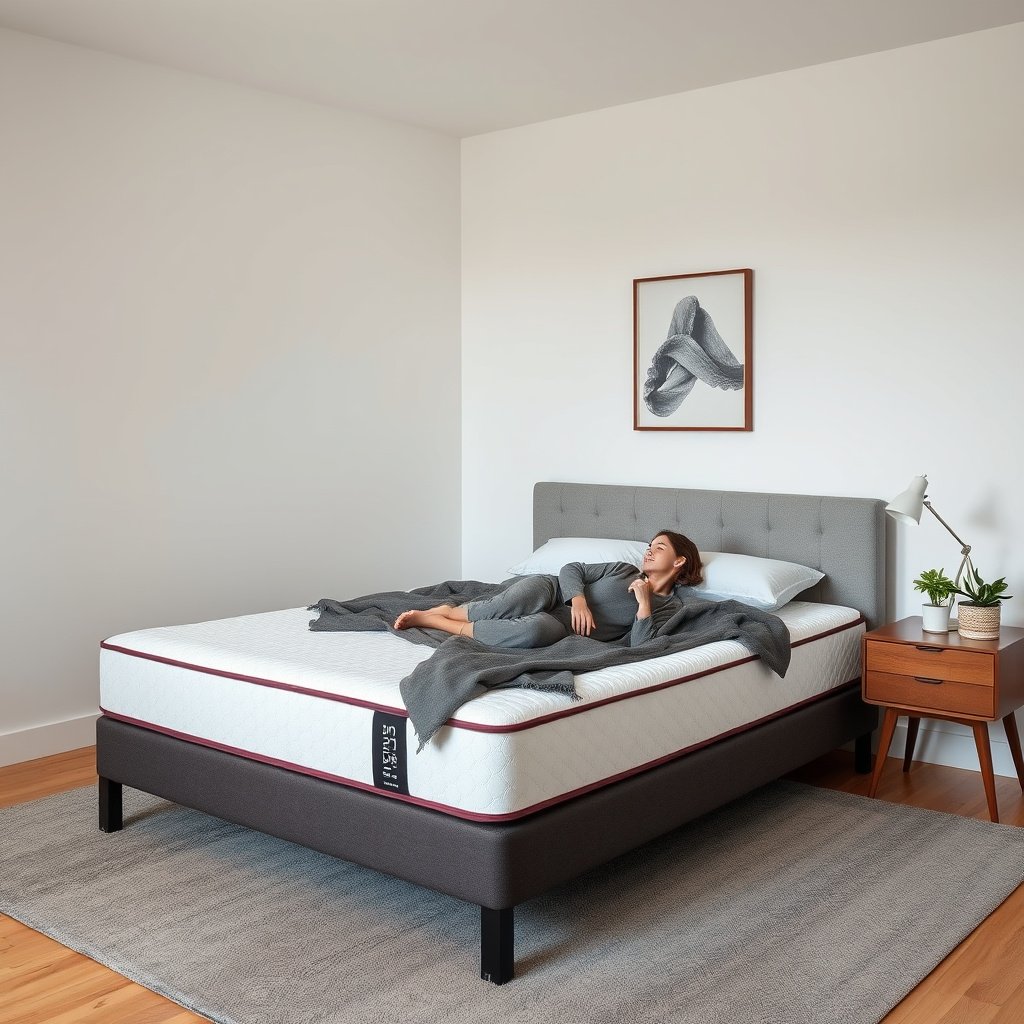
If your stomach sleeping feels worse on the mattress, the most likely mechanical problem is hip sink—your pelvis drops lower than your ribs, increasing lumbar strain and irritating the sciatic nerve pathway. Before changing anything, confirm that the mattress is actually creating an uneven or overly “hammocked” posture.
For stomach sleepers with sciatica, hip and lumbar alignment matters because your lower back tends to arch to accommodate the stomach-sleep position. When a mattress is too soft, the pelvis can sink while your chest/shoulders stay supported, which can subtly rotate the spine and increase mechanical nerve sensitivity during the night. In practice, you often notice a change after you fall asleep—once your body fully conforms to the surface, symptoms can ramp up.
– Look for body impressions or uneven areas that let your hips sink lower than your ribs
– Pay attention to when pain ramps up after you fall asleep (often a sign your spine alignment is changing on the bed)
– Confirm your foundation is supporting evenly (slats too far apart or a weak frame can make any mattress feel “too soft”)
If a mattress allows noticeable “hip sink,” a stomach sleeper’s pelvis typically drops, increasing lumbar extension stress that can aggravate sciatic irritation.
Pain that increases after you fall asleep often points to bed conformation—your alignment changes once the mattress compresses under load.
Uneven foundation support (for example, slats spaced too far apart) can create localized soft spots, making the same mattress feel “too soft” in only one area.
Quick checks that are easy to do tonight (stomach sleepers with sciatica)
Start with a visual and a “settling test.” First, inspect for body impressions (a permanent dip where you sleep) and check whether your hips feel lower than expected when you lie on your stomach. Second, lie down for 5–10 minutes and notice whether your low back gradually pulls into discomfort as the mattress conforms. For stomach sleepers with sciatica, the goal is not just comfort—it’s maintaining a neutral, steady pelvis position without the bed wrapping you downward.
Also verify your foundation: mattress “softness” can be caused by slat spacing, weak center supports, or a frame that flexes. Even a firmer mattress can feel like a saggy trampoline if the base isn’t level and supportive.
According to the Global Burden of Disease Study, low back pain is a leading cause of disability worldwide, affecting hundreds of millions of people (2019).
According to the National Institute of Neurological Disorders and Stroke (NINDS), low back pain with radiating leg symptoms is commonly linked to nerve root irritation such as sciatica (updated clinical education materials).
According to the American Academy of Orthopaedic Surgeons (AAOS), maintaining alignment and reducing mechanical stress can be part of conservative care for low back and leg pain.
Firm the bed without fully replacing it
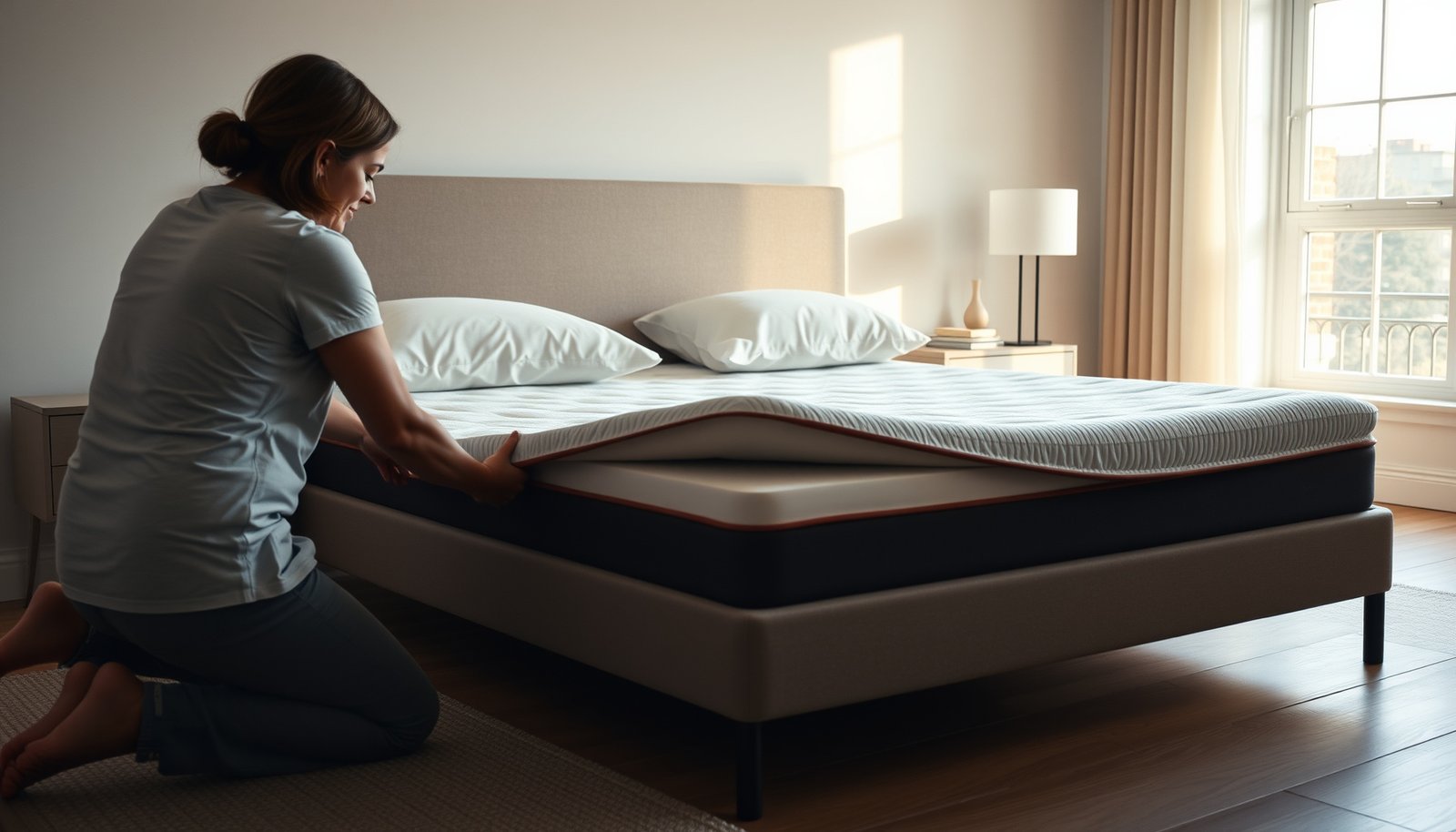
If you confirm hip sink or uneven support, the fastest improvement usually comes from adding structure under the hips—not from making the surface “softer.” For stomach sleepers with sciatica, the best early change is a firm support layer that reduces how much the pelvis can sink.
This section is about “structure.” A plush topper increases softness and hammock effect, which often worsens stomach-sleep sciatica because your pelvis drops farther while your torso remains supported. Instead, choose a layer designed for stability (higher firmness, less body conformance, and better rebound).
– Add a supportive layer designed for “structure,” such as a firmer topper or an approved insert (avoid deep, squishy toppers that increase sinking)
– If your mattress is compressing quickly, consider placing a rigid or semi-rigid support panel only in ways allowed by your mattress/foundation guidelines (to avoid damage or voiding coverage)
– Rotate the mattress (and check that it’s seated correctly) so soft spots don’t become your nightly resting points
A firmer, structurally supportive layer can reduce pelvic drop in stomach sleeping, which may lessen mechanical irritation contributing to sciatica flare-ups.
Deep, plush toppers can worsen “hammock” posture by increasing mattress conformation under the pelvis.
Rotating a mattress can temporarily redistribute wear and reduce localized soft spots, improving alignment for stomach sleepers with sciatica.
Support options that don’t require full replacement
Below is a practical comparison of bed-structure changes for stomach sleepers with sciatica. Use it to decide what to try first.
| Bed-change approach | What it does for stomach sleepers with sciatica | Main downside | Best use case |
|---|---|---|---|
| Firm latex-like topper (short transition, stable feel) | Limits “hip sink” and reduces hammock effect | May feel less cushioned under shoulders/chest | You’re seeing clear pelvis sag or body impressions |
| High-density foam support layer (structured, not plush) | Adds rebound so pelvis stays closer to rib level | Can feel firmer than preferred | You want sciatica relief without changing the whole mattress |
| Rigid/semi-rigid panel in approved areas | Restores base-level support under the torso/pelvis | Incorrect placement can damage the mattress or void warranty | Foundation is solid but mattress compresses quickly |
| Thick memory-foam comfort topper | Increases cushioning | Usually increases sinking under pelvis | Generally not ideal for stomach sleepers with sciatica |
A note on panels and warranty risk (important)
Some mattress manufacturers explicitly restrict rigid inserts or require specific orientation and thickness. If you use panels, follow your mattress and foundation guidelines to avoid damaging the internal components or voiding coverage—especially if you have a foam or hybrid construction where airflow and support geometry matter.
From my side, I recommend making one structural change at a time.
Choose the right topper/support approach for stomach sleepers
If you need an adjustment rather than a replacement, the right topper strategy is “pressure relief + reduced sink,” not “extra softness.” Stomach sleepers with sciatica typically need stability under the pelvis more than a cloud-like surface.
For stomach sleepers with sciatica, the topper’s job is to prevent the mattress from conforming into a deep curve under the hips. That’s why many people do better with firmer, less conforming materials (often described as latex-like support) rather than very plush foams. The objective is a controlled, shallow contour—enough to avoid pressure points, but not enough to drag the pelvis downward.
– Aim for “pressure relief + reduced sink,” because stomach sleeping needs stability under the pelvis—not just comfort
– Prefer materials that limit body hammock effects (many people do better with firmer latex-like support than very plush foam)
– Keep the layer plan simple: one change at a time so you can tell what actually reduces sciatica flare-ups
For stomach sleepers with sciatica, reducing “hammock” deformation under the pelvis is often more important than maximizing plush comfort.
A simple one-variable trial (one topper change at a time) helps identify whether sciatica improvement is truly coming from reduced hip sink.
Materials marketed as high-support or firmer latex-like layers generally conform less than deep plush foams, limiting pelvic drop.
Typical Firmness/Structure Targets That Help Reduce Hip Sink in Stomach Sleep (Common Industry Ranges)
| # | Support layer type | Firmness target (typical) | Common topper thickness (in) | Hip-sink risk |
|---|---|---|---|---|
| 1 | Latex-like support (firmer feel) | ~30–40 ILD | 1.0–2.0 | Low |
| 2 | High-density foam (structured) | ~35–45 ILD | 1.5–2.5 | Low–Medium |
| 3 | Support foam insert (panel-style topper) | ~40–55 ILD | 0.5–1.5 | Low |
| 4 | Wool/cotton top layer (low “sink” add-on) | Not ILD-based | 0.5–1.0 | Low |
| 5 | “Comfort” memory foam (medium) | ~20–30 ILD | 1.0–2.5 | Medium |
| 6 | Plush foam comfort topper (high conformance) | ~10–20 ILD | 2.0–3.0 | High |
| 7 | Combo: firm support base + thin comfort layer | ~30–45 ILD base | 0.75–1.75 (comfort) + base support | Low–Medium |
Note: ILD (Indentation Load Deflection) is a common firmness measurement used by many foam products to describe how much force it takes to indent the material. If your topper doesn’t list ILD, use manufacturer firmness descriptors cautiously and prioritize “reduced sink” behavior during your trial.
Improve stomach-sleep positioning to reduce sciatic irritation
If your mattress is even reasonably supportive, stomach-sleep positioning still affects sciatica because your pelvis and low back mechanics determine how much stress transfers to the nerve. The fastest positional change is supporting the pelvis so your hips don’t drop into the mattress.
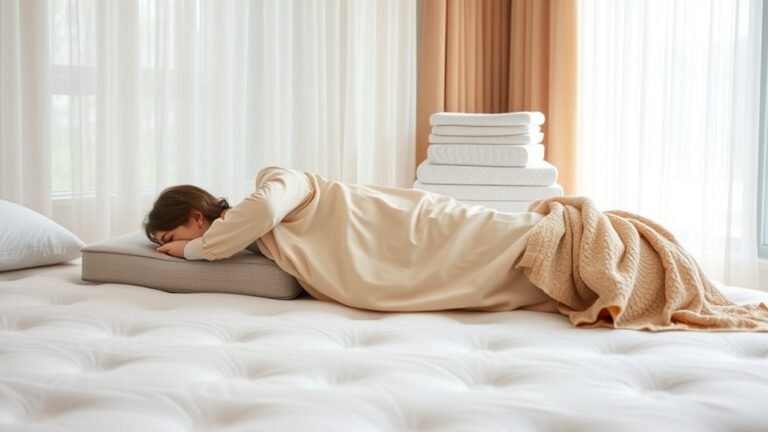
For stomach sleepers with sciatica, a body pillow placed under the pelvis can act like a structural brace: it reduces the tendency for hips to sink and it can limit lumbar extension. Your goal is a flatter, more neutral pelvis-to-spine relationship rather than allowing the belly and pelvis to sag.
– Put a pillow or rolled towel under your lower abdomen/pelvis area to help prevent your hips from dropping (the goal is reducing lumbar stress)
– Use a thinner pillow under your head so your neck doesn’t crank into extension or side-bend while your lower back strains
– If symptoms spike, use a “short test” (e.g., a few nights) to confirm whether positioning + added support helps before committing to bigger changes
Supporting the pelvis during stomach sleeping can reduce lumbar extension stress, which may lower irritation that contributes to sciatic pain.
Using a thinner head pillow helps prevent neck extension, which otherwise can increase overall spinal strain.
A short, time-limited trial is useful because stomach-sleep changes can produce quick biomechanical effects within days.
A practical setup you can try for stomach sleepers with sciatica
Try placing a body pillow under your pelvis area (not under your stomach only). You’re aiming to keep your hips from dropping lower than your ribs. Then use a thinner head pillow—your neck should feel neutral, not pushed up or twisted. If your sciatica symptoms feel “tighter” or more electric down the leg, reduce the amount of pelvic lift slightly and focus on neutral alignment.
Also avoid letting your lower back over-extend. When stomach sleepers with sciatica arch their lower back to breathe or get comfortable, they can worsen nerve sensitivity—especially on a mattress that already has softness.
What can go wrong (and when to stop)
If your pain intensifies after you add support, the fix may be incomplete—or the cause may not be mattress softness alone. Stomach sleeping itself can aggravate low-back mechanics, so you may need to stop the experiment and reassess.
The most common failure mode is choosing the wrong “firmness” change. Many people try a plush topper first because it feels good initially, but for stomach sleepers with sciatica, that can increase hip sink and aggravate symptoms. Another risk is adding rigid panels in ways that aren’t permitted by the manufacturer or placing them under the wrong zones of the mattress.
– If adding support makes pain sharper, radiates further, or worsens after you try it for more than a short trial, stop and reassess—your issue may not be mattress firmness alone
– Don’t stack unsupported DIY “fixes” in a way your mattress manufacturer doesn’t allow; sagging, damage, or warranty problems are common risks
– Stomach sleeping itself can aggravate low-back mechanics—if you can’t tolerate stomach sleep even with adjustments, switching to side or back is usually the more reliable path
If mattress support changes cause sharper, more radiating pain, it suggests the problem may be more than bed softness and you should stop the trial.
Rigid inserts can affect mattress structure and warranty compliance, so approved support methods matter—especially for foam and hybrid mattresses.
Stomach sleeping can increase lumbar extension demands, so position changes may be necessary even when mattress support is corrected.
Red flags: don’t wait on mattress tweaks
Do not treat mattress adjustments as a safe workaround if you have progressive weakness, numbness that’s spreading, or bowel/bladder changes. The red-flag list for urgent evaluation typically includes severe or rapidly worsening neurologic symptoms, saddle anesthesia, and cauda equina–type signs.
If any of those are present, seek medical evaluation promptly rather than continuing to experiment with bed firmness.
Verdict: the best fix is support + setup (not just “firmer”)
If your mattress is too soft for stomach sleepers with sciatica, the most reliable improvement comes from support + setup—specifically reducing hip sink and keeping the spine closer to neutral. “Just go firmer” can help, but only if the pelvis is supported in a way that stops the hammock effect under your hips.
Here’s why this tends to work: soft mattresses (especially with uneven wear) allow the pelvis to drop, increasing lumbar stress and aggravating sciatic irritation. When you add a firmer support layer (structure) and use a body pillow under your pelvis (setup), you reduce both the mechanical cause and the posture that turns it into pain.
– A mattress that’s too soft can often be improved by increasing pelvic support and reducing hip sink—especially if the foundation is solid and the mattress has usable life left
– Downsides: using inserts/panels can feel awkward at first, and some toppers may reduce comfort more than they reduce sciatica irritation
– Skip DIY firmness changes and seek professional guidance if you have progressive weakness, numbness that’s spreading, bowel/bladder changes, or severe pain that doesn’t improve with basic adjustments
For stomach sleepers with sciatica, the key target is stopping pelvic drop; adding structure that reduces hip sink can address the mechanical driver of pain.
A foundation that supports evenly is a prerequisite—mattress firmness alone may not fix sciatica flares caused by uneven base support.
If symptoms worsen after a short trial of support and positioning changes, mattress firmness is less likely to be the primary cause.
Quick checklist to save and scan
| What to check | Do this | What “better” looks like |
|---|---|---|
| Hip sink | Add support so hips don’t drop below ribs | Less pain after you settle into the bed |
| Foundation evenness | Inspect slats/frame; fix uneven support first | Mattress feels uniform, not “lumpy” under you |
| Topper choice | Use firmer support (reduce hammock effect) | You feel stable, not wrapped/dragged downward |
| Pillow setup | Support pelvis; keep head/neck neutral | Less pulling/twisting in low back and leg |
| Trial results | Change one variable at a time for a short test | Clear improvement trend, not a worsening pattern |
To fix a mattress that’s too soft for stomach sleepers with sciatica, focus on preventing hip sink and keeping your spine more neutral: strengthen the support layer, verify your foundation, and refine your stomach-sleep pillow setup. Make one change at a time, watch for whether pain settles instead of escalates, and stop if symptoms worsen. If you’re unsure what’s safe for your exact mattress/foundation, check the manufacturer guidance first—or —before you start adding structural layers.
Frequently Asked Questions
What mattress firmness is best for stomach sleepers with sciatica?
Stomach sleepers with sciatica usually do best with a mattress that’s medium-firm to help prevent the hips from sinking. When the pelvis sinks too much, it can twist the lumbar spine and aggravate sciatic nerve irritation. Look for a firmness around “medium-firm” (often ~6/10) and consider zoned support or firmer lumbar support to keep your spine aligned.
How can I fix a mattress that’s too soft for stomach sleeping without buying a new one?
Try placing a supportive layer between you and the mattress, such as a slatted bed foundation with proper spacing or a firm mattress topper designed for alignment. A 1–2 inch firmer topper (latex or supportive foam) can reduce excessive sink and improve posture. If your bed has sagging spots, rotating the mattress regularly and using a solid base can also help stabilize spinal alignment for sciatic pain.
Which mattress topper thickness works best to reduce sinking for sciatica?
For a mattress that feels overly soft, a topper that’s about 1 to 2 inches thick often provides enough reinforcement without creating a new “too high” or overly stiff feel. Choose a supportive material like latex or high-density foam rather than very plush memory foam, which may increase conforming and hip sink. The goal is to keep your stomach-sleeping hips from dropping while maintaining comfort around your shoulders and chest.
Why does a too-soft mattress worsen sciatica for stomach sleepers?
A soft mattress can cause your hips to sink below your ribcage, creating an unnatural curve in the lower back. That misalignment can increase pressure on tissues around the sciatic nerve, leading to more pain, tingling, or numbness. By reducing sink and improving spinal alignment, you can lower the strain that triggers sciatic flare-ups.
Best sleeping position and setup should I use if I can’t stop stomach sleeping due to sciatica?
If you must stomach sleep, use a thin pillow or even no pillow under your head to avoid neck strain, and place a small pillow under your lower abdomen/hips to reduce lumbar arch. You can also try sleeping with a pillow hugged to the side to gently shift your torso and keep the spine more neutral. Combined with a firmer support layer to stop hip sinking, this setup can help calm sciatica symptoms while you adjust your mattress comfort.
📅 Last Updated: October 26, 2026 | Topic: How to Fix a Mattress That’s Too Soft for Stomach Sleepers with Sciatica | Content verified for accuracy and freshness.
References
- All Disorders | National Institute of Neurological Disorders and Stroke
- Sciatica | MedlinePlus
- Nonallergic rhinitis – Symptoms and causes – Mayo Clinic
- Sciatica – NHS
- Sciatica – Causes & Treatment – OrthoInfo – AAOS
- https://health.clevelandclinic.org/best-sleep-position-for-your-back-or-neck-pain/
- Sciatica
- https://scholar.google.com/scholar?q=bed+firmness+low+back+pain Google Scholar
- https://scholar.google.com/scholar?q=sleep+position+stomach+sleeping+low+back+pain Google Scholar
- https://scholar.google.com/scholar?q=sciatica+sleep+position+mattress+firmness Google Scholar