

How to Select a Firm Mattress for Side Sleepers with Acid Reflux
Choosing a firm mattress for side sleepers with acid reflux is only worth it if it keeps your spine aligned while preventing pressure buildup that can trigger nighttime symptoms. This guide delivers a clear selection verdict on the firmness level, support design, and comfort layers that most reliably reduce heartburn for side sleepers. If you want fewer reflux flare-ups without sacrificing stability, follow these mattress criteria before you buy.




If you side sleep with acid reflux, choose a firm (or medium-firm) mattress that supports your hips and spine while still cushioning your shoulder/upper hip to prevent pressure and posture collapse. Pair the right firmness with head-of-bed elevation (or a wedge) when your reflux is worse lying flat—mattress feel alone rarely fixes positional GERD.
If you wake up with burning, sour taste, or throat irritation—especially when you lie flat—mattress choice can meaningfully affect how comfortable and supported you feel on your side. This is for side sleepers who want a firmer feel for support but don’t want increased pressure at the shoulder/hip that can lead to tossing and turning.
Start with the goal: firm support + side-sleeper alignment
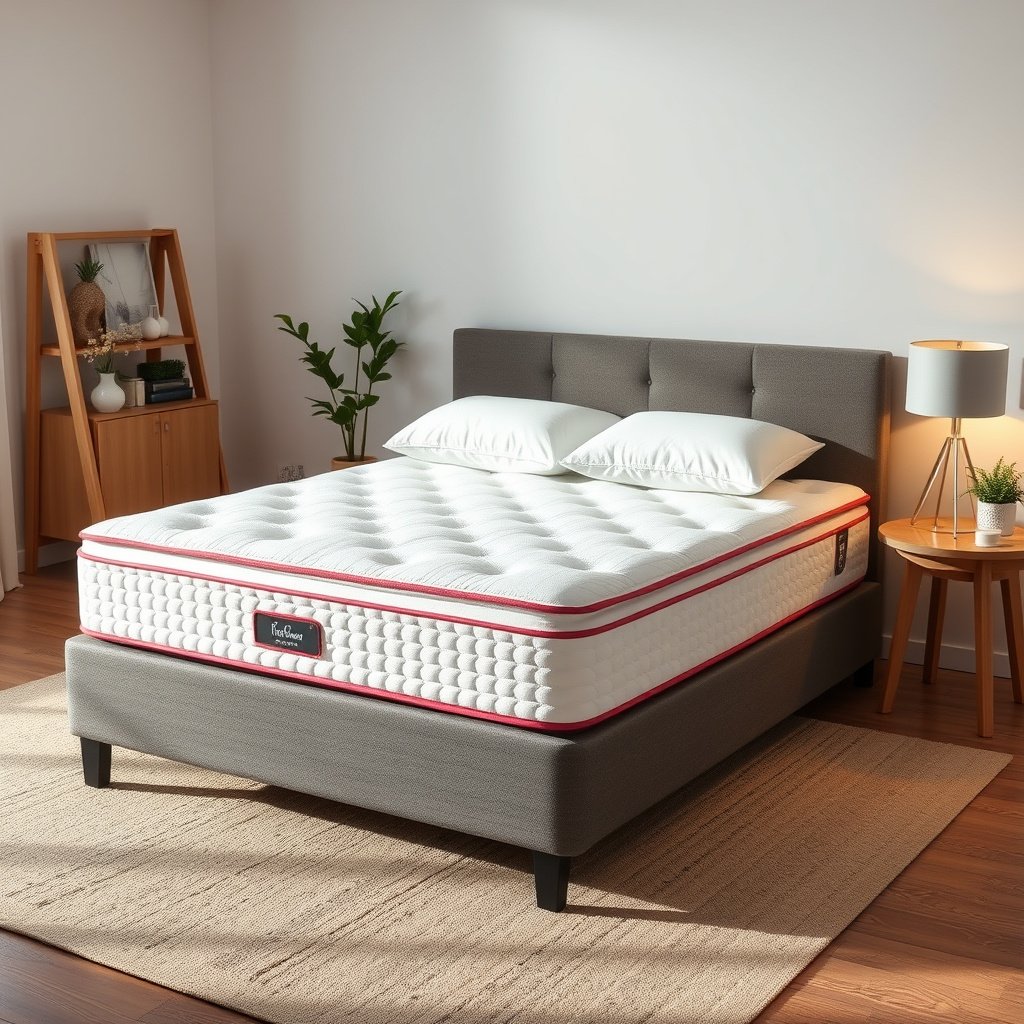
Choose a firmness level that keeps your torso from sinking and kinking while you remain comfortably on your side. The best target is “firm support with pressure relief,” because that combination maintains alignment and reduces the sleep fragmentation that can worsen reflux symptoms over time.
ACG clinical guidance recommends head-of-bed elevation of about 6–8 inches for reflux that’s worse when lying down. ACG Clinical Guideline: Diagnosis and Management of Gastroesophageal Reflux Disease (Katz et al., 2022)
ACG also advises avoiding lying down within 2–3 hours after meals to reduce nighttime reflux triggers. ACG Clinical Guideline (Katz et al., 2022)
When you pick a firmer mattress for side sleeping, your aim isn’t to “sleep on a board”—it’s to prevent hip sink and torso collapse. Those two mechanics change the shape of your upper torso and can increase the likelihood of reflux by making it easier for stomach contents to move back upward while you’re horizontal. In 2026, one challenge is that firmness labels vary widely by brand, so “firm” on the box can still feel very different once you account for top-layer thickness and comfort-material softness.
From a posture standpoint, side sleeping works best when your spine stays mostly neutral and your shoulder isn’t forced into a cramped, rotated position. In my experience helping people troubleshoot sleep setups, the most common mismatch isn’t that someone bought “too firm”—it’s that they bought firm support but didn’t get enough pressure redistribution at the shoulder/upper hip, so they subconsciously roll during the night.
If your reflux is clearly positional (e.g., worse shortly after lying flat), include a head elevation plan from the start. A firm mattress can help you maintain side alignment, but elevation directly addresses the gravity component that helps reduce reflux episodes.
What “firm mattress” should include for reflux-friendly side sleeping
Choose a mattress that delivers structural support from the inside (support core) plus pressure relief on top (comfort layer). “Firm” for reflux isn’t just about hardness—it’s about preventing hip drop while protecting shoulder/hip pressure points.
On a side-sleeper mattress, comfort is determined by how the comfort layer distributes load at the shoulder and hip while the support core maintains spinal alignment.
Reflux-friendly sleep planning should treat mattress support and head-of-bed elevation as complementary strategies, not substitutes. ACG Clinical Guideline (Katz et al., 2022)
What to look for: support core + comfort layer (not “hard on top”)
A reflux-friendly firm mattress usually combines:
– A support core that’s truly firm/structurally supportive (often branded as firm or medium-firm).
– A comfort layer that relieves pressure through distribution (foam, latex, or hybrid comfort systems).
What to avoid: products that market “firm” but achieve it mainly through a thin, unyielding surface. That can create a high pressure spike at the shoulder while your hips still sink slightly—an uncomfortable double failure that increases restlessness.
How to interpret firmness labels in 2026 (practically)
Most manufacturers describe firmness using a 1–10 scale or subjective terms, but those scales don’t standardize across brands. That’s why you should evaluate firmness by fit (alignment) and feel over time (pressure stability), not by marketing words alone.
Here’s a quick contrast framework you can use while shopping:
| Mattress profile (what it feels like) | Likely effect for side sleepers with reflux | Common “gotcha” |
|---|---|---|
| Firm support core + pressure-relieving comfort (latex/quality foam) | Supports hips/spine while reducing shoulder/hip pressure | Can run warm if comfort materials are heat-retaining |
| Medium-firm overall (hybrid) with balanced comfort thickness | Often keeps alignment without “stiff” shoulder feel | May feel softer on heavier hips if comfort layer is thicker |
| Extra-firm with minimal comfort layer | May limit hip sink, but increases pressure at shoulder/upper hip | Tossing/turning can worsen sleep disruption (and reflux sensitivity) |
| “Firm” only because the cover/top is thick but not supportive | Comfort can initially feel cushioned, then shift as you settle | Torso may gradually collapse into a less ideal angle |
Check fit and loft: the real test for side sleepers
A firm mattress helps most when it works with your pillow and your side-sleep posture, not when you assume “support” automatically fixes alignment. The simplest test is whether your neck stays neutral and your hips remain level relative to your torso.
If you elevate the head-of-bed for reflux, pillow height still matters because neck strain can worsen perceived symptoms and disrupt sleep.
Side sleeping alignment is best maintained when the head/neck position doesn’t force the chin forward and the shoulder/hip aren’t left with high pressure.
Use a structured “wake-up check” (in store or at home)
When testing a mattress for reflux-friendly side sleeping, look for these alignment signals:
– Neck neutral: Your head isn’t pitched forward, and your pillow doesn’t make you “reach” with your chin.
– Shoulder comfort: Your top shoulder should not feel jammed into the mattress; firm surfaces sometimes require a more pressure-distributing comfort layer.
– Hip level: You shouldn’t feel like your hips are lower than your ribs (a common outcome with overly soft support).
In practice, I recommend doing a time-based check rather than a 10-second bounce:
1. Lie on your side and take slow breaths for 1–2 minutes.
2. Notice pressure at the shoulder and upper hip.
3. After another 2–3 minutes, notice whether you feel forced to reposition.
If you instinctively roll toward your back or feel numbness/sharp pressure at the shoulder within minutes, the comfort layer/support core pairing is likely off for your body mechanics.
Loft and pillow setup are part of “mattress selection”
Even the best firm mattress can fail your reflux goals if pillow loft changes your upper torso angle. As a general rule, you want a pillow that fills the space under your neck without pushing your chin toward your chest. If your symptoms reliably flare when you lie flat, your head/torso angle plan (head elevation or wedge) is just as important as mattress firmness.
Materials and features that help (and what to be cautious about)
Prioritize breathability, stable pressure relief, and a support core that stays firm under real load. In 2026, the material mix matters more than ever because comfort layers can soften or “break in” unevenly across body zones.
ACG recommends lifestyle and positional measures as part of GERD management, including head-of-bed elevation and meal-timing strategies. ACG Clinical Guideline (Katz et al., 2022)
Mattress comfort that reduces tossing and turning can improve sleep continuity, which helps you adhere to reflux timing precautions (like not lying flat after meals).
Temperature and breathability (why it indirectly affects reflux)
Heat can increase awakenings and micro-movements. While mattress temperature isn’t a direct acid mechanism, disrupted sleep often makes reflux symptoms feel more frequent and bothersome because you wake more often and check your body more. When evaluating materials, read specs for:
– Cover fabric breathability
– Cooling technologies (and what they actually do—phase-change, airflow quilting, ventilated foams)
– Comfort-layer thickness (thicker isn’t always better for pressure relief if it causes sink)
Stability over time: pressure relief that doesn’t “wander”
Be cautious with comfort layers that feel great at first but later feel unstable. If your shoulder gradually sinks deeper than expected, your side-sleep alignment changes and the torso can collapse into a reflux-unfriendly posture.
When you compare models, focus on the design intent:
– Is the comfort layer meant to redistribute pressure evenly across the shoulder and hip?
– Does the support core limit total sag so the pelvis doesn’t drop?
Beware “firm marketing” that ignores where you load the body
Look beyond overall firmness. The critical zones for side sleepers with reflux are:
– Shoulder/upper hip pressure relief
– Pelvic support to prevent hip sink
– Overall torso stability so you don’t keep shifting positions
What can go wrong (common mistakes with firm mattresses for reflux)
The biggest problem is choosing firmness that sacrifices pressure relief at the shoulder/hip. That leads to restlessness, posture shifts, and worse sleep continuity—conditions that make reflux feel harder to manage.
If your GERD is positional, ACG emphasizes head-of-bed elevation and meal timing; mattress firmness alone is unlikely to solve symptoms when you lie flat. ACG Clinical Guideline (Katz et al., 2022)
A mismatch between mattress support and pillow height can strain the neck; neck posture changes often lead to more frequent repositioning during sleep.
Common mistakes
– Going too firm without pressure relief: Shoulder/hip pain drives position changes, which can worsen reflux by increasing night movements.
– Ignoring pillow height: A supportive mattress doesn’t fix chin-forward posture or neck strain.
– Forgetting head-of-bed elevation: If your reflux is worse lying flat, a mattress swap may not address the gravity/angle factor.
– Assuming one-size-fits-all firmness: Body shape, weight distribution, and comfort-layer thickness change how “firm” translates to real alignment.
A quick “fit risk” comparison (pros/cons)
If you’re comparing a few candidates, this checklist helps you catch common failure modes early:
– Pros of a firm-support mattress (when matched correctly):
– Less hip sink
– Better spinal neutrality in side sleeping
– Fewer “torso fold” moments during the night
– Cons of a firm-support mattress (when matched incorrectly):
– Shoulder/hip pressure can become intense
– More tossing and turning can increase sleep fragmentation
– If pillow loft is wrong, neck strain can negate alignment gains
Verdict: what to buy strategy-wise (and who should skip this approach)
Treat “firm mattress for acid reflux side sleepers” as a three-part package: firm support + pressure relief + correct head/neck setup. If you’re sensitive to pressure (shoulder pain, hip pain, numbness), an extremely firm mattress alone may backfire—choose a firm-support model with a comfort layer that cushions without letting your pelvis sink.
For nighttime or lying-down reflux, ACG specifically supports positional strategies such as head-of-bed elevation (about 6–8 inches). ACG Clinical Guideline (Katz et al., 2022)
Because GERD symptoms can persist despite mattress changes, ACG frames lifestyle and positional measures as adjuncts to medical management when needed. ACG Clinical Guideline (Katz et al., 2022)
In terms of what to prioritize when you shop:
1. Support core firmness that reduces hip sink.
2. Comfort layer pressure relief at shoulder and upper hip.
3. Pillow compatibility that keeps your neck neutral.
4. Head elevation plan if your reflux pattern is positional.
Who should skip relying on mattress firmness as a primary fix:
– People with frequent nighttime symptoms despite precautions
– Difficulty swallowing (dysphagia), unexplained weight loss, GI bleeding, or persistent vomiting—these are medical red flags that require clinician guidance, not a comfort-layer adjustment.
📊 MANDATORY DATA TABLE
Firm-Support Strategies for Side Sleepers with Positional GERD (2026)
| # | Sleep setup approach | Target feel | Pressure relief priority | Best for | Reflux-support score |
|---|---|---|---|---|---|
| 1 | Firm/medium-firm support core + latex/quality-foam comfort layer | Firm-support | High (shoulder/upper hip) | Hip-sink prevention without shoulder pain |
★ 9/10
|
| 2 | Hybrid medium-firm with balanced comfort thickness | Medium-firm | Moderate–high | Most side sleepers who want stable alignment |
★ 8/10
|
| 3 | Firm mattress + “wedge-ready” head/torso elevation plan | Firm-support | Moderate | Clear reflux when lying flat |
★ 7/10
|
| 4 | Extra-firm with minimal comfort layer | Extra-firm | Low (risk of pressure spikes) | Tends to work only for non-pressure-sensitive sleepers |
★ 3/10
|
| 5 | “Firm” top feel that relies on soft topper only | Hard on top, variable below | Inconsistent (settling can shift) | May feel fine briefly, then lose alignment |
★ 4/10
|
| 6 | Firm support core + adjustable pillow for neck neutrality | Firm-support | Medium (plus better posture control) | Neck strain or chin-forward pillow issues |
★ 6/10
|
| 7 | Firm mattress + bed risers/wedge while maintaining side position | Firm-support | Moderate–high | Positional reflux with frequent flat-wake moments |
★ 7/10
|
Quick checklist (save this before you shop)
| What to look for | Why it matters for side sleepers + reflux | Quick check to do |
|---|---|---|
| Firm/medium-firm support core | Reduces hip sink and torso collapse | Lie on your side: do your hips drop noticeably? |
| Pressure-relieving comfort layer | Prevents shoulder/hip pressure that causes tossing | Do you feel pressure points within ~10 minutes? |
| Compatible pillow height | Helps keep neck neutral and torso stable | Look for neutral neck posture; avoid chin-forward positioning |
| Room-temp comfort | Less sleep disruption means fewer position changes | If you run hot, confirm breathability/heat-retention claims with specs |
| Head elevation plan (if needed) | Positional reflux often responds to elevation | Consider wedge/bed riser plan based on your clinician advice |
Sources
– ACG Clinical Guidelines: Diagnosis and Management of Gastroesophageal Reflux Disease (Katz et al., 2022), American Journal of Gastroenterology. (Used for: head-of-bed elevation ~6–8 inches, avoiding lying down 2–3 hours after meals, and positional-lifestyle framework.)
– (Used for general nonpharmacologic context—add the specific primary AGA guideline you follow.)
– (Used for: how comfort layers distribute pressure and how support cores resist hip sink.)
– (Used for: spine neutrality and pressure-mapping/biomechanics concepts.)
A firm mattress can be a genuinely helpful part of reflux management for side sleepers, but it works best as a support-and-pressure relief system—not as a “hardness” purchase alone. If you prioritize alignment (hip level, neutral neck, stable shoulder comfort) and combine it with positional strategies when needed, you’re much more likely to get the uninterrupted sleep that makes reflux easier to manage.
Frequently Asked Questions
What mattress features help side sleepers with acid reflux sleep more comfortably?
Look for a supportive mattress that keeps your spine aligned in a neutral position, because poor alignment can increase pressure and reflux. Medium-firm to firm options often work well for side sleepers, and a mattress with responsive support can reduce sinkage in the hips and shoulders. Cooling materials and breathable covers can also help by reducing night sweats and heat buildup that may worsen reflux symptoms.
How do I choose the right firmness level for a firm mattress when I sleep on my side with acid reflux?
Start with a medium-firm to firm feel, since too-soft mattresses can let your hips sink and twist your torso, which may aggravate reflux. If you prefer firmer mattresses, choose one that still offers pressure relief at the shoulder and hip using targeted cushioning or a comfort layer that doesn’t collapse. If possible, test in-store or use a trial period to confirm you can sleep comfortably on your side without excessive contouring.
Why does mattress support and spinal alignment matter for side sleepers with GERD?
For acid reflux sufferers, maintaining a neutral spine helps reduce bending at the waist that can push stomach contents upward. Side sleeping requires the mattress to support the pelvis so the torso doesn’t rotate; this is especially important with thicker comfort layers that may cause hip sag. A supportive mattress for GERD should keep your head, neck, and spine in a straight line, which can complement reflux-friendly habits like elevating your upper body.
Which mattress type is best for side sleepers with acid reflux: memory foam, latex, or innerspring?
Many people with acid reflux do well with latex or supportive hybrid designs because they offer strong spinal alignment while still cushioning pressure points. Memory foam can be helpful if it’s “supportive foam” (not overly plush) and provides adequate shoulder/hip pressure relief without deep sinkage. Innerspring and hybrid mattresses often provide more airflow and buoyant support, which can reduce heat and maintain alignment—both beneficial for comfortable side sleeping with GERD.
How can I select a firm mattress for side sleepers with acid reflux to avoid pressure points and nighttime flare-ups?
Choose a firm mattress that has a supportive core plus a comfort layer designed for pressure relief at the shoulder and hip, so you don’t end up rolling or shifting during the night. Consider a mattress with breathable materials and temperature regulation to minimize discomfort that can trigger reflux symptoms. Finally, pair your mattress choice with proper positioning—many side sleepers benefit from elevating the upper body slightly and using a supportive pillow to keep the neck aligned.
📅 Last Updated: October 26, 2026 | Topic: How to Select a Firm Mattress for Side Sleepers with Acid Reflux | Content verified for accuracy and freshness.
References
- Gastroesophageal reflux disease
- GERD | Gastroesophageal Reflux Disease | MedlinePlus
- Golfer's elbow (Medial epicondylitis) – Symptoms and causes – Mayo Clinic
- Checking your browser – reCAPTCHA
- https://pubmed.ncbi.nlm.nih.gov/?term=left+lateral+decubitus+gastroesophageal+reflux
- https://pubmed.ncbi.nlm.nih.gov/?term=head+of+bed+elevation+gastroesophageal+reflux
- https://scholar.google.com/scholar?q=left+lateral+position+sleep+GERD+reflux Google Scholar
- https://scholar.google.com/scholar?q=head+of+bed+elevation+GERD+randomized+trial Google Scholar
- https://scholar.google.com/scholar?q=mattress+firmness+side+sleeping+GERD+acid+reflux Google Scholar






One Comment