
How to Choose a Mattress When You and Your Partner Disagree
Arguing over firmness, support, and motion control during mattress shopping can make even small decisions feel exhausting and personal. You will get a practical method to align on what matters, test each option the right way, and leave with a mattress that fits both of your priorities in about one afternoon. Bring your sleep positions, any comfort complaints, and your non-negotiables, then use store policies to confirm the compromise works at home.



Choosing the right mattress for two people starts with aligning on shared priorities (pressure relief, spinal support, and motion sensitivity), then narrowing firmness within a defined “range” and testing in the exact same ways you’ll actually sleep. That approach prevents the most common trap in couple shopping: picking the “prettiest feel” instead of the body-fit that keeps both partners comfortable most nights.
Choosing a mattress together is easiest when you start with shared priorities (sleep position, pain points, and motion sensitivity) and then negotiate within a defined “range” of firmness. Use a joint test plan—same room, same positions, enough time—to find a compromise that keeps both sleepers comfortable most nights. This guide walks you through a practical way to align, avoid common mistakes, and make the decision stick.
If you and your partner both want different firmness levels—or one of you sinks too much while the other feels unsupported—this is for you. It’s especially useful when you’re buying online, can’t easily try beds in-store for long, or keep disagreeing even after “second chances.”
Choosing a mattress this way matters even more in 2026, because trial and return policies are only useful if your in-home testing is structured enough to detect mismatch. Also, mattress comfort affects sleep quality: According to the American Academy of Sleep Medicine (AASM), adults generally need 7 or more hours of sleep per night (2015). According to the U.S. Centers for Disease Control and Prevention (CDC), more than one-third of U.S. adults do not get enough sleep (year: ). And if your mattress increases night awakenings, that can compound fatigue—which is why the right couple decision is about consistency, not a one-night “wow.”
Who this is for / when it applies
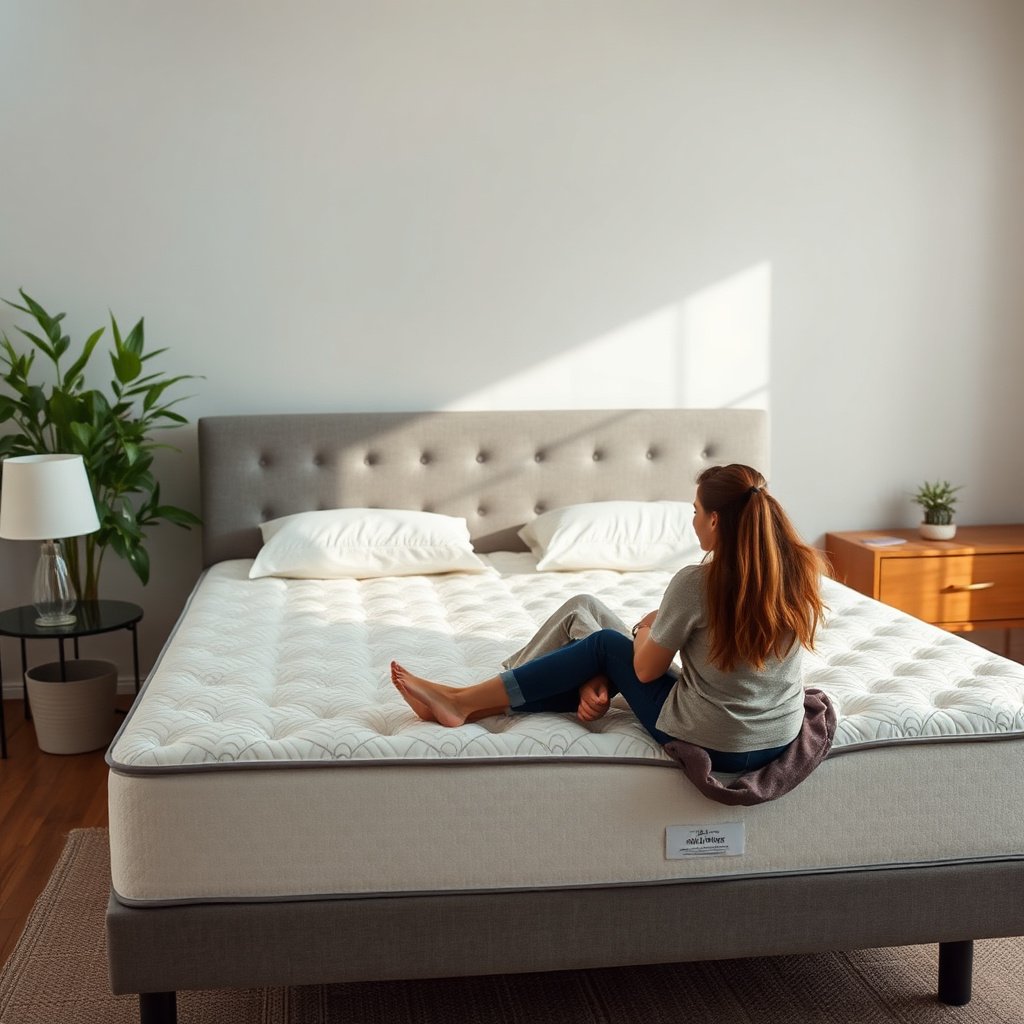
This guide is for couples who disagree on firmness (or who disagree on whether a mattress feels “supportive”), especially if you’re buying online or can only do short in-store tests. It’s also a good fit if you’ve tried to compromise on “plushness” before and still woke up with aches, hip pressure, or partner wake-ups.
Start with what you both need (not what you both want)
The fastest way to stop mattress debates is to agree on needs—what your bodies require for alignment and comfort—before you negotiate preferences. In mattress shopping, “what you want” is often emotional (“I like it softer”), while “what you need” is biomechanical (“my hips must stay level to prevent pressure”).
– List each person’s top two concerns: pressure relief, back/hip support, overheating, or motion transfer.
– Compare your sleep positions (side/back/stomach) and where each of you feels discomfort.
– Identify your non-negotiables (e.g., “no back pain,” “no partner wake-ups,” “stays cool”) so you can compromise on the rest.
Turn concerns into measurable targets (for both sleepers)
For the mattress decision to stick, translate concerns into targets you can test consistently:
– Pressure relief target: Where does pressure show up? For many side sleepers, it’s the shoulder and hip where the body needs contouring without “bottoming out.”
– Support target: Does one partner feel like the mattress is either too soft (hips sink, spine tilts) or too firm (pressure builds before alignment improves)?
– Temperature target (overheating): Does your mattress trap heat during a 20–30 minute “settling” phase? This matters because comfort isn’t only firmness—it’s how quickly the surface feels cool again.
– Motion transfer target: Do small shifts by one sleeper cause the other to wake, especially during position changes?
Compare sleep positions—and don’t average them
A couple mattress can feel “fine” in one position and wrong in another. Compare both people in the positions they actually use most:
– Side sleepers: prioritize hip/shoulder pressure relief and hip alignment.
– Back sleepers: prioritize lumbar support and overall spine neutrality.
– Stomach sleepers: prioritize “don’t let my midsection sink” support (or you’ll fight lower-back strain).
When you and your partner are disagreeing about mattress firmness, the disagreement often comes from the fact that one person’s comfort zone overlaps poorly with the other’s.
Set non-negotiables first, then trade preferences
Non-negotiables are your “range boundaries.” Common examples that prevent endless cycling:
– “No morning hip pain” (support + pressure relief)
– “No wake-ups when you turn” (motion isolation)
– “Doesn’t sleep hot for me” (temperature regulation)
– “No excessive sink under my shoulders” (surface responsiveness + pressure control)
Everything else becomes negotiable—like whether you both prefer a slightly softer top layer if alignment stays good.
Use a shared firmness “target range”
A solid compromise rarely comes from choosing one exact firmness number. It comes from agreeing on a firmness band that both sleepers can tolerate while you judge alignment and pressure relief first.
Agree on a realistic firmness band instead of chasing exact numbers (e.g., “medium” to “medium-firm,” depending on the mattress type). Look at how different constructions feel: memory foam often feels “slower” and more contouring, while innerspring/coil systems may feel more responsive. Decide how you’ll judge the compromise: alignment first (spine/hips), then pressure points, then comfort preference.
Firmness labels don’t mean the same thing across brands
“Medium-firm” is not a universal standard. Mattress feel depends on:
– top comfort layer thickness and density
– foam type (e.g., memory foam vs. polyfoam)
– coil count, gauge, and how much the comfort layers “give”
– whether there’s zoning (and how zoning is distributed)
That means your couple decision should focus on how your bodies settle—not whether a label matches your partner’s past mattress.
Negotiate range by comparing how your bodies settle
When firmness disagreements happen, it usually looks like one of these:
– One partner sinks too much → hips drop and alignment breaks.
– The other partner feels unsupported → pressure appears before hips align.
– One sleeps “too warm” → comfort drops even if alignment is good.
A better approach is to set a shared evaluation order:
1. Alignment: spine/hips stay neutral when you’re in your normal position
2. Pressure points: shoulders/hips feel relieved, not jammed into the surface
3. Preference: “I still wish it were softer/firmer,” but it’s livable
Consider construction differences when choosing the range
Memory foam can contour more, but it can also increase heat retention for some sleepers. Coil-forward mattresses may feel more responsive, but they can transmit more motion depending on quilting and comfort layers. Hybrids and latex often land in the middle—but again, your mattress firmness “range” should be anchored to what your bodies do in real positions.
Try the mattress the same way you’ll sleep
The right test removes bias from quick impressions. If you test differently than you sleep, you’ll “win” the firmness debate in the store and lose it on the first week at home.
Test in your two most common positions, not just one. Spend enough time to notice pressure and heat buildup, and move as you normally would during the night (not just a quick sit-and-lie). Check for motion transfer: have one person lie still while the other shifts weight nearby, then swap.
Use a joint test plan that’s actually comparable
To prevent couple mismatch, test in the same room (same lighting, same temperature) and in the same positions you use at home. Then run the motions that matter:
– settle into position as you would at night
– shift once or twice like you’d actually do during sleep
– switch sides or return to your usual position
I recommend treating the test like a small “N-of-1” study for each person’s comfort zone—your goal is repeatability, not perfection.
Decide what “enough time” means for pressure and heat
A mattress can feel fine for 60 seconds and reveal problems at 10–20 minutes when pressure accumulates or heat starts building. For your couple decision, you want time long enough to notice:
– pressure hot spots (shoulders/hips for side sleepers)
– surface temperature changes (cool-to-warm drift)
– whether your body reaches a stable “settle” or keeps sinking
Run motion transfer like an experiment, not an argument
Motion transfer is one of the most common “we didn’t agree” issues because it’s experienced at night, not during casual sitting. A simple controlled method:
– one partner lies still
– the other makes a realistic shift (turning over or adjusting pillow)
– swap roles
– repeat in both common positions
If one person is a lighter sleeper or has a different sleep schedule (early wake-ups, naps, light sensitivity), prioritize motion isolation earlier in the process.
Structured Couple Mattress Test Steps (2026)
| # | Test step | What it reveals | Priority | Recommended time |
|---|---|---|---|---|
| 1 | Side-sleep pressure hold | Shoulder/hip relief without bottoming | ★★★★★ | 15 min |
| 2 | Back-sleep alignment check | Lumbar support and neutral spine | ★★★★★ | 12 min |
| 3 | “Real” roll and reposition | How hard it is to move + surface response | ★★★★☆ | 8 min |
| 4 | Heat/comfort drift notice | Temperature change during settling | ★★★★☆ | 10 min |
| 5 | Partner motion isolation test | Wake-ups from nearby shifting | ★★★★★ | 14 min |
| 6 | Edge support + roll-off risk | Stability when sitting or changing sides | ★★★☆☆ | 6 min |
| 7 | The “quick sit-and-lie” shortcut | Often misses pressure + heat buildup | ★☆☆☆☆ | 2 min |
Compare options that reduce friction (zoned comfort, split designs, adjustable bases)
The best “disagreement reducer” is usually the one that separates comfort needs without separating the relationship in the middle of the night. If you truly have incompatible firmness preferences, tools like split firmness, zoning, or an adjustable base can keep both partners aligned.
– If you both truly disagree on firmness, consider a split approach (two firmness zones on one mattress) if your setup allows it.
– For some couples, zoned support can help keep hips aligned for one person while still providing contouring for another.
– If pain or sleep posture changes over time, consider whether an adjustable base or targeted support layer could reduce the need to “pick a winner.”
Split firmness: when one mattress can’t satisfy both bodies
Split designs work when disagreement is structural:
– Partner A sinks too much and loses alignment
– Partner B feels pressure because the surface is too firm
In these cases, “target range” may be too narrow for a single comfort profile. A split approach can preserve alignment for both sleepers because each side can be tuned to each person’s needs.
Zoning: useful when the problem is where support happens
Zoning can help when discomfort comes from pressure distribution rather than overall firmness. For example:
– hips need a slightly different support response than shoulders
– one person is sensitive to pressure depth but not to motion
– the couple prefers to keep one unified feel but reduce side-specific issues
Zoning can be effective, but you still need to test in the exact positions you use—zoning can also create a “two different feels” surface that some couples notice (especially during sex or when turning).
Adjustable bases: reduce the need to “choose a winner”
If pain or posture changes over time, an adjustable base can make the mattress compromise easier by letting you change:
– head/neck angle
– lower-back angle
– circulation comfort for some sleepers
This is especially relevant if one partner needs a different posture on certain nights. However, adjustable bases can also introduce new movement patterns—so you must evaluate motion behavior in your real setup (including the bed frame and any split-cord controls).
What can go wrong when couples shop together
Couple mattress shopping can fail when you optimize the wrong variable first. The most expensive mistake isn’t paying too much—it’s choosing a mattress that looks like a compromise but doesn’t actually protect alignment and comfort for both sleepers.
– Compromising only on “feel” (like plushness) while ignoring alignment can lead to morning aches for one partner.
– Testing too briefly can hide issues like heat retention or pressure buildup.
– If one person is much heavier or sleeps more on a specific side, the mattress may perform differently at each sleeper’s comfort zone—so you need to evaluate both positions.
– Don’t assume mattress labels (like “medium” or “firm”) mean the same thing across brands; feel depends on the materials and build.
Misunderstanding “medium” can turn into a support problem
Many couples interpret firmness labels as if they’re consistent. They aren’t. “Medium-firm” from a memory foam bed can feel slow and deeply contouring; “medium-firm” from a hybrid can feel more responsive and less enveloping. That means firmness labels don’t guarantee shared sleep outcomes—your body settlement does.
Time pressure during testing creates false comfort
Short tests often miss:
– heat buildup
– pressure accumulation
– unstable sinking (where your hips keep dropping after you “relax” longer)
If your mattress disagreement repeats nightly, revisit how you test and how long you actually spend in each position.
Body-weight and position asymmetry matter
If one partner weighs significantly more (or spends more time on one side), the mattress doesn’t “average out.” Each person may be living on different layers and experiencing different comfort depths. In those cases, you must evaluate both partners in both common positions, not just the “we both seemed comfortable together” moment.
A practical verdict (and who should skip this approach)
If you can define each person’s pain point and you’ll test with a structured plan in the same positions and motions, this method usually yields a compromise that both partners can live with. The downside is honest: you may not get a perfect match for either sleeper, and online trial still involves trial-and-error in real homes.
Skip this approach (or be more cautious) if you:
– Haven’t tried the mattress setup in your actual sleep positions long enough.
– Keep changing your mind nightly (“I feel different every day”) without tracking what’s actually happening (pressure, heat, or support).
– Have medical needs that require a specific support pattern—then involve a clinician and follow their guidance first.
From my experience with couple decision-making, the biggest improvement comes when the conversation becomes specific (“hip alignment in side sleep”) instead of comparative (“your side feels softer”).
Quick couple mattress checklist
Use this checklist to keep the decision consistent from test day through the trial period. It’s designed to prevent “memory-based shopping,” where you forget what felt wrong and redo the debate.
– We wrote down each person’s top 2 concerns: [Pressure relief for side hips] [Motion transfer that wakes me]
– We agreed on a firmness range (not one exact number): [Medium to medium-firm for our mattress type]
– We tested our usual positions for both sleepers: [Side] [Back]
– We checked motion transfer by shifting weight while the other stayed still: [Yes—swapped roles]
– We chose based on alignment + pressure relief, not just plush feel: [Yes—neutral spine/hips]
– We confirmed return/trial terms before committing:
Mattress type quick comparison (for couples who disagree)
When couples disagree on firmness, mattress type can change the compromise. Use the table below as a starting framework—then verify with your own in-position testing.
| Feature | Memory foam | Latex | Hybrid (coils + comfort layers) |
|---|---|---|---|
| Pressure relief depth | High (contouring) | High (responsive contour) | Medium to high |
| Surface “sink” tendency | Can be significant | Moderate (less sink) | Often moderate |
| Spine/hip alignment risk | Higher if too soft | Lower with correct firmness | Lower than very-soft foams |
| Motion isolation | Often strong | Moderate to strong | Depends on construction |
| Heat retention risk | Can be higher (material dependent) | Often sleeps cooler | Often balanced due to coils |
| Responsiveness | Slower feel | Faster feel | Faster feel |
| Edge support | Often moderate | Often good | Often strongest |
| Noise/squeak | Typically quiet | Typically quiet | Can vary by coil system |
| Ease of switching positions | May feel “stuck” if too plush | Usually easier | Often easiest |
| Best fit for firmness disagreement | Works when sink matches both | Works when one wants less sink | Works when you need support + comfort |
| Best For | Couples prioritizing strong contour + motion isolation | Couples wanting pressure relief with more “bounce” | Couples needing balanced support, edge stability, and shared feel |
Sources
– American Academy of Sleep Medicine (AASM) — adult sleep duration recommendations (2015)
– U.S. Centers for Disease Control and Prevention (CDC) — insufficient sleep prevalence statement (year: )
Choosing a mattress when you and your partner disagree is mostly a process problem, not a personality problem: define needs (pressure, alignment, heat, motion), agree on a firmness range, and run a structured same-position test long enough to reveal pressure and temperature issues. If you’re still stuck after that, consider friction-reducers like zoning, split designs, or an adjustable base—because the best compromises protect both sleepers’ comfort, not just the conversation in the showroom.
Frequently Asked Questions
How do you choose a mattress when you and your partner have different sleep positions?
Start by identifying each person’s dominant position (side, back, stomach) and match the mattress to reduce pressure points and maintain spinal alignment. Side sleepers usually need more cushioning for shoulders and hips, while back sleepers typically benefit from moderate support to keep the lower back level. If one partner sleeps mostly on their side and the other on their back, look for a medium feel with zoned support or a comfort layer that balances pressure relief and support. It also helps to test in-store or use a strong return policy so you can confirm comfort after a full night.
What mattress firmness is best when one partner is a “back sleeper” and the other is “side”?
For mixed sleep styles, “medium” firmness is often the safest starting point because it can offer both pressure relief and support. Side sleepers typically prefer slightly softer comfort to cushion the hips and shoulders, while back sleepers often need enough support to prevent the mattress from sagging at the waist. Consider hybrid options (innerspring + foam/latex) or medium-support foams that conform without collapsing. If you’re stuck, aim for a mattress that keeps the spine aligned for both positions and use a supportive topper only if your return window allows.
Why do couples disagree on mattresses, and how can you resolve it with a better process?
Mattress disagreements often come from different body types, preferred temperatures, and how each person experiences pressure relief and motion transfer. Resolve it by shopping with clear priorities—like firmness, support, cooling, and edge support—and then testing for those factors rather than just going by “feel.” Use a checklist: do both partners feel comfortable at shoulders/hips, do they wake with aches, and does one partner notice movement when the other shifts? If possible, choose a mattress with a trial period so you can fine-tune your decision based on real sleep over several nights.
Which mattress type works best for partners with different pain points (e.g., back pain vs. shoulder stiffness)?
Couples with different pain points often do best with a mattress that combines pressure-relieving comfort with targeted support. Memory foam can help reduce shoulder pressure, while responsive support layers or zoned coils can better support the lower back for alignment. Hybrid mattresses are commonly recommended because they balance cushioning and stability, reducing the chance that one partner feels “stuck in” the comfort layer. The best approach is to prioritize the most painful area for each person and look for features like contouring on top and a supportive base underneath.
How can you choose a mattress when motion transfer and sleep temperature are both deal-breakers for you and your partner?
For motion transfer, look for mattresses with excellent isolating comfort layers (typically foam or latex) and avoid overly bouncy surfaces that can transmit movement. For temperature, prioritize breathable materials such as gel-infused foam, latex, airflow through coil systems, and breathable covers, especially if either partner runs hot. If you share a bed and one person frequently changes positions, a mattress with low-motion performance can significantly improve sleep quality for both. Always test for both concerns—movement sensitivity and heat retention—then rely on a trial period to confirm comfort and temperature control over multiple nights.
📅 Last Updated: November 02, 2026 | Topic: How to Choose a Mattress When You and Your Partner Disagree | Content verified for accuracy and freshness.
References
- Mattress
- mattress firmness sleep quality – Search Results – PubMed
- mattress firmness polysomnography – Search Results – PubMed
- Effect of firmness of mattress on chronic non-specific low-back pain: randomised, double-blind, c…
- mattress pressure redistribution interface pressure – Search Results – PubMed
- sleep surface comfort pressure points – Search Results – PubMed
- partnered sleep agreement bed surface preferences – Search Results – PubMed
- https://scholar.google.com/scholar?q=how+to+choose+a+matress+for+sleep+comfort+couples Google Scholar
- https://scholar.google.com/scholar?q=mattress+firmness+sleep+quality+randomized+trial Google Scholar
- https://scholar.google.com/scholar?q=mattress+firmness+pressure+relief+shoulder+hip+interface+pressure Google Scholar