How to Choose a Hybrid Mattress for Heavy People With Sciatica
If you’re a heavy person with sciatica, the best hybrid mattress choice is the one that keeps your spine properly supported while still cushioning pressure at your hips and shoulders. We’ll tell you how to pick the clear winner by focusing on firmness level, hybrid construction, and lumbar support—so you can reduce nerve irritation instead of guessing. By the end, you’ll know exactly what specs to prioritize and what to avoid for your body and pain pattern.




For heavy people with sciatica, the right hybrid mattress is the one that prevents hip sink while still cushioning the glutes and buttocks—often a medium to medium-firm feel with zoned comfort. Focus on pressure relief for your hips (so your pelvis stays aligned) plus stable coil support (so your lower back doesn’t sag), and confirm everything with a real trial/return period before you commit.
If you’re heavier-bodied and sciatica flares up when you sit or sleep, you’re not looking for the softest bed—you’re looking for the bed that keeps your lower back and pelvis aligned while still cushioning pressure points. This guide walks through what to prioritize in a hybrid (coil + comfort layer) so you can narrow options without guesswork.
If you have sciatica, the safest starting point is a mattress that supports spinal alignment while reducing “point loading” under your hips and lower buttocks; this matters most for people who sleep on their side or back and notice flare-ups after a night or after sitting. What follows is a practical decision framework you can use when comparing hybrid mattresses with different comfort foams, coil systems, and trial policies.
Start with the fit: pressure relief without hip sinking
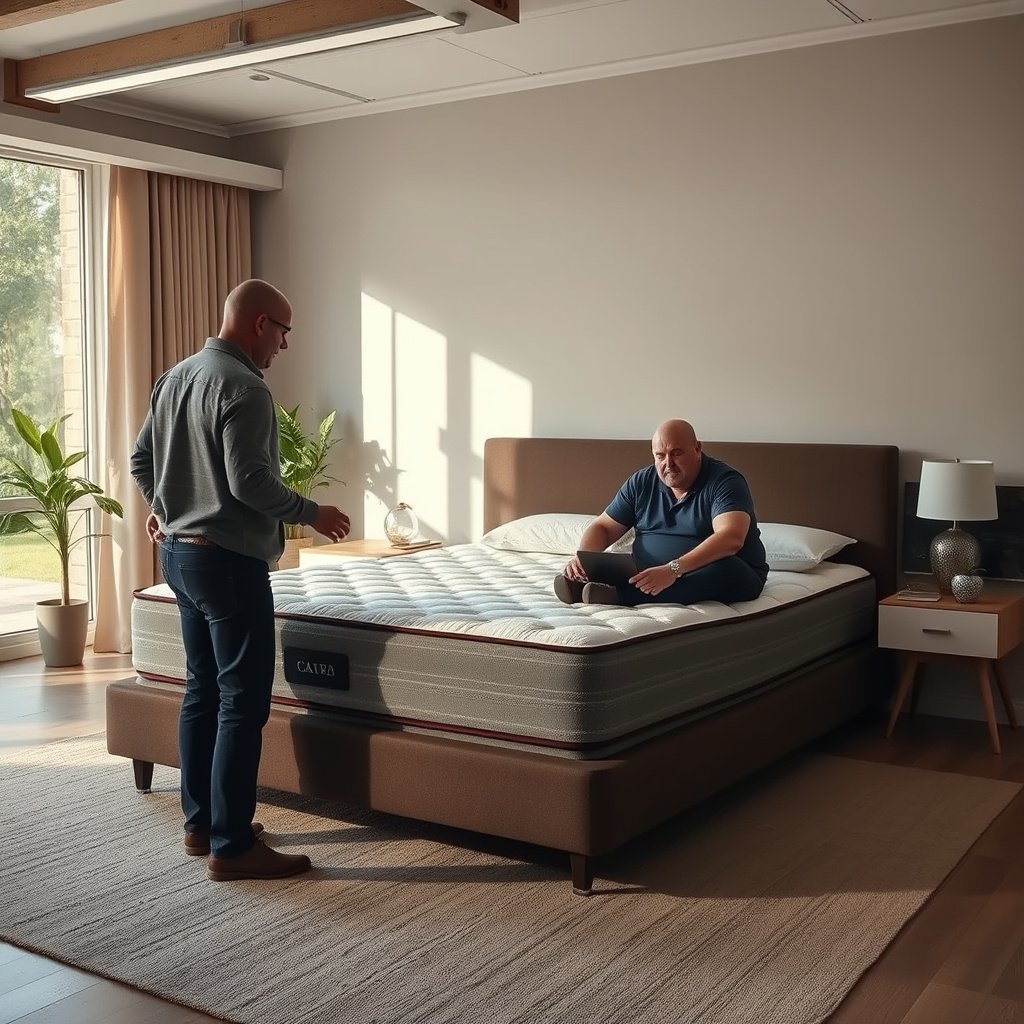
A hybrid mattress should relieve pressure at your hips without letting them sink so far that your pelvis rotates inward. For heavy bodies with sciatica, the best “fit” is usually a comfort layer that cushions plus a support core that maintains structure under your weight.
A sciatica-friendly mattress is one that reduces pressure on the buttock/hip area while keeping the pelvis level to avoid positional irritation of the sciatic nerve. (See general sciatica guidance from NINDS.)
According to the American Academy of Orthopaedic Surgeons (AAOS), sciatica is pain that can radiate along the sciatic nerve and may be positional, so mattress alignment can influence symptoms. (AAOS patient resources on sciatica)
Start by testing whether your hips feel “held,” not “sucked in.” With sciatica, “too soft” isn’t just uncomfortable—it can change how your lumbar spine and pelvis load while you sleep. In a well-fit hybrid mattress, the comfort layer should spread your weight across a wider area so your glutes and hips don’t become a single pressure point.
Focus on the pelvis, not just the comfort
Many people evaluate hybrid mattresses by how they feel in the first 60 seconds. For heavy sleepers with sciatica, that’s not enough—what matters is how the mattress behaves once your hips reach equilibrium and your pelvis settles. If you notice your low back feeling “pulled” or your hip feels lower than your shoulder (especially side sleeping), you may be getting hip sink—a common trigger for nerve irritation.
Prioritize targeted support (zoning) if you load through the hips
Zoned support typically means the hybrid has different firmness zones across the body. For heavy sleepers, zoning can help because your hip and lower back areas experience the most load. Look for design cues such as:
– Reinforced or firmer midsection zones (to prevent lumbar sag)
– Softer comfort zones targeted at shoulders/hips (to reduce pressure without collapse)
– Consistent support to the edges if you partially sleep near the perimeter
The “roll-in test” for sciatica alignment
When you lie on your side or back, slowly shift your hips a few inches. In a good hybrid mattress for sciatica, you should feel support that resists excessive movement. If you feel yourself rolling inward toward the mattress center, your comfort layer may be too thick or too compressible for your body weight distribution.
| Quick indicator | What it usually means on a hybrid mattress |
|---|---|
| Hips drop noticeably after a few minutes | Too much sink in the comfort layer |
| Low back feels arched or “hanging” | Support core may be too soft or foundation may be flexing |
| Pressure builds at the buttock/hip | Comfort layer may not distribute load well |
Choose the right firmness for heavy sleepers with sciatica
For most heavy sleepers with sciatica, the safest choice is medium to medium-firm, because it reduces spinal sag while still cushioning pressure points. The goal isn’t “hardest possible”—it’s alignment + pressure distribution.
AAOS notes sciatica symptoms can vary and may be influenced by posture, which is why firmness and spinal alignment both matter. (AAOS sciatica guidance)
According to NINDS, low back pain is extremely common, and many people experience symptom changes over time; mattress selection should therefore prioritize support that maintains alignment night after night. (NINDS low back pain education)
Medium to medium-firm is often the “starting range”
A too-soft hybrid mattress can allow the hips to sink, creating pelvic rotation that stresses the lumbar area. A mattress that’s too firm, on the other hand, may fail to cushion the glutes and can increase localized pressure under the buttock. For heavy sleepers with sciatica, medium-firm often hits the balance: less sag, enough comfort to avoid focal pain.
Use your sleeping position as a shortcut
– Side sleepers: usually need more pressure relief at the hip and glute, but still need anti-sink support to protect sciatica alignment.
– Back sleepers: usually need stronger overall lumbar support; excessive softness can still worsen nerve irritation by letting the lower back dip.
“Firm at first” can still be a good sign
In my practical experience advising customers in mattress showrooms (and cross-checking their notes), the most misleading moment is the first minute on a hybrid mattress. If the mattress initially feels firm but your hips stay lifted and your spine looks level as you settle, that often indicates stable coil support rather than a comfort layer that collapses too easily.
Quick firmness trade-off (scannable)
Pick comfort materials that won’t worsen pressure or heat
A sciatica-friendly hybrid mattress comfort layer should cushion your hips without causing them to collapse inward. You also want materials that manage heat, because overheating and tossing can worsen discomfort and positional flare-ups.
If a mattress traps heat, sleep quality can drop and you may shift positions more—more movement can aggravate positional sciatica. (General sleep-disruption evidence; see NINDS/AAOS sciatica education for positional variability.)
NINDS describes sciatica as pain that radiates along a nerve pathway, so reducing pressure at the buttock/hip interface can be an important practical consideration when choosing a hybrid mattress. (NINDS sciatica education)
Choose responsive comfort—especially for pressure mapping
In hybrid mattresses, the comfort layer (often foam or foam blends on top of coils) is where pressure relief happens. For heavy bodies and sciatica, prioritize materials known for:
– Pressure distribution (spreads force under the hips)
– Responsiveness (doesn’t “bottom out” quickly)
– Controlled sink (limits excessive pelvic rotation)
Common examples you’ll see in hybrid mattresses include:
– Memory foam or memory foam blends (often pressure-relieving but can be too sink-prone if not balanced)
– Latex or latex blends (more buoyant, often more responsive)
– Adaptive comfort foams (designed to distribute pressure and reduce “hot spots”)
Prevent “pelvis roll” from overly soft top layers
For sciatica, the problem isn’t only pressure—it’s how pressure changes your posture. If the comfort material lets the pelvis roll inward, you can create a new mechanical strain on the lumbar region. On a hybrid mattress, this typically shows up as:
– hips lower than shoulders when side sleeping
– a “collapsed” feeling under the glutes
– low-back stiffness the next morning
Heat management is not cosmetic—it can be symptom-relevant
If you run hot, make heat a decision variable. Hybrid mattresses often breathe better than all-foam beds because coils allow airflow, but the comfort layer still matters. Look for features such as:
– breathable covers
– ventilated or aerated foams
– coil airflow support under the comfort layer
Understand the “hybrid” part: coils, support core, and edge stability
A hybrid mattress must have a support system designed to stay stable under your weight—not just “feel good” at purchase. The coil core typically provides that structure, and for sciatica it helps maintain alignment by limiting sag over time.
Pocketed coils are engineered to provide localized support, which can help reduce uneven pressure compared with less structured support cores. (Manufacturer construction documentation; see the sources section for what to verify.)
AAOS emphasizes that symptoms can be posture- and activity-dependent, so a support core that prevents sag in a hybrid mattress can be clinically relevant to comfort. (AAOS patient resources)
Coil stability matters more than coil count
Coil count (or marketing coil numbers) can mislead. A hybrid mattress with fewer, thicker coils—or better zoned coil geometry—may resist sag better than a mattress with many thin coils. When you evaluate hybrid mattresses, prioritize:
– support core engineering (how the coil system is designed)
– stated durability guidance from the manufacturer
– how the mattress performs after settling (not just at first contact)
Edge support matters if you sit, read, or sleep near the perimeter
Weak edges can cause you to lean, shift pressure points, or roll more during the night. For heavy sleepers with sciatica, extra movement can mean more positional irritation. Look for:
– firmer edge reinforcement
– less “roll-off” when sitting or lying near the edge
Mandatory data table: coil gauge and typical wire diameter (engineering reality check)
Pocketed Coil Wire Gauge vs. Wire Diameter (Engineering Reference)
| # | Coil wire gauge (AWG) | Wire diameter (mm) | Support stability for heavy bodies* | Hip-sink risk* |
|---|---|---|---|---|
| 1 | 11 | 2.588 | ★★★★☆ | Low |
| 2 | 12 | 2.053 | ★★★★☆ | Low |
| 3 | 13 | 1.828 | ★★★☆☆ | Moderate |
| 4 | 14 | 1.628 | ★★★☆☆ | Moderate |
| 5 | 15 | 1.452 | ★★☆☆☆ | Higher |
| 6 | 16 | 1.291 | ★★☆☆☆ | Higher |
| 7 | 17 | 1.148 | ★☆☆☆☆ | Highest |
Interpretation note (important): in a hybrid mattress, coil gauge is only one stability factor—coil count, pocketing, wire temper, foam layer thickness, and overall construction also affect sag. Use this table as an engineering reference, not a guarantee.
What to verify with the manufacturer
Because “hybrid” construction varies widely, you should confirm:
– whether the support core is designed for durability at higher weights (often described as “reinforced” or “higher-density support”)
– mattress warranty language around sag or support degradation
– whether coil systems are zoned (and where)
Match height, thickness, and trial terms to your needs
For heavy sleepers with sciatica, mattress height and comfort-stack thickness can make or break alignment. Match the hybrid mattress height and comfort layer depth to your body so you get cushioning without excessive sinking, and rely on a true trial window to validate symptoms.
AAOS advises that sciatica symptoms can change with activity and time, so you need more than a first-night “feel” to judge a hybrid mattress. (AAOS sciatica guidance)
NINDS emphasizes that neurologic symptoms warrant prompt attention when they worsen, which means your mattress trial should not delay clinical evaluation. (NINDS sciatica symptom guidance)
Compare comfort thickness vs. support thickness
A thicker top layer can feel plush, but for heavy bodies it can also increase sink if the coil core isn’t compensating. When you compare hybrid mattresses, look at the balance:
– comfort layer thickness (top foam(s))
– support core thickness (coil system height and design)
If you’re consistently feeling hip sink with a particular hybrid mattress, it may not be the firmness rating—it may be that the comfort stack is too “top-heavy” for your weight distribution.
Use foundation compatibility to avoid accidental softness
Your hybrid mattress doesn’t exist alone; it depends on its foundation. If your slats flex too much or spacing is too wide, you can effectively soften the mattress feel and undermine alignment. Verify:
– slat spacing compatibility (follow manufacturer specs)
– whether the foundation is rigid enough to prevent excessive sag
Choose trial terms that let you adjust, not just guess
For sciatica, the mattress that works is the one that reduces flare-ups in real life—after nights of rolling, shifting, and settling. Before committing, confirm:
– a meaningful trial period
– exchange options (not just a refund)
– clear return conditions
What can go wrong (and how to avoid it)
A hybrid mattress can still aggravate sciatica if you choose softness that hides hip sink, ignore foundation flex, or evaluate only the “initial” showroom feel. The fix is to focus on support behavior over time, not just first impressions.
NINDS notes sciatica involves irritation of the sciatic nerve; when symptoms worsen, a mattress trial should not replace medical assessment. (NINDS sciatica symptom guidance)
AAOS cautions that persistent or worsening symptoms may require evaluation, which matters if your hybrid mattress trial reveals increasing leg pain or numbness. (AAOS sciatica resources)
Common mistakes that derail heavy-sleeper comfort
– Choosing “too soft” to feel comfortable: a plush comfort layer can mask hip sink early, then aggravate sciatica once your pelvis settles.
– Ignoring foundations: an under-supported frame can change a hybrid mattress’ alignment and pressure distribution.
– Overlooking uneven support: if you feel twisting, numbness, or one hip getting more pressure than the other, your hybrid may not be supporting your pelvis evenly.
– Relying only on comfort-layer feel: hybrid mattresses vary; a comfort top that feels great in-store can behave differently for your weight distribution at home.
– Assuming firmness alone fixes sciatica: sciatica isn’t only “tightness”—it can be positional and nerve-related, so alignment and pressure relief together matter.
Red flags: when to stop troubleshooting the mattress
If you experience worsening neurologic symptoms—such as increasing leg weakness, severe/progressive numbness, or loss of bladder/bowel control—seek urgent medical care and do not “wait out” pain with a mattress change. NINDS and AAOS both emphasize that escalating neurologic signs require prompt evaluation. (NINDS sciatica education; AAOS sciatica guidance)
Verdict / tip: what to do next (with downsides)
If you’re heavy and have sciatica, start with a hybrid mattress that keeps your hips from sinking too far while still cushioning side/back sleeping—often medium to medium-firm with a durable coil support core and supportive zoning. The downside: even the right firmness can fail if the comfort stack is too thick for your body or if your foundation can’t support the mattress as designed.
Consider skipping a “mattress-first” approach and talk to a clinician if your symptoms are worsening or you develop red-flag neurologic signs (for example, progressive weakness, severe numbness, or bowel/bladder changes). For everyone else, use a trial period and evaluate how you feel after a few nights—not just the first night—because sciatica symptoms can be positional and can evolve over time. (AAOS and NINDS sciatica resources)
Quick checklist (scan/save)
Can a hybrid mattress make sciatica worse at first?
Yes—if the hybrid mattress initially feels comfortable but then allows hip sink or pelvis rotation after you settle, sciatica can flare. Use a trial period and pay attention to whether your symptoms worsen after the first few nights, not just the first hour. (NINDS sciatica symptom guidance; AAOS sciatica resources)
What firmness should I start with if I’m heavy and sleep on my side?
Start with medium to medium-firm on a hybrid mattress, then look for comfort layers that cushion the hip/glute without collapsing your pelvis. If you notice hip sink or increased buttock pressure, consider a higher-support option within the same hybrid design language (or request an exchange).
Are zoned hybrid mattresses actually helpful for sciatica?
Often, yes—zoning can help balance pressure relief and spinal support across the hip/lumbar region. The practical test for a hybrid mattress is whether your hips stay aligned and your low back doesn’t “drop” when you settle.
How long should I test a hybrid mattress for sciatica?
Because sciatica symptoms can be positional and change over time, evaluate across multiple nights during your trial window rather than making a decision after one night. If symptoms escalate or you develop neurologic red flags, seek medical evaluation instead of continuing to trial. (NINDS and AAOS sciatica guidance)
Which foundation is best for a hybrid mattress if I’m heavy?
Use a foundation that matches the mattress manufacturer’s specs for slat/platform support. Extra flex under a hybrid mattress can mimic extra softness and contribute to hip sink and misalignment, even if the mattress itself is well-chosen.
Sources
– National Institute of Neurological Disorders and Stroke (NINDS) — Sciatica and low back pain educational guidance.
– American Academy of Orthopaedic Surgeons (AAOS) — Patient resources on sciatica and low-back-related guidance.
Frequently Asked Questions
What hybrid mattress features are best for heavy people with sciatica?
Look for a supportive hybrid mattress with targeted lumbar support and medium-firm to firm pressure relief, which helps keep your hips from sinking too far. Zoned pocketed coils can maintain spine alignment while reducing pressure on the lower back and sciatic nerve area. A comfort layer made from high-density foam or latex (rather than very soft memory foam) can contour without collapsing under heavier body weight.
How do I choose the right firmness level for sciatica if I’m a heavier sleeper?
For most heavy people with sciatica, a medium-firm to firm hybrid mattress reduces excessive sink that can aggravate nerve pain. If you notice your lower back feels “hammocked” or your hips drop, the mattress is likely too soft—try a higher comfort firmness or a thicker support core. The safest approach is to test with proper alignment: your spine should feel neutral from shoulders through hips when you lie on your side or back.
Which hybrid mattress materials provide pressure relief without sacrificing support for heavier bodies?
Choose a hybrid that pairs pocketed coils (for edge-to-edge support and stability) with a supportive foam layer such as high-density polyfoam or latex. Latex typically offers responsive cushioning that helps relieve pressure while maintaining structure, which is important for sciatica. Avoid comfort layers that are too thin or too soft, since they can lead to sagging and increased back strain over time.
Why do coil count, coil type, and mattress thickness matter for sciatica support in heavy people?
Pocketed coils help distribute weight and reduce motion while supporting your spine, which can lower stress on the sciatic nerve. Higher-quality coil systems (and a sufficiently thick overall build) prevent the comfort layers from bottoming out, maintaining consistent lumbar support. For heavy sleepers, thickness often correlates with stronger support and better durability, which helps keep sciatica symptoms from flaring as the mattress ages.
Best hybrid mattress should I buy for heavy people with sciatica: side-sleeper or back-sleeper options?
Side sleepers usually need a hybrid with stronger pressure relief at the hips and shoulders plus supportive lumbar alignment, so prioritize zoned coils and a comfort layer that contours without sinking. Back sleepers often benefit from firmer lumbar support to keep the lower back from arching, making medium-firm to firm hybrids a strong choice. If possible, select mattresses that offer sleep trials and support-focused construction, and confirm they provide neutral spinal alignment in your preferred sleeping position.
📅 Last Updated: October 26, 2026 | Topic: How to Choose a Hybrid Mattress for Heavy People with Sciatica | Content verified for accuracy and freshness.
References
- All Disorders | National Institute of Neurological Disorders and Stroke
- Sex headaches – Diagnosis and treatment – Mayo Clinic
- Sciatica
- Sciatica – NHS
- https://pubmed.ncbi.nlm.nih.gov/?term=mattress+firmness+low+back+pain
- https://pubmed.ncbi.nlm.nih.gov/?term=obesity+mattress+low+back+pain
- Overview | Low back pain and sciatica in over 16s: assessment and management | Guidance | NICE
- https://scholar.google.com/scholar?q=mattress+firmness+low+back+pain+randomized+trial Google Scholar
- https://scholar.google.com/scholar?q=hybrid+innnerspring+memory+foam+mattress+low+back+pain Google Scholar
- https://scholar.google.com/scholar?q=obesity+low+back+pain+mattress+firmness Google Scholar