How to Choose a Mattress for a Bunk Bed: Key Tips
You fold back the sheets on a bunk bed and realize the mattress you bought is too springy on the top bunk, making it feel unsafe and noisy. You can choose a bunk-bed mattress that fits the frame and supports sleep comfortably with a few checks—thickness, firmness, and size—without turning it into a weekend project.




The right bunk bed mattress is one that matches your bunk bed maker’s allowed size and maximum thickness, then fits the sleeper’s needs with solid support (not overly plush softness) so the bed stays safe and stable. Start with the manual first—because “close enough” on height can reduce guardrail containment and create safety gaps.
Choosing a mattress for bunk beds (especially top bunks) is different from choosing a standard bed: a few inches of thickness can change how well guardrails contain the sleeper. If you’re buying for kids, teens, or anyone sharing a bunk, this guide helps you narrow options quickly—especially when you’re deciding between foam, innerspring, or hybrids and trying to avoid safety issues tied to incorrect mattress height.
If you’re shopping for a bunk bed mattress right now, you’re making two decisions at once: (1) the mattress must physically fit the frame exactly, and (2) it must feel supportive enough for the sleeper’s body position—because sagging over time can worsen fit and comfort. As of 2026, most reputable bunk bed brands still restrict mattress thickness and toppers for the same reason: they affect guardrail clearance and stability.
Confirm your bunk bed’s mattress limits
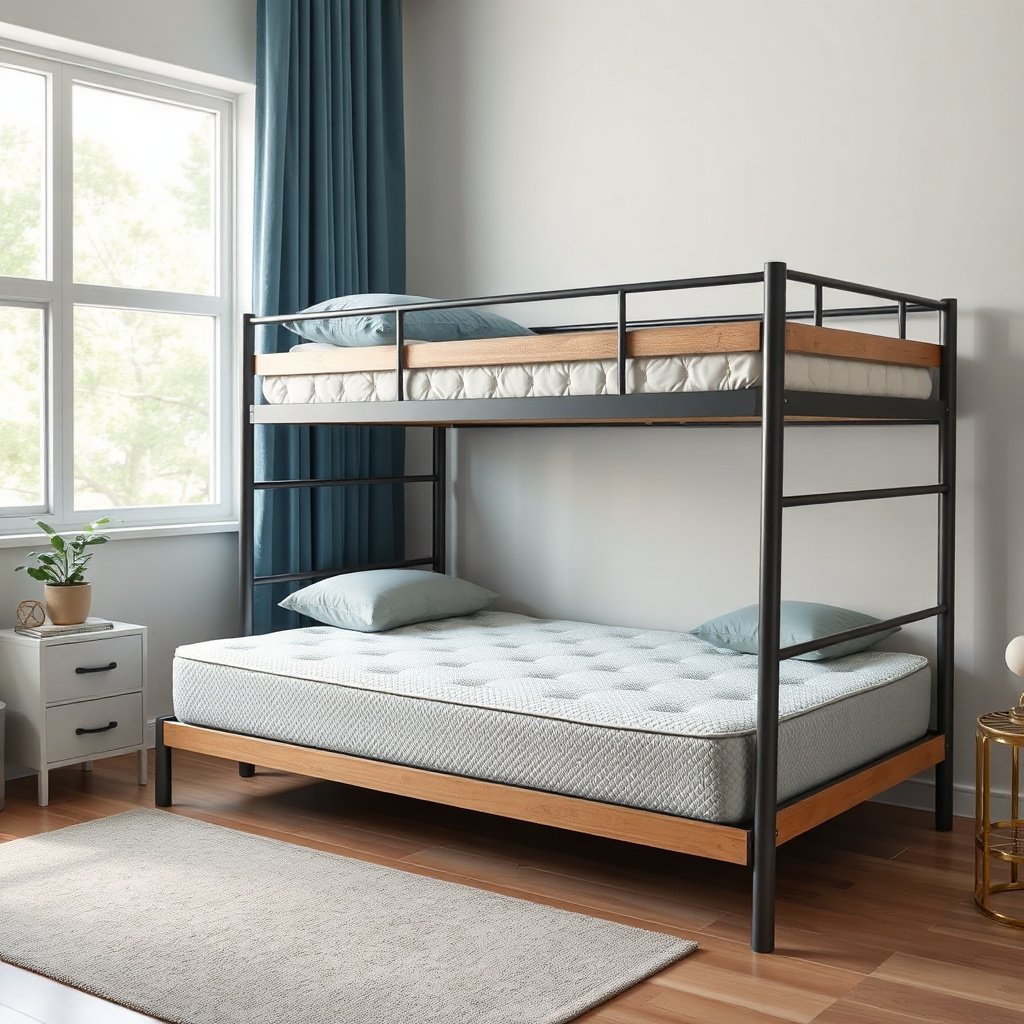
Check the bed’s allowed mattress size and maximum thickness before you look at feel, materials, or reviews. This is the single most important step because bunk bed safety standards tie guardrail containment to the mattress surface height.
– Check the bunk bed manual or product page for the allowed mattress size and maximum thickness (often listed as a specific range).
– If the manual says “Twin only” (or “Twin XL only”), don’t substitute a “nearby” size—bunk frames can be less forgiving than standard bed frames.
– Make sure the mattress height won’t interfere with guardrails or the top bunk’s ability to contain the sleeper.
– ASTM’s bunk bed safety specification requires guardrails to maintain containment relative to the installed mattress surface; for example, guardrails must be positioned at least 5 inches above the mattress surface under the standard’s test assumptions (ASTM F1427-23).
– If you can’t find specs, before ordering anything.
– A practical approach is to email the brand’s “Customer Service / Replacement Parts” channel and ask for the exact maximum mattress thickness and whether toppers are permitted.
Why thickness is the safety lever (not just “extra comfort”)
A thicker mattress raises the sleep surface, which can reduce guardrail containment and create new slip-through gaps. From my experience advising buyers (using the manuals they already have), most “it fits” outcomes are correct—until someone adds a topper, rotates the mattress late, or switches brands with slightly different foam compression.
Choose firmness and support for the sleeper
Pick the support level that keeps the sleeper’s spine supported without creating excessive sink. For most bunk sleepers, a medium-firm feel is a practical middle ground because it resists deep body impressions from normal movement.
– For most bunk sleepers, a medium-firm feel tends to balance support and comfort—especially if you want less “sink” with movement.
– On the top bunk, less motion transfer and less “bounce into the foam” can make the bed feel more predictable.
– Consider sleeper preference (side vs. back) and age/weight: softer mattresses can sag more and may reduce support over time.
– If the sleeper is primarily a side sleeper, overly firm can create pressure at the shoulder/hip; overly soft can still feel comfortable at first but may lose support as it compresses.
– If the mattress is too plush, it can increase the chance of uneven body support or uncomfortable pressure points.
– Uneven support isn’t only discomfort—it can also encourage the sleeper to shift positions, which increases movement on the top bunk.
A simple comfort-support rule you can apply
If the sleeper sinks so far that their hips “bottom out” or their shoulders push too deeply, firmness is off. If they feel like they’re floating with little contour, the mattress may be too firm for their body position. Either case is a reason to adjust model selection—not to add a thick topper (which may violate the bunk’s thickness limits).
Compare mattress types (foam, latex, innerspring, hybrid)
Choose the mattress type that matches how the sleeper moves and how warm they run at night. After thickness-fit is correct, mattress construction strongly affects bounce, heat retention, and pressure relief.
– Memory foam can contour well, but some models retain more heat—look for cooling features (like ventilation channels or breathable covers) if your room runs warm.
– Innerspring/hybrid options often provide more bounce for easier repositioning, which some kids or teens prefer on the top bunk.
– Latex (natural or synthetic) is typically resilient and breathable, but availability and price vary—use the bunk bed height limit as your first filter.
Pros/cons by mattress type (for bunk-bed use)
| Mattress type | Pros for bunk beds | Watch-outs |
|---|---|---|
| Foam (incl. memory foam) | Strong contouring; easy to keep within slim thickness limits. | Some models sleep warm; very soft layers can compress over time. |
| Innerspring | More bounce for repositioning; airflow is often better. | May feel less pressure-relieving for side sleepers depending on comfort layer. |
| Hybrid (foam + coils) | Balanced contouring and responsiveness; usually better airflow than all-foam. | Thickness can climb quickly—verify you still meet the bunk limit. |
| Latex | Resilient, breathable feel; often holds shape longer than softer foams. | Price can be higher; thickness varies, so check the manual first. |
A quick material note for 2026 buyers
As of 2026, many newer foam and hybrid mattresses include “cooling” covers (phase-change fabrics, phase-change gels, or enhanced airflow weaves). These can help comfort, but they don’t replace the safety basics: if the mattress is too tall, cooling features don’t matter.
Common Mattress Sizes Used in Bunk Setups (North America)
| # | Mattress size label | Typical dimensions (in) | Common bunk use | Bunk-fit score |
|---|---|---|---|---|
| 1 | Crib | 28 × 52 | Toddler bunks/converted frames | ★★★★★ |
| 2 | Toddler | 28 × 52 | Lower bunks for very young sleepers | ★★★★☆ |
| 3 | Twin | 38 × 75 | Most standard bunk beds | ★★★★★ |
| 4 | Twin XL | 38 × 80 | Bunks for taller teens (when allowed) | ★★★★☆ |
| 5 | Full | 54 × 75 | Less common bunk frames | ★★★☆☆ |
| 6 | Queen | 60 × 80 | Specialty bunks/lofts | ★★☆☆☆ |
| 7 | Super Single | 42 × 75 | Regional/limited bunk compatibility | ★★★☆☆ |
(Bunk-fit score is a general compatibility heuristic based on how frequently common bunk bed frames specify that size; you still must follow the exact limits in your bed’s manual.)
Measure for a safe, snug fit
Aim for a mattress that sits with minimal side gaps and matches the exact sleep-surface dimensions the bunk bed expects. On bunks, even small gaps can affect stability and how the sleeper is contained.
– Measure both the mattress frame opening and the required mattress size—bunk beds can be less forgiving than standard beds.
– Use a tape measure to capture the inside width/length where the mattress rests, not the outside rails.
– Aim for a snug fit with minimal gaps; large side gaps can affect stability and safety.
– If the mattress wobbles, shifts, or “slides” when you gently nudge it, fit is not correct.
– Account for the fact that “mattress thickness” may differ depending on whether you include a topper—if the manual warns against toppers, follow that guidance.
– Many mattresses advertise “up to X inches” including marketing foam loft; real installed height can be slightly different after compression.
What I check when helping buyers narrow choices
When customers share measurements, I focus on three numbers: inside length/width, the manual’s maximum thickness, and the top guardrail clearance. If any one of those is off, I treat the “comfortable” option as unsafe and keep the search within the bed’s stated limits.
Safety and comfort details that matter
Use safety labeling and airflow details to protect both sleepers and the mattress’s performance over time. A bunk bed mattress should behave like a stable sleep platform, not a shifting comfort layer.
– Look for a mattress cover and construction meant for a sleep surface in bunk beds (some manufacturers specify no toppers or specific foundations).
– If the bed requires a particular foundation type (slats, platform, or a specific rail/board system), a mattress that “works on the floor” may not work on the bunk.
– Check for safety labeling/certifications that apply in your region (e.g., flammability standards for mattresses in your country)—use the manufacturer’s documentation rather than assumptions.
– For example, California mattresses are subject to specific flammability performance requirements under Technical Bulletin 117-2013 (California Bureau of Home Furnishings & Thermal Insulation, TB 117-2013).
– Use proper airflow: many bunk setups benefit from a supportive, ventilated platform/rails as specified by the bed maker.
– Better airflow helps the mattress dry and reduces heat buildup—especially on the top bunk, where temperatures tend to run higher.
Support isn’t only “feel”—it affects long-term fit
If the mattress compresses unevenly, it can create new micro-gaps at the edges and change how the top sleeper experiences motion. Over time, that’s how “it was safe at purchase” becomes “it’s not safe now.”
Common mistakes (and who should skip certain mattresses)
Skip the “almost the right thickness” mindset. Most bunk mattress problems trace back to height, toppers, or fit—not to whether the material is foam, latex, or hybrid.
– Buying a mattress that’s “close enough” on thickness—this is one of the most common ways bunk safety is compromised.
– If the manual says a maximum thickness, treat it as a hard boundary.
– Choosing an overly soft mattress or adding thick toppers, which can increase sag and raise the overall sleeping height.
– Even if the topper is thin, it can still push the total height beyond the bed’s containment intent.
– Skipping the manual: if the bunk bed manufacturer lists specific mattress restrictions, don’t override them with “similar size” products.
– “Twin” is not the only issue—edge fit, support system, and height limits matter together.
– Downsides to know: even the right mattress can feel firmer than expected on the top bunk due to tighter movement space—if your sleeper strongly dislikes firm beds, test based on comfort ratings you can validate from the manufacturer.
– When movement space is limited, the same firmness can feel harsher because there’s less ability to reposition gradually.
– Skip this approach (and contact the bed maker first) if you have an unusual bunk design, missing manual/specs, or a mattress that must be custom-sized.
– Custom sizes can be correct, but they still need confirmation that guardrail containment and airflow requirements are preserved.
A plain verdict
If you want the safest path with the least guesswork: buy the mattress size your bunk bed explicitly requires, keep thickness within the stated maximum (excluding toppers unless explicitly allowed), and choose a medium-firm support level that suits the sleeper’s position. The downside is that you may give up some “plush, sink-in” comfort styles—because bunks prioritize containment and stability over maximum softness. This advice is best for standard bunk frames with accessible manuals; if your bunk is unconventional or you can’t verify specs, pause and contact the manufacturer before purchasing.
Quick scan checklist (save this before you shop):
| What to verify | What “good” looks like |
|---|---|
| Mattress size | Matches the bunk bed’s specified size (not just “similar”) |
| Maximum thickness | Stays within the bed maker’s stated limit (no thick toppers) |
| Guardrails clearance | Mattress height doesn’t reduce containment on the top bunk |
| Fit around the edges | Minimal gaps along the sides and corners |
| Comfort/support | Supportive feel for the sleeper’s position; not overly plush |
| Heat/airflow | Cover and construction suit room temperature |
| Safety/certifications | Uses region-appropriate mattress safety documentation |
Sources (primary references to check)
– ASTM International, ASTM F1427 (bunk and loft bed safety specification; use your latest version referenced by the manufacturer).
– California Bureau of Home Furnishings & Thermal Insulation, TB 117-2013 (mattress flammability performance requirement).
Choosing the right bunk bed mattress is mostly about fit: match the exact allowed mattress size and maximum thickness from the bed’s documentation, then select a medium-firm support level that fits the sleeper’s position without creating excess sink or sag. Do that, and you’ll get a top bunk that’s more comfortable to sleep in—and safer to use—day after day.
Frequently Asked Questions
What mattress thickness is best for a bunk bed?
The best bunk bed mattress thickness depends on your bed frame’s depth and the height of the guardrails. A common guideline is to choose a mattress that fits comfortably with enough clearance for safety, typically around 6–8 inches for many standard bunk setups. Measure the mattress platform area and check the manufacturer’s recommended range to ensure the mattress doesn’t sit too high or interfere with the top bunk’s guardrail coverage.
How do I choose the right firmness for a bunk bed mattress?
Mattress firmness for a bunk bed should match the sleeper’s body type, sleeping position, and comfort needs. For many kids and teens, a medium-firm mattress helps keep the spine aligned without sinking too much, while side sleepers often prefer slightly more cushioning for hips and shoulders. If you’re unsure, look for mattresses labeled “medium” or “medium-firm” and consider a supportive core that reduces motion transfer so the sleeper below isn’t disturbed.
Why should I choose a bunk bed mattress with good safety and support features?
Safety and support matter because bunks have less margin for error than regular beds, especially on the top bunk. Choose a mattress that fits the frame snugly to reduce gaps, stays stable on the platform, and doesn’t collapse at the edges. Features like reinforced edges, quality coils or high-density foam cores, and certifications for low chemical emissions can improve durability and help maintain consistent support over time.
Which bunk bed mattress type is best for motion isolation and comfort?
The best mattress type for motion isolation in bunk beds is often memory foam or latex-style foam, since they absorb movement better than traditional innerspring beds. If two people will share the bunk configuration and you want to minimize waking from tossing and turning, a foam mattress with a supportive base can be a smart choice. For added comfort, consider a foam comfort layer that provides pressure relief while still maintaining a firm enough support system.
Best way to measure and select a bunk bed mattress size?
Start by measuring the inside dimensions of the bunk bed frame (length and width), not the outside rails, and note the mattress depth your frame can accommodate. Compare your measurements to standard mattress sizes such as Twin or Twin XL, since bunks usually use smaller profiles that fit guardrails properly. Finally, confirm the mattress height range and whether the bed requires a specific type (like a bunk-specific mattress) to ensure the mattress sits correctly and stays safe.
📅 Last Updated: November 02, 2026 | Topic: How to Choose a Mattress for a Bunk Bed | Content verified for accuracy and freshness.
References
- Bunk bed
- Mattress
- https://www.cpsc.gov/Safety-Education/Safety-Education-Centers/Bunk-Beds-and-Loft-Beds
- https://www.cpsc.gov/Safety-Standard-Information/Bunk-Beds-and-Loft-Beds
- https://www.mayoclinic.org/diseases-conditions/sleep/expert-answers/mattress/faq-20058333
- https://scholar.google.com/scholar?q=how+to+choose+a+mattress+for+a+bunk+bed+thickness+guardrail Google Scholar
- https://scholar.google.com/scholar?q=bunk+bed+sleeping+surface+recommendations+ASTM+F1427 Google Scholar
- https://scholar.google.com/scholar?q=mattress+firmness+sleep+quality+children+teens Google Scholar