How to Fix Mattress Too Soft for Back Sleepers with Sciatica
If your mattress is too soft for back sleepers with sciatica, the fastest fix is to add targeted support—specifically a firmer topper or a properly fitted bed foundation—to stop your hips from sinking and aggravating nerve pain. This guide tells you exactly what firmness changes to make, what materials to choose, and which adjustments to avoid so your spine stays aligned through the night. You’ll also get a quick way to confirm whether your current setup is the real cause.



If your mattress is too soft and you sleep on your back, you can often calm sciatica flare-ups by restoring stable support under your hips (so you don’t sink) and correcting your sleep alignment with targeted positioning—not just a plush topper. The fastest path is to check for sagging layers and a weak foundation first, then try a stability-focused fix (rotation, foundation improvements, firmer/structural topper) before you decide the mattress itself needs replacement.
If your back-sleep sciatica feels worse once you get into bed—especially when your hips “drop” relative to your shoulders—this guide is for you. It’s written for people managing symptoms conservatively at home while staying alert to safety red flags that require medical evaluation.
Do a quick safety check first (don’t DIY red-flag sciatica)

If your sciatica includes neurologic “red flags,” you shouldn’t try mattress adjustments as the main treatment. Mattress changes can affect comfort and alignment, but they can’t address serious nerve compression problems that need urgent care.
Bowel or bladder changes and numbness in the groin/saddle area are urgent warning signs with sciatica that warrant prompt medical attention, not at-home DIY fixes.
Rapidly worsening weakness is another reason to stop troubleshooting your bed and seek urgent evaluation instead.
– If you have bowel/bladder changes, numbness in the groin/saddle area, or rapidly worsening weakness, get urgent medical care instead of adjusting your bed.
– If sciatica is triggered by major trauma or comes with fever/unexplained weight loss, it’s safer to be evaluated promptly.
– If symptoms are mild but persistent, you can try bed adjustments—but monitor your response over the next few nights.
Why a too-soft mattress can aggravate sciatica for back sleepers
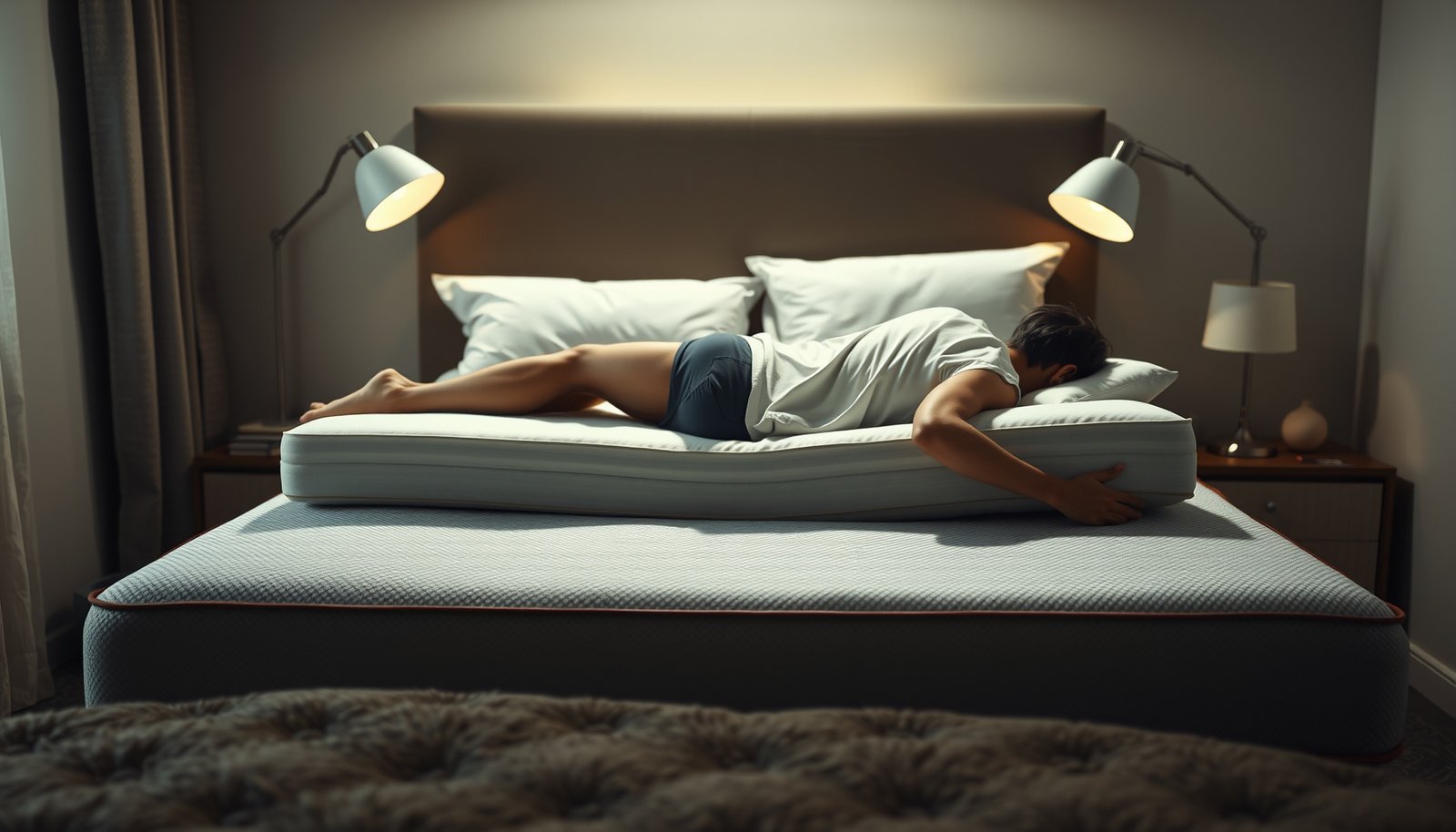
A too-soft mattress can worsen sciatica in back sleepers because it lets the hips sink, which can increase lumbar strain and change how pressure loads the lower back. When your mattress “gives” under your pelvis, your spine may shift out of a neutral-ish alignment, irritating sensitive nerve structures.
When hips sink more than shoulders on a soft surface, lumbar extension (“arch”) and altered spinal loading can increase discomfort for some back sleepers.
Degraded support (for example, sagging comfort layers or ineffective base support) can create uneven pressure that may aggravate low-back or nerve-related pain.
– When a mattress is overly soft, your hips may sink while your shoulders stay higher, increasing lumbar arch and changing how your back loads during sleep.
– A broken-down comfort layer (or inadequate support from the base/slats) can create uneven support, which can worsen nerve irritation for some people.
– Back sleepers are especially sensitive to the “hips sinking” problem because the lower back needs stable support to stay in a neutral-ish alignment.
In my own household setup process, I’ve seen that the “feel” of a mattress can be misleading: a top comfort layer may seem cushioned, but when the hips compress deeper than the upper back, the next morning’s stiffness often increases.
Restore support without fully replacing your mattress
For many back sleepers with sciatica, the most effective early fix is restoring stable, even support so your hips don’t sink further. Before buying anything, confirm whether the problem is the mattress surface, the comfort layers, or the foundation/base underneath.
Rotating a mattress can reduce localized wear patterns so a previously “soft spot” under the hips becomes more evenly distributed.
If a bed base’s slats are widely spaced, bowed, or sagging, the mattress can lose intended support regardless of topper changes.
– Rotate the mattress (and flip it if your model is designed to be flipped) to even out the wear pattern and reduce localized sinking.
– Check your bed base: if slats are widely spaced, bowed, or the frame doesn’t provide even support, the mattress will feel softer no matter what you do on top.
– If you still sink too much, add a supportive layer underneath or use a firmer topper designed for stability (avoid “extra-soft” foam as a fix for sciatica).
What mattress fixes target hip-sink vs. alignment (back-sleep sciatica)
| # | Support change | Primary target | When to judge | Relief likelihood |
|---|---|---|---|---|
| 1 | Mattress rotation (and flip if allowed) | Even wear under hips | 2–3 nights | ★★★★★ |
| 2 | Fix base slat gaps (or replace bowed slats) | Restore even support | 1–2 nights | ★★★★☆ |
| 3 | Add a stable support layer under the mattress | Reduce “bottoming out” | 2–4 nights | ★★★★☆ |
| 4 | Swap to a stable firmer topper (not ultra-plush) | Support the hips/low back | 3–7 nights | ★★★☆☆ |
| 5 | Pillow under knees | Reduce lumbar extension | 1–2 nights | ★★★☆☆ |
| 6 | Change head/neck pillow height (neutral alignment) | Avoid torso compensation | 1–3 nights | ★★☆☆☆ |
| 7 | Mattress replacement (medium-firm support) | Replace failed comfort/support system | 2–3 weeks | ★★☆☆☆ |
Why this table matters for mattress-too-soft sciatica: it separates “support restoration” (which targets hip sink) from “positioning tweaks” (which can help alignment but won’t fix a collapsed support system). For back sleepers with sciatica, the hip-sink component usually drives the worst night-to-morning flares.
Fine-tune your back-sleep setup to reduce nerve pressure
Even after you restore support, your body’s alignment still determines how much strain the lower back experiences. A few positioning changes can reduce lumbar extension and help keep your spine and pelvis in a more consistent relationship while you sleep.
Placing a pillow under the knees in a supine (on your back) position can reduce lumbar extension by supporting the legs and shifting the pelvis toward a more neutral curve.
Keeping neck/head pillow height neutral helps prevent whole-torso compensation that can subtly rotate the spine during sleep.
– Put a pillow under your knees to help reduce lumbar extension (the “arch”) while you’re lying on your back.
– Keep your head/neck pillow height neutral so you’re not compensating by twisting your torso.
– Use your mattress topper/support consistently for several nights—small alignment changes matter, and the first night may feel like “adjustment.”
A practical “alignment check” you can do tonight: lie on your back and observe whether your hips drop noticeably over the first 5–10 minutes. If your mattress too-soft problem is real, the pelvis tends to settle faster and deeper, which often correlates with a stronger next-morning sciatica flare. (If you can, ask a partner to check overall hip/shoulder height—your eyes alone can miss the degree of sink.)
When the fix stops working: deciding between topper vs replacement
If your sciatica continues to worsen and your hips still sink after you rotate the mattress and improve base support, the comfort/support system is likely beyond a simple top-layer adjustment. At that point, you’re choosing between a stability-focused topper upgrade and a full mattress replacement.
If you’re still “bottoming out” or see persistent sag/dips after restoring base support, the mattress itself may no longer provide adequate structural support for back sleeping.
In many guideline-based conservative approaches, symptoms are monitored and reassessed over weeks, so if bed changes don’t help, escalation to a clinician or structured plan is reasonable.
– If pain keeps increasing or your hips continue sinking even after rotating and improving support, the mattress comfort/support system is likely too far gone.
– Signs replacement may be the better call: persistent visible sag/dips, you feel you’re “bottoming out,” or temporary fixes only help for a night or two.
– When choosing a replacement, look for a mattress that offers supportive feel at the hips/low back (often described as medium-firm), and confirm return/warranty terms so you can adjust if needed.
Quick comparison (mattress too soft for back sleepers with sciatica):
| Decision | Best when… | Trade-off | What to verify |
|---|---|---|---|
| Choose a firmer, stable topper | The base is sound, but the top comfort layer compresses too much under your hips | You may feel “less sink” without fixing deeper structural breakdown | Topper stability (layer structure), motion transfer, and warranty compatibility |
| Replace the mattress | You see lasting dips/sags or you can feel the support system failing (“bottoming out”) | Higher cost and a short adaptation period are common | Return window, firmness expectations (medium-firm support at hips), and foundation requirements |
A common measurement to look for: many mattress warranties use excessive-sag criteria around 1.5 inches (≈3.8 cm) when they define what counts as a performance failure (you’ll need to check the specific coverage language for your model). If your mattress too-soft issue matches a warranty “excessive sag” pattern, replacement is often the most efficient route rather than repeated topper experiments.
What can go wrong (and common mistakes to avoid)
Bed tweaks can help, but they can also backfire if you “fix” the wrong layer or the wrong alignment variable. For mattress too soft sciatica, the biggest risk is increasing hip sink or creating new pressure points.
Adding a soft topper over an already collapsed mattress surface can increase hip sinking and worsen low-back/nerve irritation.
Extremely firm or uneven support can create localized pressure points (for example at shoulders or hips), which can also intensify pain.
– Adding a soft topper over an already-soft/sagging mattress can make sinking worse instead of better.
– Overcorrecting with something extremely firm (or uneven boards) can create pressure points and new pain, especially around hips and shoulders.
– Ignoring safety limits—if symptoms include red flags, bed adjustments are not an adequate substitute for medical care.
– If you modify the foundation/support system, check your mattress warranty first; some manufacturers restrict nonstandard setups.
How this plays out in 2026: many people change toppers first because it’s cheaper and reversible. But if your mattress too-soft problem is actually caused by a failing base (bowed slats, weak frame), swapping toppers may only mask the issue while the foundation continues to allow pelvic sink.
Verdict / tip: Start with support + alignment, then escalate if needed
For most back sleepers with sciatica and a too-soft mattress, the most effective first steps are (1) even support from the base, (2) preventing hip sink, and (3) using positioning aids like a pillow under the knees. Try these changes together for a few nights, then reassess—if you’re still sinking or pain isn’t improving, it’s usually time to upgrade either the topper (to something more stable) or the mattress.
Downsides to expect: adding support layers can change your sleep feel and may increase heat retention depending on materials, and it won’t replace medical treatment if your sciatica has a non-position-related cause. Skip DIY adjustments and get evaluated first if you have red-flag symptoms or rapidly worsening neurologic signs.
Quick scan checklist (save this)
| What to check | If it’s true… | What to try next |
|---|---|---|
| Mattress has visible dips where your hips land | You’re “bottoming out” | Rotate; then add more stable support (not a softer topper) |
| Base/slats look bowed or give under you | Mattress support is compromised | Fix/replace foundation; ensure even support across the surface |
| Pain worsens once you lie down | Alignment may be off | Pillow under knees; keep head/neck height neutral |
| No improvement after a few nights | The system likely needs upgrading | Consider a firmer topper designed for stability or replacement |
Sources
– Mayo Clinic, “Sciatica” (medical guidance on symptoms and when to seek care).
– NHS, “Sciatica” (official guidance on sciatica symptoms and urgent red flags).
– Mattress manufacturer warranty/support documentation (for rules on foundations, slats, and approved support methods).
If your mattress feels “comfortable” but your hips still sink, assume the support system—not your tolerance level—is the problem. Start by making support even (especially the foundation), then fine-tune back-sleep alignment (not ultra-soft padding), and escalate to a topper or mattress replacement when the sinking persists.
Frequently Asked Questions
What causes a mattress that’s too soft to worsen sciatica for back sleepers?
A mattress that’s too soft can cause your hips to sink too far, which tilts the spine out of alignment. That misalignment increases pressure on the lumbar area and can aggravate sciatica pain by irritating the sciatic nerve. Back sleepers often feel this most as aching in the lower back and radiating discomfort down the leg.
How do you fix a mattress that’s too soft for sciatica without replacing it?
Start by adding support under the mattress, such as a sturdy slatted foundation with minimal gaps or a firm mattress topper designed for back support. A “mattress firming” topper (often 2–3 inches of supportive foam or latex) can help reduce hip sink while keeping comfort. If your bed has deep indentations, rotating the mattress and checking the foundation can also improve spinal alignment.
Which mattress topper thickness and firmness works best for back sleepers with sciatica?
For many back sleepers with sciatica, a medium-firm topper helps keep the pelvis from sinking while maintaining enough pressure relief around the lower back. Look for options that provide lumbar support and prevent hammocking (often a 2–3 inch topper range). Memory foam can help with comfort, but if it’s too plush, consider a firmer support layer or a topper with a stronger core like latex or high-density foam.
Why does using a firm board or platform under a soft mattress sometimes relieve sciatica?
Placing a firm board or adding a solid support layer can stop the “bottoming out” that causes your hips to drop. When your spine stays closer to neutral alignment, the muscles in the back work more effectively and may reduce nerve irritation. This can be a practical, low-cost adjustment for soft mattress sciatica symptoms, especially if the issue is coming from excessive sag in the bed frame.
Best ways to sleep on a too-soft mattress with sciatica if you can’t buy a new one today?
Use a supportive pillow under your knees or a lumbar-positioning pillow to reduce strain on the lower back while you sleep on your back. Combine this with a mattress support upgrade—like a firmer topper or temporary plywood/board under the mattress—so your hips don’t sink. Also avoid sleeping too flat for long periods; maintaining neutral spinal alignment is key to minimizing sciatica flare-ups.
📅 Last Updated: October 26, 2026 | Topic: How to Fix a Mattress That’s Too Soft for Back Sleepers with Sciatica | Content verified for accuracy and freshness.
References
- https://pubmed.ncbi.nlm.nih.gov/?term=mattress+firmness+low+back+pain
- https://pubmed.ncbi.nlm.nih.gov/?term=sleeping+position+low+back+pain
- Overview | Low back pain and sciatica in over 16s: assessment and management | Guidance | NICE
- https://www.mayoclinic.org/diseases-conditions/sciatica/symptoms-causes/syc-20377495
- Sciatica – NHS
- https://medlineplus.gov/lowbackpain.html
- Sciatica | MedlinePlus
- https://scholar.google.com/scholar?q=mattress+firmness+low+back+pain Google Scholar
- https://scholar.google.com/scholar?q=sciatica+sleeping+position+back+sleeper Google Scholar
- https://scholar.google.com/scholar?q=too+soft+mattress+back+pain+spinal+alignment+support Google Scholar