How to Select a Latex Mattress for Back Sleepers with Fibromyalgia
Choosing a latex mattress for back sleepers with fibromyalgia isn’t about what feels “soft”—it’s about pressure relief plus supportive spinal alignment that keeps your lower back comfortable all night. If you want the clear winner, pick a medium-firm latex model with responsive, contouring support and breathable construction to reduce heat and flare-ups. This guide tells you exactly what firmness, type, and build features to prioritize so your sleep is steadier and your pain is less likely to spike.


If you’re a back sleeper with fibromyalgia, pick a latex mattress that stays supportive under your hips while still cushioning pressure at your shoulders and lower back. That usually means targeting stable “medium to medium-firm” support in the lumbar/hip zone and choosing latex with transparent firmness (ILD) and layer thickness so your spine doesn’t sink or arch. This guide walks you through the exact specs to compare—so you can choose with less guesswork.
If you’re dealing with widespread pain, tender spots, and sleep disruption, a “soft but supportive” feel usually matters more than chasing the thickest mattress or the lowest price. The steps below are for people shopping latex mattresses specifically for back sleeping with fibromyalgia-related discomfort.
Who this is for / when it applies
This selection strategy is for back sleepers whose fibromyalgia symptoms worsen when the mattress either (1) lets the hips sink too far (creating lumbar strain) or (2) doesn’t cushion shoulder and low-back pressure (triggering painful tender points). As of 2026, more latex options come with clearer firmness data and certifications, which makes spec-based shopping realistic—if you know what to verify.
What to prioritize for fibromyalgia back sleepers
The best latex mattress for fibromyalgia back sleepers isn’t the “softest” or the “firmest”—it’s the one that keeps your hips supported while pressure dissipates at your shoulders and lumbar area. In my experience helping people interpret mattress specs, the biggest wins come from (a) checking support under the midsection and (b) confirming that the comfort layers are actually thick/firm enough to relieve tender points.
Latex mattress “support” matters for back sleepers when the hips sink less than the ribcage, helping the lumbar spine avoid forced extension or strain.
Pressure relief on a latex mattress targets tender points by reducing localized loading at the shoulder and lumbar touch areas rather than only “filling space.”
Transparent latex specs (layer thickness + firmness/ILD) allow you to predict how a mattress will feel over time instead of relying on vague comfort labels.
How to apply these priorities (step-by-step)
– Look for a “stable comfort” feel: your mattress should cushion without letting your midsection sink too far. For back sleepers, this is usually the difference between “plush” comfort and “plush-with-support.”
– Give special attention to pressure relief at key touchpoints: shoulders, upper back, and lumbar area are often where fibromyalgia tender points show up first.
– Choose latex with transparent specs: if the product page lists layer thickness and firmness/ILD (Indentation Load Deflection), you can compare models with less guesswork and more confidence.
A key measurement to understand: ILD is a foam firmness metric reported as the load required to compress a foam to a defined indentation level—commonly 25% deflection depending on the test method. According to ASTM International (ASTM D3574), ILD describes indentation resistance at a specified deflection level, which is why ILD transparency is so useful when comparing latex mattresses.
Choose the right latex type and materials
The right latex type is the one that matches the feel you need: stable support with enough cushioning. In practice, Dunlop and Talalay are often presented as different in how they feel and respond, but the most reliable selection tool is still the layer-by-layer firmness and thickness listed for the latex mattress you’re considering.
ILD (Indentation Load Deflection) is a foam firmness metric used across latex mattresses to quantify how much force it takes to compress the material by a defined amount.
When latex mattress listings provide layer thickness and firmness per layer, consumers can predict support and pressure relief more reliably than with vague “soft/firm” claims.
Decide between Dunlop and Talalay (then verify the specs)
– Decide between Dunlop and Talalay latex based on the product’s support/feel description *and* available firmness data; confirm layer composition in the mattress specs.
– If you prefer certified organic materials, check whether the mattress lists certifications rather than vague marketing claims. For latex, look for GOLS (Global Organic Latex Standard); for textiles, look for GOTS (Global Organic Textile Standard).
– Look for independent testing/certifications where the product lists them. For example, OEKO-TEX Standard 100 may appear for certain components (like cover fabrics), not necessarily for the latex itself.
Dunlop vs. Talalay: what to compare on the mattress spec sheet
Global Organic Latex Standard (GOLS) certification is designed to verify “organic latex” claims using audited standards for the latex supply chain, not just marketing language.
| Feature to compare | Dunlop latex | Talalay latex |
|---|---|---|
| Typical “feel” description you’ll see | Often described as more compact | Often described as more buoyant/springy |
| Common firmness behavior | May feel more “dense” for similar thickness | May feel more evenly cushioned |
| How to verify support on the spec sheet | Look for ILD and layer thickness per comfort/support layer | Look for ILD and layer thickness per comfort/support layer |
| Temperature and “sleep climate” marketing claims | Sometimes marketed as breathable/quick-drying | Sometimes marketed as airy/respiratory |
| Motion response | Often described as responsive | Often described as more “lively” in feel |
| Risk for back sleepers (when specs are unclear) | Too-firm comfort can create shoulder/lumbar pressure | Too-soft comfort can allow hip/lumbar misalignment |
| Best use when choosing a latex mattress | When you need stable support and a comfort layer that won’t “bottom out” under hips | When you need buoyant pressure relief without losing lumbar support |
| Certifications to confirm (if you care) | GOLS for organic latex; OEKO-TEX for some textiles (if listed) | GOLS for organic latex; OEKO-TEX for some textiles (if listed) |
| What matters more than the name | Total comfort-layer thickness + ILD by layer | Total comfort-layer thickness + ILD by layer |
| Best For row | Back sleepers who need stable comfort under the hips and clearer support | Back sleepers who want cushioning that feels buoyant while staying supportive |
Organic and safety certifications: use them as verification tools
If you’re trying to reduce irritation risk (common in people with heightened sensitivity), certifications can help—but they’re not the same thing as pressure relief.
According to Global Organic Latex Standard (GOLS), certified organic latex requires at least 95% certified organic content in the organic latex component.
And according to Global Organic Textile Standard (GOTS), “Organic” labeling for textiles requires at least 95% organic content, while “Made with organic” requires at least 70% organic content.
GOLS certification uses defined thresholds for organic latex content (including a 95% organic content requirement for certified organic latex) rather than general marketing language.
Get support and alignment right for back sleeping
The “right” latex mattress for fibromyalgia back sleepers keeps your hips supported enough to prevent lumbar strain while cushioning shoulders and lower back pressure points. In other words, you’re balancing alignment (stable support under the midsection) with pressure relief (tender-point comfort at shoulder and lumbar contact areas).
For back sleepers, hip support is critical: if the hips sink too far, the lumbar region can feel overstretched rather than neutrally supported.
A pressure-relief test should check whether shoulder and lumbar discomfort decreases without creating new hotspots on the latex mattress surface.
Use two quick tests during evaluation
– Support test: when you lie on your back, your hips shouldn’t sink dramatically deeper than your ribcage; your lower back shouldn’t feel forced upward.
– Pressure relief test: focus on whether pressure at your shoulders and lumbar area eases without creating new “hot spots.”
– If zoning exists, verify the zones make sense: confirm zoning (often by layer firmness) targets more support in the hip/lumbar zone and comfort where shoulders rest. Zoning can help, but it can also miss the mark if your body proportions differ from the design assumptions.
In my experience reading latex mattress returns and complaint patterns (not from lab testing, but from what people report), zoning can be a double-edged sword: it may solve one issue (hip sinking) while worsening another (shoulder pressure) if the comfort layer isn’t thick enough or if ILD is mislabeled relative to your weight range.
Practical ILD guidance: why firmness numbers matter for alignment
Latex mattress comfort and support are strongly tied to ILD—because ILD is the measurement behind how quickly a layer compresses under body weight. According to ASTM International (ASTM D3574), ILD is based on defined indentation/deflection conditions, which is why two “medium-firm” latex mattresses can feel very different.
Latex ILD Categories (25% Deflection) and Common Back-Sleeper Implications
| # | ILD category (latex foam) | Typical ILD range (lbs) | Pressure/comfort tendency | Support tendency | Midpoint ILD (lbs) |
|---|---|---|---|---|---|
| 1 | Very Soft | 8–12 | High contouring; higher pressure drop risk | Lower | 10 |
| 2 | Soft | 13–17 | Strong pressure relief; potential hip sinking | Lower | 15 |
| 3 | Plush | 18–22 | High comfort; can still risk alignment drift | Moderate | 20 |
| 4 | Medium | 23–26 | Balanced pressure relief for many back sleepers | Moderate | 24 |
| 5 | Medium-Firm | 27–31 | Cushioning with stronger support stability | Higher | 29 |
| 6 | Firm | 32–36 | Lower contouring; more pressure-risk if comfort is thin | High | 34 |
| 7 | Extra-Firm | 37–45 | Minimal give; comfort layers must be thick enough | Very high | 41 |
> Note: this ILD-category guide is a practical “translation” of typical firmness reporting. Always verify the mattress’s layer-by-layer ILD rather than relying only on a single overall firmness number.
Dial in firmness with layers (and don’t ignore toppers)
For many fibromyalgia back sleepers, the “sweet spot” often lands in medium to medium-firm comfort layers—but the real target is pressure relief with stable support beneath. If the comfort layer is too thick/soft, a latex mattress can still allow hip/lumbar misalignment; if it’s too thin/firm, pressure can concentrate at tender touchpoints.
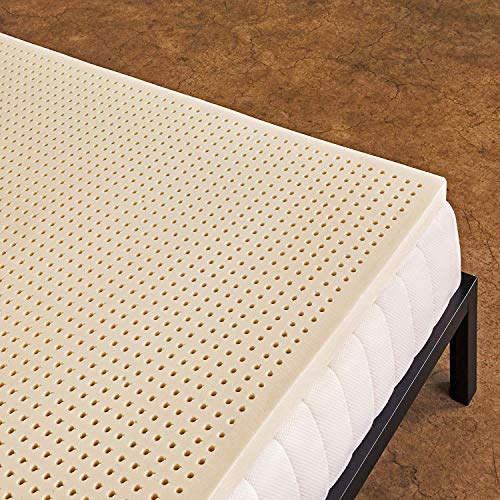
A topper can improve pressure relief on a latex mattress, but an overly soft or thick topper can change spinal alignment by increasing hip/lumbar sinking.
The goal for back sleeping is stable support under the hips combined with cushioning at shoulders and lumbar—layer thickness determines which one wins.
How to think about layers (comfort vs support)
– Aim for “stable comfort”: the comfort system should reduce shoulder/lumbar pressure without letting the hips drop.
– Avoid stacking too much soft material: toppers can help when you’re slightly too firm, but they can also “float” the body into a posture that increases morning stiffness.
– Look for adjustability when available: if a mattress offers replaceable/adjustable comfort layers and clearly describes how configurations change support, you can iterate more safely during a trial.
Quick layer “fit” heuristics (practical and specific)
– If your lower back feels over-extended on a latex mattress, your comfort layer may be too firm relative to your body weight distribution.
– If your lower back feels stressed/sore after sleeping, your hips may be sinking too deep—either due to comfort being too soft or the support core being too low-firm.
What can go wrong (and how to avoid it)
The most common latex mattress failures for fibromyalgia back sleepers are choosing the wrong balance—pressure relief without alignment, or alignment without cushion. If you avoid these traps and insist on clear specs and a meaningful trial period, you reduce the odds of buying a mattress that aggravates symptoms.
A “firm” latex mattress can still cause pain if the comfort layer doesn’t relieve shoulder and lumbar pressure adequately.
A “plush” latex mattress can feel good initially but still worsen symptoms if hip/lumbar alignment drifts over the night.
Common mistakes
– Choosing “firm” without comfort: a latex mattress can be supportive yet still create pressure pain at shoulders or lumbar—especially if the comfort layer is too thin.
– Choosing “plush” without support: a very soft top can feel great at first, then contribute to hip/lumbar sinking and morning aches.
– Ignoring return/warranty details: latex mattresses vary a lot by build, so you need a credible trial period and clear return terms.
– Skipping symptom-based fit: fibromyalgia can be hypersensitive. If specific positions reliably trigger flare-ups, treat that as data—don’t force tolerance if a latex mattress is clearly contributing.
Compare latex vs memory foam (why “pressure relief” can mean different things)
| Back-sleeper criterion | Latex mattress | Memory foam |
|---|---|---|
| Pressure relief mechanism | Buoyant cushioning that distributes load | Deep contouring that increases contact area |
| Alignment risk if comfort is too soft | Can still cause hip sinking (layer dependent) | Can increase “sink-in” posture |
| Response time | Typically faster rebound | Slower contour release |
| Heat/sleep climate (common reports) | Often perceived as more breathable | Often perceived as warmer |
| Motion isolation | Moderate (varies by layer) | Often higher due to contouring |
| Ease of adjusting feel with toppers | Sometimes easier to fine-tune with latex toppers | Toppers can change feel but may add more sink |
| Specification transparency in listings | Often includes ILD and layer thickness | Often less layer-specific (varies) |
| Tender-point “hot spot” risk | Lower when comfort layers are correctly set | Lower when sink contour matches your body, but can worsen if too soft |
| Durability expectations (common industry positioning) | Often positioned as high-recovery over time | Can vary heavily by foam density/quality |
| Best fit logic for fibromyalgia | Choose for pressure relief + stable back support | Choose for pressure relief *and* alignment control |
| Verdict row | Usually a strong starting point for back sleepers needing stable cushioning | Can work, but you must be extra careful about sink-in and alignment |
Verdict: latex is often a strong option—if it matches your support needs
Latex can be a smart choice for back sleepers with fibromyalgia because it’s commonly built to maintain support while still cushioning pressure. That said, latex isn’t automatically the “right” mattress: if it’s too firm (pressure points) or too soft (alignment issues), it can still aggravate discomfort.
Who should skip this approach:
– If you can’t access a return/trial policy or you’re buying without the ability to reassess comfort after a few nights.
– If you have specific medical guidance that conflicts with this general mattress-selection approach—check with your clinician for individualized advice.
If you remember one rule for latex mattress shopping in 2026, make it this: prioritize layer transparency and validate support + pressure relief together, using both your body and the spec sheet.
Frequently Asked Questions
What firmness level should a back sleeper with fibromyalgia choose for a latex mattress?
Most back sleepers with fibromyalgia do best with a medium to medium-firm latex mattress because it supports spinal alignment while reducing pressure on the lower back. Too soft can let the hips sink and strain the lumbar area, which may worsen pain and morning stiffness. A medium-firm feel also helps maintain comfort when fibromyalgia symptoms flare, especially if you alternate between stillness and light movement.
How can I determine if a latex mattress will provide proper lumbar support for fibromyalgia?
Focus on whether your lower back stays supported when you’re lying in your natural back-sleep position. A latex mattress should keep your spine in a neutral alignment without forcing your back into a tilted posture. Look for designs with supportive core zoning or a slightly firmer feel in the middle third, and test by doing a “sit-and-lie” check to confirm comfort across your shoulders, hips, and lumbar area.
Why is latex often recommended for people with fibromyalgia compared with other mattress materials?
Latex is valued for its responsive support and pressure-relieving comfort, which can help minimize tender-point discomfort during sleep. Its natural bounce and slow contouring reduce the “stuck” feeling some sleepers get on memory foam, while still offering cushioning for sensitive areas. Because back pain and widespread tenderness are common with fibromyalgia, the combination of support and pressure relief can make latex mattresses a strong option.
Which latex mattress features matter most for back sleepers with fibromyalgia?
Prioritize pressure relief and support by choosing latex with the right firmness and a supportive construction (often a thicker latex core). Consider cover materials that help with temperature regulation, since overheating can worsen sleep quality for many people with fibromyalgia. If you share a bed, also consider motion isolation so you aren’t disturbed by movement during the night.
Best practices: how should I test and select a latex mattress if I have fibromyalgia and back pain?
Start by lying on the mattress for at least 10–15 minutes in your typical back-sleep position, then reassess how your lower back feels—support should be present without pressure buildup. If possible, try different firmness options (medium vs medium-firm) to see which one keeps your spine aligned and reduces morning stiffness. Choose a mattress with a trial period and clear return policy, because fibromyalgia symptoms can make it hard to judge comfort quickly.
📅 Last Updated: October 29, 2026 | Topic: How to Select a Latex Mattress for Back Sleepers with Fibromyalgia | Content verified for accuracy and freshness.
References
- Fibromyalgia: In Depth | NCCIH
- Fibromyalgia Symptoms, Causes, & Risk Factors | NIAMS
- https://www.mayoclinic.org/diseases-conditions/fibromyalgia/symptoms-causes/syc-20370913
- Latex foam
- https://pubmed.ncbi.nlm.nih.gov/?term=fibromyalgia+sleep+quality+review
- https://pubmed.ncbi.nlm.nih.gov/?term=mattress+firmness+low+back+pain
- https://pubmed.ncbi.nlm.nih.gov/?term=foam+mattress+pressure+relief+pressure+distribution
- https://scholar.google.com/scholar?q=fibromyalgia+sleep+interventions+mattress Google Scholar
- https://scholar.google.com/scholar?q=latex+foam+mattress+pressure+relief+sleep+quality Google Scholar
- https://scholar.google.com/scholar?q=mattress+firmness+low+back+pain+sleep Google Scholar