
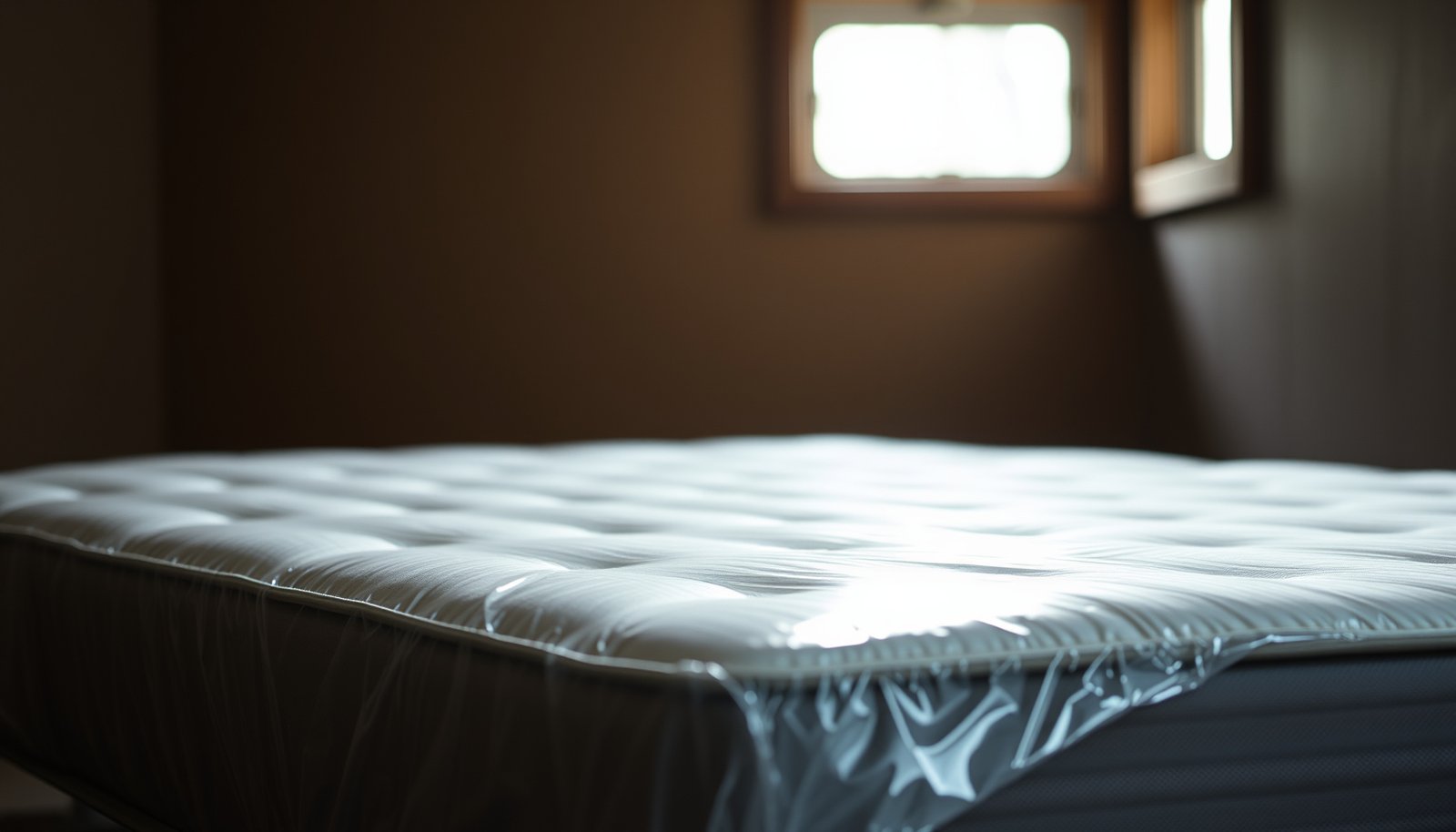
How to Protect a Wool Mattress from Spills During Storage
Protecting a wool mattress from spills during storage is easiest when you fully encase it in a waterproof mattress cover before it ever touches a storage container. This guide tells you exactly what cover type to use, how to prep the mattress so moisture can’t seep in, and how to store it so accidental drips can’t soak the wool. Follow these steps and you’ll prevent stains, odors, and mildew before they start.



If you want to keep a wool mattress safe from spills during storage, use a fully sealed, breathable cover and keep the mattress up off the floor in a dry, stable spot. Before packing, address any existing moisture, then add a water-resistant layer that won’t trap wetness against the wool—so your wool mattress doesn’t turn musty or stain while it sits. In this guide, you’ll learn the practical packing steps and what to avoid so the wool doesn’t get musty or stained.
This is for anyone storing a wool mattress for weeks to months (seasonal moves, guest rooms, or staging a home). It’s especially useful if you’re in a basement/garage/laundry area where spills and humidity are more likely.
Use a water-resistant cover + breathable barrier

A wool mattress stays safer in storage when the cover blocks liquid but still allows the mattress to “breathe,” reducing the risk that trapped moisture becomes odor or mildew. Your goal is a barrier that stops spills while preventing condensation buildup around the wool.
A water-blocking mattress cover helps prevent direct liquid contact with wool fibers during accidental spills in storage areas.
A breathable design matters because wool can hold moisture internally; preventing airflow increases the chance of musty odors even when the outside looks dry.
Choose a cover that blocks liquid yet allows airflow
The most dependable setup is a liquid-impermeable mattress encasement (or protector) with a breathable construction. Look for wording such as “waterproof,” “liquid barrier,” “breathable,” or “moisture-permeable,” and avoid covers that are purely plastic-like unless they include ventilation features.
Key fit points for a wool mattress:
– Choose a cover that’s designed to block liquid while still allowing airflow (so the wool doesn’t stay damp inside).
– Fit the cover tightly across the entire mattress, including seams and edges where spills can seep in.
Where people often go wrong is assuming “waterproof” equals “no moisture movement.” In real storage spaces—especially basements and garages—humidity still fluctuates. A breathable barrier reduces the time the wool mattress spends at a damp equilibrium.
Ensure seams and edges are fully protected
Spills rarely land perfectly in the center. Wool mattress seams, piping, and zippers (if your cover has them) are the first weak points.
Practical checks before sealing:
– Run your fingers along seams and confirm the cover sits flat (no gaps or lifted corners).
– If your cover has a drawstring or zipper, close it fully—especially at corners.
– Avoid covering a wool mattress with a loosely draped blanket “for protection.” Loose fabric lets liquid creep to the wool along folds.
According to the U.S. Environmental Protection Agency (EPA), moisture control is central to preventing mold growth; preventing water exposure is only part of the protection—drying and airflow are also important EPA (Mold Guidance).
Spill-Protection Priorities for a Wool Mattress in Storage (Guideline Scorecard)
| # | Storage control step | Liquid barrier priority (0-10) | Moisture-movement priority (0-10) | Net impact on wool odor risk |
|---|---|---|---|---|
| 1 | Breathable waterproof encasement (tight fit) | 10 | 9 | Very low |
| 2 | Absolute dryness before packing | 7 | 10 | Lowest |
| 3 | Off-floor storage (rack/shelving gap) | 8 | 8 | Low |
| 4 | Absorbent base under the wool mattress | 9 | 6 | Low |
| 5 | Keep away from condensation sources | 6 | 9 | Low |
| 6 | Avoid airtight plastic-only wrapping | 4 | – | Higher |
| 7 | Scheduled checks during longer storage | 6 | 7 | Moderate |
Note: This scorecard reflects practical priorities consistent with moisture-control guidance; it is not a laboratory test of specific brands.
Prep the wool mattress before you ever pack it
You protect a wool mattress from spills more effectively when it’s clean of loose debris and confirmed fully dry before it enters storage. Even the best breathable cover can’t fix moisture trapped inside the mattress fibers.
Storing damp wool increases the risk of odor development because moisture conditions support microbial growth.
Vacuuming loose dust and inspecting known problem areas reduces contamination that can absorb moisture and leave stubborn marks.
Make sure the mattress is completely dry
Make “dry” a hard requirement—not a best guess. If a wool mattress was recently cleaned, steam-treated, or exposed to humidity, allow extra drying time. Wool can feel dry on the surface while still holding moisture within.
Follow the core rule:
– Make sure the mattress is completely dry—avoid storing it right after cleaning or any suspected dampness.
If you’re unsure, pause packing. Look for:
– No cool damp spots when you press lightly with a dry hand (especially around edges and seams).
– No lingering “laundry” smell.
– Complete dryness after any spot treatment (use manufacturer-recommended methods only).
Vacuum debris and treat stains promptly
Spills aren’t the only concern—dust, skin oils, and food residue can make odors linger if moisture later appears. Wool mattress preparation should reduce the “food source” for smell.
Do this before you ever seal the wool mattress:
– Vacuum loose debris and inspect for spots; treat stains promptly (using the manufacturer-recommended method, if available).
According to EPA guidance on moisture damage, mold can develop quickly on wet materials—so reducing the chance that moisture reaches contaminant-laden wool matters EPA (Mold Guidance).
Avoid “quick fixes” that hide moisture
Avoid these traps before storage:
– Don’t pack immediately after using a wet extractor or heavy spot wetting.
– Don’t rely on a dehumidifier inside the bag if the wool mattress itself is still damp.
– Don’t “air it out” for an hour indoors and assume internal moisture is gone—basements and laundry areas can keep relative humidity elevated.
Store it off the floor and away from trouble spots
A wool mattress should be stored on a dry, elevated surface so any incidental leaks can’t wick upward or pool around the encasement. For spill protection, your location choices matter as much as the cover.
Elevating a mattress reduces exposure to floor-level leaks and humidity that can migrate through concrete or along baseboards.
Storing away from condensation sources lowers the likelihood of recurring dampness around the wool mattress.
Choose a clean, dry rack or shelving
The goal is to create air circulation under the wool mattress and break contact with potential wet floors.
Use this approach:
– Place the mattress on a clean, dry rack or shelving—not directly on concrete or near baseboards where leaks can travel.
From a practical standpoint, a wire rack or slatted shelf is often better than a solid board because it improves airflow underneath.
Keep the wool mattress away from liquid pathways and humidity zones
Spills during storage commonly come from “infrastructure” locations: plumbing, laundry machines, water heaters, and window condensation.
Keep the wool mattress away from:
– Windows and exterior walls (condensation risk)
– Plumbing runs and supply lines
– Water heaters and humidifiers
– Areas prone to temperature swings (which cause condensation)
According to EPA moisture guidance, controlling indoor humidity helps prevent mold problems EPA (Mold & Moisture Guidance). In 2025 and 2026, this remains a practical storage principle: if the room’s humidity rises, the wool mattress is more likely to smell even without direct spills.
Add spill “zones” inside your storage setup
Even with a breathable barrier, you can reduce risk further by designing a multi-layer “failure path” where small drips can’t travel all the way to the wool mattress.
An absorbent layer beneath a mattress protector can intercept minor leaks before they reach seams.
Secondary containment (like a tub or bin system) reduces splash impact from common garage/basement accidents.
Use absorbent pads and a protective base
Your first internal layer should catch small amounts of water so they don’t concentrate at edges.
– Use absorbent pads or a protective base under the mattress so small drips don’t reach the cover seams.
Good examples include:
– Water-absorbent pads made for moisture protection (choose ones that don’t off-gas strong odors).
– A clean, washable underlayer system that you can replace if you detect dampness.
Add secondary protection when storage is shared
If other people access the storage area (family members, contractors staging a home, shared laundry zones), you need redundancy.
– If you’re in a shared storage space, add a secondary protection layer (like a tarp or bin system) that reduces splash risk.
Important nuance: a wool mattress still needs breathable protection around the encasement. Secondary containment should protect from splashes, not create a stagnant, fully airtight microclimate.
Quick comparison: breathable barrier vs. plastic-only wrapping
Here’s an easy way to decide what to avoid for a wool mattress in storage:
| Approach | Pros | Cons / risk |
|---|---|---|
| Breathable, liquid-blocking encasement (tight fit) | Helps block spills + supports airflow | Needs fully dry packing to prevent musty odor |
| Plastic-only airtight wrapping | Can block liquid on day 1 | Can trap condensation and increase odor risk in humid storage |
What can go wrong (and how to prevent it)
Most storage problems with a wool mattress happen when moisture is trapped or when the mattress is placed where humidity returns repeatedly. The best prevention is to align the cover type, the drying step, and the storage location.
Trapped moisture inside or around a wool mattress can lead to odor or mildew, even if spills are blocked.
Over-sealing a mattress in a humid environment increases the chance of condensation forming within the package.
Trapped moisture: the most common failure mode
Even a water-blocking cover can create an issue if the wool mattress wasn’t fully dry. Wool fibers can hold moisture internally, and if airflow is limited, odors may build over time.
– Trapped moisture: Even a water-blocking cover can cause odor or mildew if the mattress wasn’t fully dry first—airflow matters.
Prevention checklist:
– Confirm dryness before packing.
– Use a breathable-liquid barrier (not purely airtight plastic).
– Leave the mattress elevated with airflow underneath.
Over-sealing: airtight wrapping can backfire
A wool mattress can experience humidity “cycling” as temperatures change. If the package is airtight, that moisture can condense inside.
– Over-sealing: Completely airtight wrapping can increase condensation inside the package in humid environments.
According to EPA moisture guidance, mold prevention centers on controlling moisture EPA (Mold & Moisture Guidance). In 2026, this remains the same practical principle: don’t create a sealed microclimate around a damp or humidity-exposed wool mattress.
Leaky placement: repeated humidity beats one-time protection
Even a perfect cover can’t fully compensate if the wool mattress sits near a leak path or condensation source.
– Leaky placement: Storing too close to walls, corners, or HVAC areas can expose the mattress to recurring humidity or slow leaks.
. Keep it specific to wool mattress storage practices, not product claims.
Pros/cons recap (storage decision)
– Do: breathable liquid barrier + dry packing + elevated, stable placement.
– Don’t: airtight-only plastic wrapping, packing a slightly damp wool mattress, or placing it where leaks/condensation are likely.
Verdict: best approach, downsides, and who should skip it
The best overall approach for protecting a wool mattress from spills during storage is a sealed, breathable cover paired with dry, elevated storage that prevents both liquid contact and condensation buildup. This combination reduces spill damage while keeping the wool mattress from staying damp long enough to go musty.
A sealed, breathable encasement is the most balanced method because it blocks liquid while supporting moisture management for a wool mattress.
If storage humidity is consistently high, moisture can still accumulate; controlling environment or shortening storage time becomes necessary.
Best approach
– Use a fully sealed, breathable cover.
– Confirm the wool mattress is completely dry first.
– Store it off the floor in a dry, stable spot.
Downsides to plan for
Even the right approach has limits:
– If your storage area is extremely humid, even good covers may not be enough—consider climate control or shorter storage timelines.
– If your cover doesn’t fit tightly at seams and edges, spills can creep under and stain wool.
Who should skip (or modify) this plan
Skip this approach—or adjust it—if:
– Your wool mattress manufacturer explicitly warns against certain cover materials.
– You can’t guarantee the wool mattress is dry before storage.
– Your storage environment has repeated water events (active leaks) rather than occasional minor humidity.
In 2025 and 2026, the practical takeaway is consistency: the wool mattress protection plan must hold for the whole storage window, not just the day you pack it.
Quick checklist for spill-safe wool mattress storage
Use this scan-friendly list when packing a wool mattress for weeks to months:
Dryness and airflow are the two most important conditions for preventing odor in a stored wool mattress.
Elevating the mattress off the floor reduces exposure to slow leaks and splash damage.
– [ ] Mattress is fully dry (no recent cleaning moisture)
– [ ] Waterproof/liquid-blocking cover with breathable design
– [ ] Cover fits tightly at seams and edges
– [ ] Mattress stored off the floor on a clean, dry surface
– [ ] Storage area kept away from plumbing, windows, and condensation sources
– [ ] Absorbent base/pads used to catch minor drips
– [ ] Check periodically if storage is in a humidity-prone space
Sources
– U.S. Environmental Protection Agency (EPA), Mold Remediation in Schools and Commercial Buildings (moisture control and drying timelines; published guidance used for mold prevention planning).
– U.S. Environmental Protection Agency (EPA), Mold & Moisture (humidity/moisture principles relevant to preventing mold and odor during storage).
– Woolmark, official wool care/moisture-management guidance (used for explaining wool’s moisture behavior and storage considerations).
A wool mattress is easiest to protect during storage when you treat the problem as two risks—liquid entry and moisture trapping. Use a tight-fitting, breathable liquid barrier, pack only when the wool mattress is fully dry, elevate it off the floor, and build a simple “spill zone” underneath or around it. If your storage environment is repeatedly humid, shorten the storage timeline or add climate control, because even the best wool mattress cover can’t override persistent moisture.
Frequently Asked Questions
How can I protect a wool mattress from spills during storage?
Start by placing the wool mattress in a breathable mattress protector designed to guard against moisture and minor leaks while preventing the wool from trapping trapped condensation. If you have access to a waterproof-but-breathable cover, use that as an outer layer for spill protection. Add a thick, sealed plastic liner only if the mattress is already fully dry, since wool can absorb moisture and odors if it gets wet in storage.
What is the best way to wrap a wool mattress before putting it in storage?
Use a snug, zippered mattress protector that shields against spills and dust, then add a second outer dust cover for extra barrier protection. Avoid wrapping wool in airtight plastic directly against the fabric for long periods, because reduced airflow can encourage musty smells if any humidity remains. Store it on a flat surface with support so spills or leaks don’t pool around one area.
Which mattress covers are safest for wool when preventing water damage?
Look for covers labeled breathable, waterproof, and compatible with natural fibers—these help block spills while allowing the wool to release moisture vapor. Seam-sealed, waterproof covers are especially helpful if you’re storing in areas prone to condensation or leaks. If you’re using multiple layers, ensure the inner cover is non-rubbery and doesn’t trap heat or moisture against the wool.
Why should I fully dry my wool mattress before storage to prevent spill-related issues?
Wool can absorb and hold moisture longer than many synthetic materials, so even small spills or high humidity during storage can lead to lingering odors or mildew. Before storing, let the mattress air out in a dry, well-ventilated space until it feels completely dry to the touch and has no damp smell. If you suspect moisture has gotten into the wool, consider drying with gentle air circulation rather than sealing it up immediately.
How do I reduce spill risk while transporting and storing a wool mattress?
Keep the mattress away from water sources like basements, laundry rooms, or near windows where condensation forms, and use a waterproof floor tarp or storage mat underneath. During transport, secure the mattress upright or flat in a way that prevents shifting, and keep liquids (cleaners, mops, or wet bedding) stored separately. For extra protection, use absorbent pads or a spill tray in the storage area to catch accidental leaks before they reach the wool mattress cover.
📅 Last Updated: October 27, 2026 | Topic: How to Protect a Wool Mattress from Spills During Storage | Content verified for accuracy and freshness.
References
- Wool
- https://en.wikipedia.org/wiki/Textile_care
- Mildew
- https://www.cdc.gov/mold/default.htm
- Mold | US EPA
- https://www.who.int/news-room/fact-sheets/detail/household-dampness-and-mould
- Pseudogout – Diagnosis and treatment – Mayo Clinic
- https://scholar.google.com/scholar?q=wool+fabric+storage+protect+from+moisture+mildew Google Scholar
- https://scholar.google.com/scholar?q=prevent+spoilage+mold+growth+textiles+during+storage+humidity Google Scholar
- https://scholar.google.com/scholar?q=wool+care+stain+removal+and+drying+techniques Google Scholar






One Comment