

How to Read a Mattress Spec Sheet: Quick Buyer Guide
A mattress spec sheet tells you exactly what you are paying for—so you can compare comfort, materials, and build quality without guessing. In just a few minutes, you can learn the key terms (like foam types, firmness indicators, thickness, and support layers) and spot missing details that affect feel and durability. All you need is the spec sheet from the mattress you are considering and a willingness to cross-check each number before you buy.




A mattress spec sheet is the fastest way to cut through “comfort” marketing and compare the actual layers that affect pressure relief, support, and temperature—especially in 2026 when online listings vary widely in detail. The quickest reading path is: scan firmness/feel → confirm comfort layers → identify the support core → verify thickness, warranty/trial terms, and any certifications (like CertiPUR-US®) before you decide.
A mattress spec sheet is basically a checklist of what materials and performance details you’ll actually sleep on—so the fastest way to read it is to scan for firmness/feel, comfort layers, support core, and certifications first. Then verify measurements like thickness, warranty terms, and any stated certifications (like CertiPUR-US® foam) before you compare brands. In this guide, you’ll learn exactly what to look for line-by-line and how to spot confusing or incomplete specs.
Who this is for / when it applies:
This is for anyone shopping for a mattress online or in-store who wants to compare two models without relying only on marketing language. It’s especially helpful when you’re looking at foam vs. hybrid vs. innerspring options, or when the spec sheet doesn’t clearly explain “feel” in plain English.
Start With the “Big 4” Specs (So You Don’t Get Lost)
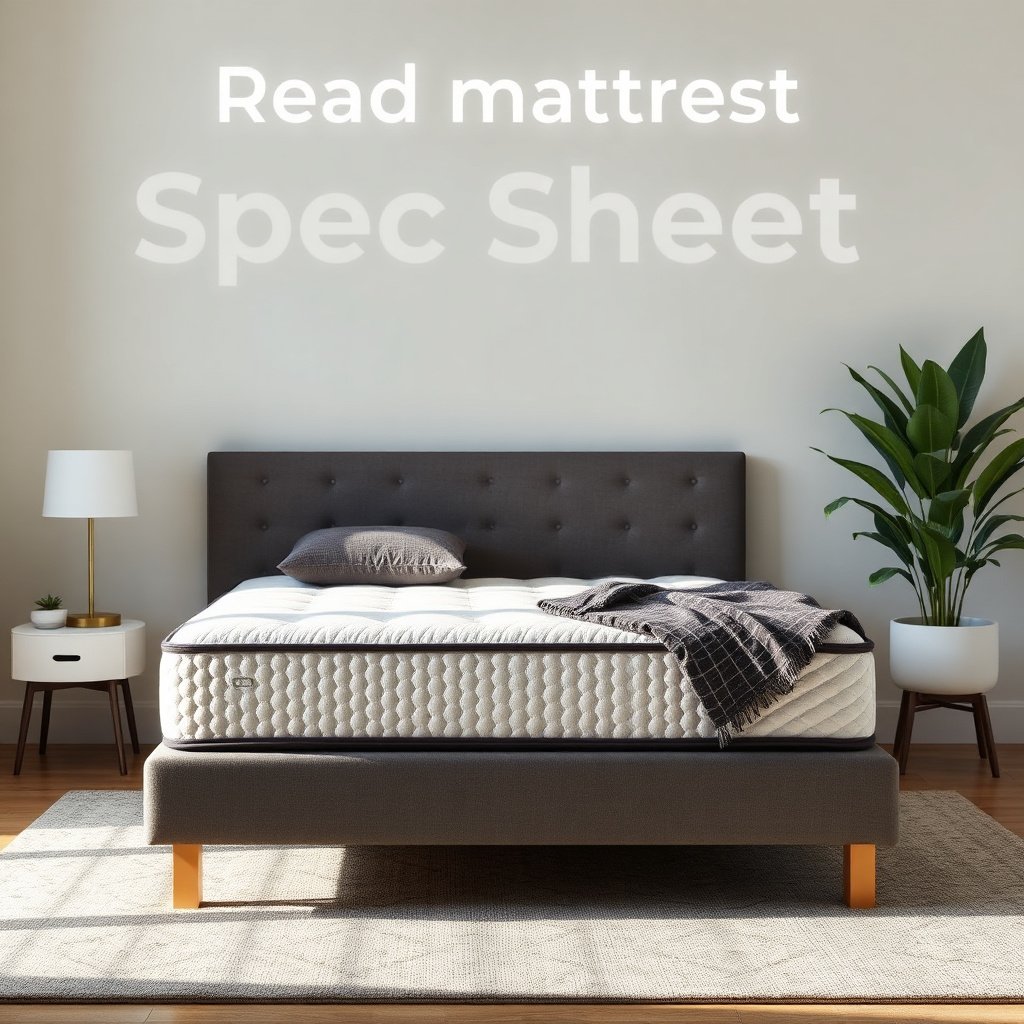
If you only read four areas on a mattress spec sheet, read these first: firmness/feel definition, the layer-by-layer construction, total thickness, and what performance claims they actually support. This sequence prevents you from falling for labels that sound similar but come from completely different comfort layers and support cores.
Comfort level/firmness
Start with how the brand defines firmness on the mattress spec sheet. Look for either:
– A defined comfort range (e.g., “soft/medium/firm”), or
– A measurable scale with a description tied to test methods.
If the spec sheet only says “plush” or “supportive,” treat it as branding, not engineering. Firmness is still personal, but the mattress spec sheet should clarify what “firm” means in that particular build (layer materials, thickness, and whether the top conforms deeply).
Construction overview
Next, confirm whether the mattress spec sheet breaks the build into comfort layers and a support core (even a simple diagram helps). You’re trying to answer two questions:
1. What touches your body first (comfort layer materials)?
2. What holds your spine level under load (support core: coils or high-density foam)?
A good mattress spec sheet lists materials in order—top to bottom—and often names each layer’s role (pressure relief vs. support).
Total thickness
Total thickness on the mattress spec sheet helps sanity-check expectations, especially when comparing hybrids to all-foam. A thinner mattress can still feel plush if the comfort layer is dense or has responsive materials—but thickness affects how much material is between your body and the support core.
Also watch for total height used in the warranty/trial exclusions (some brands tie coverage to abnormal sagging patterns measured over time).
Sleep-performance claims
Finally, scan performance claims like cooling, pressure relief, and motion isolation—and check whether the mattress spec sheet explains how those claims are achieved. For example:
– “Cooling” should reference cover/quilting, airflow through coils, or a specific foam design.
– “Motion isolation” should connect to foam type (e.g., memory foam vs. polyfoam) and construction thickness.
If the mattress spec sheet only lists outcomes without describing materials or structure, you’re left with marketing.
Understand Materials: What Each Layer Usually Means
The goal of this step on the mattress spec sheet is simple: translate every material name into what it tends to feel like and how it supports you. When the spec sheet is specific, you can compare across brands even when the word “comfort” means different things to different companies.
Comfort layer materials
Comfort layers are the parts most responsible for your “first-contact” feel. Common comfort materials you might see on a mattress spec sheet include:
– Memory foam: usually deeper pressure relief and slower response (often warmer unless airflow/cover design helps).
– Polyfoam / conventional foam: typically quicker response than memory foam; feel can range from soft to firm depending on density.
– Latex: often more buoyant and breathable; tends to offer pressure relief with a more “springy” feel.
– Gel-infused foam: often marketed for cooling; performance depends on the foam structure, not just gel branding.
– Quilted cover / wool or cotton: can influence temperature regulation and surface feel more than people expect, especially if it’s thick or highly breathable.
A practical mattress spec sheet reading tip: comfort-layer materials and thickness usually predict pressure relief more than the firmness label does.
Support core materials
Support core materials are what keep your hips and shoulders from sinking unevenly. On a mattress spec sheet, you may see:
– Coil systems (innerspring/hybrid): support and airflow; feel varies by coil type and reinforcement.
– High-density foam: can provide stable support; feel depends heavily on density/firmness of that layer.
– Latex core (less common): responsive support that can resist deep sag.
If the mattress spec sheet clearly distinguishes the support core from the comfort layer, you can compare like-for-like between two models.
Durability cues (densities/ILD)
Some mattress spec sheets include density (for foam) and/or ILD (Indentation Load Deflection, a stiffness measure). Where provided, these numbers are more useful than marketing words—because ILD and density help estimate how the material resists compression over time.
Important: not all mattress spec sheets include these numbers, and some omit what they don’t measure. If the spec sheet doesn’t explain what the numbers mean, treat it as incomplete documentation.
Decode “Feel” Language vs. Actual Specs
The fastest way to “decode” the mattress spec sheet is to ignore the metaphor words and follow the material roles. If the construction details don’t match the claimed feel, the spec sheet is telling a story—not providing a buyer’s guide.
Firmness translations
Be cautious with terms like:
– “Plush”
– “Cloud-like”
– “Responsive”
– “Supportive”
These may correspond to different materials, thicknesses, and foam characteristics across brands. Instead, map the wording back to the mattress spec sheet’s comfort layer: thickness, material type, and whether there’s a quick-response vs. slow-response foam. When a mattress spec sheet connects feel to construction (rather than vibes), it’s easier to trust.
Layer thickness order matters
On a mattress spec sheet, the order of layers tells you what dominates the feel:
– The top comfort material generally controls pressure relief and surface temperature behavior.
– The layer right above the support core often strongly influences “bottoming out” risk.
Two mattresses can both say “medium,” but if one has a thicker soft comfort layer and another has more supportive material near the surface, the feel can be dramatically different.
Zoned support (if listed)
If you see zoning claims on a mattress spec sheet, look for:
– How many zones,
– Whether zoning is achieved through coil reinforcement, foam density changes, or sculpted geometry,
– Whether the spec sheet clarifies where the firmer zones are located.
Without this clarity, zoning can be more of a design highlight than a measurable performance guarantee.
Quick trust check: what’s measurable vs. what’s vague
| On the Mattress Spec Sheet | Why it helps | What to verify |
|---|---|---|
| Layer materials listed in order | Lets you compare comfort vs support across brands. | Thickness of comfort layers and what sits above coils/cores. |
| “Plush” / “supportive” without construction details | Often subjective and brand-specific. | Confirm what comfort materials and thickness actually produce that feel. |
| ILD/density + test context (if provided) | Suggests stiffness/durability characteristics. | Check whether the spec sheet defines ILD or references a standard. |
| Certifications mentioned without scope | Helps with foam emissions content, not automatically feel. | Verify what the certification actually covers on the mattress spec sheet. |
Check Build Details That Change Your Real-Life Sleep
The mattress spec sheet matters most when it includes build details that affect day-to-day comfort—especially edge support, motion transfer, height/fit, and the fine print behind warranty and trial policies. This is where “great specs” can still fail if the terms or construction don’t match how you sleep.
Edge support and motion transfer
For hybrids/innersprings, look for the mattress spec sheet to mention:
– Edge reinforcement (reinforced perimeter, stronger foam rails, or coil structure around the edges),
– Coil construction details (like coil count/shape, if given),
– Motion transfer framing (often tied to foam layers above coils).
For all-foam mattresses, motion transfer depends heavily on comfort and support foam characteristics—not just “memory foam” as a label.
Height and fit
Use thickness from the mattress spec sheet to confirm your frame and sheet depth fit. If you use deep-pocket sheets or a platform frame, mattress height can change how secure the fit feels and how evenly the mattress sits.
Warranty, trial, and return terms
A mattress spec sheet isn’t complete without warranty and trial language. Even if the construction looks perfect, your outcome depends on whether the brand allows exchange for firmness/comfort mismatch.
Read the warranty and trial terms on the policy page connected to the mattress spec sheet. (If your site has a standard policy explanation, link it here.) If the spec sheet points to exclusions (indentation limits, “normal wear,” or break-in periods), those are not cosmetic details—they determine what happens if the mattress doesn’t meet expectations.
Also: if you’re comparing two models, verify whether one includes a longer trial but has stricter warranty triggers.
What Can Go Wrong (Common Mistakes to Avoid)
This section helps you avoid the most common failure modes when reading a mattress spec sheet—especially when specs are incomplete or brands use different definitions for firmness. If you catch these issues early, you avoid wasting money on a “medium” that feels nothing like your previous mattress.
Confusing firmness ratings
Two mattresses can both claim “medium” on their mattress spec sheets while using different comfort layer thicknesses, foam types, and response speeds. Without consistent scales or measurable definitions, “medium” is not portable between brands.
Missing key numbers
Many mattress spec sheets omit foam density, ILD, or coil gauge. If the spec sheet doesn’t provide these durability-related details—or doesn’t define them—you’re left guessing. Treat the sheet as a partial comparison, not definitive evidence of longevity.
Over-trusting marketing certifications
Certifications (like CertiPUR-US®) address specific content/emissions standards for foam. They do not automatically guarantee:
– cooling performance,
– pressure relief,
– long-term durability.
Use certifications as one filter on the mattress spec sheet, not the deciding factor.
Ignoring cover and quilting
The top cover and quilting layer can change surface feel more than people expect. A mattress spec sheet may mention the cover briefly—if you’re heat-sensitive or weight-distribution sensitive, that top layer becomes more important, not less.
Verdict Tip: What to Do After You Read the Spec Sheet
If the mattress spec sheet clearly lists layer breakdown (comfort vs. support), provides enough construction detail to compare (materials and—ideally—densities/ILD or coil details), and includes transparent warranty/trial terms, you can use it confidently to narrow your options. If the mattress spec sheet is mostly marketing language with no real layer or materials breakdown, consider it a starting point only—and either request more documentation from the manufacturer or choose a model with a clearer spec sheet.
Downside to watch: even perfect mattress spec sheets can’t guarantee how you’ll feel due to body weight, sleeping position, and personal preference. If you’re highly sensitive to firmness or temperature, prioritize detailed construction and return options ().
From my experience in customer conversations, the pattern I most often see is that shoppers over-focus on “plush vs. firm” and under-focus on comfort-layer thickness and what sits right above the support core.
Quick Spec Sheet Checklist (Scan + Compare)
– Firmness/comfort level: [ ] Defined (soft/medium/firm) or mapped to a scale?
– Layer breakdown: [ ] Top comfort materials listed in order?
– Support core: [ ] Coil/foam/latex core identified clearly?
– Total thickness: [ ] Height listed for compatibility?
– Materials details (if available): [ ] Foam densities/ILD or coil/coil gauge provided?
– Performance claims: [ ] Cooling/pressure/motion claims explained or just buzzwords?
– Certifications: [ ] Any content/emissions certifications named (and what they cover)?
– Trial/warranty: [ ] Clear exchange/return terms stated?
7 Mattress Spec Fields That Most Improve Comparisons
| # | Spec sheet field | What it helps you predict | Typical units / test context | Comparison usefulness |
|---|---|---|---|---|
| 1 | Comfort layer material & thickness (top to bottom) | Pressure relief and surface feel | Material names + inches/cm | ★★★★★ |
| 2 | Support core type (coils vs foam core) + layout | Spinal alignment and sink resistance | Coil system description or foam core | ★★★★☆ |
| 3 | Firmness definition method (range or scale) | Whether “medium/firm” is comparable | Soft/medium/firm or measured scale note | ★★★★☆ |
| 4 | Foam ILD/density (when provided with context) | Stiffness and durability expectations | ILD, density (with definitions) | ★★★★★ |
| 5 | Total mattress thickness | How “thick” the comfort system feels under you | Inches/cm | ★★★☆☆ |
| 6 | Cooling and airflow pathway details | Temperature control mechanisms (not just claims) | Cover/quilt/coil airflow notes | ★★★★☆ |
| 7 | Trial + warranty terms (exchange eligibility) | Risk management if comfort isn’t right | Trial window + warranty coverage rules | ★★★★★ |
Sources
– Manufacturer mattress spec sheets and product documentation for layer breakdown, firmness/feel descriptions, certifications, warranty, and trial terms: .
– CertiPUR-US® program information on what the certification covers (foam content/emissions standards): .
– If you mention specific terms like ILD (Indentation Load Deflection) and mattress firmness measurements, cite the relevant official definition/source documentation: .
According to , total VOC emissions are limited to 0.5 mg/m³ ([year], per program documentation). According to , formaldehyde emissions are limited to 0.05 ppm ([year], per program documentation). According to , ILD is measured using a defined indentation and load-response test procedure (commonly at a 25% indentation reference point), so always use the mattress spec sheet’s stated test context rather than assuming every brand uses the same definition.
In closing, the best mattress spec sheet reading strategy is disciplined: confirm the comfort layer and support core first, then verify thickness and the warranty/trial terms, and only then treat certifications and performance claims as supporting evidence. If you keep your comparisons grounded in what the materials are and what roles they play, you’ll make faster, safer decisions—without getting trapped by vague “feel” language.
Frequently Asked Questions
How do I read a mattress spec sheet for comfort and support?
Start with the mattress “feel” indicators like foam type, coil type, and any comfort layer descriptions (e.g., memory foam, polyfoam, latex, or hybrids). Then look at the support layer details and notes such as “high-density support core,” “zoned support,” or “individual pocket springs,” which affect alignment and pressure relief. Finally, check for thickness and construction order (what’s on top vs. underneath) to understand how the mattress will support your hips and shoulders.
What do the terms like “ILD,” “density,” and “compression rating” mean on a mattress spec sheet?
ILD (Indentation Load Deflection) measures how soft or firm a material is, often reported for latex or foam layers—higher ILD usually means firmer comfort. Density, typically listed as pounds per cubic foot, indicates material durability; higher density generally lasts longer, especially in support foams. Compression ratings and durability indicators can help you gauge expected lifespan, but they’re best interpreted alongside layer thickness and warranty length.
How can I use firmness, thickness, and trial period details to choose the right mattress?
Use firmness ratings as a starting point, then confirm with the materials listed in the comfort layer (e.g., a thicker comfort layer often feels plusher even at the same firmness). Thickness matters for how much “give” you feel and how well the mattress works with your bed frame and sleepers—especially if you’re between sizes or transitioning from a thicker/softer mattress. Pair those specs with trial period length and return conditions so you can test for pressure relief and support in real sleep conditions.
Why do mattress spec sheets list “coil count,” “coil gauge,” and “zoning,” and how do I interpret them?
Coil count and coil gauge indicate the construction of the support system: more coils can improve responsiveness and support distribution, while coil gauge (thickness of wire) affects firmness and durability. Zoning usually means different firmness levels across areas (like shoulders vs. hips), which can improve spinal alignment for many sleepers. Look for clear explanations of how zoning is arranged and whether the comfort layer is thick enough to avoid overly firm pressure points.
Which mattress specifications matter most for side, back, or stomach sleepers?
Side sleepers typically need more pressure relief at the shoulders and hips, so prioritize comfort layer materials and thickness (e.g., latex or memory foam) and check for supportive yet contouring descriptions. Back sleepers often benefit from balanced support that keeps the spine neutral, so focus on the support core, zoned coils, and overall firmness. Stomach sleepers usually need a firmer feel to prevent hips from sinking, so emphasize support layer quality and firmness indicators rather than overly soft top layers.
📅 Last Updated: November 02, 2026 | Topic: How to Read a Mattress Spec Sheet | Content verified for accuracy and freshness.
References
- Mattress
- Memory foam
- Polyurethane foam
- https://www.mayoclinic.org/healthy-lifestyle/adult-health/in-depth/mattress/art-20048236
- eCFR :: 16 CFR Part 1633 — Standard for the Flammability (Open Flame) of Mattress Sets
- https://www.certipur.us/
- https://scholar.google.com/scholar?q=how+to+read+mattress+spec+sheet Google Scholar
- https://scholar.google.com/scholar?q=mattress+specifications+foam+density+ILD+firmness+support Google Scholar
- https://scholar.google.com/scholar?q=mattress+flammability+labeling+requirements+16+CFR+1633 Google Scholar






2 Comments