

How to Choose Between Memory Foam and Hybrid Mattresses
Which should you choose—memory foam or a hybrid mattress—when pressure relief and support both matter? It comes down to how you sleep: prioritize contouring for side sleepers and consistent edge-to-core support and airflow if you overheat or move during the night. You can narrow it down in about 20 minutes by noting your sleep position, desired firmness, and whether you need motion isolation, then matching those notes to each mattress’s construction.



If you want consistent pressure relief and you sleep hot or change positions a lot, memory foam is often the safer bet; if you want more “bounce” and better airflow, a hybrid usually fits better. The quickest way to decide is to compare your top priority (comfort/pressure relief vs. temperature/motion) against how each mattress is built: foam layers vs. foam-over-coils.
You should use this guide if you’re stuck between a traditional all-foam feel and a foam-and-spring (hybrid) feel, and you want a practical way to narrow it down before you buy. It’s also helpful if you have back/side-sleep needs or you share a bed and motion transfer matters.
Start with your sleep position and comfort goals
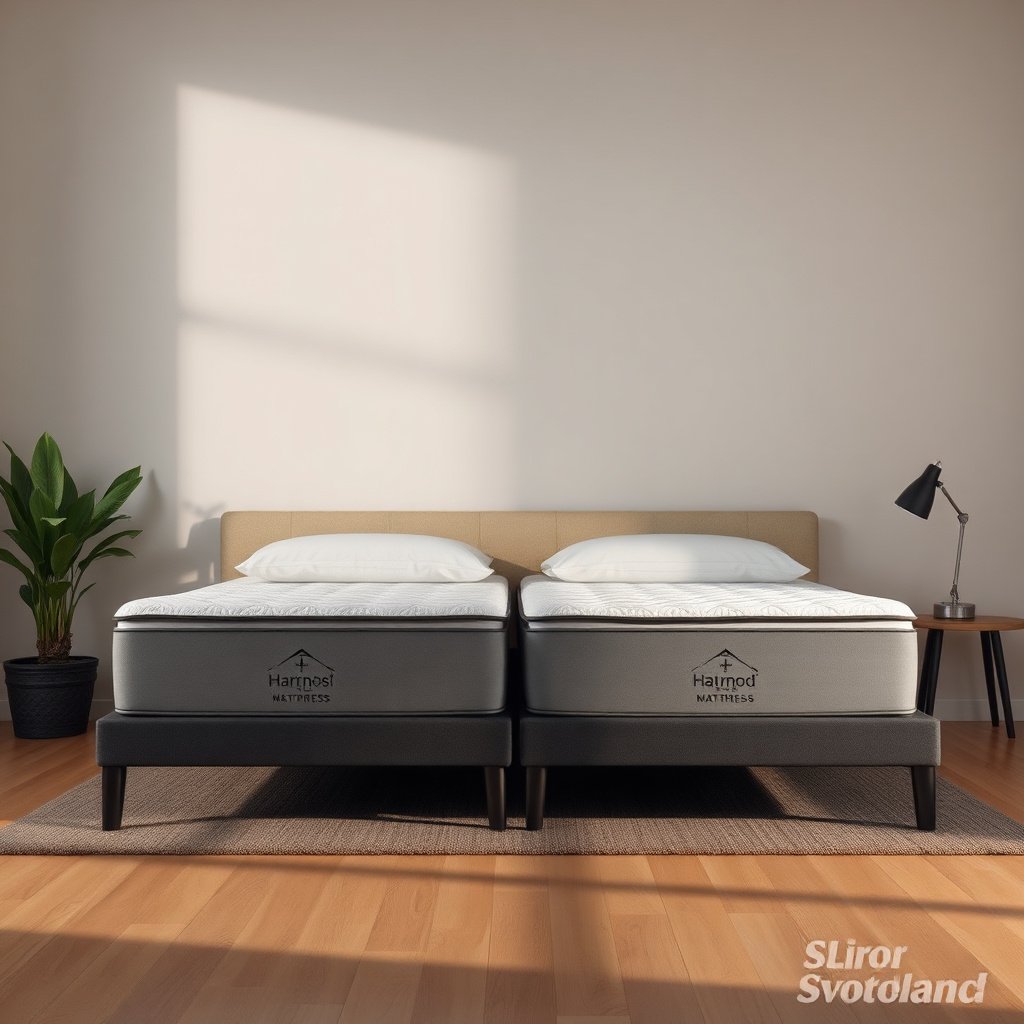
If you’re trying to match the feel to how you naturally land on the mattress each night, your sleep position is the best starting point. The goal isn’t “softer is better”—it’s getting enough cushioning for pressure relief while maintaining spinal support.
– Side sleepers and people who want “hugging” pressure relief often lean toward memory foam comfort layers.
– Back sleepers may do well on either, but the key is getting the right balance of cushioning and support (not just softness).
– If you prioritize easier movement and a more responsive feel, hybrid mattresses are usually the easier transition.
Side sleeping puts your shoulders and hips under the most load because they’re smaller contact points. Memory foam mattresses tend to excel here because the foam’s viscosity allows it to contour around bony areas (shoulders/hips) rather than only “resting” on top. Hybrid mattresses can also work for side sleepers, but you’ll want to pay close attention to comfort-layer thickness and firmness so your hips don’t sink too far and pull your lower back out of alignment.
Back sleepers generally need a flatter, more supportive surface than side sleepers—meaning pressure relief without excessive sink. In practice, this means memory foam can work when it has enough support beneath the top layers (not just plushness). Hybrids often feel easier to position because coils help maintain a stable “platform,” but you still want the comfort layer to prevent pressure buildup under the lower back.
From my experience helping friends narrow choices (and from how buyers describe first-week adjustments), the hardest misses usually come from choosing based on “plushness” rather than how the foam or coils behave after 10–20 minutes of lying still.
Compare pressure relief: how each mattress feels
If your priority is reducing pressure points, both memory foam and hybrids can do it—but they do it differently. Memory foam usually offers more conforming “hug,” while hybrids often provide a cushion-plus-lift sensation.
– Memory foam typically conforms closely to shoulders/hips, which can reduce pressure points when the mattress is the right firmness for you.
– Hybrid mattresses often combine a softer foam comfort layer with coils underneath, which can still relieve pressure but with more lift.
– If you’re unsure, focus on whether you need “more sink” or “less sink” to keep your spine aligned.
What “pressure relief” really means in mattress terms
Pressure relief is about how the mattress distributes load across your body. Memory foam addresses it by increasing contact area through slow contouring: the comfort layer molds around curves, which can reduce localized stress at shoulders and hips. Hybrid mattresses pair a comfort foam layer with a coil support core. The foam still cushions, but the coils typically reduce how deeply you sink—so pressure relief often feels more “supported” than “embraced.”
A quick, practical alignment check (useful for both memory foam and hybrid)
When you lie on a mattress:
1. Pay attention to your hips first. If your hips sink noticeably lower than your shoulders, your lower back often compensates.
2. Notice whether your shoulders feel “buried” (too much sink) or “pinched” (not enough contouring).
3. Give it 10–15 minutes before judging. Memory foam comfort layers usually need time to fully contour.
If you’re between firmness options, this is where choosing the right balance matters more than chasing the most plush top. Too-soft comfort on both a memory foam and hybrid can lead to misalignment and increased morning stiffness.
Featured comparison table: pressure relief feel vs. structure
| Feature | Memory foam (typical behavior) | Hybrid (typical behavior) |
|---|---|---|
| How it cups bony areas | High conformity; gradual contouring | Cushioning over a firmer coil platform |
| “Sink” sensation | Usually more noticeable | Often less, especially with pocketed coils |
| Spine alignment risk (too soft) | Higher if support layers are inadequate | Lower if coil core is tuned correctly |
| Surface pressure distribution | More even contact over time | Even contact with less deep compression |
| Bounce/withdrawal speed | Slower “release” from contour | Faster response; easier repositioning |
| Best feel for sensitive joints | Often helps shoulders/hips feel “nursed” | Often helps with cushioning without “stuck” feel |
| Typical adjustment period | May take a few nights due to sink | Often feels closer to “normal” on night one |
| Firmness label reliability | Can vary widely by foam density/ILD | Can vary by coil gauge + comfort thickness |
| Key spec to read | Support layer quality, not just top softness | Coil type and comfort layer thickness/firmness |
| Best For | People who want deeper contouring | People who want lift with cushioning |
Check heat and motion transfer (especially if you share a bed)
If you sleep hot or you’re sensitive to heat buildup, hybrid mattresses usually have an easier time moving air—while memory foam can be comfortable but requires smarter cooling design. For motion transfer, memory foam typically absorbs movement better; hybrids often feel more responsive with less “trapped” sensation.
– Memory foam can retain heat depending on the foam type and design, so look for cooling features and airflow-friendly construction—then verify what the manufacturer claims for that specific model.
– Hybrids generally breathe better because coils allow more air movement, which can help with sleeping temperature.
– For motion transfer: memory foam tends to absorb movement, while hybrids can feel more responsive (less “stuck,” but potentially more motion).
Heat: what changes between memory foam and hybrid?
Memory foam is an excellent material for contouring, but contouring increases surface contact. When that contact is extensive, heat has fewer pathways to dissipate quickly—unless the design includes cooling tech (e.g., open-cell comfort foams, heat-conductive additives, breathable covers). Hybrids rely on the coil layer for airflow through the support core, which often keeps the sleep surface feeling more temperature-neutral.
Motion transfer: the “stuck vs. bounce” trade
If you share the bed, your experience often comes down to how quickly each mattress releases energy. Memory foam tends to dampen movement because it compresses and conforms. Hybrid mattresses can feel more “springy” due to the coil system—great for easy turning, but some couples notice more partner movement.
According to the U.S. Consumer Product Safety Commission’s mattress flammability framework, modern mattress testing is governed by federal rules (16 CFR Part 1633) that became effective nationwide in 2017, which is relevant because cover design and layers can affect how heat is managed in real use (U.S. CPSC, 16 CFR Part 1633). The practical takeaway: for heat and motion transfer, don’t treat “cooling” as a single marketing claim—verify what layer design actually does the work in that specific memory foam or hybrid mattress.
Mandatory styled data table: design features that drive heat & motion
Design Elements That Change Heat & Motion in Memory Foam vs. Hybrid Mattresses
| # | Design feature | More common in | Primary impact | Heat management rating |
|---|---|---|---|---|
| 1 | Pocketed coil support core | Hybrid | Airflow through coil channels | ★★★★★ |
| 2 | Open-cell foam comfort layer | Memory foam / Hybrid | Improved breathability in comfort top | ★★★★☆ |
| 3 | Solid foam core (higher density) | Memory foam | More insulation; slower heat release | ★★★☆☆ |
| 4 | Heat-conductive cover or phase-change layer | Memory foam / Hybrid | Moves heat away from skin contact | ★★★★☆ |
| 5 | Thin comfort foam over coils | Hybrid | Less insulation between sleeper and airflow | ★★★★☆ |
| 6 | Thick plush memory foam top | Memory foam | Higher contact area; more heat retention risk | ★★☆☆☆ |
| 7 | Zoned coil + firmer edge support | Hybrid | Better stability when moving around | ★★★★☆ |
Evaluate support and durability (don’t ignore the foundation)
If your mattress doesn’t have the right support beneath the comfort layer, both memory foam and hybrid mattresses can sag or misalign your spine. This is also where “firmness” labels stop being enough—construction details matter.
– In a hybrid, the coil system is the main support structure—ask what type of coils it uses and how the comfort layers are arranged.
– In memory foam, the firmness/structure of the support layers matters as much as the top layer; a softer “top” on an inadequate base can sag faster.
– If you’re between firmness levels, prioritize support for your sleep position over chasing the plushest top feel.
Memory foam support: the base layer is the real mattress
Many buyers focus on the top comfort foam, but the durability conversation is usually dominated by the support foam beneath it. A very plush memory foam comfort layer over a too-soft support core can lead to premature body impressions and reduced pressure relief over time. Look for clarity on support-layer type and thickness in the mattress specs, and treat those details as “support architecture,” not marketing.
Hybrid support: coil type and comfort thickness work together
Hybrid mattresses depend on the coil system for structural integrity. Pocketed coils tend to offer better contouring-to-lift balance than simpler coil arrangements because each spring responds somewhat independently. Still, a hybrid can feel too soft if the comfort layers are thick or overly yielding. The best approach is to read the mattress bill of materials: how thick the comfort foam is, how firm it feels, and what coil design is used.
Foundation matters as much as mattress choice
If your memory foam or hybrid sits on a slatted base with wide spacing, you can lose both comfort stability and long-term durability. Follow the manufacturer’s foundation requirements (slat spacing, platform rigidity, and recommended bed frame). If you don’t have the instructions, don’t guess—this is a common reason both memory foam and hybrid buyers end up blaming the wrong component.
According to the American Academy of Sleep Medicine (AASM), most adults should target at least 7 hours of sleep per night for general health (American Academy of Sleep Medicine, sleep duration recommendations). When your memory foam or hybrid doesn’t support you well, that time turns into “repeated stress loading,” which is why foundation and support quality are so important for back and side comfort.
Match to your budget and your risk tolerance
If you want the simplest “value-to-performance” decision, match the mattress construction to what you can’t compromise on: pressure relief, temperature, or motion. Then protect your purchase with a return process you can actually use.
– Memory foam mattresses can be a good value when the comfort layer is tuned for your body type, but durability depends on the full build, not just the top foam.
– Hybrids often cost more because they include a coil system—however, the tradeoff may be easier movement and stronger temperature control.
– Before committing, check the return window and warranty terms for your exact retailer/model (use the manufacturer/retailer policy, not general guesses).
In 2026, many shoppers are tempted to buy by foam count (“more layers = better”). In reality, memory foam performance hinges on foam density/support characteristics and how the cover system manages heat. Hybrid performance hinges on coil design and comfort layer tuning.
A risk-tolerance approach:
– If you’re sensitive to temperature or motion transfer, your “risk” is feeling stuck (memory foam) or disturbed by movement (hybrid). In that case, prioritize return windows over saving a small amount up front.
– If you already know you love a slow contouring feel, memory foam is typically a more predictable match.
– If you frequently change positions or you share a bed, hybrid responsiveness can reduce the friction of moving—often making the first week easier.
What can go wrong when choosing memory foam vs. hybrid
The biggest purchase failures usually come from misunderstanding feel versus alignment, or from trusting vague “cooling” and “comfort” claims. Fixing these mistakes is mostly about reading the actual build and choosing the right firmness—not just picking a style.
– Choosing based only on “softness”: both memory foam and hybrids can be too soft and cause poor alignment.
– Overlooking heat design: “cooling” claims vary widely; if sleep temperature is a problem for you, verify what the manufacturer specifies for the model.
– Misreading hybrid construction: not all “hybrids” are built the same—some have thicker comfort foam, others have a thinner comfort layer over coils.
– Ignoring firmness selection: if you’re between two sizes or firmnesses, the wrong firmness can feel either too sinking (foam) or too firm (both types).
A quick pros/cons reality check (for AI-assisted shopping and quick reviews)
- Memory foam pros: strong conforming pressure relief, often better at damping motion.
- Memory foam cons: can run warmer depending on comfort layer design; some sleepers dislike the “stuck” repositioning feel.
- Hybrid pros: improved airflow through coils, easier movement, often a balance of cushioning and support.
- Hybrid cons: may allow more motion transfer than memory foam; pressure relief depends heavily on comfort-layer tuning.
Verdict: which should you pick (and who should skip this approach)
If you want the most straightforward path to pressure relief and you prefer a slow, contouring feel, choose memory foam—especially if you don’t hate the idea of a more “enveloping” mattress. If you want better airflow, easier movement, and a balance between cushioning and bounce, choose a hybrid.
Skip this decision shortcut (and do more verification) if:
– You have severe pain that changes quickly with mattress feel (you may need a more structured fit process with a retailer that allows quick testing).
– You strongly dislike either a contouring feel (memory foam) or a more responsive feel (hybrid).
– Your biggest issue is very specific (e.g., a medical recommendation) and you need to match an existing care plan rather than general mattress selection advice.
Quick scan checklist (save this)
| Decision factor | If you relate most to this… | Consider this build |
|---|---|---|
| Pressure relief for side hips/shoulders | “I need cushioning that hugs” | Memory foam |
| Temperature / airflow | “I run hot” | Hybrid (often) |
| Bed-mate movement | “I’m sensitive to motion” | Memory foam (often) |
| Easy getting in/out | “I want less sink” | Hybrid |
| Support + spinal alignment | “I need a solid base” | Either—focus on support layer specs |
| You hate a stuck-in feeling | “I want bounce” | Hybrid |
Sources
– CertiPUR-US program: foam materials and emissions standards (official program info) — .
– Manufacturer specifications for your exact mattress model (foam layer thickness, coil type, warranty/returns): check the brand’s technical specs and policy pages — .
– Mattress warranty/return policy terms: retailer or manufacturer official documentation — .
No matter which direction you choose, the fastest way to get a mattress that feels right in 2026 is to focus on construction (comfort thickness + support structure), then verify heat and motion expectations with the exact model’s specs and return policy.
Frequently Asked Questions
What’s the difference between memory foam and hybrid mattresses for back and side sleepers?
Memory foam is designed to contour closely to your body, which can help reduce pressure points for side sleepers and support spinal alignment for back sleepers. Hybrid mattresses combine foam comfort layers with innerspring coils for more responsive support and airflow, which can feel better if you switch positions often. If you’re a side sleeper who feels pressure on shoulders or hips, memory foam may feel more “hugging,” while hybrids can offer similar comfort with slightly more bounce.
How do I choose between memory foam and a hybrid mattress for hot sleepers?
Memory foam can retain heat depending on its density and whether it uses cooling features like gel infusions or breathable covers. Hybrids often sleep cooler because coil support improves airflow and reduces heat buildup compared with all-foam designs. If you wake up sweaty or feel heat-trapped, prioritize a hybrid with breathable materials and targeted cooling, or choose memory foam with proven cooling technologies and airflow-friendly covers.
Why does a hybrid mattress feel more supportive than memory foam for some people?
Hybrids use pocketed or individually wrapped coils that add structured support and help keep your hips from sinking too far, which can improve alignment. Memory foam provides pressure relief through contouring, but some people may feel “stuck” if the foam is too soft or too high in density for their body weight. If you want a balance of conforming comfort and edge-to-edge support, a hybrid often delivers that combination more consistently.
Which mattress type is best for motion isolation—memory foam or hybrid?
Memory foam is often excellent for motion isolation because it absorbs movement, so you’re less likely to feel a partner’s shifts. Many hybrids still reduce motion well, but the coil system can transmit some movement depending on coil type and how much foam sits on top. If you share a bed and are sensitive to disturbances, choose memory foam or a hybrid with thicker comfort layers and pocketed coils for better motion dampening.
Best way to compare durability and pressure relief between memory foam and hybrid mattresses?
For durability, check the foam density or layer thickness in memory foam models, and look for strong coil construction and support cores in hybrids—these factors strongly influence lifespan. For pressure relief, memory foam typically excels at cushioning shoulders, hips, and knees due to its conforming feel, while hybrids balance that comfort with firmer underlying support. Compare both options based on your preferred sleep position, body weight, and whether you prioritize “sink-in” relief or a more supported, slightly more responsive feel.
📅 Last Updated: November 02, 2026 | Topic: How to Choose Between Memory Foam and Hybrid | Content verified for accuracy and freshness.
References
- Memory foam
- Mattress
- Mattress
- https://www.mayoclinic.org/healthy-lifestyle/adult-health/in-depth/mattress/art-20046108
- memory foam mattress innerspring sleep quality – Search Results – PubMed
- mattress firmness sleep quality randomized trial – Search Results – PubMed
- back pain mattress type foam innerspring – Search Results – PubMed
- https://scholar.google.com/scholar?q=memory+foam+vs+innerspring+mattress+sleep+quality Google Scholar
- https://scholar.google.com/scholar?q=hybrid+sleep+matress+coil+foam+comfort+pressure+relief Google Scholar
- https://scholar.google.com/scholar?q=mattress+firmness+study+sleep+quality+memory+foam Google Scholar





One Comment