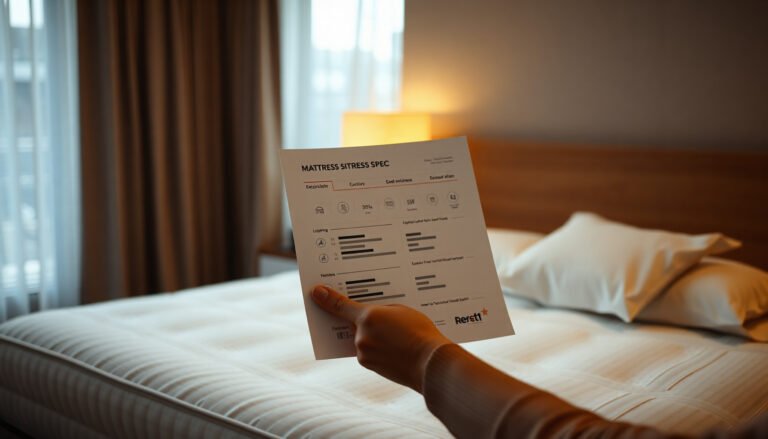
How to Verify Mattress Certifications: A Step-by-Step Checklist
You check a mattress label, see “certified,” and still wonder whether it was tested to real standards or just marketing. In about 15–25 minutes, you can verify the most important claims by confirming the certifying body, reading the exact scope on the certificate, and matching it to the model and manufacturer. You will need the product label details, the certification website (or documentation), and the model number—then you can shop with confidence instead of guessing.


Don’t treat mattress certification seals as proof until you verify the exact standard, the certifying organization, and the scope of what was tested. Before you trust a mattress “certification,” verify the exact standard, the certifying organization, and what parts of the mattress the test actually covers—then confirm it matches the product label and materials. This matters in 2026 because brands frequently update materials and certifications, while tags and marketing images can lag behind.
If you’re shopping for lower-odor foam, want chemical screening details, or care about organic textiles, you’re not overthinking it—most “seal” confusion comes from missing scope and not checking the certifier’s own verification database.
Know what a mattress “certification” is (and isn’t)
A mattress certification is a claim tied to a specific testing standard and defined scope, not a universal safety guarantee. The same is true for mattress certifications in 2026: they can be meaningful, but only for the exact components and chemicals/emissions the program evaluated.
– Certifications are usually tied to a specific standard (e.g., emissions, chemicals, organic textiles) and a specific scope (cover fabric vs. foam vs. the full mattress).
– A seal doesn’t automatically mean “safer overall”—it means “tested to a particular requirement for particular components.”
– If the marketing claim is broad (“non-toxic,” “eco-friendly”) but the certification is narrow, you’ll want to verify what was actually tested.
Concrete example: GOTS (Global Organic Textile Standard) is about organic textile requirements and auditing. It does not automatically certify mattress foam emissions. OEKO-TEX STANDARD 100 is about restricted substances in textiles, not necessarily organic content or foam chemistry. CertiPUR-US focuses on polyurethane foams’ content and emissions—useful, but still not the cover fabric or every adhesive/bonding step.
Identify the certification clearly (don’t rely on the seal alone)
You’ll save time by capturing the exact certification name and version before you start searching verification databases. Mattress certifications often look similar, and “brand-approved” phrasing can hide what standard you’re actually getting.
– Record the exact certification name as shown on the product page/tag (e.g., “CertiPUR-US,” “GREENGUARD Gold,” “OEKO-TEX,” “GOTS,” etc.).
– Note whether it’s referencing the mattress brand, a manufacturer of the materials (like foam), or a specific product line.
– If the label doesn’t show enough detail (standard version, what’s covered), treat it as incomplete until you can confirm using official documentation.
Tip that prevents mistakes: If the label says “certified” but doesn’t mention the standard, don’t assume you can match it later. For many programs, the *standard name and program version* are what determine eligibility and test method.
Confirm the certifier is legitimate—and find the product in their records
You should verify the certification in the organization’s own verification database (or request the certificate/report from the brand). For mattress certifications, “legitimate certifier” means there is a real record you can locate for the exact brand/product/material.
– Use the certification body’s official website or verification system to look up the brand/company and the certified product/material. (If there’s no lookup tool, ask the brand for proof from the certifier.)
– Match the listing to what you’re buying: brand name, model/collection name, and the materials included.
– Watch for “partner badges” or vague mentions without an actual certifier record—those often don’t include test results.
From my experience helping shoppers compare mattress claims, the most common mismatch is simple: the listing you find is for the foam manufacturer’s material, but the mattress uses different upholstery, different glue/bonding, or a different foam formulation than the one in the record. Mattress certifications can still be helpful—you just need to ensure the record matches your exact layers.
Check the scope: what parts of the mattress were actually tested?

You only benefit from a mattress certification if the scope aligns with your concern (emissions, chemical screening, or organic textiles). The same seal can be highly relevant—or mostly irrelevant—depending on whether it covers the cover fabric, the foam core, or the finished mattress.
– Many certifications apply to components (like foam or textiles), not necessarily every layer (glue/bonding, ticking, fibers, fire-barrier materials, etc.).
– Confirm whether the certification covers the cover fabric only, foam layers, or “finished mattress” (the wording matters).
– Ask for the certificate details if the claim is ambiguous—what you want is the scope stated in the certifier documentation, not just a marketing summary.
Here are three scope clarifiers that frequently affect real purchasing decisions:
1) Component vs. finished product
– A foam certification can be valid even if the cover fabric is not part of the test.
– A textile certification can be valid even if the foam emissions aren’t covered.
2) Textile “product classes”
– OEKO-TEX STANDARD 100 divides textiles into product classes based on skin contact (including separate requirements for items like baby articles). According to OEKO-TEX’s description of product classes, the system uses multiple classes (commonly referenced as Class I–IV) to represent different intended skin-contact levels.
3) Organic content thresholds
– GOTS is measured in organic fiber percentages, not “eco vibes.” For example, GOTS labeling distinguishes between “organic” and “made with organic” thresholds based on fiber content, with commonly referenced minimums of 95% vs. 70%. According to GOTS product labeling/requirements documentation, “organic” labeling requires at least 95% organic fibers, while “made with organic” requires at least 70% organic fibers.
Quick reference: how common certifications map to mattress layers
To make verification faster, this scan shows the typical mattress component each program most directly addresses. (Always confirm scope in the certifier record—programs can vary by listing and standard.)
7 Certification Programs Commonly Mentioned on Mattress Labels (2026 shopper relevance)
| # | Program | Most typical mattress component covered | What you can usually verify in records | Scope-match for common concerns |
|---|---|---|---|---|
| 1 | CertiPUR-US | Polyurethane foam (core layers) | Foam emissions + restricted chemical content | ★★★★★ |
| 2 | GREENGUARD Gold (UL) | Emissions from products/components | Low chemical emissions performance | ★★★★★ |
| 3 | OEKO-TEX STANDARD 100 | Cover fabrics & textile components | Restricted substances testing for textiles | ★★★★☆ |
| 4 | MADE IN GREEN (OEKO-TEX) | Textiles with OEKO-TEX-related checks | Documented textile compliance under program scope | ★★★★☆ |
| 5 | GOTS | Organic textile fibers (cover/upholstery if applicable) | Organic content + compliance across textile processing | ★★★☆☆ |
| 6 | bluesign® | Textile input/manufacturing control | Chemical management and input restrictions | ★★★☆☆ |
| 7 | Global Recycled Standard (GRS) | Recycled-content textiles/materials | Recycled-content verification (not emissions) | ★★☆☆☆ |
Note: This table is a “start here” orientation for mattress certifications—not a substitute for checking each certifier’s exact record for your mattress model and layer stack.
What can go wrong when verifying mattress certifications
You can end up with the wrong mattress conclusion when the record you find doesn’t match the exact component stack or the certification status has changed. Mattress certifications also expire or get updated, so your verification needs to be current, not based on an image from an older listing.
– Outdated listings or expired scope: Some certifications require renewal; a seal may stay visible even if the certification is no longer current. Check the certifier record for the latest status.
– Certification-by-association: You might see a seal that applies to a material supplier, not your mattress’s specific configuration.
– Missing standard/version: Without the standard name (and often the edition/version), it’s hard to judge what “passed” really means.
– Misleading “non-toxic” language: A chemical screening certification is usually about specific restricted substances and tests—not a guarantee of zero chemicals.
– No documentation available: If the brand can’t provide the certificate details or can’t be found in the certifier’s verification system, treat the claim as unverified.
Common mistakes vs. what to do instead
If you want a fast mental model for mattress certifications, this comparison keeps you from over-trusting packaging language:
| What shoppers often do | Why it fails | Better verification step |
|---|---|---|
| Trust the seal image | The scope may cover a component you’re not buying | Search the certifier’s database for the exact brand + product line |
| Verify only the foam label | The cover, fibers, and fire barrier materials may not be included | Confirm whether the certification covers cover fabric vs. finished mattress |
| Assume “non-toxic” = zero chemicals | Most programs test against restricted lists and measured emissions | Read what substances/emissions the standard actually restricts |
| Ignore certification status dates | Programs can be renewed or replaced as formulations change | Use the certifier record status as of the current year (2026) or request a fresh report |
Verdict: what to do next (and who should skip this)
If you can verify the certification in the certifier’s own records and confirm the scope matches your mattress layers, it’s reasonable to rely on it for the specific concern the certification addresses (emissions, restricted substances, organic textiles, etc.). If you can’t confirm those basics, treat the seal as “maybe” and ask for the certificate details before buying.
Downside: Verification takes a few minutes and sometimes requires contacting the brand. Also, even verified mattress certifications don’t automatically cover every potential issue in a real bedroom (e.g., durability, comfort, or every component of the fire barrier).
Skip this extra verification effort only if you’re comfortable choosing based on comfort preferences and return policy, and you don’t need certification-backed reassurance for chemical/emissions/organic criteria. If your concern is specifically foam emissions, chemical screening, or organic materials, verification is the difference between “tested” and “marketed.”
Mattress certification verification checklist (save this)
| What to verify | How to check | Red flag |
|---|---|---|
| Exact certification name | Copy the seal wording from the label/product page | Seal name is vague or not searchable |
| Certifying organization is real | Use the organization’s official site/verification tool | “Certified by” doesn’t match a legitimate body |
| Product/material is listed | Look up the brand/company + product/material scope | Listing doesn’t match model/collection or layer |
| What’s covered (scope) | Confirm whether it covers cover, foam, or full mattress | Claim is broad (“entire mattress”) but docs cover only components |
| Recency/status | Check the latest status on the certifier record (or ask for current documentation) | Seal present but records show expired/not found |
Sources
– CertiPUR-US official website and verification resources (including program/certification process and verified-product lookup guidance) — CertiPUR-US “Verified Products” / certification overview materials
– UL GREENGUARD program documentation for GREENGUARD Gold scope, testing basis, and verification approach — UL GREENGUARD Gold program info and certification process documentation
– OEKO-TEX official materials for interpreting STANDARD 100 certification and product class meanings — OEKO-TEX STANDARD 100 product class documentation
– Global Organic Textile Standard (GOTS) official documentation for label interpretation and organic fiber thresholds — GOTS labeling/requirements for “organic” vs. “made with organic”
– Any additional primary source relied on for a specific certification name/version should be taken directly from the relevant certifier’s own official standard/program documentation —
In the end, mattress certifications are only as useful as your verification—standard, certifier, and scope all need to line up with the exact mattress layers you’re buying. Do that, and you’re shopping with real documentation, not just a seal that might be outdated or narrowly applicable.
Frequently Asked Questions
How can I verify a mattress’s certifications before I buy?
Start by asking the seller for the actual certification certificate or the testing laboratory’s name and report number, not just a marketing badge. Then confirm the claim on the certifying body’s website (or via a quick email/phone inquiry) to ensure it matches the exact brand, model, and production date. Finally, check whether the certification covers the right standards (e.g., flame retardants, emissions/VOC levels, or material safety) since many labels apply to specific criteria only.
What do mattress certifications like CertiPUR-US, GREENGUARD, and OEKO-TEX actually confirm?
CertiPUR-US typically verifies the foam’s emissions and material content limits for standards like VOCs and certain chemical restrictions, while GREENGUARD focuses on indoor air quality and low chemical emissions. OEKO-TEX is commonly used for textiles and fabric components, indicating reduced levels of regulated substances. Always read the scope of each certification—some cover only foam, some only covers/labels, and others apply to specific materials within the mattress.
How do I confirm that a “low-VOC” or “safe chemicals” mattress claim is backed by testing?
Look for third-party verification such as GREENGUARD Gold, CertiPUR-US, or other recognized lab testing, and make sure it references the mattress components being tested (foam, cover, adhesives). If the retailer only provides vague language, request documentation that includes test results or a verification ID that can be cross-checked with the issuing organization. Also note that performance can change with different covers or foam batches, so the certification should correspond to the exact mattress model you’re considering.
Which documents should I request from a retailer to verify mattress compliance and certification claims?
Request the certification certificate or verification number, the certifying organization’s name, and the specific product/model it applies to. For compliance-type claims (like flame retardant standards), ask for evidence that the mattress meets the relevant regulation or standard for your region, as requirements vary by location. If available, ask for test reports that show what was measured (e.g., chemical emissions, VOCs, or fabric substance limits) and when the testing occurred.
What is the best way to verify a mattress certification if the label only shows a logo?
Don’t rely solely on the logo—use it as a starting point to track down the underlying verification details. Search the certifying body’s database using the brand and model name, or request the verification ID and scope in writing from the manufacturer or retailer. If you can’t find a match, treat it as a red flag and consider choosing a mattress with clearly documented, third-party tested certifications.
📅 Last Updated: November 02, 2026 | Topic: How to Verify Mattress Certifications | Content verified for accuracy and freshness.
References
- eCFR :: 16 CFR Part 1632 — Standard for the Flammability of Mattresses and Mattress Pads (FF 4-7…
- eCFR :: 16 CFR Part 1633 — Standard for the Flammability (Open Flame) of Mattress Sets
- https://www.ftc.gov/business-guidance/resources/green-guides
- Organic Regulations | Agricultural Marketing Service
- https://en.wikipedia.org/wiki/CertiPUR-US
- https://en.wikipedia.org/wiki/OEKO-TEX
- https://en.wikipedia.org/wiki/Global_Organic_Textile_Standard
- https://scholar.google.com/scholar?q=how+to+verify+consumer+product+certifications+mattress Google Scholar
- https://scholar.google.com/scholar?q=CertiPUR-US+independent+testing+study Google Scholar
- https://scholar.google.com/scholar?q=Global+Organic+Textile+Standard+GOTS+certification+verification Google Scholar