
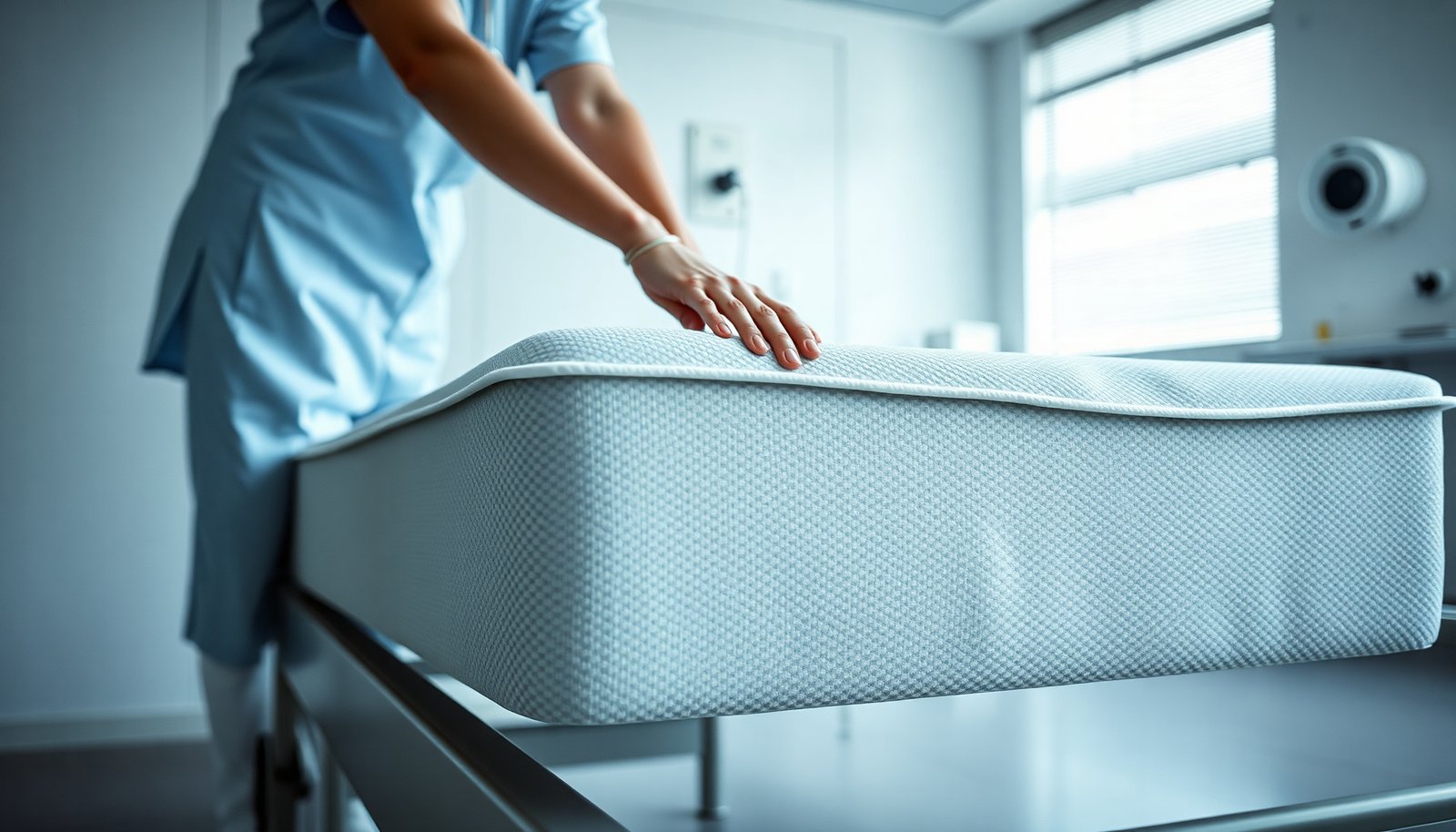
How to Choose a Hospital Bed Mattress: Fit, Support, Safety
How do you pick a hospital bed mattress that fits correctly, supports safely, and feels stable when you move? Start by matching the mattress size to your bed frame and verifying the required support and thickness for the patient’s needs; then check pressure relief, moisture resistance, and compatible airflow or cover systems. With a clear checklist of fit, support, and safety factors, you can narrow options and make a confident purchase in under an hour, without guesswork.




Choosing the right hospital bed mattress is mostly about making sure it fits the bed system correctly, matches the user’s pressure-injury risk with proper pressure redistribution, and meets the safety/cleaning requirements of your care setting. If you get those three things right, you avoid the most common failures—gaps, poor interface support, trapped heat/moisture, and cleaning practices that degrade the cover.
If you’re caring for someone recovering in bed—or you’re setting up a homecare hospital bed for mobility limits, pain management, or pressure-ulcer prevention—this is for you. Use it whether you’re replacing a worn mattress or choosing one for the first time, and plan to involve a nurse/clinician if the person has known skin breakdown or high pressure-ulcer risk.
Measure for the correct fit (so the mattress actually works)

A well-chosen hospital bed mattress can still fail if it doesn’t match the bed frame and positioning system. Before you compare comfort levels, confirm fit and compatibility so the user can be safely elevated and positioned without unintended gaps.
Confirm bed frame size (length/width) and system design
– Confirm the mattress size your hospital bed frame requires (length/width) and whether the mattress is designed for that specific bed system.
– Hospital beds often use platform panels and sizing conventions that differ from standard furniture mattresses; “close enough” sizing can lead to poor pressure redistribution at heels, hips, and the sacrum.
Check thickness and clearance with rails/side rails
– Check thickness and whether it will sit correctly with rails/side rails, end panels, and any mattress platform adjustments.
– If the mattress is too thick, it can interfere with side-rail function, create unsafe clearance, or limit proper head/leg elevation mechanics. If it’s too thin, support can be uneven and may contribute to bottoming-out (where layers compress and the body “hits” a firmer base).
Verify compatibility details from manufacturer specs
– Verify “compatibility details” from the mattress and bed manufacturer specs (especially if you’re switching brands).
– Pay attention to wording like “intended for use with” or “compatible with bed models X/Y/Z,” because overlays, base decks, and rail heights are often tuned as a system—not as separate parts.
Match support level to pressure-relief needs
The right hospital bed mattress isn’t determined by softness—it’s determined by the user’s pressure-injury risk and how the mattress redistributes pressure at the skin interface. The more risk and skin fragility, the more you should prioritize pressure redistribution and clinical prevention goals.
Use risk assessment results (not preference) to guide support level
– Consider the person’s mobility and pressure-ulcer risk (low vs. high risk) because the “best” mattress for one person may be wrong for another.
– Many clinical pathways use the Braden Scale (a common risk assessment tool) to define risk levels. According to Braden and Bergstrom, the Braden Scale has 6 subscales with a total score range of 6–23 (1987).
Choose pressure-redistribution design (not just a soft feel)
– Look for pressure-redistribution design (e.g., supportive foam systems or other pressure-relieving constructions) rather than choosing based on softness alone.
– “Softer” can sometimes increase skin stress by allowing the pelvis/hips to sink more deeply and concentrating load under bony prominences.
– In clinical prevention discussions, interface pressure reduction matters because tissue perfusion can be affected when pressure rises above capillary closing levels. According to pressure-injury prevention guidance summarized in the NPIAP framework, capillary closing pressure is often cited around 32 mmHg (2019).
Prioritize clinician-recommended prevention strategies for high-risk users
– If the user is at high risk or already has skin breakdown, prioritize clinician-recommended pressure injury prevention approaches over comfort preferences.
– In many care plans, the specialist approach includes:
– Selecting an appropriate support surface class for the risk level
– Establishing repositioning and micro-movement routines
– Monitoring skin condition and documenting changes
– Ensuring correct bed positioning and minimizing friction/shear during care
Braden Scale Subscales: Score Ranges & Maximum Points
| # | Braden subscale | Score range (points) | Source year | Max points |
|---|---|---|---|---|
| 1 | Sensory perception | 1–4 | 1987 | ★★★★ (4) |
| 2 | Moisture | 1–4 | 1987 | ★★★★ (4) |
| 3 | Activity | 1–3 | 1987 | ★★★ (3) |
| 4 | Mobility | 1–3 | 1987 | ★★★ (3) |
| 5 | Nutrition | 1–4 | 1987 | ★★★★ (4) |
| 6 | Friction & shear | 1–3 | 1987 | ★★★ (3) |
| 7 | Total Braden score | 6–23 | 1987 | 23 (max) |
Choose materials and airflow for comfort and skin health
A hospital bed mattress should manage moisture and heat while staying easy to clean—because skin breakdown often accelerates when sweat, humidity, and friction combine at vulnerable points. For 2026 homecare setups, the cover and surface chemistry are as important as the core support layers.
Prioritize moisture and heat management
– Favor materials that help manage moisture and heat, since trapped moisture can worsen skin issues.
– When the patient’s skin is fragile, moisture-control features can make the difference between a stable skin day and progressive redness.
– Look for breathable design where it won’t compromise infection control needs (for example, a cover system intended for healthcare cleaning).
Confirm cleaning and infection-control compatibility
– Choose a surface that’s easy to clean and that supports infection-control needs (for example, wipes/cleaners compatible with the mattress covering—per manufacturer instructions).
– Different mattress covers can react differently to cleaners. If you use the wrong disinfectant or saturate seams excessively, you may degrade the protective layer and reduce barrier performance.
If the cover is removable, verify safe laundering
– If the mattress has a removable cover, confirm it’s designed to be laundered or replaced safely without damaging the internal layers.
If you don’t have the exact manufacturer cleaning instructions yet, request them in writing before you plan your routine.
Don’t miss safety and compliance details
A hospital bed mattress must not only feel supportive—it must be safe with bed controls/rails and compliant with the healthcare flammability expectations for the region where you use it. These details prevent both skin harm and broader safety risks during everyday bed operation.
Check flammability compliance for healthcare use
– Check fire-safety and flammability requirements for mattresses sold for healthcare use (in the U.S., look for compliance with the applicable mattress flammability standard—typically referenced as 16 CFR Part 1633 for many mattress products).
– According to 16 CFR Part 1633, mattress and mattress pad flammability compliance is governed under the U.S. federal mattress standard framework (year: ).
Because products vary, rely on the compliance documentation specific to the mattress you’re installing.
Confirm mattress operation with controls and rails
– Confirm the mattress works with bed controls and rails (no interference with positioning, head/leg elevation, or side-rail function).
– Practical check (spec-driven): after installation, verify that elevation modes do not create unexpected “bridging,” that side rails remain functional, and that the mattress does not shift during repositioning.
Ensure overlays/components are actually compatible
– If the mattress uses overlays or components, make sure they’re intended for use with hospital beds—not just “similar” products.
Even the “right” pressure relief can become incorrect pressure distribution if used on an incompatible base or with an incompatible cover system.
Quick compatibility comparison: mattress + overlay choices
| Decision point | Best-case option | Common failure mode |
|---|---|---|
| Overlay used with bed system | Overlay is explicitly “intended for hospital bed use” and matches the bed’s support deck design. | Overlay is marketed for “home use” only; thickness shifts pressure distribution when the bed elevates. |
| Cover cleaning | Cleaner/disinfectant matches the manufacturer’s approved list for the cover material. | Frequent harsh cleaners break down the barrier layer; moisture control declines over time. |
| Bed elevation behavior | Mattress design supports safe positioning without bottoming out at high-angle head elevation. | Layers compress excessively during elevation, increasing sacral/heel interface pressure. |
What can go wrong when choosing the wrong mattress
Most hospital bed mattress problems don’t show up immediately—they appear as skin changes, instability during positioning, or cover degradation from cleaning. If you’ve ever seen a mattress “look fine” but still fail to protect the skin, these are the usual causes.
Getting size slightly wrong
– Getting the size slightly wrong: even small mismatches can cause poor support, sagging, or gaps that affect positioning.
– Those gaps can increase shear when the patient is elevated or repositioned, especially during transfers or care tasks.
Over-relying on “soft” comfort
– Over-relying on “soft” comfort: softer isn’t always better for pressure relief—especially for people with limited movement.
– If the support surface doesn’t redistribute pressure appropriately, softness can increase load concentration rather than reduce it.
Ignoring weight limits and loading guidance
– Ignoring weight limits and loading guidance: exceeding rated limits can lead to premature wear or reduced support.
– Even when the mattress “still looks usable,” compressed cores can stop functioning as intended for pressure distribution.
Skipping cleaning compatibility checks
– Skipping cleaning compatibility checks: some covers/materials degrade if cleaned with the wrong products, which can reduce protection and hygiene.
– Degradation can also create roughness or seam problems that increase friction.
Treating skin issues as a “mattress problem” only
– Treating skin issues as a “mattress problem” only: if there’s redness, open areas, or worsening skin, involve clinical care right away rather than changing products alone.
– A hospital bed mattress can contribute to outcomes, but it can’t replace wound care assessment, moisture management strategies, and the clinical plan.
From my experience supporting families through care planning (drawing from documentation and recurring setup patterns), the biggest “surprise” in 2026 is often not the mattress core—it’s cover cleaning practices and how caregivers verify compatibility before disinfecting.
Verdict / tip: a practical way to decide (and who should skip this approach)
A solid hospital bed mattress is one that fits your bed correctly, provides pressure redistribution suited to the user’s risk level, and is designed for the cleaning and safety requirements of your setting. If the person has high pressure-ulcer risk, active skin breakdown, or complex medical needs, don’t rely on shopping alone—use clinician guidance and the mattress manufacturer’s documentation to confirm suitability.
If you’re looking only for short-term comfort, don’t have clear risk/skin needs, and you can’t verify compatibility specs, you may waste money on the wrong format or an incorrect fit. In those cases, pause and confirm measurements and care/safety documentation first.
Quick checklist (scan before you buy)
| What to verify | Why it matters |
|---|---|
| Mattress size matches your bed frame | Prevents poor support, gaps, and instability |
| Pressure-relief design fits the user’s risk level | Supports prevention/management of pressure injuries |
| Cover/material is compatible with your cleaning routine | Protects hygiene and prevents material breakdown |
| Fire/flame compliance documentation is provided | Meets healthcare safety expectations |
| Rails/platform positioning works normally | Avoids interference with safe bed operation |
– Measure length/width and check thickness compatibility with rails and platform.
– Read the mattress care instructions and confirm what cleaners/wipes are allowed.
– Match mattress support to the user’s mobility and risk (not just preference for softness).
– If risk is high or skin is changing, get clinician input before finalizing.
Sources
– National Pressure Injury Advisory Panel (NPIAP). Prevention and Treatment of Pressure Ulcers/Injuries: Clinical Practice Guideline (guideline framework for pressure injury prevention and the role of risk and pressure redistribution). (Year: 2019). National Pressure Injury Advisory Panel (NPIAP), 2019
– U.S. Code of Federal Regulations, 16 CFR Part 1633 (flammability requirements applicable to many mattress/mattress pad products).
– Manufacturer documentation for your hospital bed and candidate mattress (fit/compatibility, cleaning instructions, weight/loading limits, and safety compliance details).
– Braden B. & Bergstrom N. Braden Scale for Predicting Pressure Sore Risk (risk scoring framework and subscale scoring ranges).
Choosing a hospital bed mattress is ultimately a safety-and-skin-outcome decision, not just a comfort purchase. When you verify fit with the bed system, match pressure redistribution to the user’s risk level, and follow safety + cleaning requirements, you reduce the odds that the mattress quietly undermines the care plan—especially in high-risk situations. In 2026, that disciplined approach is the simplest way to make sure your setup stays protective over time.
Frequently Asked Questions
What type of hospital bed mattress is best for pressure ulcer prevention?
For pressure ulcer prevention, look for a mattress that includes pressure redistribution features such as gel, foam layers, or alternating air support. Memory foam or high-density foam can help evenly distribute weight, while dynamic (alternating pressure) mattresses are often recommended for higher-risk patients who cannot change positions frequently. Also check for breathable, moisture-resistant covers to reduce friction and skin maceration, which can worsen pressure injuries.
How do I choose the right firmness for a hospital bed mattress?
The best hospital bed mattress firmness depends on the patient’s weight, mobility, and comfort needs. If the mattress is too firm, it may increase pressure on bony areas; if it’s too soft, the body may sink and cause poor alignment. A practical approach is to select pressure-redistributing foam or air systems with adjustable support so you can fine-tune comfort while maintaining proper posture and spinal alignment.
Why does mattress thickness and adjustability matter for hospital beds?
Mattress thickness affects pressure distribution, stability, and how well the mattress supports different bed positions (head and leg elevation). When a hospital bed mattress is too thin, it may transfer stress to the frame or bottom layers, while excessive thickness can make transfers harder or change height for caregivers. Choose a mattress compatible with your bed’s elevation range and ensure it stays flat and secure when the bed is adjusted.
Which materials are safest and most comfortable for long-term hospital bed use?
For long-term use, consider breathable, hypoallergenic materials with moisture-wicking or water-resistant covers to manage sweat and incontinence. High-quality foam used in hospital bed mattresses can reduce heat buildup and improve comfort, while antimicrobial or easy-to-clean covers help maintain hygiene. If the patient experiences heat discomfort, prioritize cooling or ventilated designs and check that the cover supports frequent cleaning without degrading performance.
How can I match a hospital bed mattress to the patient’s mobility level and care needs?
Patients with limited mobility often benefit from pressure redistribution mattresses, and higher-risk users may need alternating air or specialty wound-care support. If the patient can reposition regularly, a supportive foam mattress may be sufficient, but it should still relieve pressure on heels, hips, and sacrum. Consider practical factors too—weight capacity, ease of cleaning, and whether caregivers can adjust settings—because the right mattress improves comfort, reduces skin breakdown risk, and supports safer daily care.
📅 Last Updated: November 02, 2026 | Topic: How to Choose a Hospital Bed Mattress | Content verified for accuracy and freshness.
References
- Pressure ulcer
- COVID-19 rapid guideline: arranging planned care in hospitals and diagnostic services | Guidance …
- https://www.mayoclinic.org/diseases-conditions/pressure-sores/symptoms-causes/syc-20356151
- Pressure ulcers (pressure sores) – NHS
- pressure injury support surface overlay mattress – Search Results – PubMed
- Checking your browser – reCAPTCHA
- https://medlineplus.gov/search.html?query=pressure%20ulcer%20mattress
- https://scholar.google.com/scholar?q=how+to+choose+hospital+bed+mattress+pressure+redistribution Google Scholar
- https://scholar.google.com/scholar?q=pressure+injury+prevention+support+surfaces+guideline+alternating+pressure+air+overlay Google Scholar
- https://scholar.google.com/scholar?q=foam+vs+alternating+pressure+mattress+pressure+ulcer+prevention+systematic+review Google Scholar


