
How to Clean an Organic Mattress with Food Odors Naturally
How do you remove lingering food odors from an organic mattress without harsh chemicals? Start by airing the mattress, spot-cleaning the affected area with a gentle enzyme-based cleaner or a diluted natural solution, and then using baking soda to draw out remaining smells—usually within a few hours plus drying time. You will need clean towels, a spray bottle, baking soda, and your chosen natural odor treatment. With the right steps, you can refresh the surface safely and make the mattress feel clean again.




Blot up the spill, then deodorize and lift the odor source with a baking-soda treatment and (if needed) an enzyme-based cleaner used according to the care label. Finish by thoroughly drying the mattress so the smell doesn’t return. In this guide, you’ll learn a natural, step-by-step way to handle food odors on an organic mattress without harsh chemicals.
If your organic mattress has a lingering smell from food, drinks, sweat, or a recent accident, these steps are for you—especially if you want to avoid strong fragrances and stay compatible with natural fibers. Always check the care label first, because organic materials (like latex, wool, cotton, and natural fibers) can react differently to moisture and cleaners.
If your organic mattress has a lingering smell from food, drinks, sweat, or a recent accident, these steps are for you—especially if you want to avoid strong fragrances and stay compatible with natural fibers. Always check the care label first, because organic materials (like latex, wool, cotton, and natural fibers) can react differently to moisture and cleaners.
Check the Care Label First (Before You Clean)

This is the fastest way to avoid accidentally damaging an organic mattress while treating odors. You only get one chance to keep natural fibers and latex safe—so the care label sets the rules for moisture, cleaning agents, and drying.
Start by looking for wording such as “spot clean only,” “no wet cleaning,” or “do not use bleach,” then follow it over any general advice. If the label limits liquid exposure, plan to rely more heavily on vacuuming and baking soda (which are low-risk for many natural fillings). Next, identify the cover and fill materials—common organic mattress components include natural latex, wool, organic cotton, and blended natural fibers—because each behaves differently when it stays damp. Finally, plan drying time. In 2026, the cleanest odor strategy is still “dry fast and dry fully,” because lingering moisture can turn a one-time spill into a returning smell.
Remove Food Odors by First Cleaning the Surface
This stage prevents you from “baking in” residue before deodorizing. If you lift the crumbs, proteins, and sauce compounds from the top layer first, the baking soda and enzyme cleaner can work on what remains rather than on a dirty surface.
Strip all bedding and wash it according to the label; odors often travel into sheets, duvet covers, and mattress protectors. Then gently blot any fresh residue—no scrubbing—using a clean cloth or paper towels. After blotting, vacuum the mattress surface thoroughly with an upholstery attachment to pull up crumbs, dried bits, and surface oils. If the odor is still strong, do a second light vacuum pass before moving to deodorizing; from a practical standpoint, this improves results because odor-removal powders can absorb more effectively when they contact clean fibers.
For stubborn food odors on an organic mattress, it helps to think in layers: top-layer residue, absorbed material in the fill, and humidity trapped inside. Vacuuming is your best first action for the first layer.
Deodorize Naturally with Baking Soda (Main Step)
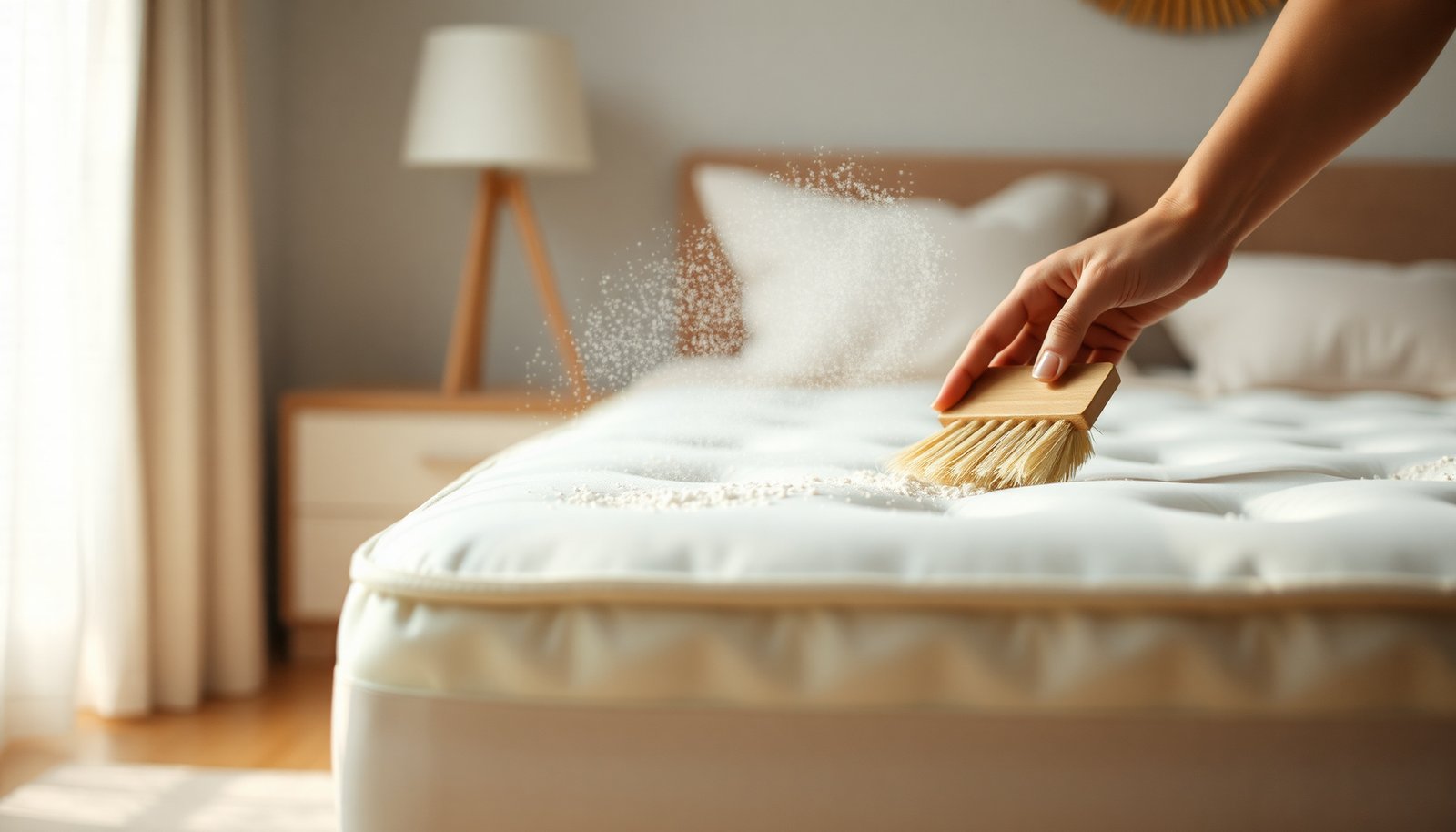
This is the simplest natural deodorizing step for food smells on an organic mattress. Baking soda (sodium bicarbonate) works mainly by absorbing and neutralizing odor compounds on contact, so it reduces smell without soaking the mattress.
Sprinkle a light, even layer of plain baking soda across the affected area, and lightly around it if the odor spread. You’re aiming for coverage, not a thick blanket—too much powder can be harder to remove and can leave residue you’ll need to vacuum later. Let it sit long enough to absorb odors (overnight is a common practical approach), then vacuum thoroughly. Repeat the deodorizing cycle if the smell lingers; adding more liquid too early can keep organic materials damp longer and can make the odor return.
Here’s the mechanism in plain terms: many food odors are acidic or otherwise reactive, and sodium bicarbonate can neutralize certain odor-causing acids. Baking soda also helps lift some smell compounds from fibers through absorption. This is especially helpful when the odor is still relatively “surface-level,” which is often true for newer spills on organic cotton covers or wool blends.
Odor Source → Natural Target for Organic Mattresses (2026)
| # | Food/odor source on mattress | Common residue type | Natural tool that targets it | Why it helps (mechanism) | Match strength |
|---|---|---|---|---|---|
| 1 | Protein-rich foods (meat, dairy, egg) | Proteins | Enzyme cleaner with protease | Protease breaks down peptide bonds (protein digestion) | ★★★★★ |
| 2 | Greasy foods (pizza, fried foods, sauces) | Fats & oils | Enzyme cleaner with lipase | Lipase breaks down triglycerides (fat breakdown) | ★★★★★ |
| 3 | Starchy foods (pasta, bread, rice) | Starches | Enzyme cleaner with amylase | Amylase breaks down starch into smaller sugars | ★★★★★ |
| 4 | Sour or acidic spills (tomato, citrus) | Acidic compounds | Baking soda deodorizing | Bicarbonate can neutralize certain acids on contact | ★★★★☆ |
| 5 | Older “set-in” food odors | Deep residue + trapped smell | Enzyme cleaner (label-approved) | Enzymes target specific residue instead of only masking smell | ★★★★☆ |
| 6 | Smoke-like odors (cooking smoke) | Complex gases | Baking soda first; targeted steps after | Absorption helps, but deep gases may need extra lift | ★★★☆☆ |
| 7 | General “food room” smell (not a fresh spill) | Airborne odor residue | Baking soda deodorizing + airing | Absorbs surface odor without soaking organic fibers | ★★★☆☆ |
Treat the Source Odor with Natural Enzyme Cleaning (When Needed)
This is the escalation step when baking soda alone doesn’t touch the real residue. Enzyme-based cleaners are designed to break down odor sources (like protein, fats, and starch) rather than simply covering smell with fragrance.
Use an enzyme-based cleaner labeled for upholstery or mattresses when the odor seems “set in,” especially after older food spills. Apply it only as directed on the product label—often that means a light mist and blot, rather than soaking the mattress. This matters for organic mattress materials because excessive moisture can weaken some natural fibers and substantially increase drying time. After application, let the mattress dry completely.
A practical note: enzymes are biological catalysts, so they work best when they’re given the conditions the label specifies (often involving the right moisture level and the appropriate wait time). Also, enzyme cleaners are typically formulated around specific substrate targets—protease for proteins, lipase for fats, and amylase for starch—so the most effective choice matches the type of food residue you suspect.
| Option | Pros for organic mattress food odors | Cons / limits |
|---|---|---|
| Baking soda |
|
|
| Enzyme cleaner (label-approved) |
|
|
Dry Correctly to Prevent Odors Coming Back
This is the step that stops the smell from returning. An organic mattress must be thoroughly dry throughout, not just at the surface, because trapped moisture can reactivate odor sources and encourage musty smells.
Dry with airflow: keep the room ventilated, avoid covering the mattress while it’s damp, and if your care label allows it, use a fan aimed near the mattress (not blasting water in). If you used any liquid cleaner, ensure the mattress is fully dry before remaking the bed. Mold and odor risks rise when materials stay damp; the CDC notes that mold can begin to grow within 24–48 hours after water damage occurs (CDC, last reviewed 2024). That’s why “overnight” is often not enough if your organic mattress has a thick wool layer or latex comfort layer that holds moisture.
To confirm dryness, your organic mattress should feel consistently dry and should not emit a “cool/wet” smell when you put your hand near it. If it feels cool or damp, keep airflow going and wait.
According to the IICRC guidance for water-damage restoration, drying within 24–48 hours helps limit microbial growth (IICRC S520, 2015). Treat odor control similarly: dry quickly and fully.
What Can Go Wrong (Common Mistakes to Avoid)
These errors are what make a natural cleanup look like it “didn’t work.” Most failures come from over-wetting, aggressive scrubbing that spreads residue, or skipping the care-label rules for moisture and materials.
Over-wetting is the biggest risk on an organic mattress. Soaking can damage fibers, slow drying, and trap smells inside the fill. Scrubbing stains aggressively can push food residue deeper and spread the odor beyond the original spot—especially in wool and cotton layers. Another frequent issue is skipping patch tests. Vinegar, detergents, and other cleaners can discolor covers or affect natural fibers. If you need an enzyme cleaner or any liquid treatment, test in a hidden corner first and wait for it to dry completely before proceeding.
Finally, don’t assume every “food smell” is from active residue. Sometimes it’s from airborne cooking odors or built-up humidity in an organic mattress cover—those cases often respond better to airing and deodorizing rather than heavy wet cleaning.
Verdict: A Natural Cleaning Plan That’s Usually Safer Than “Odor Bombs”
This approach (vacuum + baking soda + enzyme cleaning only when necessary + thorough drying) is a practical, generally mattress-safe way to handle food odors naturally. The downside is that it can take time—especially for older odors—because absorption and drying are slower than heavy chemical cleaning.
Skip this method or be extra cautious if your organic mattress care label forbids wet cleaning, if the mattress has delicate materials you can’t identify confidently, or if the odor comes from a larger issue like persistent dampness underneath the mattress. If you’re dealing with a musty smell that suggests moisture in the room, you’ll get better results by addressing ventilation and humidity rather than only treating the organic mattress.
Quick Checklist: Natural Food-Odor Cleanup
– [ ] Read the mattress care label (spot clean vs. wet cleaning)
– [ ] Remove bedding and wash separately
– [ ] Blot residue (if fresh) and vacuum thoroughly
– [ ] Deodorize with baking soda; wait; vacuum again
– [ ] If odor persists, use enzyme cleaner as directed (light application)
– [ ] Dry completely with strong airflow before covering
Frequently Asked Questions
How can I clean an organic mattress naturally when it has food odors?
Start by removing all bedding and vacuuming the organic mattress thoroughly, focusing on seams and creases where food smells can linger. Mix baking soda with a few drops of essential oil (like lavender) and sprinkle it lightly over the area, then let it sit for several hours or overnight before vacuuming. For any sticky residue, use a gentle spot-clean with a solution of mild soap and cool water, then blot with a clean towel until dry.
What is the best way to remove food stains and odors from a natural latex or organic cotton mattress?
Treat stains first using cool water and a small amount of mild, fragrance-free soap—apply sparingly and blot, rather than soaking the mattress. After the spot is clean, sprinkle baking soda over the damp area to absorb remaining odor molecules, and let it dry completely. Finish by vacuuming and allowing the mattress to air out with good airflow, ideally with a fan for faster drying.
Why do food smells come back even after I’ve cleaned my organic mattress?
Food odors often cling to the organic materials and can remain trapped in deeper layers if the mattress wasn’t dried thoroughly or if residue wasn’t fully removed. Moisture also helps odors redevelop, especially with spills or sweat mixed with food oils. Using baking soda for odor absorption plus ensuring the mattress dries completely (no lingering dampness) helps prevent smells from returning.
How do I deodorize an organic mattress with baking soda without damaging the fibers?
Choose pure baking soda and apply a thin, even layer—avoid heavy clumps that can be difficult to vacuum out. Let it sit long enough for odor absorption (at least 4–8 hours, longer is better for strong food odors), then vacuum thoroughly with an upholstery attachment. If the mattress uses natural latex, foam, or wool, this method is generally safe, but always test in a hidden spot first and avoid oversaturating the surface.
Which natural cleaning method is safest for removing strong food odors from an organic mattress?
For strong odors, combine careful spot cleaning (mild soap + cool water) with a deodorizing step like baking soda for absorption, followed by complete air-drying. Avoid harsh cleaners, steam, or soaking liquids unless the mattress care instructions explicitly allow them, since organic mattresses can be sensitive to excess moisture and lingering chemical scents. If the odor persists after one cycle, repeat the baking soda treatment and increase airflow to fully dry any affected areas.
📅 Last Updated: November 14, 2026 | Topic: How to Clean an Organic Mattress with Food Odors Naturally | Content verified for accuracy and freshness.
References
- https://www.cdc.gov/hygiene/cleaning/index.html
- Mold | US EPA
- https://www.cdc.gov/parasites/bedbugs/faq.html
- enzymatic cleaners odor removal – Search Results – PubMed
- Sodium bicarbonate
- Vinegar
- Mattress
- https://scholar.google.com/scholar?q=natural+deodorizing+baking+soda+vinegar+upholstery Google Scholar
- https://scholar.google.com/scholar?q=enzymatic+cleaners+odor+removal+fabric Google Scholar
- https://scholar.google.com/scholar?q=mattress+cleaning+odors+home+remedies Google Scholar




One Comment