

How to Choose a Latex Mattress for Heavy People with Neck Pain
Choosing a latex mattress for heavy people with neck pain? The best pick is a medium-firm latex model with strong shoulder cushioning and a zoned support core that keeps your neck aligned all night. This guide tells you exactly what firmness, density, and support features matter most for heavier body types—so your sleep stops aggravating your neck.




For heavy sleepers with neck pain, choose a latex mattress that preserves spine alignment by supporting your hips/shoulders without letting you bottom out, then pair it with a pillow that keeps your neck neutral. The best latex feel is usually buoyant and responsive—comfortable enough to relieve pressure, but stable enough that your head/neck angle doesn’t slowly drift overnight.
Choosing latex for neck pain isn’t just about “soft vs firm.” It’s about how a latex mattress distributes your weight across pressure points (hips, shoulders, and upper back) while maintaining the correct head-and-neck height. As of 2026, more shoppers are also moving away from memory-foam “hug” and toward latex’s springy response, especially when morning stiffness suggests the mattress is changing alignment while you sleep.
If you’re heavier than average and your neck pain feels worse after sleeping, this guide is for you—especially if you’re considering latex because you want pressure relief that many innersprings can’t reliably deliver. You’ll learn what to check (layers, firmness/ILD/IFD, loft, zoning), what mistakes to avoid, and how to set up your pillow so alignment holds overnight.
If you want the most useful guidance, note your sleep position (side/back/stomach), approximate weight range, and whether you prefer a softer or firmer surface—those preferences change which latex comfort layer thickness and firmness will work best.
Match latex firmness to body weight (support without bottoming out)
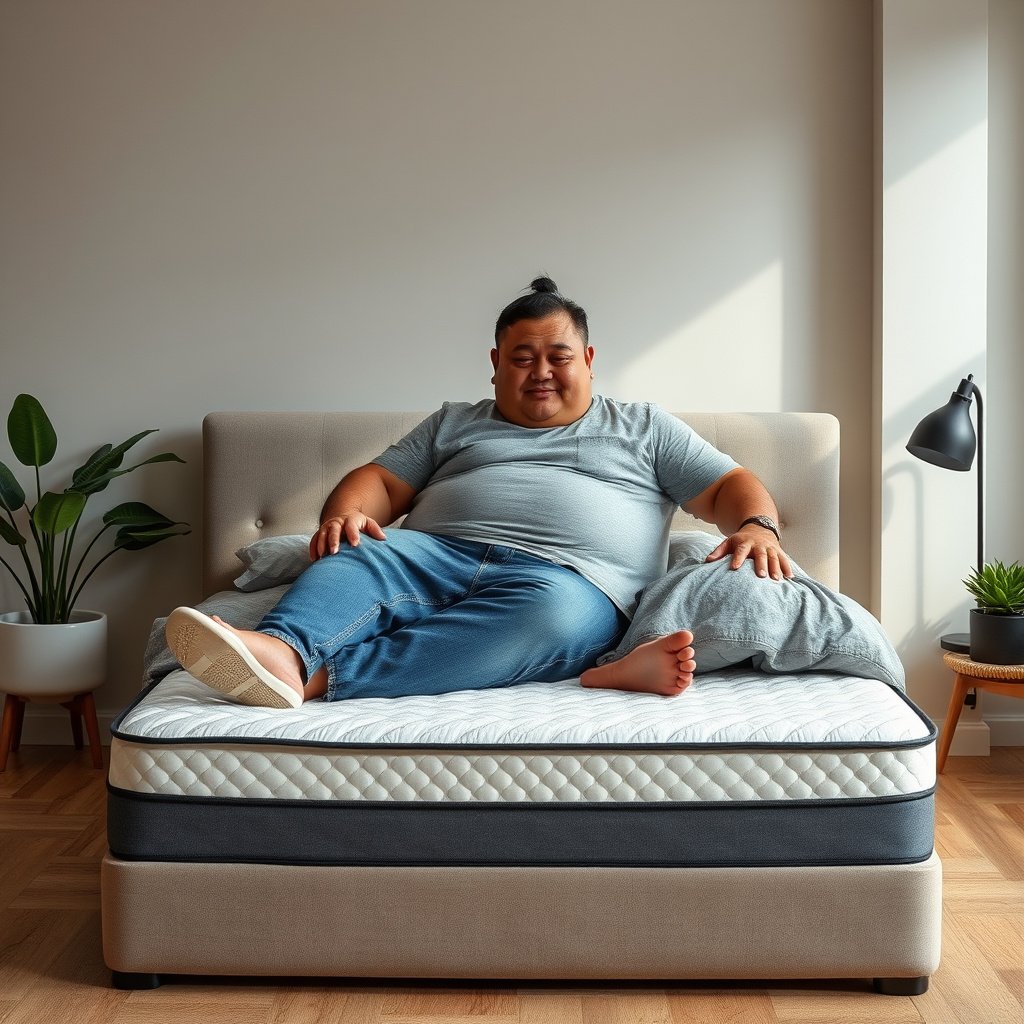
A latex mattress for heavy people should feel supportive under the “load-bearing” zones (hips and shoulders) so you don’t sink enough to change your neck angle. In practice, that means choosing a comfort/support balance where latex stays responsive for your body weight, rather than collapsing and slowly pulling your spine out of neutral.
“Indentation force deflection (IFD) / indentation load deflection (ILD) numbers are measured with a standardized indentation method, so they’re a practical reference—but not a universal translation to ‘feel’ across brands.”
“For foam-based mattresses, too much softness under hips and shoulders can change spinal alignment even if the top feels plush right away.”
For a heavy sleeper, “support without bottoming out” matters more than showroom comfort. When hips sink too deeply, your torso rotates slightly and your neck often compensates—resulting in morning pain, headaches, or restricted range of motion.
To shop more accurately, understand what ILD/IFD is referring to: ILD (often used for latex) and IFD (often used for other foams) are essentially the force required to compress a foam sample to a specified depth. According to , ILD/IFD test methods define the measurement approach using a standardized indentation level (commonly expressed as a percentage of foam thickness), which is why ILD/IFD comparisons are most meaningful only when the test method is consistent.
Here are three practical measurement anchors to keep in mind while you compare latex mattresses:
– According to , ILD/IFD is determined by measuring the force needed to indent a foam sample to a specified compression level (commonly 25% indentation in mattress marketing contexts).
– According to , the test uses a standardized indenter and test specimen setup to make force readings repeatable.
– According to , the force reading is a property of the foam material and construction—not your body—so layer thickness and build (how thick the comfort layer is) still determine how it feels to you.
Quick guidance for heavy sleepers
– If you try a latex mattress and your hips “drop” noticeably, your neck pain is often a delayed symptom of the same alignment problem.
– If the surface feels too firm and your shoulders don’t sink enough, you can create localized pressure that also irritates the neck and upper traps.
– Your target is a latex comfort layer that contours your hips/shoulders without letting them drift past neutral alignment.
Common ILD Ranges Used in Latex Comfort Layers (25% Indentation)
| # | Latex ILD Range | Typical Comfort-Layer Behavior | Alignment Risk for Heavy Side/Back Sleepers | Fit for Neck-Pain Support |
|---|---|---|---|---|
| 1 | < 17 ILD | High contouring; strongest surface sink | Often increases hip/shoulder drop | ★☆☆☆☆ |
| 2 | 17–20 ILD | Soft comfort; noticeable pressure relief | May tilt neck via deeper shoulder/hip sink | ★★☆☆☆ |
| 3 | 21–24 ILD | Balanced contouring; moderate sink | Can work if deeper support is firmer/thicker | ★★★☆☆ |
| 4 | 25–29 ILD | Comfort cushioning with good pushback | Typically better for neutral neck positioning | ★★★★☆ |
| 5 | 30–34 ILD | More support-forward; less sink | Often stable for hips/shoulders under load | ★★★★☆ |
| 6 | 35–39 ILD | Firm comfort; minimal contour depth | May require a higher loft pillow strategy | ★★★☆☆ |
| 7 | ≥ 40 ILD | Very firm; limited conforming | Can increase shoulder pressure for side sleepers | ★★☆☆☆ |
Choose the right neck-friendly alignment (surface height + pillow pairing)
Neck pain relief from a latex mattress depends on how well it keeps your head/neck in neutral alignment—not only on mattress softness. Your pillow height and loft must “complete” the alignment your latex mattress starts by supporting your shoulders and keeping your spine straight.
“Neck discomfort often correlates with sustained head/neck angles relative to the thoracic spine, so bedding that changes shoulder/hip depth can indirectly change neck posture.”
“Side sleeping typically requires a pillow that fills the space between shoulder and neck without forcing the chin up or down.”
A latex mattress is only half the system. The other half is your pillow loft (how thick and how compressible it is) and your pillow material (latex, memory foam, shredded foam, or down/feather).
If you sleep on your side, your goal is for the latex comfort layer to cradle your shoulder while your pillow supports the neck space created by shoulder height. If the latex mattress is too soft, the shoulder sinks deeper than your pillow expects, which can tuck your chin downward. If the mattress is too firm, your shoulder may stay high, pushing your chin upward and stressing cervical extension.
If you sleep on your back, you generally need a latex mattress that prevents excessive shoulder sink (which can tilt your neck) while also avoiding a “gap” under your neck that leaves your head floating. In my experience reviewing mattress specifications and comfort layer designs, the most common mismatch I see is pairing a supportive latex base with a pillow that’s either too lofty or too flat—either case changes neck angle quickly.
Practical alignment checks you can do
– Side sleeper check: lie on your side and look for a straight line from the tip of your nose through your collarbone (not tilted down toward the chest or up toward the ceiling).
– Back sleeper check: ensure your neck isn’t falling backward or forward; the pillow should support the natural curve without lifting the head excessively.
– Consistency check: pay attention to how your neck feels after 10–20 minutes and again the next morning. A mattress that “feels great immediately” but changes posture later often indicates a support/compression mismatch in the latex layers.
Pick the latex type and layering that won’t collapse over time
The best latex mattress for heavy sleepers with neck pain uses layering so comfort is responsive while deeper layers remain stable under long-term load. Don’t shop only for the latex type (natural Dunlop vs Talalay); shop for which layer(s) are doing the conforming versus the supporting.
“Latex mattress feel and durability depend on layer design (thickness and firmness distribution), not only whether the latex is Dunlop or Talalay.”
“If the top comfort layer is the same layer carrying most of the structural load, heavier sleepers can experience faster loss of alignment-support over time.”
Latex mattresses are often built as multiple layers, such as a comfort layer on top and one or more deeper support layers underneath. The practical risk for heavy sleepers is a design where the comfort layer is thin and soft enough that it does more structural work than intended—leading to increased sink and drift in head/neck posture.
Natural vs blended latex can also change what you feel over time. Blends may still perform well, but you should verify what portion is natural latex versus synthetic latex and how that’s reflected in the mattress’s comfort layer firmness and thickness. If you’re neck-pain sensitive, stable support matters because your cervical posture depends on shoulder and hip depth consistency.
Pros/cons to keep layering decisions grounded
- Pros of “firmer base + supportive comfort” latex layering
- Often preserves neutral alignment as you move, helps heavy shoulders/hips resist bottoming out, and supports pillow loft choice over years rather than weeks.
- Cons
- If the comfort layer is too thin, the mattress can feel firm despite being “medium” on paper; if it’s too soft, it can still allow drift that stresses the neck.
- Best-fit scenario
- Heavier side and back sleepers who want pressure relief without the “slow tilt” effect that often shows up by the next morning.
What to look for in the layer stack
– The top layer should provide pressure relief and conform without creating excessive sink.
– The deeper layer(s) should be stable enough that your hips and shoulders return to a supportive shape as you change positions.
– If the mattress is advertised with zones, confirm whether zoning is truly structural (base support) versus just a comfort surface pattern.
Prioritize durability and motion control for heavy sleepers
A heavy body benefits from latex designs that hold their support characteristics under repeated load and still reduce unwanted motion transfer. Durability matters because neck pain is alignment-sensitive—small long-term changes in sink depth can bring symptoms back even after an initial “perfect” trial.
“Heavier sleepers place more repeated load on the comfort/support transition, so mattress designs with thin soft layers are more likely to lose alignment support sooner.”
“Latex is generally more responsive than many viscoelastic foams, which can help reduce the ‘stuck’ sensation that sometimes changes posture during sleep.”
Durability indicators to read (not just scan)
– Warranty wording: look for the exact definition of sagging/indentation and how it’s measured. Many warranties define a threshold indentation (e.g., a certain depth) that counts as a defect; you want this to be specific and measurable.
– Cover construction: a well-designed cover and quilt system can help reduce shifting of internal layers and improve perceived stability.
– Return/trial details: a trial is only useful if it allows you to compare pillow setups and sleep positions consistently for more than one night.
Motion control considerations
If you share the bed, you’ll want a latex mattress that doesn’t transmit every movement as a jolt. While latex is often more responsive than memory foam, motion behavior depends on the exact layer construction and how the comfort layer couples with the support layer. Focus on: how the mattress feels when your partner gets in/out, and whether your neck area stays supported during those changes.
What can go wrong when choosing latex for neck pain
Many neck-pain issues come from mismatches in the alignment system—even when the mattress feels “right” in the first few minutes. The most common failures are softness-induced drift, pillow incompatibility, and skipping the adjustment window that lets your posture stabilize.
“If hips and shoulders sink more than expected, the resulting spinal angle change can manifest as neck pain—even when the mattress is initially comfortable.”
“Pillow loft that is too high or too low can force the cervical spine into flexion or extension, aggravating symptoms.”
Here are the main pitfalls to avoid:
– Buying based on surface comfort only: You may feel great briefly, but latex layers can compress enough over time to shift neck angle.
– Choosing a pillow that doesn’t “match” the mattress: A supportive latex base can still fail if your pillow loft doesn’t fit your sleep position.
– Ignoring return policy and adjustment time: Neck pain can take a few nights to settle after bedding changes. If pain increases consistently, stop and reassess rather than pushing through.
– Over-relying on “cooling/hypoallergenic” claims: Those features don’t directly address alignment, pressure relief, or support stability.
– Edge cases: If you have diagnosed neck conditions (for example, severe disc-related symptoms), mattress changes may not be sufficient—coordinate with a clinician.
As of 2026, many shoppers still treat neck pain as purely a mattress comfort issue. In reality, alignment is only one variable—sleep duration, stress, activity level, and physical therapy exercises can all affect flare-ups.
Verdict / tip: what to buy (and who should skip this approach)
If you’re choosing a latex mattress for heavy weight and neck pain, prioritize layering that supports your hips/shoulders (so the neck stays neutral), then pair it with a pillow that matches your side/back sleeping loft needs. Look for responsive latex that cushions pressure without collapsing, because that reduces the risk of the slow alignment drift that triggers morning stiffness.
“For alignment-sensitive problems like neck pain, the mattress’s job is to keep shoulder and hip depth consistent so the pillow can support neutral head/neck angles.”
“Layer thickness and support distribution are key because the comfort layer alone can’t be responsible for both pressure relief and long-term structural support.”
Consider latex especially if you like a buoyant, responsive feel and you want to avoid the ‘stuck in the foam’ sensation some sleepers experience with certain memory foams. Downsides to be upfront about: latex isn’t automatically “soft,” and very firm models can increase shoulder pressure for side sleepers; very soft models can sink too far under heavier loads.
Skip this approach (or take extra caution) if:
– You’re extremely sensitive to firmness changes and can’t use a trial/return process. A wrong latex ILD/comfort layer thickness can worsen neck tilt.
– You have complex pain causes where alignment adjustments aren’t the main factor—seek guidance first.
– The mattress construction relies on thin comfort layers with unclear deeper support plans (a common risk for heavy sleepers).
Quick checklist (scan/save before you buy)
| What to check | What “good” looks like | Red flag |
|---|---|---|
| Comfort vs support layers | Conforming top + firmer base that maintains alignment | Feeling great only on top layer, then “sink” after a few minutes |
| Firmness reference (IFD/ILD) | You can compare within the same brand/model style | No usable specs provided, only vague wording |
| Neck alignment plan | Your pillow height works with your sleep position | Neck feels pushed forward or tucked down |
| Durability/warranty clarity | Warranty defines what counts as sag/indentation | Warranty is hard to claim or doesn’t address body impressions |
| Return/trial option | You can test and compare sleep comfort over multiple nights | No return path, short or unclear trial terms |
Sources
– ASTM indentation force deflection / ILD-type measurement standards (for how firmness numbers like IFD/ILD are defined).
– Manufacturer specifications for latex layer construction, warranty coverage terms, and how firmness/support is described (use the specific mattress model you’re covering).
– Medical/physio guidance on sleep posture and cervical alignment.
Choosing a latex mattress for heavy weight and neck pain is about getting the whole alignment system right: stable latex support (especially under hips/shoulders), pressure relief that doesn’t cause slow bottoming out, and a pillow that keeps your cervical spine neutral for your sleep position. If you shop using ILD/IFD as a reference, verify the layer stack logic, and commit to a real trial with pillow adjustments, you’ll drastically improve your odds of waking up with less stiffness—and fewer neck flare-ups as you settle in.
Frequently Asked Questions
What firmness level should a heavy person choose in a latex mattress to help with neck pain?
Heavy people usually do best with a medium to medium-firm latex mattress because it supports the shoulders and hips without letting the body sink too deeply. For neck pain, proper alignment matters more than “soft vs. hard,” since a mattress that’s too soft can cause your head and spine to bend out of neutral alignment. Look for latex that provides responsive support and maintains stable posture across your weight range.
How do I choose the right latex mattress thickness if I’m heavy and have neck pain?
Choose a thickness that prevents bottoming out and helps keep your spine level, especially if you’re heavier—typically around 10–14 inches (or more, depending on the comfort layer design). A thicker, well-constructed latex setup often provides better pressure relief while still supporting your neck and upper back. Pay attention to the support core and how the comfort layers distribute weight, since neck pain can worsen when the upper body sinks.
Which latex mattress construction is best for heavy people with neck pain: Dunlop vs. Talalay?
Dunlop latex is often slightly firmer and denser, which can be helpful for heavy sleepers needing strong, stable support to reduce neck misalignment. Talalay latex is frequently more buoyant and can feel more pressure-relieving, which may help if your neck pain is linked to shoulder pressure. The best choice depends on your sleep position and whether you need firmer core support or softer contouring at the shoulders and upper torso.
Best way to evaluate support for neck alignment in a latex mattress when you’re heavier?
When testing, lie in your primary sleep position and check whether your neck and head feel “held” without pushing upward. Your shoulders should be able to sink enough to relieve pressure, but your hips shouldn’t sink so far that your spine tilts or forms a curve. Many heavy sleepers benefit from a latex mattress that offers firm support in the midsection and consistent alignment through the upper back.
Why is pressure relief important for neck pain on a latex mattress, and how can I tell if it’s enough?
Neck pain in heavy sleepers often comes from poor spinal alignment caused by either excessive sink or uneven support, and pressure points at the shoulders can worsen it. Latex is known for pressure-relieving comfort, but you still need the right balance so the head/neck doesn’t drop or tilt. If you feel shoulder pressure, “hammocking,” or stiffness after lying down, consider a firmer latex option or a design with better support beneath the comfort layer.
📅 Last Updated: October 26, 2026 | Topic: How to Choose a Latex Mattress for Heavy People with Neck Pain | Content verified for accuracy and freshness.
References
- https://pubmed.ncbi.nlm.nih.gov/?term=mattress+firmness+back+pain+systematic+review
- https://pubmed.ncbi.nlm.nih.gov/?term=mattress+firmness+randomized+trial+low+back+pain
- https://pubmed.ncbi.nlm.nih.gov/?term=latex+mattress+pressure+distribution
- https://pubmed.ncbi.nlm.nih.gov/?term=latex+foam+mattress+pressure+relief+sleep
- https://pubmed.ncbi.nlm.nih.gov/?term=neck+pain+sleeping+position+pillow
- https://pubmed.ncbi.nlm.nih.gov/?term=body+mass+index+%28BMI%29+mattress+support+back+pain
- https://pubmed.ncbi.nlm.nih.gov/?term=spinal+alignment+sleep+mattress+firmness
- https://scholar.google.com/scholar?q=latex+mattress+pressure+relief Google Scholar
- https://scholar.google.com/scholar?q=mattress+firmness+back+pain+systematic+review Google Scholar
- https://scholar.google.com/scholar?q=neck+pain+sleeping+position+pillow Google Scholar





One Comment