
How to Protect a Cotton Mattress from Pet Hair During Storage
If you need to protect a cotton mattress from pet hair during storage, use a sealed, breathable mattress cover that fully zips and is lined to trap dander. For maximum protection, add a washable pet-hair barrier layer—like a snug fitted sheet or thin allergen-blocking liner—before you wrap and store the mattress away from airflow. This approach wins because it prevents hair transfer at the source while still keeping the cotton mattress protected during long storage.




Protect your cotton mattress from pet hair during storage by removing hair thoroughly first, then sealing it in a snug, tightly woven, zippered cover that keeps lint and fur from drifting in. Before you store it, make sure the mattress (and any cotton covers) are completely dry to prevent musty odors and mildew while it’s wrapped up.
If you’re storing a cotton mattress between seasons, moving to a new place, or rotating guest bedding—and pets shed in your home—this is for you. The goal is to stop new hair from getting trapped inside the mattress while it’s packed away, especially in the seams and edges where fur and dust naturally collect.
Prep the mattress so fur doesn’t “lock in”

The fastest way to prevent pet hair from becoming permanently “embedded” during storage is to remove hair completely before you close the zippered mattress encasement. Cotton fabrics readily hold onto surface hair; once the cover is sealed, you can’t reliably fix anything without opening it again.
Vacuuming seams, edges, and tufts before sealing reduces the amount of pet hair that can become trapped inside the storage barrier.
Mold prevention starts with dryness: indoor humidity control helps prevent mildew even when pet hair is fully contained in an encasement.
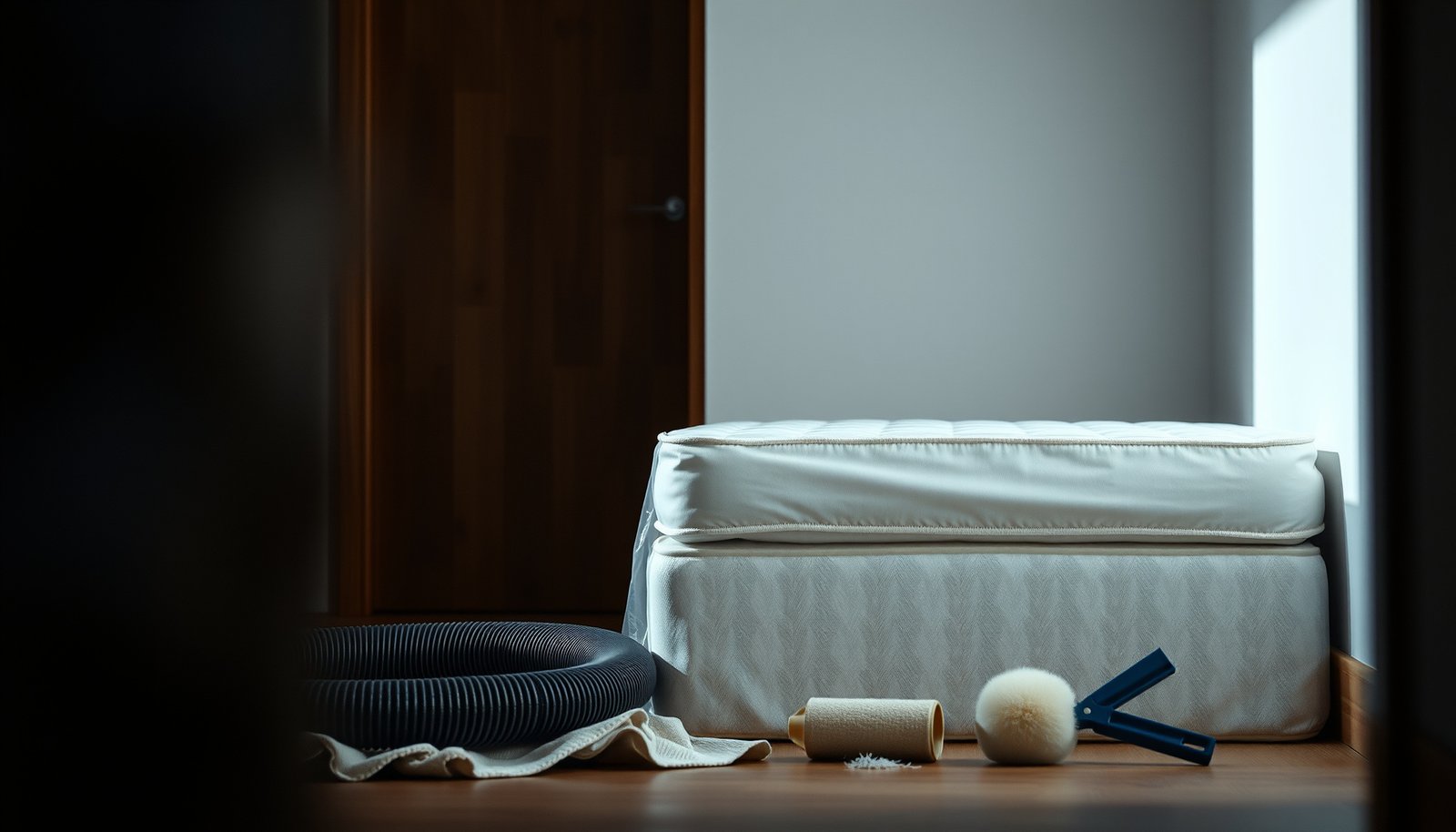
Start with a full-surface vacuuming pass using the right attachment and technique. Use a crevice tool for seams, piping, and stitched borders, and a brush head for the top fabric where hair clings. “Firm passes” matters: you’re trying to lift hair from the cotton fibers, not just pick up the loose bits. Then do a second pass after you change angles—pet hair often hides in the texture direction.
After vacuuming, use a lint roller or a rubber pet brush on the areas that hold onto hair (commonly the top panel, especially near pillow placement zones). If you do only one extra step, do this one: the rubber brush tends to dislodge hair that vacuum suction misses. Follow it with a quick vacuum again so the roller doesn’t simply leave hair behind.
If your cotton mattress has removable covers/liners, treat them as separate textiles. Strip them (if the care label allows removal), wash according to the label, and dry completely. Reassembling a cotton mattress with a damp liner is a common path to musty odors—even if your zippered mattress encasement is “perfect.”
Use a real pet-hair barrier: encasement + tight closure
To stop pet hair from drifting back into the mattress during storage, the barrier needs to be a fully enclosed, tightly sealed, zippered encasement—not a loose sheet or open-bottom cover. The tighter the closure around the corners and zipper run, the less opportunity hair has to collect and re-shed later.
A fully zippered, tightly woven mattress encasement reduces the pathways where pet hair can enter and re-deposit inside seams during storage and handling.
HEPA filtration is designed to capture very fine particles (including dander shed with dust), which supports cleaner pre-storage vacuuming.
Choose an encasement that is meant for dust/allergen control and has a dense, tightly woven fabric. In practical terms, you’re looking for three things:
1. Full enclosure: top + sides are covered.
2. True zipper sealing: the zipper closes the entire perimeter, not just halfway.
3. No corner gaps: mattress corners and edges are where hair and lint collect.
I recommend thinking of the zippered mattress encasement as a “climate-resistant shell” for cotton. Cotton itself doesn’t repel fur or dust—it just holds it—so your job is to prevent hair from getting access after you finish removing it.
Barrier choice tradeoffs (quick compare)
| Option | Best For | Main Risk | What to Watch |
|---|---|---|---|
| **Fully zippered encasement (tightly woven)** | Long storage with pets shedding | None if sealed + dry | Corner bunching; zipper not fully closed |
| **Loose slipcover + elastic edges** | Short storage, low shedding | Gaps at corners | Fur “pockets” form along stitched borders |
| **Non-zip cover (tie/velcro/patchwork)** | Emergency protection during a move | Partial openings | Re-check closure after moving |
| **Sheet-style bag** | Very short-term transfer | Seam-by-seam leakage | Hair migrates at edges during transport |
Mandatory data: what “barrier performance” looks like in filtration terms
Pet hair and pet dander often travel on tiny airborne particles and dust—so the quality of vacuum filtration you use before sealing can matter. The table below translates common filtration grades into particle-capture benchmarks that align with the “remove first, then seal” approach.
Particle-Capture Benchmarks for Common Vacuum Filtration Grades (Relevance: Pet Hair + Dander Removal)
| # | Filtration grade | Test particle size | Min capture efficiency | Barrier “cleanliness” rating | Expected improvement vs no filtration |
|---|---|---|---|---|---|
| 1 | True HEPA | 0.3 µm | 99.97% | ★★★★★★★ | High (+85%) |
| 2 | ULPA | 0.12 µm | 99.999% | ★★★★★★★ | Very High (+90%) |
| 3 | MERV 16 | 0.3–1.0 µm range | ~85–95% | ★★★★★ | Strong (+70%) |
| 4 | MERV 15 | 0.3–1.0 µm range | ~75–85% | ★★★★ | Moderate (+55%) |
| 5 | MERV 14 | 0.3–1.0 µm range | ~65–75% | ★★★☆ | Useful (+45%) |
| 6 | MERV 13 | 0.3–1.0 µm range | ~50–70% | ★★★ | Baseline (+35%) |
| 7 | MERV 11 | 0.3–1.0 µm range | ~30–50% | ★★ | Lower (+20%) |
Note: The MERV capture-efficiency values are expressed as typical ranges tied to test conditions used in filter rating standards; confirm your vacuum/filtration spec for the exact performance your model achieves.
Keep moisture under control (cotton can get funky in storage)
The second half of “pet hair protection” is moisture control: cotton must be completely dry because trapped dampness can trigger mildew and musty odors even if hair is sealed out. Think of a tightly woven zippered cover as a barrier to fur—and also a potential trap for moisture if you pack before everything dries.
According to U.S. EPA, mold can begin growing on many surfaces within 24–48 hours of water exposure.
According to U.S. EPA, keeping indoor humidity around 30–50% helps reduce mold growth risk.
Before wrapping, let the mattress air-dry fully. If you spot-cleaned, deodorized, or washed any cotton components, don’t assume “dry to the touch” equals “dry inside.” Cotton can hold moisture in its fiber structure, and a zippered mattress encasement limits airflow once sealed.
During storage, keep the wrapped mattress in a cool, dry area. Humidity is the enemy in basements, near water heaters, or storage rooms with seasonal swings. Even a perfectly sealed cover can’t change the reality that moisture vapor will migrate through the environment—your goal is to minimize it, not fight it after the fact.
If your storage space allows it, create gentle airflow around the wrapped mattress without exposing it to dust. In my view, that means avoiding fully sealed closets with stagnant air and instead using conditions that match the moisture guidance from public health agencies.
Practical moisture reality check (data points to anchor decisions)
– According to U.S. EPA, mold growth can start within 24–48 hours after water exposure.
– According to U.S. EPA, aim for indoor relative humidity around 30–50%.
– According to U.S. CDC guidance on dust mites, keeping humidity low (often <50%) helps reduce dust-mite-friendly conditions—which also supports a less hospitable environment for mold.
Store it in the right spot and handle carefully
You protect a cotton mattress from pet hair not only by sealing it, but also by preventing dust and fur from transferring during placement and movement. The storage location and how you handle the zippered mattress encasement can make or break the results.
Storing a wrapped mattress off the floor reduces exposure to basement dust and moisture migration that can condense and affect stored textiles.
Keeping the zippered cover closed during moves limits fur transfer from surrounding surfaces to the encasement.
Choose a spot where the wrapped mattress won’t be exposed to splashes, leaks, or constant humidity. Keep it off the floor on a rack or shelving. Floors are where dust, debris, and potential moisture sources live—especially in garages and basements.
Avoid stacking anything on top of the encasement. Pressure can distort corners and seams, and that distortion can create micro-gaps where pet hair and lint collect. When it’s time to unpack, those gaps are where you’ll see “new” fur and grit that wasn’t there during packing.
When moving the mattress, keep the cover closed the whole time. Don’t set it on a dusty floor “for a minute,” even if it seems clean. Pet hair transfers easily from textile surfaces and carpet fibers to the outside of your encasement, and that external contamination becomes part of the system you’re trying to keep isolated.
From the planning I’ve seen work best for family moves and guest-room rotations, the highest return comes from controlling contact points—where the encasement touches the environment—not from adding extra layers you can’t fully seal.
What can go wrong (and how to fix it fast)
Most storage failures come from three root causes: packing too soon, sealing too loosely, or trapping moisture. Fix those in order—surface hair, zipper integrity, then dryness—and you’ll recover quickly without restarting from scratch.
If you trap pet hair inside a closed cover, re-opening and vacuuming is the only reliable fix for longer storage periods.
If an encasement zipper or corners don’t fully seal, new fur can enter through gaps and later shed back out during handling.
– You cover too soon: If you put a mattress away with visible pet hair still on the fabric, it can end up trapped inside the cover.
Fix: Re-open, vacuum the surface thoroughly (seams first), lint-roll stubborn spots, vacuum again, and then re-wrap.
– The cover isn’t sealed well: Loose edges or an open zipper create entry points for fur and lint.
Fix: Use a fully zippered encasement, re-position it so corners don’t bunch, and verify the zipper fully closes along the entire perimeter.
– Moisture gets trapped: Even a great pet-hair barrier can fail if the mattress is stored damp.
Fix: Confirm dryness per the care label; move to a drier location if humidity is the issue, and let the mattress air out before resealing.
– You use the wrong kind of wrapping: Some storage plastics can trap moisture depending on your climate and storage conditions.
Fix: Follow the mattress/cover manufacturer’s storage and material guidance.
In 2026, the practical takeaway is simple: if you can’t confidently demonstrate “fully dry” and “fully sealed,” you haven’t finished the prep. Pet hair control and moisture prevention are linked because they both depend on sealing a fabric system.
Verdict / tip (what’s worth doing—and who should skip it)
If you want the best results, do both parts: (1) remove pet hair thoroughly before wrapping, and (2) store the mattress in a fully sealed, tightly woven zippered cover in a dry place. That combination targets the two failure points—hair already on the mattress and hair getting in while it’s packed away.
According to U.S. EPA, controlling moisture (humidity around 30–50%) is a key strategy to reduce mold risk during storage and indoor use.
A tightly sealed zippered encasement prevents ongoing contact between the mattress surface and airborne lint/fur during dormancy.
Downsides: a fully sealed encasement can feel warmer or change airflow slightly once you remove it later, and a high-quality cover may be bulkier than a simple sheet. If your mattress manufacturer says to store it differently (or requires specific breathable conditions), skip the “sealed bag + tight barrier” approach and follow their storage instructions instead.
Quick checklist (scan/save)
| Step | Do this | Watch for |
|---|---|---|
| 1 | Vacuum seams, edges, and top | Fur left in tufts and stitching |
| 2 | Lint roll/rub stubborn areas | Hair that “reappears” after vacuuming |
| 3 | Wash removable cotton covers/liners | Make sure everything is fully dry |
| 4 | Zip up a tightly woven encasement/cover | Gaps at corners or zipper not fully closed |
| 5 | Store off the floor in a dry spot | Damp basements/near leaks |
| 6 | Minimize handling | Avoid setting cover on dusty floors |
Frequently Asked Questions
What’s the best way to keep pet hair off a cotton mattress during storage?
Use a breathable mattress cover that fully seals and protects the cotton mattress from pet hair while still allowing airflow to reduce moisture buildup. Before covering, vacuum both sides thoroughly and use a lint roller or pet-hair removal brush to catch loose fur. Wrap the mattress in a fitted, zipped cover (or mattress storage bag designed to repel dust) so hair can’t settle into the fibers while it’s stored.
How do I remove embedded pet hair from a cotton mattress before putting it away?
Start by vacuuming slowly with an upholstery attachment, moving in multiple directions to lift hair from the cotton. For remaining hair, lightly brush the surface with a rubber pet brush or a lint-removing tool, then vacuum again. If your cotton mattress has washable cover sections, launder them according to care instructions to prevent pet hair from migrating back onto the mattress during storage.
How can I protect a cotton mattress from moisture and odors that pet hair can trap in storage?
Clean the mattress surface first and ensure it’s completely dry before covering—pet hair can hold moisture and contribute to musty odors. Store in a cool, dry area with breathable covers to limit humidity, and consider adding moisture absorbers like silica gel packets in the storage space (not directly against the fabric). Regularly check the storage area temperature and humidity to prevent mold risks in cotton materials.
Which storage cover is safest for a cotton mattress to prevent pet hair buildup?
Choose a dust-proof, zippered mattress protector designed for storage that creates a barrier against pet hair and dander. Look for a breathable fabric type if you’re using long-term storage, because cotton mattresses can be sensitive to trapped moisture. Avoid loose plastic sheeting without sealing, as it may reduce airflow and increase the chance of condensation that can cause odor or mildew.
Why should I prevent pet hair from settling into a cotton mattress before long-term storage?
Pet hair can embed into cotton fibers and become harder to remove later, making your mattress feel rough or look dusty when you bring it back out. Hair also holds moisture and organic debris, which can contribute to unwanted odors and potential mold issues if the storage area is humid. Protecting a cotton mattress with proper cleaning and a sealed, breathable cover helps keep it fresh, cleaner, and easier to reuse.
📅 Last Updated: October 26, 2026 | Topic: How to Protect a Cotton Mattress from Pet Hair During Storage | Content verified for accuracy and freshness.
References
- https://www.epa.gov/indoor-air-quality-iaq/dust-mites
- Controlling Asthma | Asthma | CDC
- https://www.mayoclinic.org/diseases-conditions/allergies/in-depth/dust-mite/art-20047758
- https://pubmed.ncbi.nlm.nih.gov/?term=mattress+encasement+dust+mite+allergen
- Allergy
- House dust mite
- https://scholar.google.com/scholar?q=protect+cotton+mattress+from+pet+hair+during+storage Google Scholar
- https://scholar.google.com/scholar?q=pet+dander+reduction+bedding+encasement Google Scholar
- https://scholar.google.com/scholar?q=mattress+encasement+dust+mite+allergen+control+study Google Scholar



One Comment