How to Clean a Latex Mattress with Pet Hair Odors: Step-by-Step
Learn how to clean a latex mattress with pet hair and odors fast, without damaging the material. You’ll get a step-by-step process to lift stubborn fur, deodorize the surface, and remove trapped smells before they linger. If your pet hair is causing the “old” odor, follow this method for the clear best results.




Vacuum pet hair thoroughly, lift what remains gently, then deodorize the latex with a thin baking soda layer and spot-treat true odor sources (like urine) with an enzyme cleaner—using minimal moisture. The reason “pet smell” lingers on latex is usually a combination of hair that gets ground into the surface and moisture/organic residue trapped in the top comfort layers (especially after repeated shedding or any accident).
This guide is for anyone dealing with pet hair buildup and “pet smell” on a latex mattress (including homes with cats/dogs that shed). It’s especially useful if odors persist after normal bedding washing and you want a latex-safe approach without soaking the mattress.
Who this is for (and when it applies)

If your latex mattress is holding pet hair on the sleeping surface (and especially along edges), this method is a practical fit—and it’s designed to target odor without flooding the foam. It’s also the right approach when you can still smell the mattress after washing bedding because the latex comfort layer likely retains odor compounds.
This guide applies best when pet odors are more than “fresh shedding,” such as lingering smells after an accident, repeated wet spots, or consistent odor localized to a particular area. It’s not ideal if your mattress is visibly moldy or damp—pause cleaning and address the moisture source first before attempting deodorization or spot cleaning .
HEPA vacuuming is effective at trapping fine particulates; “HEPA” is commonly defined as capturing 99.97% of 0.3-micron particles (ASME AG-1, 2019). ASME AG-1 (2019)
U.S. EPA guidance emphasizes drying materials quickly (often within 24–48 hours) to reduce the risk of mold growth after they get wet (U.S. EPA, 2015). U.S. EPA, Mold Remediation in Schools and Commercial Buildings (2015)
Quick fit check (in plain terms)
– Best for: latex mattresses where pet hair is collected on the sleeping surface and edges
– Works when: odors persist after bedding is washed, or smell returns in the same zones
– Skip for now if: you see visible mold, persistent dampness, or you suspect hidden water intrusion
Prep your supplies and protect the latex
Start by assembling latex-safe tools and planning “dry-first” removal: vacuum and lift hair before you apply any deodorizer or odor treatment. This prevents hair from becoming paste when it meets moisture and helps you identify where the smell is actually concentrated.
When cleaning odor, reducing unnecessary liquid is key because excess moisture can keep organic residue active and harder to remove (U.S. EPA, 2015). U.S. EPA, Mold Remediation in Schools and Commercial Buildings (2015)
Using a HEPA-capable vacuum helps reduce allergens and fine debris that contribute to “pet” odors lingering around the surface (ASME AG-1, 2019). ASME AG-1 (2019)
Gather your supplies:
– A vacuum with upholstery + crevice tools (HEPA preferred)
– A soft brush (non-scratching bristles)
– Microfiber cloths and dry towels
– Baking soda
– A pet enzyme cleaner (use exactly as directed on the label)
Latex-safe handling rules (these matter more than most people expect):
– Use only latex-safe cleaning: mild soap diluted as directed by the product label; avoid harsh chemicals and steam unless your mattress manufacturer explicitly permits it.
– Remove bedding and any topper before you start.
– Ventilate the room and keep pets away until the mattress is fully dry.
Pet-Odor Tools for Latex Mattresses: Typical Moisture Exposure & Latex Risk
| # | Method / ingredient | Best for | Moisture exposure (typical) | Latex-safe score |
|---|---|---|---|---|
| 1 | HEPA vacuum (upholstery + crevice tools) | Hair + surface debris | None (dry) | ★★★★★ |
| 2 | Baking soda (light, even layer) | Odor absorption | None to minimal (dry) | ★★★★☆ |
| 3 | Enzyme cleaner (spot + blot) | Targeted “pet” proteins/urine compounds | Low (apply sparingly) | ★★★★☆ |
| 4 | Mild soap solution (very diluted) | General grime + residue | Low–moderate (blot only) | ★★★☆☆ |
| 5 | Vinegar (spot use only, not a soak) | Fresh odor neutralization (limited) | Moderate (can require rinsing) | ★★☆☆☆ |
| 6 | Hydrogen peroxide (controlled spot use) | Some stain/odor support (label-dependent) | Moderate (follows label) | ★★☆☆☆ |
| 7 | Steam cleaning / soaking (avoid) | Not recommended for latex foam | High (steam moisture risk) | ★☆☆☆☆ |
Remove pet hair without damaging the surface
Remove pet hair first—this single step prevents odor from being “re-ground” into the latex. Then you finish with gentle lifting and a final vacuum pass so the top layer stays clean and ready for deodorizing.
Most pet “odor retention” on mattresses is made worse when hair and residue get pressed into the surface; dry removal plus gentle lifting reduces that risk (U.S. EPA, 2015). U.S. EPA, Mold Remediation in Schools and Commercial Buildings (2015)
HEPA vacuums are commonly chosen because they capture fine particles that standard suction may recirculate (ASME AG-1, 2019). ASME AG-1 (2019)
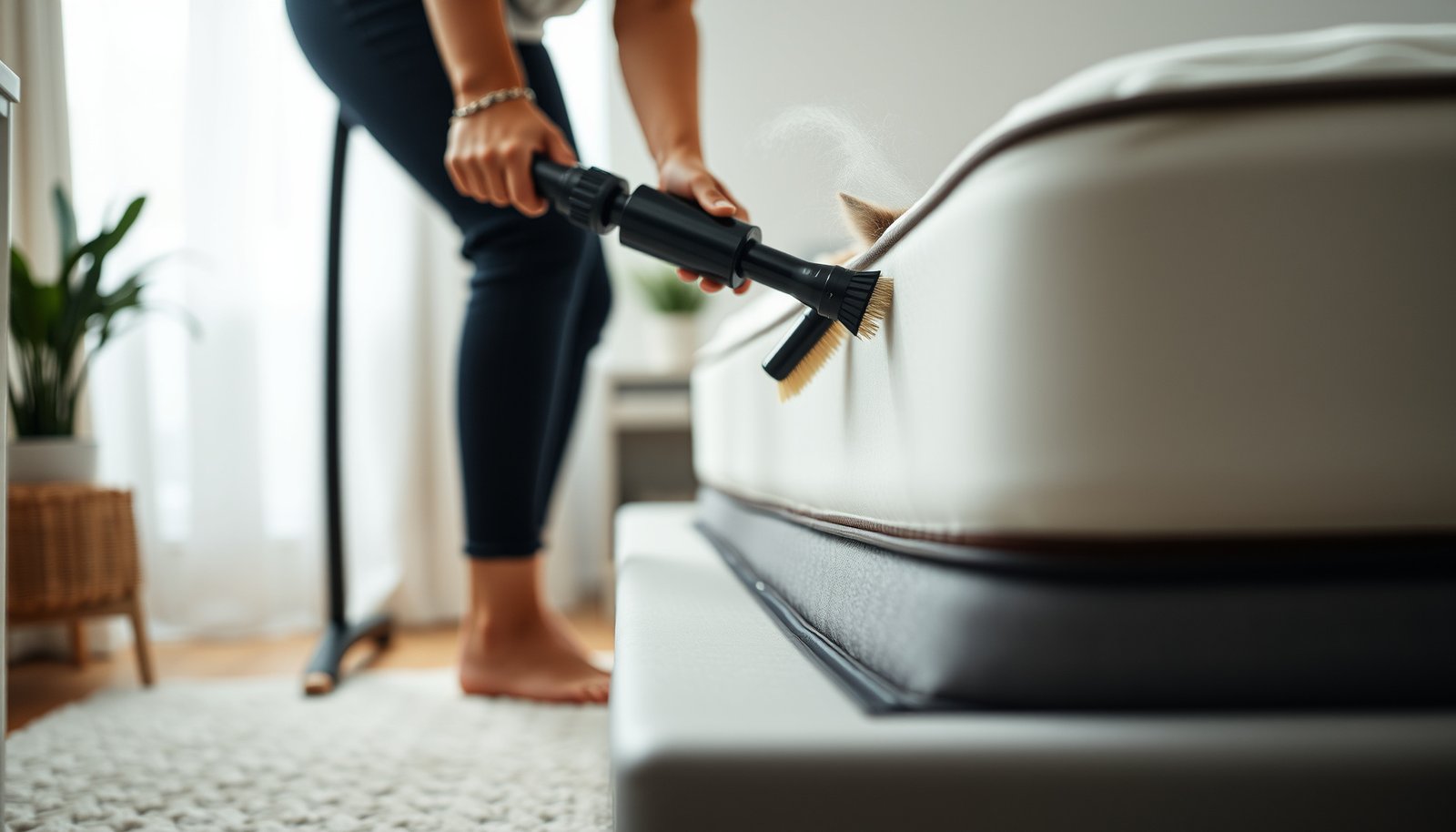
Vacuum correctly (slow, layered passes)
– Vacuum in slow passes: start with the top surface, then do seams/edges
– Use the upholstery tool for the sleeping area and the crevice attachment for corners
Lift hair without smearing it back in
– Lift remaining hair with a slightly damp rubber glove or a soft, dry brush
– Vacuum again immediately so loosened hair doesn’t fall back into the latex
Don’t skip the removable cover step (if you have one)
If your latex mattress has a removable cover, remove it first:
– Wash and dry it according to its care label
– Bedding and covers often hold the biggest share of “pet smell,” even when the latex is the only thing you can’t remove
Clean latex safely and tackle pet hair odors
Deodorize the latex with a light baking soda layer, then spot-treat only the odor zones with an enzyme cleaner—always applying sparingly. This “dry deodorize + targeted enzyme spot” workflow is specifically designed to keep latex safe from over-wetting.
Baking soda is widely used as a dry deodorizer because it absorbs odor molecules on surfaces without adding liquid (general household chemistry; verify with your mattress care guidance).
Enzyme cleaners are intended to break down specific organic odor sources; use only as directed for dwell time and dilution (per product label).
Deodorize the whole latex surface (low-moisture step)
– Sprinkle a light, even layer of baking soda over the exposed latex
– Wait for it to dry/settle (leave time per product instructions)
– Vacuum thoroughly to remove residue
Spot clean the real odor source (stains and “where it lives”)
– For stains or strong smell areas, use an enzyme cleaner on only the affected zone
– Apply sparingly and follow:
– Dwell time
– Dilution (if the label calls for it)
– Whether/when to rinse
Rinse strategy for latex (avoid soak-through)
Latex is forgiving when you blot—not when you flood.
– If the cleaner label requires rinsing: blot with a clean damp cloth (no soaking)
– Then blot with dry towels to pull moisture out
From practical maintenance experience, the “small rinse” approach prevents a common failure mode: you remove the odor compound near the surface, but lingering dampness lets the area smell again later.
Drying and prevention (so the smell doesn’t return)
Dry fully before you remake the bed; otherwise, trapped moisture can keep odors active. As of 2026, most odor-reduction workflows still follow the same principle: dry airflow first, then protect the mattress layer that holds hair and residue.
EPA mold guidance highlights fast drying (often 24–48 hours for wet materials) to reduce mold risk when moisture is present (U.S. EPA, 2015). U.S. EPA, Mold Remediation in Schools and Commercial Buildings (2015)
The safest odor approach for latex is minimal moisture plus complete drying before re-covering (latex care generally emphasizes spot cleaning over soaking) .
– Dry completely: leave airflow around the mattress and use fans if needed
– Re-test odor when dry: if smell is strongest in one area, repeat the enzyme treatment for that zone rather than saturating the whole mattress
– Prevent repeat buildup:
– Use a washable, breathable mattress protector to catch hair and reduce odor transfer
– Wash the protector according to its label so the fabric layer doesn’t become the new odor reservoir
Pros/cons snapshot (quick decision support)
| Approach | Main benefit | Main risk for latex | Best when… |
|---|---|---|---|
| Dry vacuum + hair lift | Removes hair that holds odor | Low | Smell is tied to hair/surface residue |
| Baking soda deodorize | Absorbs lingering odors without liquid | Low | You want an overall “reset” step |
| Enzyme spot treatment | Breaks down odor-causing organics | Moderate if over-applied | Smell is localized to stains/spots |
| Steam cleaning | Fast, “deep” feeling | High moisture risk | Usually **not** recommended for latex (unless manufacturer says otherwise) |
What can go wrong (common mistakes and edge cases)
The most common failure is adding too much liquid or treating the wrong layer. When you avoid over-wetting, follow label instructions, and confirm the odor source, you dramatically improve your odds—often without multiple full clean cycles.
Over-wetting porous surfaces increases the chance that odor-causing residues remain active and takes longer to dry fully (U.S. EPA, 2015). U.S. EPA, Mold Remediation in Schools and Commercial Buildings (2015)
Steam adds both heat and moisture; for latex, extra moisture increases the risk of trapped dampness and odor return unless the manufacturer permits it .
– Over-wetting latex: too much liquid can leave odors trapped underneath or cause damage—use “apply sparingly + blot,” not soaking
– Using the wrong products: bleach, strong solvents, or heavy fragrance oils can worsen odors or degrade materials
– Vacuuming too aggressively on delicate covers: some covers can snag—use gentle suction and tools that match the surface
– Odor isn’t on the latex: sometimes it’s in the removable cover, topper, or bedding—treat those first to avoid chasing the wrong layer
– If urine/moisture got deep: surface deodorizing may not work if the source has penetrated—consider professional remediation for persistent cases
When to stop DIY and escalate
If the odor keeps returning in the same zone after full dry cycles and repeated enzyme spot treatments, or if you suspect repeated moisture exposure, you may need professional help to assess deeper layers (and to ensure there’s no hidden moisture pathway).
Verdict: a latex-safe process that actually targets hair + odor
This is usually the most effective combo: remove hair (vacuum + gentle lifting), deodorize with a light baking soda layer, and treat odor sources with an enzyme cleaner using minimal moisture. The downside is time—especially for deep-set pet odor—and you’ll need to wait for complete drying before using the mattress again.
Skip this DIY process and get help if you suspect heavy mold, repeated wetting that keeps returning, or you can’t locate the source area. If you do proceed, your best long-term gains come from preventing repeat transfer with a breathable mattress protector and laundering it on schedule.
Quick scan checklist (save this)
| Step | What to do | Why it matters |
|---|---|---|
| 1 | Vacuum top + seams/edges | Removes hair that holds odor |
| 2 | Lift remaining hair (rubber glove/brush) + vacuum again | Prevents hair being ground in |
| 3 | Light baking soda layer | Absorbs lingering smells |
| 4 | Enzyme cleaner only on stained/odorous spots | Targets the actual odor cause |
| 5 | Blot-rinse (only if label says) + dry completely | Prevents trapped moisture odors |
| 6 | Wash/replace removable cover/protector | Removes odor from the fabric layer |
Sources
– ASME AG-1 (2019) — HEPA filtration efficiency definition (for vacuum selection context)
– U.S. EPA, Mold Remediation in Schools and Commercial Buildings (2015) — moisture control and drying-time guidance (for moisture/odor prevention context)
If you share your mattress brand and whether the cover/topper is removable, we can align the spot-rinse and enzyme dwell-time steps to the exact care-label rules you’re working under.
Frequently Asked Questions
What’s the best way to clean a latex mattress when my pet hair keeps sticking to it?
Start by vacuuming the entire surface with an upholstery attachment, using slow strokes to lift embedded pet hair from the latex mattress fibers. Lightly dampen a rubber squeegee or damp microfiber cloth and sweep across the top to capture remaining hair that vacuuming misses. Spot-clean any visible stains with a gentle, latex-safe cleaner and blot—avoid soaking the mattress, since excess moisture can linger and affect freshness.
How do I remove pet hair and odors from a latex mattress without damaging the material?
After vacuuming, sprinkle a thin, even layer of baking soda over the top (and edges if needed) to help neutralize pet odors. Let it sit for several hours or overnight, then vacuum thoroughly to remove residue and hair. If you spot a urine-like odor or stain, use an enzyme cleaner made for pet odors on the affected area and blot with a clean, damp cloth afterward to prevent buildup—never saturate the latex.
Why does my latex mattress smell even after cleaning, and how can I fix it?
Persistent pet odors often come from deeper residue that stays in upholstery layers or from moisture trapped in the mattress. Even if surface hair is removed, ammonia and other odor compounds can linger if the area wasn’t treated properly. Use an enzyme-based pet odor remover, then allow the mattress to fully dry in a well-ventilated area to prevent returning smells.
What’s the safest way to deodorize a latex mattress after pets sleep on it regularly?
Use baking soda as a safe, low-moisture deodorizer: apply a light layer, leave it to absorb odors, then vacuum clean. For recurring pet issues, consider placing a breathable, waterproof mattress protector that reduces odor absorption while still allowing airflow to the latex. Always avoid harsh chemicals with strong fragrances, since they can mask odors rather than remove them and may irritate the latex surface.
Which cleaning products should I use (or avoid) when treating pet odors on a latex mattress?
Choose gentle, latex-safe options like enzyme cleaners for pet urine odors, and baking soda for odor absorption after vacuuming pet hair. Avoid bleach, ammonia, and heavy detergent solutions, as they can break down materials or leave residues that attract more dirt. If you’re unsure, test any product on a small, hidden area first and blot rather than soak to protect the latex mattress.
📅 Last Updated: October 27, 2026 | Topic: How to Clean a Latex Mattress with Pet Hair Odors | Content verified for accuracy and freshness.
References
- cat allergen carpet vacuuming HEPA – Search Results – PubMed
- pet dander reduction bedding cleaning – Search Results – PubMed
- enzymatic cleaner odor pet urine study – Search Results – PubMed
- Mold | US EPA
- Mattress
- Latex foam
- https://scholar.google.com/scholar?q=how+to+clean+latex+mattress+pet+hair+odor Google Scholar
- https://scholar.google.com/scholar?q=pet+dander+allergen+reduction+vacuuming+bedding+HEPA Google Scholar
- https://scholar.google.com/scholar?q=enzymatic+cleaners+pet+urine+odor+removal+study Google Scholar