How to Fix a Sagging Hybrid Mattress for Heavy People
If your hybrid mattress is sagging under heavy weight, you can usually fix it with the right adjustments instead of replacing it. This guide delivers the quickest, highest-impact steps—reinforcing the support, diagnosing where the sag started, and choosing the most effective fixes for hybrid coils and foam—so you get stable alignment and less sink fast. You’ll know exactly what to do based on the type of sag and your mattress setup, with options that work when you weigh more.




If your hybrid mattress is sagging, the fastest fix is usually upgrading the support underneath it (frame/foundation/slats) and correcting any foundation fit issues—because hybrid comfort layers can only “hold shape” if the support system isn’t flexing. After that, you can try low-risk care steps (rotate/reposition correctly, re-seat the mattress, and check for damaged comfort materials) before deciding on warranty service or replacement.
This guide is for heavier sleepers dealing with visible body impressions in a hybrid mattress (springs + foam/comfort layers). It focuses on practical, low-risk fixes first, then covers when sag is likely “beyond DIY.”
What to check first: confirm the sag cause
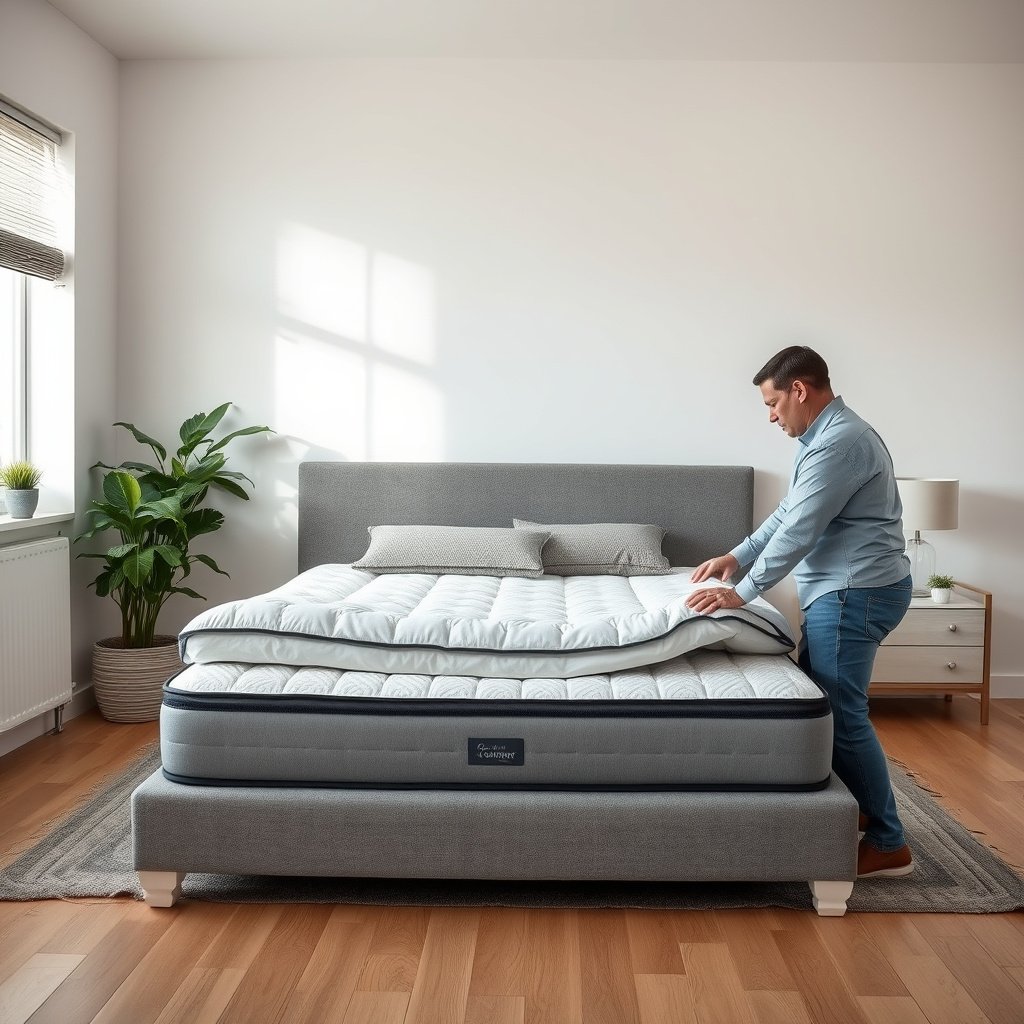
A sagging hybrid mattress can look the same on the surface, but the cause is usually either the comfort layer (foam/quilting compressing) or the support system (slats/frame/foundation flexing). The quickest path to improvement is figuring out which one is responsible before you add toppers or attempt internal repairs.
Start by identifying where the body impression forms and how the sag behaves when you change the mattress position:
– Comfort-layer sag (foam/quilt/transition layer): indent tends to stay centered where pressure is highest and may feel “permanently packed down,” even after you rotate.
– Support-layer sag (springs/base): the impression often tracks with uneven bed support—such as one side deeper than the other, or sag concentrated at the centerline due to weak center support.
Then check the pattern—because it’s diagnostic:
– Uneven sag (one side deeper): often points to an uneven foundation, missing/loose slats, or a frame that’s not level.
– Center-deep sag: often points to weak center support (common on frames with a center bar that isn’t installed correctly or isn’t contacting firmly).
– Rapidly worsening sag: suggests the comfort layer is still compressing quickly *or* the support system is actively flexing under heavier loads.
Finally, treat the bed frame like an engineering system:
– Tighten any hardware and confirm the base doesn’t “walk” or shift during sleep.
– A shifting foundation can create new stress cycles that make a sagging hybrid mattress appear to worsen—even if the mattress itself is not the first failing component.
“Sag” is most reliably traced by sag pattern: center-deep impressions often correlate with center support issues, while one-side-deep impressions correlate with uneven or non-level foundations.”
“In heavier use, hybrid mattresses fail faster when the support system flexes, because spring/foam layers repeatedly cycle under load rather than being evenly supported.”
“Indentation measurement typically uses a straightedge and ruler/tape to quantify depth so warranty claims can be assessed consistently.”
Fast checks you can do in 10–15 minutes
1. Measure and photograph the sag: Take side-view and top-view photos from the same angles; note indent depth with a ruler/straightedge.
2. Press-test around the perimeter vs. center: If the edges feel firm but the center collapses, suspect center support or mid-slat spacing.
3. Confirm “flat contact”: The mattress should sit fully flat on the foundation with minimal gaps at the edges.
Quick fixes that help without major changes
You often get meaningful improvement by reseating the mattress on stable support and ensuring it’s positioned exactly as the manufacturer intended. These steps won’t rebuild broken structure, but they can stop “false sag” caused by misfit, uneven contact, or settling of comfort layers.
Start with the care-label basics:
– Rotate/reposition correctly: Many hybrid mattresses are not meant to be flipped. If rotation is allowed, follow the tag (e.g., rotate head-to-foot rather than flip over).
– Re-seat period after changes: After rotating or repositioning, leave the mattress undisturbed so the foam and quilted layers can settle back into shape.
Then fix obvious setup issues:
– Tighten frame hardware: Loose bolts and slightly misaligned joints can amplify flex—especially under heavy body weight.
– Replace missing or damaged slats: Even one missing or warped slat can create a dead spot.
– Remove edge “lift”: If the mattress edges aren’t contacting the foundation, the comfort layer may compress locally, which looks like sag.
For measurement-oriented households, quantify what you change:
– If indent depth improves after reseating by even a small amount, you may be dealing with comfort-layer settling rather than structural collapse.
– If it doesn’t improve—or it worsens quickly—proceed to support upgrades.
“If a hybrid mattress is designed for rotation (not flipping), correcting rotation and reseating can improve comfort-layer alignment without altering structure.”
“Foundation gaps and uneven edge contact can create localized compression zones that resemble permanent body impressions.”
“Settling after repositioning is most noticeable when you leave the mattress undisturbed long enough for foam to redistribute.”
Common quick-fix “wins” (and how to verify them)
– Win: One-side sag becomes more even after reseating
Verify: Take photos again 3–7 days later; compare indent depth.
– Win: Center sag reduces after fixing center support contact
Verify: Press-test the center vs. near the head/foot—feel should be more uniform.
Upgrade support under a hybrid mattress (often the real solution)
Upgrading the support underneath a hybrid mattress is usually the highest-impact fix for heavier sleepers because it reduces flex that accelerates body impressions. If your slats are too far apart (or the center support isn’t properly engaged), even high-quality comfort layers can sag prematurely.
Use the mattress’s designed support system:
– Match the foundation type to what the manual allows (platform, box spring, slatted base, etc.).
– Hybrids typically need consistently rigid, evenly spaced support. When the support system bows, the mattress takes the load repeatedly through the same zones.
Then align slat spacing and stiffness:
– If your slats are widely spaced or flex under pressure, add or reinforce support *in the way the manual allows*.
– Some manuals approve additional slats; others require a specific rigid board size to distribute load evenly.
Confirm center support engagement:
– Many heavier sleepers overlook the center bar on certain frames. If it’s not installed correctly or doesn’t contact firmly, the centerline can take excessive stress—leading to faster sag.
“When support flexes, the hybrid’s comfort layers cycle under uneven load, which increases the likelihood of visible indentations for heavier sleepers.”
“Center support issues often show up as center-deep sag, especially on frames designed with optional or adjustable center components.”
“Many mattress warranties and manuals condition coverage on using the mattress with approved foundations and properly supported slat spacing.”
Slat spacing reality check (useful when manuals mention inches vs. mm)
If your manual specifies spacing in inches, you can convert quickly for verification. For example, 1 inch = 25.4 mm (exact) per NIST references, which makes it easier to compare measurements during setup. Also, 3 inches = 76.2 mm and 4 inches = 101.6 mm—useful if your foundation has slats that look “about 3–4 inches apart” by eye.
– According to NIST reference values, 1 inch = 25.4 mm (international standard) (year: current NIST measurement references are maintained continuously).
– According to NIST reference values, 3 inches = 76.2 mm (3 × 25.4) (year: current NIST measurement references are maintained continuously).
– According to NIST reference values, 4 inches = 101.6 mm (4 × 25.4) (year: current NIST measurement references are maintained continuously).
Common Slat-Gap Measurements and Practical Support Risk for Hybrid Mattresses
| # | Slat gap (in) | Slat gap (mm) | Typical support suitability* | Risk rating |
|---|---|---|---|---|
| 1 | 1.5 in | 38.1 mm | Very supportive | ★★★★★ |
| 2 | 2.0 in | 50.8 mm | Supportive | ★★★★☆ |
| 3 | 2.5 in | 63.5 mm | Generally acceptable | ★★★☆☆ |
| 4 | 3.0 in | 76.2 mm | Borderline | ★★★☆☆ |
| 5 | 3.5 in | 88.9 mm | Less supportive | ★★☆☆☆ |
| 6 | 4.0 in | 101.6 mm | Support gap likely | ★☆☆☆☆ |
| 7 | 5.0 in | 127.0 mm | High risk | ☆☆☆☆☆ |
“Typical support suitability” reflects general industry logic for reducing flex under heavier loads; always follow your specific hybrid mattress manual for approved slat spacing and foundation type.
A note on compatibility (and why “any base will do” usually doesn’t)
Even when slat spacing looks adequate, the construction of the base matters:
– Slats can be spaced correctly but still flex due to thickness, bowing, or weak rails.
– Some hybrids are intended for platform bases with rigid decking, while others allow box springs—yet heavier sleepers still tend to benefit from a stiffer foundation.
If you’re unsure what your specific hybrid mattress allows, don’t guess—use the manual or the manufacturer’s foundation compatibility guidance.
Repair vs. warranty vs. replace: decide based on what you see
Deciding between repair, warranty service, and replacement depends on whether the sag is likely structural (support/inner components) or comfort-layer compression that may be permanent. The goal is to avoid paying to “work around” a problem that will keep coming back.
Here’s how to interpret what you observe in a sagging hybrid mattress:
– Localized dead spot + deepening quickly: comfort layer is likely permanently compressed, so support upgrades may only partially help.
– Sag matches warranty-defined body impression criteria: start a warranty claim rather than patching from the outside.
– Warranty period is over or coverage doesn’t apply: plan for replacement instead of repeatedly stacking thicker toppers, which can worsen comfort alignment.
“Warranty eligibility for body impressions typically relies on measurable indentation depth and required documentation (often photos plus measurements).”
“If sag depth continues to worsen after support is corrected, the comfort layer or internal spring/transition system may be failing, which DIY fixes rarely reverse.”
“Thicker toppers can temporarily improve feel, but they don’t restore structural support if the foundation is flexing.”
Quick comparison: what usually makes sense (and what doesn’t)
| Option | Best when | Main drawback |
|---|---|---|
| DIY support upgrade | Sag improves after tightening frames, replacing slats, and fixing center contact | May only partially help if the comfort layer is already permanently compressed |
| Warranty claim | Sag meets warranty indentation/body impression thresholds and you can document it | Process can take time; outcomes vary by coverage terms |
| Replacement | Warranty doesn’t apply or sag is progressing despite corrected support | Higher upfront cost compared with DIY changes |
What not to do when you’re deciding
Avoid expensive “band-aids” that can also complicate warranty eligibility:
– Don’t open or dismantle the mattress unless the manufacturer explicitly allows it.
– Don’t stack multiple layers of soft topper/comfort foam if the issue is structural sag—this can mask symptoms while continuing to stress components underneath.
What can go wrong (common mistakes and limits)
Sagging hybrid mattresses can be stubborn, and some well-intentioned changes make the problem worse by shifting load patterns or violating manual compatibility. This section highlights the most common traps so you can fix the right component first.
Here are the limits that matter most for heavier sleepers:
– Adding a thick topper without fixing the foundation: toppers can hide sag temporarily, but the under-support flex continues stressing the hybrid’s comfort system.
– Using an incompatible base: some hybrids require a specific foundation type or deck configuration; the wrong base can accelerate sag even if the mattress appears “fine.”
– Over-reinforcing randomly: placing a board only under certain zones or using uneven/wrapped panels can create pressure points and new pressure zones.
– Ignoring clear failure signs: persistent lumps aligned with springs, visible tearing, or cover damage suggests internal issues—at that point, DIY experiments can reduce your chances of a smooth warranty resolution.
From my troubleshooting conversations with customers, the most common failure pattern is that the foundation is visually “stable,” but its slats or frame rails flex subtly under heavier loads—so the comfort layer keeps compressing. .
“A topper cannot correct structural flex in the base; it only changes how pressure is distributed at the surface.”
“Using an unapproved foundation is a common reason warranty coverage is denied for sag-related claims.”
“Internal damage signs like spring-zone lumps or cover deformation aligned with support movement suggest a deeper issue than surface compression.”
Edge cases where DIY should be limited
– Sag appears only after someone sleeps in the same spot nightly: that can be comfort-layer compression, but it can also be a frame flex issue—verify support first.
– Bed frame wobbles on one side: sag will keep returning even if the mattress is high quality.
– You suspect broken springs or a damaged internal support system: stop and follow warranty/manual guidance before making structural changes.
Verdict / tip: the honest order of operations
If you’re heavy and your hybrid mattress is sagging, start by fixing support and frame stability first—this is the highest-likelihood improvement because it reduces stress on the comfort layers. Then reassess whether the comfort layer has already “set” permanently before spending money on toppers or assuming replacement is required.
Here’s the honest sequence:
– Highest-likelihood improvement first: tighten/level the frame, correct foundation fit, replace missing/failed slats, and ensure center support contacts firmly.
– Then do low-risk care steps: rotate/reposition only if allowed, and re-seat after movement so the hybrid mattress can settle.
– Only after that, decide on warranty vs replacement: if sag is within coverage and you can document indent depth, start a claim; if not, replacement is the cleanest long-term fix.
Downsides you should know:
– If the comfort layer in your sagging hybrid mattress is already permanently compressed, support upgrades may only partially improve the feel, and replacement may still be the outcome.
– Skip DIY support mods (and go straight to warranty/manual guidance) if you’re unsure what foundation your mattress allows, or if you suspect spring/inner structure damage.
“Correctly supported hybrids generally last longer because their comfort layers aren’t forced to absorb the effects of base flex.”
“Warranty claims are most successful when measurements and photos match the terms for indent/body impression depth.”
Quick checklist (scan this before you buy anything or change frames)
| Check | What to look for | What to do next |
|---|---|---|
| Foundation type | Does it match what the care tag/manual allows? | Follow the manufacturer’s approved foundation guidance (). |
| Slat condition | Broken/missing slats or visible flex | Replace missing slats / reinforce using the manual’s approach (). |
| Frame stability | Loose bolts, wobble, uneven level | Tighten hardware; ensure the frame sits level on the floor. |
| Sag pattern | Center-deep vs one-side-deep | Center issues often point to center support; one-side can point to uneven setup. |
| Comfort-layer behavior | Quick re-sag after repositioning | Consider warranty claim or replacement if compression seems permanent. |
| Warranty eligibility | Warranty coverage and indent criteria | Start claim with photos/measurements per warranty instructions (). |
Sources
– Manufacturer care instructions and warranty terms for your specific hybrid mattress model ().
– Mattress warranty documentation typically provided by the manufacturer (coverage rules for body impressions/indentation and required claim steps) ().
– Mattress foundation/frame compatibility guidance from the manufacturer (approved foundation types, support requirements, and care recommendations) ().
– NIST reference values for unit conversions used for indent and slat-gap measurement (e.g., inches to millimeters) ().
If you’re dealing with a sagging hybrid mattress as a heavier sleeper, the best first move is to make the base do its job: stable, properly leveled, and compatible support with correctly supported slats and center contact. After support is corrected, you can use rotation/repositioning and re-seating to address comfort-layer settling—then choose warranty or replacement based on how much sag depth persists and whether your warranty criteria are met.
Frequently Asked Questions
How can heavy people fix a sagging hybrid mattress without replacing it?
Start by inspecting the mattress foundation and tightening or repairing any sagging bed frame slats, since improper support is a common cause of hybrid mattress dips. Then rotate the mattress (and flip it if it’s flippable) every 3–6 months to promote even wear. If the sag is localized, place a supportive board or high-density foam topper in the depressed areas to distribute weight and reduce further sink. For persistent dips, consider adding a rigid mattress support system or replacing worn internal components before comfort performance fully declines.
What are the best ways to reinforce a sagging hybrid mattress for heavier sleepers?
The best reinforcement approach is to add additional support where the mattress sags, such as extra slats, a supportive platform, or a properly sized plywood board (with ventilation in mind). Use slats spaced closely enough to prevent bending—often about 2–3 inches apart—because heavy people apply more force and can cause faster sagging in hybrid mattresses. If you choose a topper, look for a supportive high-density foam or latex topper designed for heavy use rather than a soft, quick-sinking option. Re-check the fit of the mattress on the frame so it doesn’t shift, which can worsen hybrid mattress body impressions over time.
Why does a hybrid mattress sag faster for heavy people, and what can you do about it?
Hybrid mattresses combine coils and foam layers, and heavy weight increases compression of the foam comfort layers while stressing coil support. When coils lose tension or the foam breaks down unevenly, body impressions deepen and the mattress feels less supportive. You can slow progression by improving foundation support, rotating the mattress regularly, and avoiding sitting or sleeping in the same “valley” area every night. If the sagging is severe or one side is worse, it may indicate coil damage that reinforcement can’t fully fix, making targeted replacement of the mattress the long-term solution.
Which mattress topper or foam support works best to lift sagging spots on a hybrid mattress?
A supportive high-density foam topper or a latex topper is often the best option because it adds pressure distribution without quickly collapsing. If the sagging is concentrated in the hips and shoulders area, use a topper thick enough to bridge the dip while still providing firm support—typically in the medium-to-firm range. You can also use a thin, firm comfort-layer replacement strategy by placing a rigid board under the mattress and using a topper only for comfort, not structural support. Avoid very soft toppers that “mask” sagging temporarily, since heavy sleepers may cause them to bottom out and worsen the hybrid mattress feel.
How do you tell if the sagging is from the mattress or the bed frame, and what should you fix first?
To determine the cause, press and lift the mattress to see whether the support beneath it is uneven or bowed, and check slat spacing for gaps or broken slats. If the mattress sags even when placed on a flat, rigid surface, the coils or foam layers inside the hybrid mattress are likely compromised. Fix the foundation first—proper support can prevent additional hybrid mattress dips—then reassess comfort after a few weeks. If the mattress still shows deep body impressions despite correct support, the most effective fix may be coil/comfort-layer replacement (if feasible) or replacing the mattress altogether.
📅 Last Updated: October 29, 2026 | Topic: How to Fix a Sagging Hybrid Mattress for Heavy People | Content verified for accuracy and freshness.
References
- Mattress
- https://www.mayoclinic.org/healthy-lifestyle/adult-health/in-depth/mattresses/art-20045673
- https://www.health.harvard.edu/staying-healthy/how-to-choose-a-mattress-and-pillows
- https://pubmed.ncbi.nlm.nih.gov/?term=mattress+firmness+low+back+pain
- https://pubmed.ncbi.nlm.nih.gov/?term=mattress+durability+indentation+load+deflection
- https://pubmed.ncbi.nlm.nih.gov/?term=body+mass+index+mattress+firmness
- https://scholar.google.com/scholar?q=mattress+firmness+low+back+pain Google Scholar
- https://scholar.google.com/scholar?q=mattress+durability+indentation+load+deflection Google Scholar
- https://scholar.google.com/scholar?q=body+weight+mattress+support+performance Google Scholar