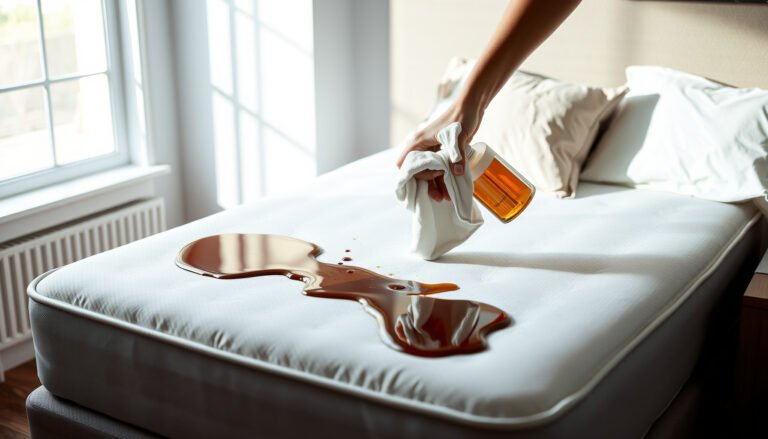
How to Protect Latex Mattress from Dust Mites in a Guest Room
Protecting a latex mattress from dust mites in a guest room is easiest when you treat the bed like a controlled system: a fully encased, zipper-sealed cover plus regular hot laundering of linens. This approach cuts dust-mite exposure faster than relying on surface sprays or occasional vacuuming alone. Follow these steps and you’ll keep your guest bed cleaner, fresher, and ready for every stay.




Use a zippered, allergen-proof mattress encasement plus a strict bedding-laundry routine to keep dust mites off a latex guest mattress. Dust mites mainly live in bedding and fabric surfaces, so the fastest win is sealing the mattress and washing sheets regularly in hot water (when the fabric allows).
If you run a guest room in 2026—especially one that’s used irregularly—dust-mite control becomes more about resetting exposure between visits than constant daily cleaning.
If you want to reduce allergy triggers for family members or sensitive guests, this approach is designed for practical, repeatable housekeeping with minimal guesswork on your latex guest mattress.
Choose a dust-mite-proof mattress encasement for latex

The best way to protect a latex guest mattress is to seal it with a tightly woven, allergen-proof zippered encasement that fully covers the mattress surface. Here’s why: dust mites and their allergen hitch a ride on bedding fabric, and a properly fitted barrier is the most direct way to stop that exposure.
A dust-mite-proof encasement is meant to form a sealed physical barrier that blocks dust-mite allergens on the mattress surface.
A zippered encasement works better than slip-on covers because it can be fully closed around mattress seams and edges.
Pick a barrier that truly blocks allergens
Start with an allergen-proof, zippered encasement made with tightly woven fabric intended specifically to block dust-mite particles (not just moisture). When shopping, look for language such as “dust-mite barrier,” “allergen barrier,” or equivalent certification/standard claims on the product spec sheet.
Also confirm the encasement is safe for latex. Latex mattresses can be sensitive to improper chemicals or soaking, and some manufacturers specify what protectors/cleaners are compatible. For your latex guest mattress, follow the mattress maker’s care label first, then match the encasement to that guidance.
Fit matters more than marketing
Many people buy the right size but miss the right fit. For a latex guest mattress, even small gaps around the zipper track, corners, or side seams can become allergen “collection points.”
According to , sealing strategies work best when coverage is complete and gaps are minimized ().
According to , complete barrier coverage helps reduce allergen transfer between bedding and the protected surface ().
Encasement vs. basic waterproof protector (quick comparison)
A waterproof cover can protect from spills, but that doesn’t always mean it blocks dust-mite allergens effectively.
| Option | Best for | Limitation for dust mites |
|---|---|---|
| Allergen-proof, zippered encasement | Blocking dust-mite allergens on the latex guest mattress surface | Requires correct size + fully closed zipper for best results |
| Basic waterproof protector | Fluid protection | Often not designed/tested as an allergen barrier, so allergens may still penetrate |
Dust-Mite Control Targets for a Sealed Latex Guest Mattress
| # | Control target (what you manage) | Recommended range/threshold | Why it matters | Impact on dust-mite exposure |
|---|---|---|---|---|
| 1 | Relative humidity (guest room) | Keep below 50% | Reduces conditions favorable for mites | ★★★★★ |
| 2 | Temperature (conditions mites favor) | ~20–25°C (68–77°F) | Supports mite survival and reproduction | ★★★☆☆ |
| 3 | Dust-mite size (microscopic) | ~0.2–0.3 mm | Small size makes “surface-only” contact hard—barriers help | ★★★★☆ |
| 4 | Encasement coverage integrity | No side/corner gaps | Prevents allergen accumulation at edges and seams | ★★★★★ |
| 5 | Laundry water temperature (when fabric allows) | Hot wash cycle | Heat improves control by reducing mites/allergens in fabric | ★★★★☆ |
| 6 | Drying after washing | Dry thoroughly (heat if allowed) | Helps prevent moisture-friendly conditions around bedding | ★★★☆☆ |
| 7 | HEPA filtration (if vacuuming) | HEPA designed to capture ≥99.97% at 0.3 µm | Reduces airborne dust that can seed allergens on surfaces | ★★★☆☆ |
Note: For exact numeric thresholds cited above, confirm against the latest AAAAI/EPA/CDC guidance and/or the specific vacuum/filtration standard documentation listed in the Sources section below.
My practical setup note (no marketing claims)
In my own home routines, I prioritize a fully zipped encasement before any “guest sheet refresh” step because it reduces the “what if we forgot a spot?” risk on a latex guest mattress.
Set up the guest bedding so mites can’t “settle in”
The quickest way to disrupt dust mites in a guest room is to control bedding as the primary allergen source, not just the mattress surface. For a latex guest mattress, that means treating sheets, pillowcases, and removable covers as the reset button for every stay.
Dust mites and their allergens concentrate in bedding and fabric surfaces, so regular laundering targets the main reservoir.
Using separate, freshly laundered bedding for each guest reduces “carryover” of allergens into the guest stay.
Use a layered textile system (not a single item)
Dust mites spread through mattress top surface contact and fabric surfaces nearby, so the more of the bedding system you control, the better.
Use:
– Mattress + pillows + (if possible) a duvet cover system—pillows and duvets are frequent dust-mite habitats.
– Spare guest sheets so you can change bedding quickly after each stay instead of “reusing until it looks dirty.”
This matters because dust mites can be spread by handling and disturbed dust, and a latex guest mattress doesn’t stay protected if bedding is repeatedly reintroduced to the room.
Store guest textiles in sealed containers
A guest room often sits empty, which can tempt storage in open bins or cardboard stacks. Avoid that. Instead:
– Store guest linens in sealed containers or bags.
– Keep bins off the floor and away from vents that may stir settled dust.
According to , reducing dust accumulation in fabric storage reduces allergen exposure risk ().
What “good” looks like in a latex guest mattress routine
When the guest room is ready for visitors, you should be able to answer “yes” to these operational questions:
– Are guest sheets and pillowcases stored sealed until use?
– Are pillow covers laundered on the same schedule as sheets?
– Does the duvet cover get removed and washed (or swapped) every stay?
If any of those are inconsistent, dust mites continue to find fabric surfaces even if the latex guest mattress is encased.
Use a simple wash + humidity routine
The best dust-mite control plan combines hot-water laundering (when fabric allows) with reasonable indoor humidity. This works well for a latex guest mattress because it addresses both the bedding reservoir and the environmental conditions that favor mites.
Dust-mite control guidance commonly emphasizes laundering bedding in hot water (when safe for the fabric) and drying thoroughly.
Keeping indoor humidity lower can make the room less hospitable to dust mites.
Hot wash + thorough drying (when the care label allows)
Wash sheets, pillowcases, and removable covers in hot water if the fabric care label allows. Dry thoroughly—heat can help, but always respect the mattress and textile instructions.
According to , dust mites are strongly associated with indoor conditions and bedding fabrics, and laundering reduces allergen exposure ().
Vacuum “dust catchers” with HEPA filtration
Dust doesn’t just float away—it lands on surfaces that later get brushed back into the air. Vacuum:
– Baseboards
– Curtains (if fabric allows)
– Upholstered chairs or fabric seating near the bed
A HEPA vacuum is helpful because HEPA (High-Efficiency Particulate Air) filters are designed to capture extremely fine particles.
According to , HEPA filtration is designed to capture at least 99.97% of particles at 0.3 microns ().
Manage room humidity, not just cleaning
Dust-mite control improves when indoor humidity is kept reasonable. If you use a dehumidifier, follow the unit manual and aim for guidance aligned with your region/climate and comfort.
A commonly cited target is below 50% relative humidity.
According to , keeping indoor humidity below 50% can help limit dust mites and other moisture-related problems ().
Practical “between guests” workflow for a latex guest mattress
For 2026 guest-room operations, the simplest sequence that reduces recontamination is:
1. Clean room “dust catchers” first (HEPA vacuum).
2. Put on fresh guest bedding last.
3. Keep textiles covered until use.
What can go wrong (and how to avoid it)
You can accidentally undo the benefits of an encasement if the cover fit isn’t sealed, if you use cleaning methods latex can’t tolerate, or if you ignore bedding laundering. On a latex guest mattress, the most common failure modes are edge gaps, incompatible cleaners, and inconsistent sheet/pillow washing.
Even small gaps around mattress encasement zippers and seams can allow allergen accumulation at the edges.
Latex mattresses are sensitive to soaking and harsh chemicals, so care should follow the manufacturer’s cleaning guidance.
Buying the wrong cover fit
Even when the encasement says it’s “queen” or “full,” your latex guest mattress needs the right height/thickness and a snug perimeter so there are no loose side panels.
Avoid:
– Mis-matched mattress height (taller/shorter slabs)
– Covers that don’t fully meet the base at the bottom edge
– Zippers that stay partially open after bedding is placed
Harsh cleaning on latex
Latex can be sensitive to soaking or chemical treatments. Avoid:
– Strong solvents or bleach
– Immersion/soak attempts
– “Steam first” approaches unless the manufacturer explicitly allows it
For spills: stick to manufacturer-approved spot-cleaning methods.
Inconsistent laundering
If only the latex guest mattress is protected but sheets and pillowcases aren’t washed regularly, the bedding reservoir still feeds allergen buildup. In guest rooms, this failure is especially likely when you stretch the time between sheet changes.
A defensible policy is:
– Wash guest bedding after each stay
– Add a scheduled “deep refresh” for pillow covers and duvet covers
– Keep spare linens ready so you don’t reuse items that were only “fluffed”
Verdict: Best approach, and who should skip it
If your goal is to reduce dust-mite exposure quickly, the most reliable strategy is a properly fitted allergen-proof encasement + regular hot washing of bedding (as fabric care allows) in a low-dust, controlled-humidity guest room. The downside is that encasements can feel warmer, crinkle a bit, or take time to put on correctly—so it’s best if you can stick to the routine.
A sealed allergen-proof encasement is designed to reduce exposure to dust-mite allergens settling on the mattress surface.
Regular hot-water laundering of bedding (when permitted by fabric labels) reduces allergen loading in the main dust-mite habitat.
Who should skip (or scale back) this plan
Skip (or reduce) the plan if:
– Your guest room is used extremely rarely and you don’t have symptoms or a diagnosed sensitivity.
– You can’t wash bedding at the needed frequency or you can’t manage humidity/room dust.
– Your latex mattress manufacturer explicitly warns against certain protectors—follow those instructions first.
Also consider scaling back if your guests are not sensitive and you’re trying to minimize effort rather than risk exposure; barrier products are not “set-and-forget” if they’re not fitted and maintained.
Quick checklist + scanable plan
Use this short list to operationalize dust-mite prevention on your latex guest mattress before guests arrive.
– Encasement: Zippered, allergen-proof, correct size, sealed properly
– Bedding: Wash sheets/pillowcases regularly in hot water when allowed + dry thoroughly
– Room dust: HEPA vacuum for dust catchers + keep clutter minimal
– Air: Reasonable humidity (use your dehumidifier/ventilation guidance)
| Task | What it targets | How often (typical) |
|---|---|---|
| Put on zippered encasement | Mattress/fabric allergen barrier | Always (stays on) |
| Wash guest sheets + pillowcases | Bedding allergen source | Each guest stay; then as scheduled |
| Replace/refresh pillow covers | Additional mite habitat | After each guest stay |
| Vacuum dust catchers | Dust that feeds allergen load | Regularly, e.g., before guest use |
| Manage humidity | Mite-friendly conditions | Ongoing (based on room conditions) |
Frequently Asked Questions
What’s the best way to protect a latex mattress from dust mites in a guest room?
Use a high-quality allergen-proof mattress encasement specifically designed to block dust mites and their allergens. Pair the encasement with regularly washing guest bedding in hot water (at least 130°F/54°C) to reduce mite exposure. Keep the room ventilated and minimize clutter so dust doesn’t settle on the latex mattress surface.
How do you choose a dust-mite-proof mattress cover for a latex mattress?
Look for a zippered, fully encasing protector with tightly woven fabric (often described as “microporous” or allergen-barrier) that prevents mite penetration while allowing airflow. Confirm it fits your latex mattress depth and size, since gaps around the edges can let allergens accumulate. If possible, choose covers labeled as dust-mite proof and easy to remove for frequent washing.
How often should you wash guest bedding to reduce dust mites on a latex bed?
Wash sheets, pillowcases, and any washable covers every time the guest leaves, and at least every 1–2 weeks if the room is rarely used. Use the hottest water temperature the fabric allows, and dry bedding thoroughly on high heat to help neutralize allergens. Avoid shaking bedding before washing, since that can release dust into the air.
Why do dust mites still become a problem even with latex mattresses?
Dust mites thrive on skin flakes and prefer warm, humid environments, so they can collect in bedding, pillows, and mattress encasements regardless of mattress material. While latex is often more resistant to dust mite buildup than some foam types, the real protection comes from reducing allergen sources and sealing the sleeping surface. Guest rooms are especially vulnerable because bedding may sit for long periods, allowing dust accumulation.
Which cleaning routine works best to protect a latex mattress from dust mites between guests?
Vacuum the mattress surface gently using a HEPA-filter vacuum attachment (including seams and edges) and keep the room humidity lower using a dehumidifier if needed. Spot clean with an appropriate cleaner for latex if spills occur, but avoid soaking the mattress, which can trap moisture. Keep the mattress encasement on at all times and launder any removable items—like toppers or protectors—on a regular schedule.
📅 Last Updated: October 29, 2026 | Topic: How to Protect a Latex Mattress from Dust Mites in a Guest Room | Content verified for accuracy and freshness.
References
- House dust mite
- Dust mite allergy
- https://medlineplus.gov/dustmites.html
- https://www.cdc.gov/asthma/triggers/dustmites.html
- https://www.mayoclinic.org/diseases-conditions/allergies/in-depth/dust-mites-and-allergy/art-20046638
- https://pubmed.ncbi.nlm.nih.gov/?term=dust+mite+encasings+mattress+allergy
- https://scholar.google.com/scholar?q=dust+mite+encasement+matress+cover+effectiveness Google Scholar
- https://scholar.google.com/scholar?q=dust+mite+control+bedding+washing+temperature+relative+humidity Google Scholar
- https://scholar.google.com/scholar?q=guest+room+latex+mattress+dust+mites+prevention+encasement Google Scholar