
How to Select an Adjustable Mattress for Back Sleepers With Neck Pain
Selecting an adjustable mattress for back sleepers with neck pain comes down to one question: which setup keeps your cervical spine neutral while you change positions. The best choice is the model with precise, independent firmness adjustment plus head-and-shoulder support that doesn’t let your neck kink when you raise your torso. If you match those features to your pain triggers—especially how your neck feels in a fully reclined versus flat position—you’ll know what to buy faster.




If you sleep on your back with neck pain, choose an adjustable mattress/base that lets you fine-tune head elevation (gradually) while keeping your spine in a neutral line. Prioritize adjustability features that reduce neck bending—then confirm the fit with a pillow and a few starting positions.
If you’ve tried “medium” firmness and your neck still aches, this approach is often more actionable than swapping mattress materials alone. According to *Moore et al., Clinically Oriented Anatomy* (2018), the cervical spine has 7 vertebrae (C1–C7)—and small alignment changes at the head can meaningfully change how that structure loads overnight. Because neck pain is also common, with lifetime prevalence estimates around 30–50% in many adult populations (*Carroll et al., Spine* (2008)) Carroll LJ et al., Spine (2008) , using an adjustable mattress can be a practical way to address the *sleeping mechanics* behind your symptoms. In 2026, many adjustable bases include smoother controls and wider angle ranges, making fine-tuning more realistic than older models.
Who this is for / when it applies
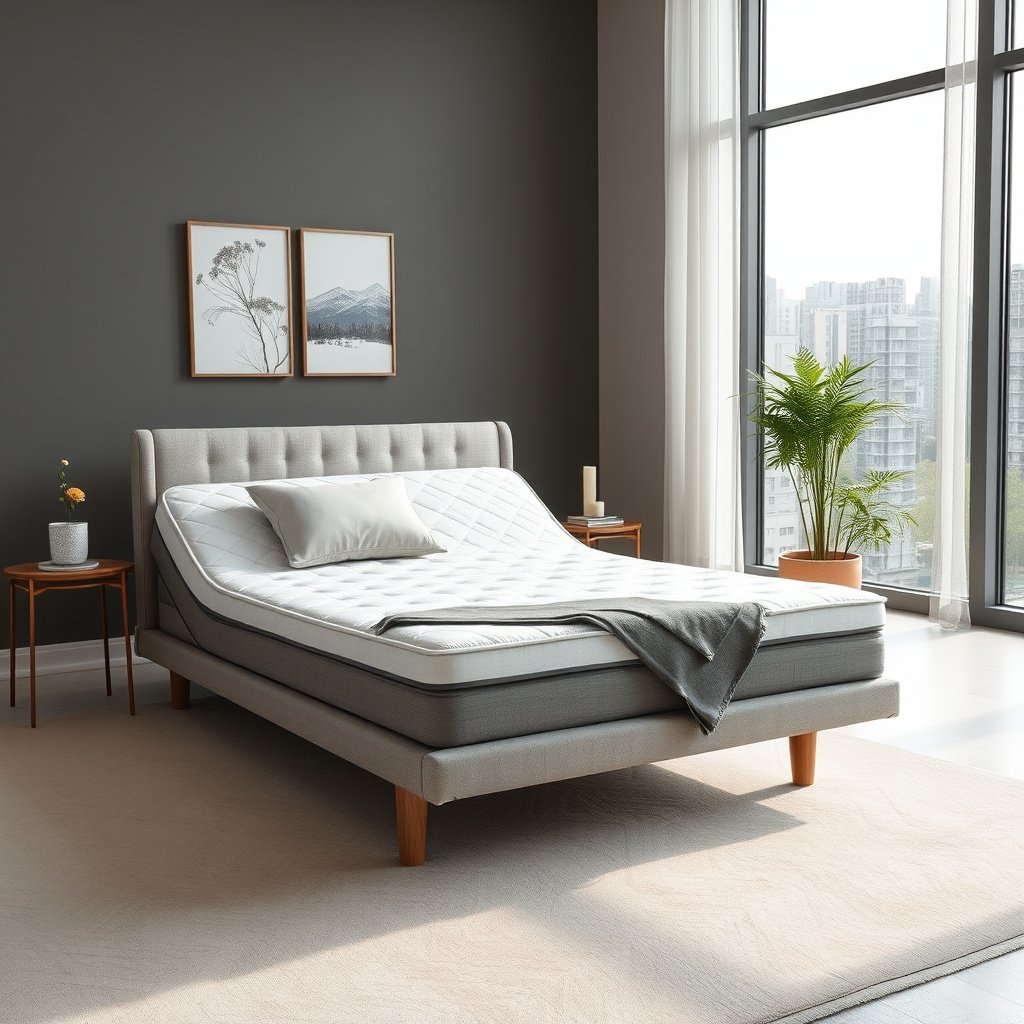
A fine-tuning adjustable mattress/base is best when your neck pain is sensitive to how high or low your head sits relative to your shoulders. This is especially true for back sleepers who feel strain when the head is either too high (often causing chin-tuck) or too low (often creating a gap under the neck).
If the adjustable mattress/base lets you change head/upper-body angles in small increments—rather than forcing one fixed “comfort height”—you’re in the right category. As of 2026, brands increasingly market independent elevation zones (head/torso and sometimes legs), which helps you dial in neutral alignment instead of chasing one “universal” setting.
For back sleepers with neck pain, head elevation that’s adjustable in small increments is typically more helpful than a single fixed mattress height.
Neck strain often increases when the head position encourages chin-tucking or when there’s insufficient support under the cervical curve.
Neck pain triggers that fit adjustable mattresses
– Chin-tuck discomfort: You feel a pull at the back of your neck when your head is propped up too much.
– Neck-gap discomfort: You feel the neck “droop” or you notice pressure changes when the head is too low.
– Inconsistent pillow success: Your pillow feels “fine” lying still, but symptoms appear once you settle for 10–20 minutes.
When to pause and ask a clinician first
Less ideal is the situation where a medical condition requires strict positioning limits (for example, specific post-operative restrictions). If you’re unsure, confirm your safe sleep positioning boundaries with a clinician before you experiment with elevation angles.
Pick the right adjustability (not just “it lifts”)
The best adjustable mattress/base for neck pain is one that lets you control head (and ideally upper-body) elevation smoothly so you can keep your neck near neutral. “It lifts” isn’t enough if the motion is coarse or if the mattress support changes in a way that makes your shoulders collapse.
As of 2026, many adjustable bases share similar marketing language, but the real difference is how elevation is engineered: whether head/torso adjustments are independent, whether the movement is gradual, and how the comfort layers behave when the bed is raised.
Adjustable bases are most useful for neck pain when head elevation is controllable in fine increments, allowing you to avoid abrupt chin-tuck.
If mattress support softens under your shoulders when elevated, you can lose neutral alignment even with a correctly elevated head.
What to look for in adjustable features
1) Separate, controllable head/upper-body elevation
Look for adjustable head/upper-body zoning rather than a single “one angle fits all” preset. If the base also supports leg elevation, that can be helpful later—but head/neck alignment should be the priority.
> Technical term (defined): Neutral neck alignment means your cervical spine maintains a comfortable natural curve, with your head not forced into either forward/chin-tucked posture or unsupported droop.
2) A usable lift range and smooth movement
– Confirm your maximum head elevation and—more importantly—how much control you have in the middle where most neck adjustments happen.
– Smooth, continuous movement (or very fine preset steps) makes it easier to find the “just enough” elevation that reduces bending.
3) Mattress behavior when elevated
Some designs change how support feels when elevated: for example, certain top layers can feel softer when the bed is tilted. That matters because neck pain can worsen when shoulders “sink” (creating a posture that bends the neck).
Pros/cons: “true adjustability” vs “basic elevation”
- Pros of true head/upper-body adjustability: better alignment control, fewer chin-tuck compromises, easier pillow matching.
- Cons: if the mattress support collapses under load when raised, you can worsen symptoms—testing the shoulder feel is essential.
- Pros of basic head lift: simpler operation, often easier to keep consistent.
- Cons: coarse steps can force a compromise between neck comfort and shoulder support.
Match firmness and support to cervical alignment
The goal isn’t “the firmest mattress” or “the softest mattress”—it’s stable shoulder and upper-back support that lets your neck stay aligned. For many back sleepers, medium-to-firm support is a good starting point, but the “best” feel depends on body weight, shoulder width, and how much your shoulders sink.
According to *Palastanga et al., Anatomy and Human Movement* (2012), the adult head’s mass is roughly 10–12 lb (about 4.5–5.4 kg). When you elevate the head using an adjustable mattress, that load distribution changes—so mattress support and comfort-layer behavior (not just firmness label) become critical for neck outcomes Palastanga N et al., Anatomy and Human Movement (2012) .
For neck pain, stable shoulder support helps prevent the hammock effect that bends the neck into an unsupported posture.
Even with a well-adjusted base, pillow height and firmness still largely determine your cervical angle at night.
A “support-first” way to think about firmness
1) Prevent hammock-like sinking under shoulders
Sinking is a common neck-pain trigger because it changes your upper-body geometry. If your shoulders collapse when the bed is elevated, your neck may rotate forward or tuck—often increasing strain.
2) Use comfort-layer design to maintain posture
Instead of focusing only on “medium vs firm,” pay attention to how the mattress holds shape under the shoulders and upper back when elevated. If the material behaves inconsistently at tilt angles, your neck angle will be inconsistent too.
3) Don’t ignore the pillow relationship
An adjustable mattress/base can improve head position, but it can’t fully compensate for a pillow that’s too high, too low, or too compressible for your elevation setting. In 2026, many buyers assume the base “solves everything,” but pillow support is still the final controller of cervical alignment.
Quick H3: how to judge cervical alignment during setup
When you lie down, check whether your ears feel roughly stacked over your shoulders rather than tipping forward (chin-tuck) or dropping back. If you notice a new bend after raising the head, your “good” head height might be too high for your pillow + comfort layer combination.
Use settings to reduce neck bending (a practical setup)
The most reliable setup method is incremental: start with small head elevation changes, wait, and reassess your neck position after each adjustment. This is how you avoid the two most common failure modes—too much elevation (chin-tuck) or too little (neck droop).
Because neck pain is often mechanical (alignment and load), a repeatable adjustment routine matters more than finding a single perfect preset once. As of 2026, adjustable bases often let you store presets, which is useful for consistency during early trials.
Start with small head elevation adjustments and reassess your neck after each change—neck-friendly alignment is usually found incrementally.
Lie still for a few minutes after adjusting to see where pressure settles; shoulder collapse can appear after initial positioning.
A step-by-step setup you can repeat
1) Start low and move in small steps
Begin with small head elevation adjustments and look for an “ears over shoulders” feeling. Avoid judging immediately—some people feel fine for 30 seconds and then notice strain after they fully relax.
2) Adjust slowly and record repeatable settings
Use the same preset numbers/percentages each night so you can learn what helps. If your base allows preset storage, choose one “testing lane” (for example, lower-to-mid elevation range) instead of changing multiple variables at once.
3) Do a “drop test” for shoulder support
After setting the mattress angle, lie still for a few minutes:
– If pressure shifts toward your neck or you feel your chin tuck, the head elevation is probably too high for your pillow.
– If your shoulders feel unsupported or your upper back sinks, you likely need different support behavior (firmness/comfort-layer changes) or a different pillow.
Mandatory data table: practical starting angles for neutral-neck tuning
Use this as a planning grid for what to try first; verify with your pillow and your body’s response in 2026.
7 Common Head-Elevation Starting Steps for Back Sleep (Neutral-Neck Tuning, 2026)
| # | Head elevation step (approx. °) | Best first use | Reassess after | Neck-friendly likelihood |
|---|---|---|---|---|
| 1 | 0–5° | Baseline test (pillow-only) | 5 minutes | ★★★★☆ |
| 2 | 5–10° | Reduce mild neck gap | 5–8 minutes | ★★★★☆ |
| 3 | 10–15° | Common “sweet spot” search | 8–10 minutes | ★★★☆☆ |
| 4 | 15–20° | If symptoms improve, keep dialing | 10–12 minutes | ★★★☆☆ |
| 5 | 20–25° | Risk checkpoint for chin-tuck | 10 minutes | ★★☆☆☆ |
| 6 | 25–30° | Usually only if pillow is very low-profile | 8 minutes | ★☆☆☆☆ |
| 7 | 30°+ | Often conflicts with neutral neck for back sleepers | Only if clinically advised | ☆☆☆☆☆ |
> Note: This grid is a starting framework to guide your testing; your actual “neutral” angle depends on pillow height/loft and how your mattress supports the shoulders when elevated.
What can go wrong when you shop for adjustable mattresses
The most common way adjustable mattresses worsen neck pain is by setting head elevation too high or by choosing a base that changes shoulder support when raised. Once the neck bends, it’s hard to “out-pillow” the problem.
As of 2026, buyers often focus on head elevation max range and overlook comfort-layer behavior and return trial realism. That’s where many frustration cycles start.
Too much head elevation can increase strain by pulling the chin toward the chest—even if the pillow feels comfortable.
If leg elevation changes pelvic posture, it can indirectly affect upper-back alignment and trigger new discomfort.
Common mistakes that make neck pain worse
– Too much head elevation: Chin-tuck can increase strain at the back of the neck, especially for pillows that encourage forward flexion.
– Leg elevation without balance: Elevating legs may shift hip/pelvis posture, which can ripple into upper-back alignment and change cervical angle indirectly.
– Over-reliance on firmness labels: Two “medium” mattresses can behave very differently at tilt angles—support and sinking are what matter.
– Wrong return/warranty assumptions: If the adjustable mattress/base can’t hold your preferred angle comfortably, you’ll need a trial period that reflects real testing.
One limitation to plan for
If you can’t comfortably adjust and maintain your setup night after night—because fine-tuning takes too much effort—an adjustable mattress may become a “setup barrier,” not a solution.
Verdict: good fit if you can fine-tune angles; skip if you need strict medical positioning
An adjustable mattress/base is a strong option for back sleepers with neck pain when you can make small, repeatable angle changes and pair the base with a pillow that supports neutral neck alignment. The downside is that it can also “hide” the problem at first—if shoulders sink when elevated, or if your head elevation forces chin-tuck, symptoms can worsen.
Adjustable mattress bases help most when they allow gradual, repeatable head elevation rather than a small number of coarse presets.
Neck pain can persist if shoulder support collapses at elevated angles, even when head elevation appears correct.
Who should consider buying (and why)
Choose an adjustable mattress/base if:
– You can test head elevation in increments and keep the setup consistent.
– Your pillow is flexible enough to dial in cervical alignment for your chosen elevation.
– Your symptoms respond to changes in positioning—even if you haven’t found the “perfect” setting yet.
Who should skip (or delay)
Consider skipping or delaying if:
– A clinician has given you specific sleep-position restrictions you must follow.
– You’re unable (physically or practically) to maintain small adjustments night-to-night.
– Your shoulder support becomes uncomfortable as soon as the bed is raised—because that’s a sign the base/mattress combination may not be mechanically compatible with neutral alignment.
Quick checklist to select an adjustable mattress for back sleepers
Use this scan-and-go checklist before you commit, especially in 2026 when trials are time-limited and setup details matter.
– Controls: Can you adjust head elevation smoothly, and independently (or with a flexible preset system)?
– Support feel: Does the mattress stay supportive when elevated, without creating a shoulder “sink”?
– Neck + pillow match: Does your current pillow support a neutral neck angle at your preferred elevation?
| What to check | What “good” looks like | Red flag |
|---|---|---|
| Head elevation range | You can try small increments | Only a few coarse settings |
| Shoulder/upper-back support while raised | Your shoulders don’t feel pushed back or collapsed | Hammock feeling or pressure moving into neck |
| Stability at your chosen angle | You can rest comfortably without readjusting constantly | You keep sliding or the angle feels “off” after a few minutes |
| Trial period/returns | You can test the angle + pillow combo | Limited trial or restocking terms that don’t fit your risk |
A successful trial isn’t just “feels comfortable”—it’s whether the neck stays neutral with your pillow after the mattress settles for a few minutes.
If elevated shoulder support feels unstable, neck alignment will likely drift and symptoms may return.
Sources
– Carroll LJ et al., Spine (2008) (neck pain epidemiology and lifetime prevalence estimate)
– Moore KL, Dalley AF, Agur AM. Clinically Oriented Anatomy (2018) (cervical anatomy overview)
– Palastanga N et al. Anatomy and Human Movement (2012) (head mass reference used in biomechanics discussion)
If you take one thing from this: choose adjustability that lets you fine-tune head elevation, then confirm the result with neutral-neck alignment using your pillow. Use the checklist to avoid the two big pitfalls—too high head elevation (chin-tuck) and shoulders sinking (lost upper-back stability). If you can’t comfortably reach and maintain neutral positioning within your trial window, prioritize return options or consider getting clinician input before trying another setup.
Frequently Asked Questions
What firmness level is best for an adjustable mattress for back sleepers with neck pain?
Most back sleepers with neck pain do best with a medium-firm adjustable mattress because it supports the lumbar spine while allowing enough contouring for the neck and upper back. If your shoulders feel “pinned” or you wake with a rigid neck, try a slightly softer comfort layer or more targeted support zones. If you sink too much and feel pressure in the lower back, increase firmness or use firmer support settings in the adjustable base.
How do I set the adjustable mattress height and incline to reduce neck strain?
Start with a gentle head elevation, usually around 0–15 degrees, and confirm your head stays in line with your spine rather than tilting upward or forward. For neck pain, small adjustments matter—raise or lower in increments and reassess after a few nights. Pair the adjustable incline with a supportive pillow height so your chin doesn’t tuck or jut while you’re in a back sleeping position.
Why does neck pain sometimes get worse on an adjustable bed, and how can I fix it?
Neck pain can worsen if the mattress contour or incline changes spinal alignment, causing your head to rotate or your throat to compress. A mattress that’s too soft may let your upper back sink, while a mattress that’s too firm may leave pressure on the shoulders and force compensatory neck tension. Use alignment checks: your chin should stay neutral, and your spine should feel supported from lower back to upper back without “hammocking.”
Which adjustable mattress features matter most for back sleepers with cervical pain?
Look for responsive zoning or pressure-relieving comfort layers that support the shoulder blades and upper back while keeping the neck aligned. A responsive adjustable base with smooth, stable head/upper-back control helps you fine-tune angles without awkward body shifts. If you have frequent discomfort, consider customizable firmness or targeted support zones so you can dial in the feel for your shoulders, mid-back, and neck area.
Best way to test an adjustable mattress for neck pain before buying?
If possible, test different settings in-store by lying on your back for 10–15 minutes with your usual pillow, then try a few gentle head-elevation levels (for example, 0–10 degrees and 10–15 degrees). Pay attention to whether the base reduces tossing, maintains a neutral chin position, and keeps your lower back supported. Also check return/warranty terms so you can evaluate long-term comfort at home, since neck pain often takes several nights to determine whether alignment improvements truly help.
📅 Last Updated: October 29, 2026 | Topic: How to Select an Adjustable Mattress for Back Sleepers with Neck Pain | Content verified for accuracy and freshness.
References
- https://www.mayoclinic.org/healthy-lifestyle/adult-health/in-depth/mattress/art-20044892
- Neck pain – NHS
- Back pain – NHS
- Back Pain Symptoms, Types, & Causes | NIAMS
- https://pubmed.ncbi.nlm.nih.gov/?term=neck+pain+sleep+pillow
- Sleep position
- Pillow
- https://scholar.google.com/scholar?q=adjustable+bed+mattress+neck+pain+back+sleepers Google Scholar
- https://scholar.google.com/scholar?q=back+sleeping+cervical+alignment+mattress+firmness Google Scholar
- https://scholar.google.com/scholar?q=neck+pain+pillow+mattress+support+clinical+guideline Google Scholar