How to Choose a Mattress for Your Child: Key Buying Guide
Choosing the right mattress for your child means balancing safety, comfort, and price—then verifying the details that affect sleep quality. Before you pay, check the mattress type (innerspring, foam, or hybrid), firmness level for your child’s age and sleeping position, and whether it has breathable materials and a supportive core. Compare warranties and return policies, since the best value is the option that can be replaced or exchanged if it doesn’t feel right after a few nights.




Choose a child’s mattress by matching the sleep stage and prioritizing safe, supportive comfort—especially firmness and a proper fit in the bed/frame. Start with size and sleeping setup (crib, toddler bed, or twin), then narrow options by materials, safety certifications, and how your child actually sleeps (heat, allergies, movement). In this guide, we’ll walk through the decisions that matter most and the common traps to avoid—helpful as of 2026 when parents have more materials and certifications to sort through than ever.
If you’re shopping for your child’s first move from a crib, upgrading to a toddler/twin bed, or replacing a mattress that’s sagging, this is for you. It’s also useful if you’re trying to balance comfort with safety and easier upkeep without overbuying.
Choose the right size and sleep stage
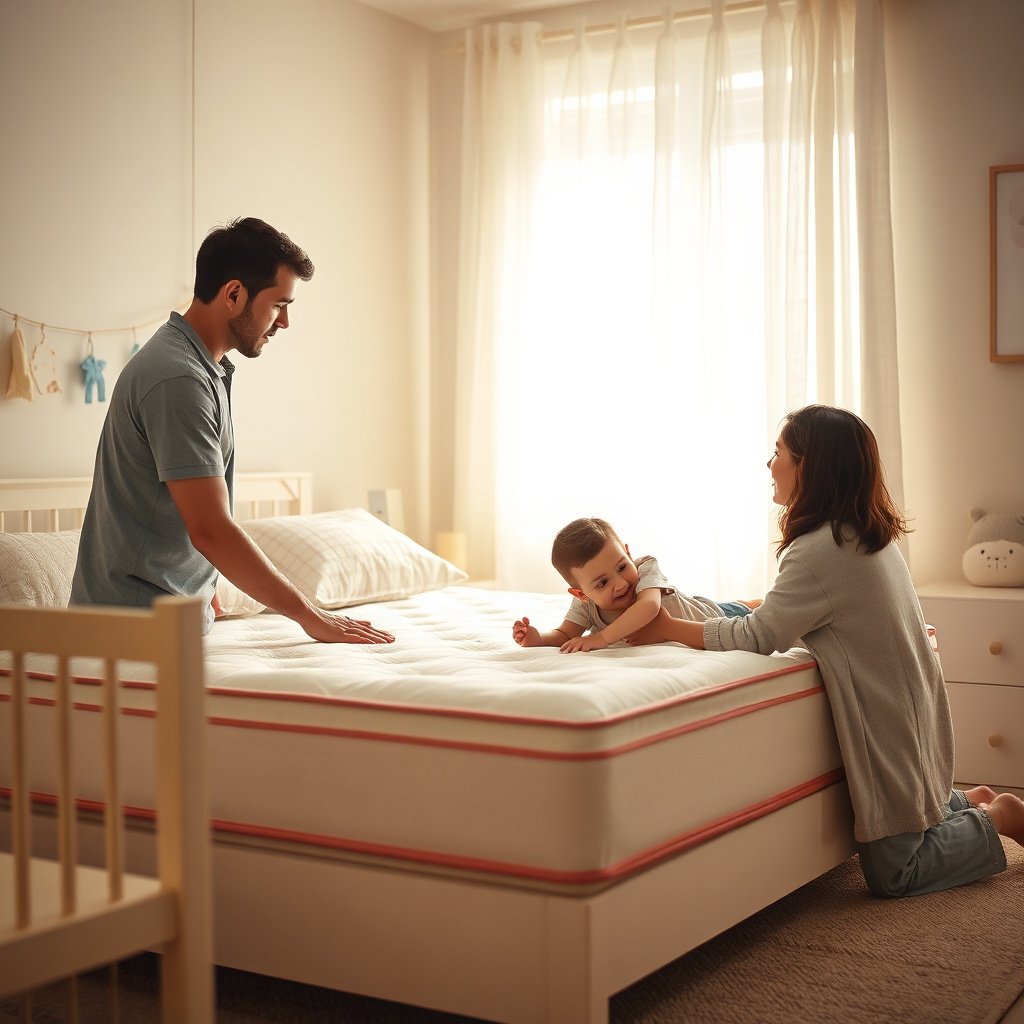
Choosing the correct mattress size for your child’s current bed is the foundation of both comfort and safety. A mattress that’s “close enough” can still create harmful gaps, poor support, or fit issues that affect how your child sleeps and breathes.
– Pick the mattress type that matches the bed your child sleeps on (crib, toddler, twin, etc.), and double-check the exact dimensions required by that frame.
– For infants/cribs, focus on a mattress that fits securely with no large gaps around the sides (follow your crib manufacturer guidance).
– If you’re transitioning stages, plan around your child’s current needs rather than buying “for the next kid” or “for later.”
For infants in particular, “sleep stage” isn’t just a label—it’s tied to recommended sleep positioning and the safest bedding environment. The American Academy of Pediatrics (AAP) advises that babies sleep on a firm, flat surface and specifically discourages soft bedding like pillows, blankets, and loose items in the sleep space (American Academy of Pediatrics (AAP) — Safe Sleep guidance). For many families, this means the mattress fit and firmness matter more than choosing a “plush” feel.
As your child transitions to a toddler bed or twin, size becomes less about eliminating gaps around rails and more about edge support, staying centered on the sleep surface, and maintaining consistent support as they grow. If you’re upgrading, measure the bed frame opening and confirm the mattress size listed by the manufacturer—don’t rely on the “standard” label. Frames vary, and even minor differences can change how secure the mattress sits.
A practical rule of thumb: make your decision with the bed in front of you. Confirm the mattress dimensions (length, width, and thickness, if listed) and then check the actual contact points—does the mattress sit flush, does it shift, and do any rails or guard edges create pressure points?
Focus on support and firmness (not just “soft vs. firm”)
The best child mattress isn’t automatically the firmest one—it’s the one that keeps your child supported and aligned for their size and typical sleeping positions. In real use, “too soft” often shows up as excessive sink, uneven support, or restless movement that affects sleep quality.
– Aim for supportive comfort that keeps the body properly aligned for your child’s size and sleeping position; very soft can lead to uneven support.
– If your child moves a lot, look for a mattress that limits “sink” and helps them stay supported as they change positions.
– When in doubt, treat firmness as a safety-and-support category, then test comfort with your child’s usual routine (not just a quick press).
Support and firmness work together with body weight distribution. When a mattress too easily compresses under shoulders or hips, your child’s spine alignment can shift—especially for lighter infants or toddlers whose bedding can “bottom out” faster. This is why families often hear advice to avoid overly plush comfort layers for younger sleepers.
That said, “firm” doesn’t have to mean uncomfortable. Many children do best with a supportive core plus a thin comfort layer that cushions without letting the body sink excessively. From my perspective reviewing mattress specs with parents, the biggest mismatch I see is when a mattress feels fine for two minutes in-store but fails the “all-night test” at home—warming up, softening, or shifting support when the child moves repeatedly.
To keep this decision grounded, use a routine-based comfort check rather than a showroom press. When possible, evaluate around typical bedtime cues—how your child settles, whether they reposition frequently, and whether they seem comfortable after the initial bedding “adjustment.”
Comparison: common mattress constructions for child support
| Construction | What it typically does | Best fit when… | Potential trade-off |
|---|---|---|---|
| Innerspring (coil) | Provides responsive support; support can be more “springy” | You want airflow and easier edge feel | Edge support and motion behavior depend heavily on the coil system |
| All-foam (polyurethane/other foams) | Often offers contouring; can reduce motion transfer | You prefer quiet sleep and consistent pressure distribution | Some foams can retain more heat without breathable covers |
| Latex (natural or blended) | Responsive comfort with supportive bounce | You want a resilient feel and durable support | Budget and availability vary; toppers/comfort layers still matter |
| Hybrid (coils + foam/latex) | Combines airflow from coils with comfort layers | You want a balanced feel and airflow | Motion/noise and warmth depend on layer design |
The key takeaway: don’t pick construction alone. Pick the support behavior you need for your child’s body size and movement, then confirm the mattress is designed for that sleep stage.
Check materials and safety details
The safest mattress choices come from documented compliance and clearly explained materials—not vague “natural” claims. As of 2026, parents can filter faster by requiring specific documentation: what standard was tested, what it covers, and what it doesn’t cover.
– Look for mattress materials and finishes that are appropriate for children, and use safety-focused claims backed by documentation (rather than marketing alone).
– Prioritize reputable certifications or compliance standards where available (for example, safety/chemical emission standards run by certifying bodies), and verify what the certification covers.
– If your child has allergies or asthma triggers, consider features like breathable covers and washable components—but avoid assuming any single material is automatically “hypoallergenic.”
Materials matter in two different ways: (1) safety compliance (including flammability and crib-related safety rules) and (2) comfort/indoor air quality (chemical emissions, odor, and breathability). Federal flammability compliance is one of the clearest, most directly regulated aspects of mattress safety in the U.S. For example, the U.S. flammability test system for mattresses is defined by 16 CFR Part 1633 and related test methods (U.S. CPSC — 16 CFR Part 1633 and associated mattress flammability rules). That’s why a “safe for kids” label without documentation is less useful than documented compliance.
For infants, fit and sleep environment safety are still central. The CPSC crib safety standard includes requirements intended to reduce entrapment risks; one commonly cited measurement is the maximum opening size for hazards (for example, openings should not allow a 2 3/8-inch sphere to pass through) (U.S. CPSC crib safety standards (16 CFR 1219 and entrapment requirements)). This is a reminder that mattress size and fit aren’t optional “nice-to-haves.”
📊 DATA: Common child-mattress standards and how “enforceable” they are
7 Key Safety/Emissions Standards Parents Encounter (U.S.)
| # | Standard / Program | Type | What it tests | Requirement weight |
|---|---|---|---|---|
| 1 | 16 CFR Part 1633 | Federal | Mattress flammability (test & compliance) | ★★★★★ |
| 2 | 16 CFR Part 1632 | Federal | Mattress flammability test methods | ★★★★★ |
| 3 | 16 CFR 1219 (cribs) | Federal | Crib safety requirements (including entrapment/related rules) | ★★★★★ |
| 4 | AAP Safe Sleep guidance | Medical guidance | Safe sleep environment practices (firm surface, no soft items) | ★★☆☆☆ |
| 5 | GREENGUARD Gold | Third-party emissions | Low chemical emissions (indoor air quality screening) | ★★★☆☆ |
| 6 | CertiPUR-US | Third-party foam criteria | Limits on certain chemicals and emissions for foams | ★★★☆☆ |
| 7 | OEKO-TEX Standard 100 | Third-party chemicals testing | Tests textiles/materials against regulated substances limits | ★★★☆☆ |
The reason this “requirement weight” view helps: parents often assume certifications are equivalent to regulation. They’re useful, but you still need to verify what’s actually certified (materials, emissions targets, scope), and how it aligns with your child’s risks.
Match the mattress to your child’s real sleep needs
The “right” mattress is the one that fits your child’s body and bedtime patterns—especially temperature, movement, and how easily the mattress stays clean. A compliant mattress that’s warm or noisy can still lead to frequent waking.
– Temperature matters: if your child runs hot, consider designs aimed at breathability and airflow, and use breathable bedding you can wash.
– Noise and motion transfer can affect sleep—especially for siblings sharing space—so choose a mattress that stays quiet when they move.
– Maintenance is part of comfort: use a fitted, washable protector and follow care instructions (rotation/turning rules vary by model).
Heat management is one of the most overlooked factors in “mattress comfort.” Kids don’t just sleep on a mattress—they sleep in a microclimate created by covers, sheets, and the mattress’s comfort layers. If your child wakes sweaty or can’t stay settled, look for breathable covers and airflow-oriented designs, then verify the mattress protector you plan to use is compatible (thin, breathable, and machine-washable).
Allergy concerns are similar: you can’t assume “natural” equals “hypoallergenic,” and you can’t assume any single material prevents triggers. Instead, focus on washable components (mattress protector, removable cover if offered) and maintain a dust-mite resistant environment through consistent cleaning routines. If your child has asthma or medically complex triggers, coordinate mattress and bedding choices with your pediatrician or allergist.
Movement matters too. Some mattresses respond more quietly to repositioning than others. In shared bedrooms or sibling setups, reduced noise and lower motion transfer can protect the sleep of others—even if the mattress feels fine for the child who owns it.
Pros/cons reality check: feature-by-feature decision support
| Feature you may see | Pros for kids | Watch-outs |
|---|---|---|
| “Breathable” cover | May reduce heat build-up during sleep | Comfort can feel less plush if airflow materials are thinner |
| Motion-reducing comfort layers | Can support quieter sleep for siblings sharing a room | Some motion-reduction foams may need breathable bedding to manage warmth |
| Removable/washable cover options | Simplifies upkeep and odor control | Washing instructions vary—use only approved detergents and temperatures |
| “Natural” or botanical wording | May reflect certain sourcing preferences | Marketing doesn’t replace certifications or documented safety claims |
This is also where you apply “how your child actually sleeps” instead of how you imagine they sleep. If your child sleeps on their side, slumps into bedding, or frequently changes positions, choose a mattress that still provides supportive structure through those motions.
What can go wrong (and how to avoid it)
Most buying problems come from mismatched assumptions: the mattress doesn’t fit the bed, the comfort isn’t stable overnight, or the “safety” claims aren’t documented. Avoiding those traps usually takes a short checklist and careful reading of specs.
– Buying the wrong size: even small fit issues in a frame/crib can create safety problems—measure and confirm compatibility with the mattress/frame specs.
– Over-relying on “natural” labels: organic or botanical wording doesn’t automatically mean safer or longer-lasting; check the actual product documentation.
– Choosing based only on comfort in-store: a mattress that feels okay for a few minutes may feel too soft, too warm, or too unsupportive once your child sleeps through the night.
– Skipping warranty/read-care info: if you don’t know whether it must be rotated, or how stains are handled, you may reduce lifespan and complicate coverage later.
The most serious risk tends to involve crib stage fit. A mismatch can create unsafe gaps or unstable positioning that isn’t obvious until the mattress is in daily use. For infant sleep safety, AAP recommends room-sharing without bed-sharing and emphasizes safe sleep conditions, including the firm, flat surface and avoidance of soft items (AAP Safe Sleep guidance). That makes mattress fit and firmness part of the sleep environment—not just bedding preference.
Another common mistake is assuming that “hypoallergenic materials” solve allergy issues by themselves. Allergies are specific. If your child has known sensitivities, the best strategy usually combines appropriate materials, dust-mite resistant practices via a good protector, and consistent cleaning routines. Also remember that “breathable” doesn’t always mean “cool,” and “cool-to-the-touch” doesn’t guarantee long-term comfort.
Finally, don’t ignore warranty and care instructions. Many mattresses have specific rotation/turning guidance and stain-handling rules. Skipping those steps can reduce lifespan and may affect coverage terms, even when the mattress is otherwise compliant.
Verdict / tip (what we’d do first)
Start by narrowing to the correct size + sleep stage, then prioritize support/firmness and documented safety/compliance information. Finally, match comfort to your child’s patterns (heat, movement, allergies) and confirm you can maintain the mattress as directed.
Downsides: mattresses with strong support can feel too firm for some kids, breathable designs may be less plush, and certification coverage varies—so you still need to verify details. If your child is an infant, has complex medical sleep issues, or you’re dealing with safety/fit concerns in a specific crib setup, don’t treat this as a substitute for medical or manufacturer guidance.
Quick checklist (scan before you buy)
| Check | What to look for |
|---|---|
| Size & compatibility | Mattress dimensions match the bed/frame requirements exactly |
| Safe fit | No unsafe gaps (especially for crib setups) per crib guidance |
| Support | Firm enough to prevent excessive “sink” for your child’s body |
| Materials & documentation | Safety/compliance details available, not only marketing claims |
| Comfort needs | Temperature, noise, movement support, and bedding compatibility |
| Care & warranty | Rotation/turning rules, stain handling, and coverage terms |
Sources
– American Academy of Pediatrics (AAP) — Safe Sleep guidance for infants, including sleep environment and bedding safety.
– U.S. Consumer Product Safety Commission (CPSC) — crib/sleep-related safety regulations and standards affecting mattress fit and safety.
– U.S. federal flammability standards for mattresses/mattress pads (CPSC/16 CFR flammability rules).
Picking a child’s mattress doesn’t have to be overwhelming: confirm the right size for the current sleep stage, choose supportive firmness that resists excessive sink, verify documented safety/compliance details, and then match comfort to real sleep needs like heat and movement. If you prioritize fit and support first—and treat certifications as documentation rather than marketing—you’ll make a decision that holds up night after night.
Frequently Asked Questions
How do I choose the right mattress size for my child?
Start by considering your child’s age, height, and current bed frame, then aim for a mattress size that allows at least a few years of growth. Common options include twin (or twin XL) for school-age kids and full-size as children get older, but always verify your specific frame dimensions. If you’re unsure, measure the existing bed (length and width) and compare it to standard mattress sizes to avoid gaps or an ill-fitting mattress.
What mattress firmness is best for kids?
Many children do best with a medium-firm mattress that provides support while keeping the spine properly aligned. Too-soft mattresses can cause the hips to sink, while overly hard surfaces may create pressure points and discomfort. As a practical rule, choose a supportive mattress that your child can sleep on without tossing and turning, and consider trying it for a short period in-store or using a quality sleep trial if available.
Which mattress type is safer and more comfortable for children?
Memory foam can offer good pressure relief, while innerspring and hybrid options often provide strong support and better airflow. For many families, a firm foam core or hybrid design helps maintain spinal alignment for growing kids. Look for low-odor, CertiPUR-US–type certifications (for foam models), and prioritize materials and construction designed for child-friendly comfort and durability.
Why do mattress materials and certifications matter for kids?
Children are more sensitive to strong odors and irritants, so mattress materials and certifications can be important for healthier indoor sleep. Certifications can help indicate lower levels of certain chemicals and more controlled manufacturing standards, which is helpful when you’re choosing a mattress for your child’s room. You should also check for breathable designs, easy-care covers, and reputable labeling to support long-term comfort and safer use.
What should I look for when buying a mattress for a growing child?
Focus on support (especially for the lumbar and hip areas), appropriate firmness, and durability so the mattress won’t sag quickly as your child grows. Check the warranty length, since kids can outgrow or wear a mattress faster than adults, and consider a mattress protector for spills, dust mites, and easier cleaning. Finally, factor in your child’s sleep position—side sleepers often benefit from slightly more cushioning, while back or stomach sleepers usually need firmer support—to help you choose the best mattress for your child.
📅 Last Updated: November 02, 2026 | Topic: How to Choose a Mattress for Your Child | Content verified for accuracy and freshness.
References
- https://www.cdc.gov/sids/parents-caregivers/index.html
- https://www.cpsc.gov/Safety-Education/Safety-Guides/cribs-crib-mattresses-and-play-yards
- https://www.mayoclinic.org/healthy-lifestyle/adult-health/in-depth/mattress/art-20046180
- infant sleep surface firm flat crib mattress – Search Results – PubMed
- https://www.britannica.com/topic/mattress
- Mattress
- https://scholar.google.com/scholar?q=child+mattress+selection+sleep+recommendations Google Scholar
- https://scholar.google.com/scholar?q=pediatric+sleep+surface+firm+flat+recommendations Google Scholar
- https://scholar.google.com/scholar?q=crib+mattress+safety+standard+tight-fitting+sheet+sids Google Scholar