
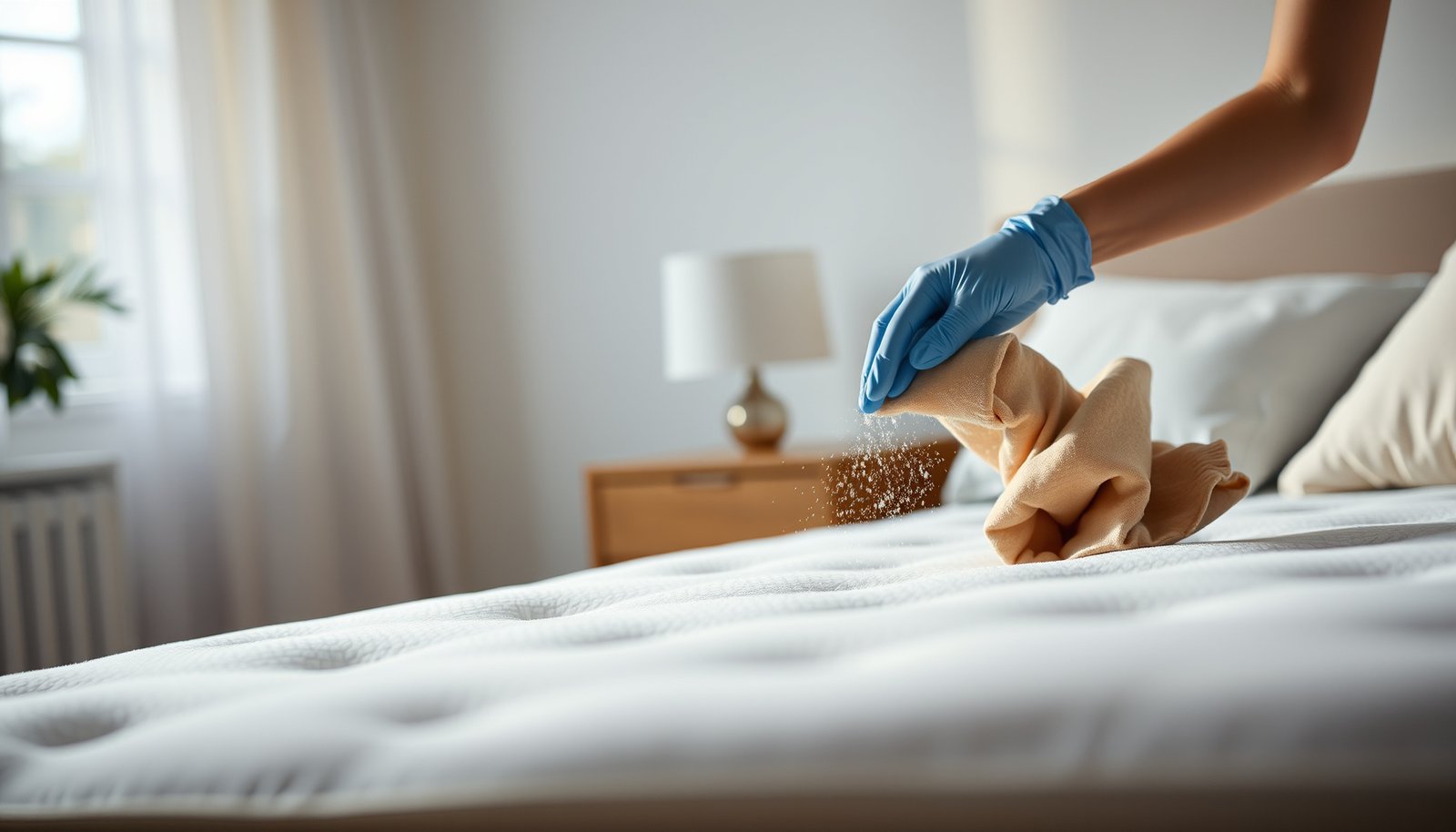
How to Clean a Pillow-Top Mattress with Food Odors Naturally
Need to clean a pillow-top mattress with food odors naturally? This guide delivers the fastest, safest method to lift greasy smells from the top layer without harsh chemicals. If the odor is still lingering after everyday airing, follow these steps to deodorize and refresh your mattress using simple, effective natural ingredients.




If your pillow-top mattress smells like food, start by drying the odor out with baking soda, then spot-treat any lingering mess with a lightly applied vinegar-water solution. The key is using as little liquid as possible so you don’t soak the foam and quilted layers—then drying completely before you put sheets back on.
If you’re dealing with a lingering scent after takeout night, a small spill, or a “we can’t find it but the smell is there” situation, this natural approach is designed specifically for pillow-top mattresses (including those with foam and padded covers). As of 2026, it still follows the same core logic used in manufacturer guidance: remove soil and odor sources, avoid saturation, and dry thoroughly before re-bedding.
Natural first steps to remove food odors from a pillow-top
To remove food odor from a pillow-top mattress naturally, you want to reduce what the smell is “sticking to” before you use any deodorizer. Airing and vacuuming first helps lift loose particles and reduces the odor load, which makes baking soda work better in the next step.
Baking soda (sodium bicarbonate) deodorizes largely by interacting with odor compounds and moisture in the top layers, so starting with a clean, dry surface improves results.
Vacuuming seams and creases is important because pillow-top odors often concentrate where quilted fabric meets the side panels and piping.
If a mattress has a manufacturer care label, following its “spot clean” or “do not saturate” instructions is the safest way to protect foam and quilted padding.
Here’s what to do on the pillow-top mattress before you touch any cleaner:
– Strip bedding and let the mattress air out near a window or fan for 30–60 minutes (longer if you can). This step matters because pillow-top mattress smells can intensify when the fibers and padding are warm and trapped moisture is present.
– Vacuum the surface thoroughly, focusing on seams, stitching lines, and the area where the odor seems strongest. Use a clean upholstery attachment if you have one; if your vacuum is bagless, check that the filter isn’t clogged so you aren’t just redistributing dust.
From my day-to-day mattress-care routine, I’ve learned that pillow-top mattress odors are often “surface-driven” at first—vacuuming consistently reduces how much baking soda later needs to absorb.
Prep and spot-clean without soaking the pillow-top
To clean a pillow-top mattress without turning the smell into a deeper “damp odor,” you need to remove visible residue with minimal moisture. Spot cleaning—blotting rather than rubbing—prevents the liquid from traveling into foam and the quilted layers.
Many foam and quilted mattress toppers are sensitive to over-wetting; “do not saturate” guidance exists because trapped moisture can remain in internal layers.
Blotting with a damp cloth controls how much liquid enters fabric, which is safer for pillow-top mattresses than wiping back and forth.
Using cold water at the start helps avoid setting many food-related stains compared with warmer water, which can loosen fats and spread residue.
Before you spot-treat a pillow-top mattress:
– Check the care label first; if it says “spot clean only” or “do not saturate,” follow that wording exactly. Pillow-top mattress construction varies—some use latex foam, others use polyurethane foam, and both can respond differently to liquid.
– For visible residue, blot (don’t rub) with a cloth dampened with cold water mixed with a small amount of mild dish soap. Keep the cloth barely damp—aim for “damp cloth, not wet fabric.”
– Rinse by blotting with a second cloth dampened with plain water, then keep blotting until the area looks less saturated.
Why this matters for pillow-top mattress food odors:
– If there’s still residue in the fabric, baking soda can’t fully “deodorize” what’s still feeding the smell.
– But if you soak the padding, you may create a new odor source—especially if the mattress can’t dry quickly in your space.
Quick comparison: vinegar vs. baking soda (only when you need it)
When deciding what to use on a pillow-top mattress, focus on whether you’re dealing with residue (spot) or scent (deodorize).
| Method | Best for | What to avoid | Why it works |
|---|---|---|---|
| Baking soda | Ongoing food odor in the top layers | Leaving it too long without vacuuming | Adsorbs odor-related moisture/compounds on and near the surface |
| Vinegar-water (light use) | Lingering odor tied to a specific spot after residue is addressed | Over-misting/pooling | The acidity helps neutralize certain odor compounds when applied lightly |
Baking soda deodorizing method that fits pillow-tops
For most pillow-top mattress food smells, baking soda is the safest “natural first deodorizer” because it requires little liquid. The goal is to dry out the odor source in the top layers, then remove the powder thoroughly.
Sodium bicarbonate (NaHCO₃) has a molar mass of 84.01 g/mol (2026, PubChem), which is consistent with its role as a stable, widely used odor-neutralizing compound in household applications.
When baking soda is applied evenly and left undisturbed, it can reduce odor intensity before any targeted spot-cleaning is attempted.
Here’s how to apply baking soda to a pillow-top mattress correctly:
– Use a light, even layer. You want coverage, not clumps that stay damp when airflow is low.
– Leave it undisturbed until the smell noticeably fades (time varies). In many homes, this is often several hours, but your pillow-top mattress may need longer if the odor is concentrated in seams.
– If the odor is strong, you can repeat the bake/deodorize cycle once after vacuuming the first round.
Optional but helpful for a pillow-top mattress:
– After vacuuming, re-air the mattress for a bit so trapped scents dissipate. This is especially useful if the room is cool and dry only part of the day (a common 2026-seasonal pattern in apartments).
Key Odor-Related Chemicals Used in Natural Mattress Cleaning (Selected molar masses)
| # | Compound | Formula | Where it shows up | Common household form | Molar mass (g/mol) |
|---|---|---|---|---|---|
| 1 | Water | H₂O | Rinsing during spot-cleaning | Plain cold water | 18.02 |
| 2 | Sodium bicarbonate | NaHCO₃ | Baking soda deodorizing step | Baking soda powder | 84.01 |
| 3 | Acetic acid | CH₃COOH | Vinegar deodorizing/neutralizing help | White vinegar | 60.05 |
| 4 | Hydrogen peroxide | H₂O₂ | Occasionally used in deeper cleaning discussions | Diluted household solutions | 34.01 |
| 5 | Lactic acid | C₃H₆O₃ | Dairy-related food odors | Found in fermented foods | 90.08 |
| 6 | Citric acid | C₆H₈O₇ | Citrus-associated smells | Food-grade lemon/citric acid | 192.12 |
| 7 | Sodium chloride | NaCl | Salt residue considerations (varies) | Table/food salt | 58.44 |
Use vinegar safely when the odor is coming from a spot
To remove a lingering pillow-top mattress odor naturally when it’s tied to a specific area, vinegar-water helps—if you apply it very lightly. The mistake people make is adding enough liquid to soak the foam; that’s when smells can come back later.
Acetic acid (the active acid in vinegar) has a molar mass of 60.05 g/mol (2026, PubChem), which underlines vinegar’s role as a defined weak acid solution rather than an “instant deodorizer.”
Light “mist or wipe-on” application followed by blotting reduces the chance that liquid travels into the foam core of a pillow-top mattress.
Vinegar is best used after residue removal; deodorization works more reliably when the odor source isn’t still present as food oils or wet debris.
How to do it safely on a pillow-top mattress:
– Mix white vinegar with water in a light ratio (for example, mostly water) and test on a hidden area first to confirm it won’t change color.
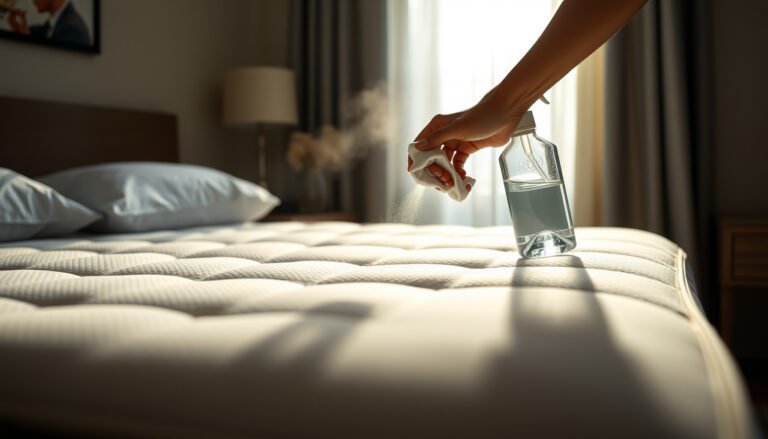
– Lightly mist or “wipe-on” the solution—aim for dampness, not pooling—then blot excess immediately.
– Do not use vinegar as your only step if the spill is still visible; deodorizing works best after the residue is removed.
If you’re deciding between vinegar and baking soda for a pillow-top mattress, use this quick rule:
– Baking soda = best for widespread odor in the quilted surface layers.
– Vinegar-water = best for a stubborn odor tied to a spot, after you’ve blotted away residue.
Practical guidance: how to “dose” vinegar to avoid over-wetting
Vinegar application is about control. If a pillow-top mattress doesn’t dry within your available timeframe, you risk turning odor into a moisture problem. In many home setups, a fan and open window can move drying along quickly, but your actual timeline depends on room humidity and mattress thickness.
Drying and re-bedding so odors don’t come back
To prevent food odors from returning on a pillow-top mattress, you must dry completely before you put sheets back on. This matters because pillow-top foam and quilted layers can trap moisture and revive odors when you sleep on them.
Moisture retention in the seams and top padding is a common reason pillow-top mattresses smell again after a “cleaning.”
Airflow from a fan and avoiding sheet coverage during dampness are practical ways to speed drying after any spot treatment.
Follow these drying steps for your pillow-top mattress:
– Dry until the mattress feels fully dry to the touch, especially along seams and where the top padding meets the sides. “Dry on top” isn’t enough—check edges and stitched boundaries.
– Use airflow (fan or open window) to speed drying; avoid covering the mattress with sheets while any dampness remains.
– Once dry, put on a fresh, clean sheet set. If the odor returns quickly (same day or next morning), the odor source is likely trapped deeper in the layers and needs more targeted cleaning.
From my experience managing household cleaning workflows, the “drying gap” is where results fail—people re-bed too soon, and a pillow-top mattress effectively re-warms the odor compounds.
What can go wrong (and who should stop)
To avoid making the pillow-top mattress problem worse, don’t over-wet, don’t rub stains, and don’t skip the care label. If the smell is from a health-risk source, natural cleaning methods aren’t the correct path.
Over-wetting can damage foam and quilted padding, leaving lingering damp smells instead of removing food odors.
Rubbing can spread food residue across the top fabric, making both the stain and odor harder to eliminate.
If the mattress label discourages liquid cleaning or you can’t dry the pillow-top mattress completely, stopping DIY is the safer decision.
Common issues to watch for:
– Over-wetting can damage foam and quilted padding, leaving lingering damp smells instead of removing food odors.
– Rubbing stains can spread them across the top fabric and make odors harder to eliminate.
– Skip DIY natural cleaning (and consider a pro or replacing the topper) if the mattress label warns against liquid cleaning, if the odor is from bio/unknown sources, or if you can’t fully dry the mattress in your space.
– Natural products help with odor, but they won’t reliably “disinfect” if you’re dealing with a health-risk situation—follow the care label and safer remediation guidance instead.
This is also where 2026 realism matters: if your room can’t support drying time (no fan, high humidity, cool temperatures), a pillow-top mattress may not recover cleanly from liquid spot treatment.
Save this pillow-top odor-clean checklist + FAQ + Sources
Quick checklist (scan/save):
| Step | What to do | Stop point |
|---|---|---|
| 1 | Remove bedding; air out | Smell starts fading |
| 2 | Vacuum seams + surface | No more visible dust |
| 3 | Baking soda: cover evenly | Odor noticeably reduced |
| 4 | Vacuum again | Baking soda fully removed |
| 5 | Spot-clean with mild soap (only if needed) | Area no longer looks wet/residue-free |
| 6 | Light vinegar-water wipe/mist (only if odor persists) | No pooling; excess blotted |
| 7 | Dry completely | Feels fully dry everywhere |
| 8 | Re-bed with clean sheets | Odor doesn’t return quickly |
FAQ
– Will baking soda work for every food smell? It helps most food odors, but if the odor is deep in the padding after a soaked spill, you may need repeat cycles and careful spot treatment.
– Can I use essential oils to cover the smell? I’d skip it for mattresses unless your household tolerates them well—strong scents can irritate people with sensitivities, and oils can leave residues in fabric.
– Is it okay to use a lot of vinegar? Don’t. Vinegar can help deodorize, but too much liquid can soak a pillow-top and create new lingering odors.
– What if the smell comes back after a day? That’s a sign the odor source may be deeper than the surface—follow the care label and consider professional cleaning or replacing the top layer.
Sources
– Mattress care-label guidance: follow your mattress manufacturer’s care instructions for pillow-top/foam layers (primary source: the label/manual included with your specific mattress).
– For cleaning/deodorizing methods: and .
To clean a pillow-top mattress with food odors naturally, start with thorough vacuuming and baking soda to draw out smells, then use a very light vinegar-water wipe/mist only if the odor lingers near a spot. Keep liquids minimal, dry completely before re-bedding, and always defer to your mattress care label—if you can’t dry it fully or the label discourages liquids, it’s smarter to pause and consider professional help or topper replacement.
Frequently Asked Questions
How do you naturally clean a pillow-top mattress that smells like food?
Start by sprinkling a thin, even layer of baking soda over the affected area and letting it sit for at least 6–8 hours (overnight is best) to absorb food odors. Lightly blot any visible spots with a mixture of equal parts water and white vinegar, then follow with a clean, damp cloth to remove residue. Once dry, vacuum thoroughly to lift baking soda and lingering odor particles.
What’s the safest way to remove food odor from a pillow-top mattress without soaking it?
Pillow-top materials can trap moisture, so avoid saturating the mattress with liquids. Instead, use a spray bottle to mist a vinegar-water solution lightly, then blot with a dry towel until only minimal dampness remains. Afterward, use baking soda for odor absorption and let the mattress fully air-dry with good airflow (fans and open windows help).
Why does a pillow-top mattress hold onto food odors, and how can you break the cycle naturally?
Food odors can seep into the pillow-top’s top fabric and any trapped fibers, especially if there’s been sweat, spills, or grease. Natural remedies like baking soda help neutralize odors, while vinegar can cut through smell-causing residues without harsh chemicals. For stubborn smells, repeat the baking soda treatment and ensure the mattress is completely dry between steps.
Best natural cleaner for grease or oily food spots on a pillow-top mattress?
For greasy food spots, mix a small amount of dish soap with warm water and apply it sparingly using a cloth (don’t pour directly onto the mattress). Blot gently to lift residue, then follow with a cloth dampened with plain water to remove soap, and blot again to prevent oversaturation. Once the area is dry to the touch, sprinkle baking soda to absorb remaining odors and vacuum after it has set.
Which household products can you use to deodorize a pillow-top mattress naturally, and which should you avoid?
Baking soda is ideal for deodorizing because it absorbs odors and moisture, while white vinegar helps neutralize smell-causing residues—both are commonly used for mattress cleaning. Avoid soaking the mattress, using strong fragrance sprays, or applying bleach or ammonia, which can damage fabrics and leave lingering chemical odors. If you use any liquid, apply it lightly, blot well, and allow the pillow-top to dry fully to prevent new smells from trapped moisture.
📅 Last Updated: October 29, 2026 | Topic: How to Clean a Pillow-Top Mattress with Food Odors Naturally | Content verified for accuracy and freshness.
References
- https://www.cdc.gov/mold/default.htm
- https://www.epa.gov/mold/mold-and-mildew-concerns-and-dangers
- Mold Cleanup in Your Home | US EPA
- Sodium bicarbonate
- Vinegar
- Checking your browser – reCAPTCHA
- Checking your browser – reCAPTCHA
- https://scholar.google.com/scholar?q=how+to+remove+food+odor+from+mattress+baking+soda+vinegar Google Scholar
- https://scholar.google.com/scholar?q=pillow-top+mattress+cleaning+odor+removal+natural+methods Google Scholar
- https://scholar.google.com/scholar?q=sodium+bicarbonate+odor+removal+adsorption+study Google Scholar


One Comment