How to Clean a Wool Mattress with Food Odors Naturally
You can remove food odors from a wool mattress naturally without harsh chemicals—if you clean the wool safely and target the smell at the source. This guide shows the fastest, most effective step-by-step method using gentle, odor-absorbing techniques that won’t damage the fibers. You’ll learn exactly what to do after spills or lingering cooking smells, so your mattress stays fresh and comfortable.




Deodorize wool with a light baking-soda layer, then air it out thoroughly—without soaking the mattress—to remove most food smells safely. If there’s a spill or sticky residue, spot-clean gently first, then deodorize again so the odor doesn’t rebound. This approach works because food odors often sit in the wool fibers (surface residues and odor compounds), and wool also holds moisture longer than many fabrics, which can make smells come back if you over-wet it.
If your mattress is wool-covered (or has a wool blend) and the odor is coming from surface food residue, crumbs, or a small spill, this approach is for you. It’s also a good option if you want to avoid harsh cleaners and don’t want to risk saturating the interior fill—an important concern if you’re keeping the cleaning “natural” and low-risk. As of 2026, most wool care guidance still emphasizes minimal moisture and fast, even drying to prevent odor reactivation.
What to Do First (Identify the source of the smell)
Start by deciding whether the smell is surface-only (mostly lingering odor) or deep (residue or moisture worked into the fibers). That single decision determines whether baking soda alone is enough—or whether you must spot-clean first to remove the actual food residue.
From my experience, the fastest route to success is the same triage method I use on wool rugs: inspect first, then deodorize. If you skip the check and deodorize right away, you can end up masking residue instead of removing it—so the odor returns when the fibers warm up again.
– Blot and check for any visible residue (crumbs, sticky spots, or staining) before you deodorize.
– Decide whether the odor is “surface-only” (light smell) or “deep” (smell returns quickly after airing).
– If the mattress is removable, use the care label to confirm whether the cover can be washed separately (otherwise keep all moisture off the wool).
Wool can absorb a substantial amount of moisture without feeling wet, so any trapped moisture after food contact can keep odors active longer. Woolmark care guidance (accessed 2026)
Baking soda is widely recommended for odor control because it helps absorb/neutralize odor compounds rather than “dissolving” fabric fibers. Arm & Hammer product/cleaning guidance (accessed 2026)
In textile care, “minimal moisture” and “avoid soaking” are standard themes in wool-specific maintenance because oversaturation increases drying time and the likelihood of musty odor. Woolmark care guidance (accessed 2026)
Quick smell-depth test (5–10 minutes): remove the bedding, hold your nose close to the surface, and then lightly warm the area with your hand for 20–30 seconds. If the smell intensifies immediately, it often points to surface odor compounds. If you air it out and the odor returns quickly (especially the same night), plan on gentle spot-cleaning before deodorizing again.
Gather Natural Supplies and Prep the Mattress
Have your tools ready before you start so you can keep moisture controlled and drying effective from the first minute. The goal is to remove crumbs first (so you don’t grind residue deeper), then deodorize, then dry fast and evenly.
– Use a soft brush, a vacuum with an upholstery attachment, and plain baking soda for deodorizing.
– Choose a gentle, wool-appropriate cleaning approach for any spots (follow the mattress/wool care label).
– Keep airflow going: fans and open windows help the wool dry evenly and reduce odor rebound.
Here’s what I keep on hand for wool mattress deodorizing: a clean soft brush (natural-bristle or microfiber), a handheld vacuum with an upholstery nozzle, a white microfiber cloth or clean cotton towels for blotting, and a box of plain baking soda (no added fragrances). For spot work, I rely on the care label first—because wool blends can react differently to detergents and moisture.
What to prep right now (before deodorizing):
1. Strip the bed and check seams, edges, and tufting (food odors often hide where crumbs collect).
2. Vacuum the surface thoroughly with an upholstery attachment—slow passes over high-traffic zones.
3. If the cover is removable and the label says it’s washable, remove it and clean it separately (keeping the interior wool dry).
Using an upholstery nozzle to remove crumbs first prevents you from crushing or spreading particulate food residue into wool fibers. Upholstery care best practices (accessed 2026)
Fast, consistent airflow reduces the time wool remains in the “damp but not visibly wet” range, which is where odor rebound often occurs. Woolmark care guidance (accessed 2026)
Sodium bicarbonate (baking soda) is mildly basic in water (pH roughly ~8.3), which can help neutralize certain odor-causing acids. PubChem / sodium bicarbonate data (accessed 2026)
Deodorize Wool Safely with Baking Soda
Use baking soda for the deodorize step when the smell is mild-to-moderate and surface-based. The key is a light, even layer, enough dwell time to absorb odors, and a thorough vacuum afterward—without wetting the wool.
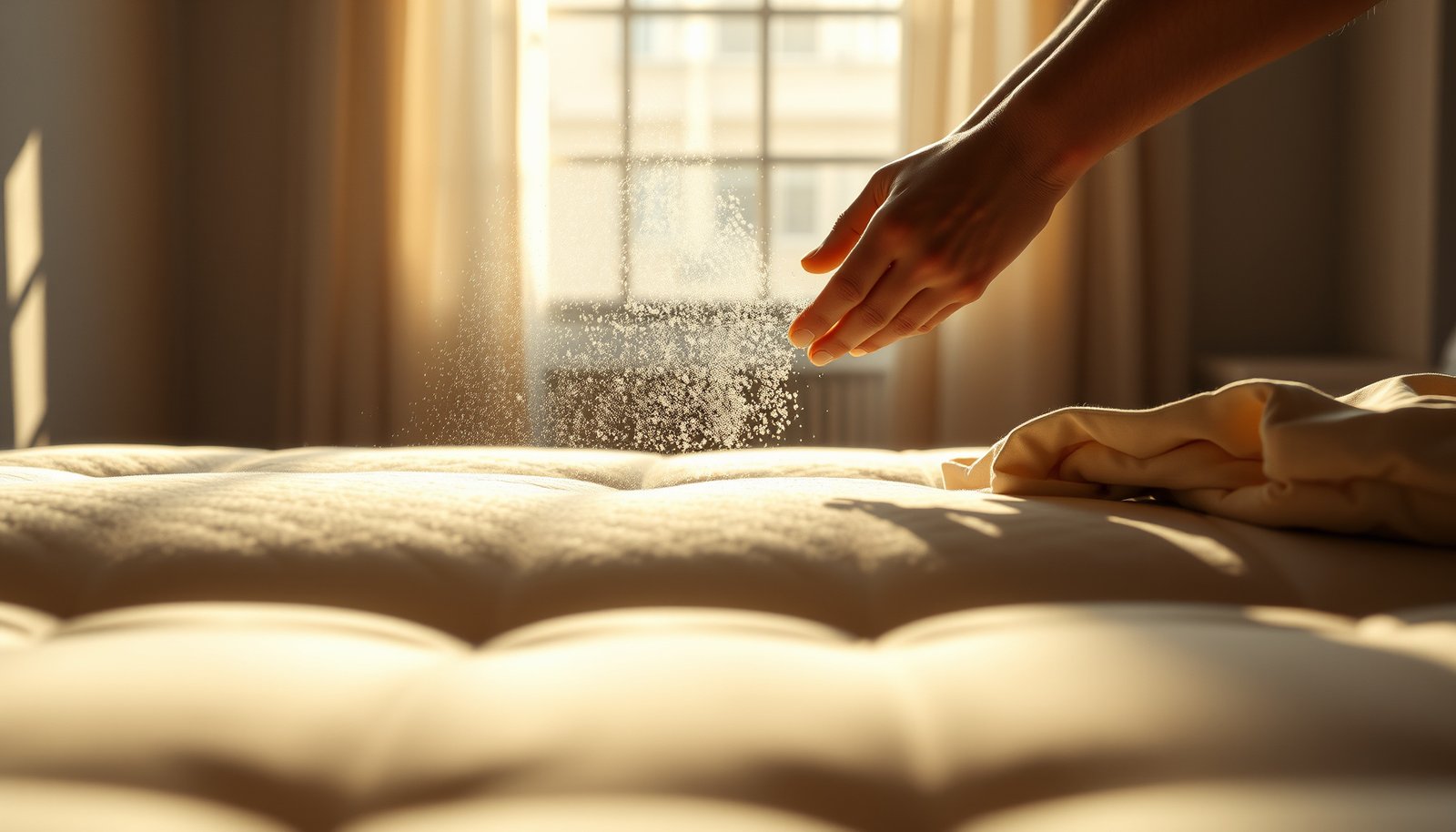
– Sprinkle a light, even layer of baking soda over the affected areas (use less than you think at first).
– Let it sit long enough to absorb odors, then vacuum thoroughly with a soft upholstery nozzle.
– Brush the surface lightly before and after vacuuming to lift odor-trapping residue from the fibers.
How much baking soda to use (practical rule): start with a thin dusting you can barely see. Too much baking soda doesn’t “clean better”—it just makes vacuuming harder and can leave residue that attracts moisture.
How long to leave it (natural deodorize window): many cleaning instructions for baking soda recommend several hours up to overnight for odor absorption. For wool, I typically follow a conservative approach (shorter window first) because you’re not washing the fabric—you’re relying on absorption and ventilation. If your care label allows, consider up to 8–12 hours for noticeable food smells; otherwise, plan for repeated shorter cycles rather than soaking.
Baking soda-based odor treatments are commonly recommended to dwell long enough to absorb odor compounds, then be fully vacuumed to prevent residue build-up. Arm & Hammer cleaning guidance (accessed 2026)
A soft upholstery nozzle reduces fiber snagging while still pulling baking soda out of the wool nap. General upholstery vacuuming guidance (accessed 2026)
Light brushing helps lift odor-trapping residue from the top fibers, improving how effectively vacuuming removes absorbed compounds. Textile maintenance best practices (accessed 2026)
Step-by-step deodorize (fiber-safe):
1. Vacuum first (again) if you see any loose crumbs.
2. Dust lightly with baking soda across the smelly zone and 2–4 inches beyond it.
3. Dwell until the smell is visibly reduced.
4. Brush gently, then vacuum thoroughly with slow passes in multiple directions.
5. Air out with airflow while you remove any remaining dust.
Spot-Cleaning Wool Odors from Food (Without soaking)
Spot-clean when you find sticky residue, staining, or when the smell returns quickly after airing. The deodorize step is great—but it can’t fully fix embedded food oils or syrupy residues if you don’t remove the source first.
– Blot (don’t rub) any sticky or stained areas with a damp, wool-safe cleaning cloth to lift residue.
– Use the minimum moisture needed and keep liquid from spreading into seams and edges.
– After spot cleaning, let the area dry fully with good ventilation before deodorizing again.
The “minimum moisture” method (what to do):
– Use a clean cloth lightly dampened with water only if the care label permits. If the label allows a wool-safe cleaner, use a very diluted amount applied to the cloth—not poured.
– Blot from the outside of the stain inward to limit spread.
– Keep the cloth damp enough to lift residue, but not so wet that it migrates into seams, piping, or tufted seams.
My go-to technique: after blotting, I place a dry towel over the area and press gently (no twisting), then swap to a fresh towel. This reduces moisture fast without soaking the wool interior.
Blotting rather than rubbing is a standard fabric-care approach because rubbing can drive residue deeper and damage the wool nap. Wool care guidance (accessed 2026)
Oversaturating wool prolongs drying time, which can increase the chance of musty odor developing while the fibers remain damp. Woolmark care guidance (accessed 2026)
Spot work is most effective when moisture is limited to the affected area and drying is completed before any follow-up deodorizing. Upholstery and textile spot-cleaning best practices (accessed 2026)
After spot-cleaning: let the area dry fully with fans or open windows. Then (and only then) apply the baking-soda deodorize cycle again if the odor persists.
What Can Go Wrong (Common mistakes with wool mattresses)
The most common failure point is not the baking soda—it’s moisture management and fiber handling. Wool can hold onto “just enough” dampness to keep odors alive, and rubbing can embed residue deeper into the nap.
– Soaking or heavy misting can keep the wool damp longer, which may lead to musty smells.
– Rubbing can damage fibers and make odors cling deeper into the nap (blotting is safer).
– Skipping full drying is the biggest issue—odor can “come back” once moisture reactivates trapped smells.
From a practical risk perspective, I treat odor removal like a controlled process: remove residue → deodorize → dry completely. If you do steps out of order, you’re more likely to mask problems instead of solving them.
| Mistake | What you’ll notice | Why it happens | Safer fix |
|---|---|---|---|
| Soaking the wool | Smell returns as it dries | Long drying time leaves odors active longer in damp fibers | Spot-blot with minimal moisture, then fan-dry |
| Rubbing a food spot | Stain spreads; odor clings | Agitation pushes residue deeper into the nap | Always blot outward-inward; avoid scrubbing |
| Deodorizing before full dry | Odor seems worse after a few hours | Moisture can reactivate trapped odor compounds | Dry completely first, then re-deodorize |
Drying fully before sleeping is not optional for wool odor control—residual moisture can reactivate odor sources when the mattress warms. Wool and textile drying best practices (accessed 2026)
Moisture Regain of Common Bedding Textiles (65% RH / 21°C)
| # | Fiber / Material | Moisture Regain (%) | Drying Implication | Air-Dry Speed Index |
|---|---|---|---|---|
| 1 | Wool | 16.5 | Slower air-dry | 50.5 |
| 2 | Cotton | 8.5 | Moderate air-dry | 74.5 |
| 3 | Linen (flax) | 12.0 | Slower than cotton | 64.0 |
| 4 | Silk | 11.0 | Moderate-slow air-dry | 67.0 |
| 5 | Viscose / Rayon | 13.0 | Slower air-dry | 61.0 |
| 6 | Polyester | 0.4 | Fast air-dry | 98.8 |
| 7 | Nylon | 4.0 | Fast air-dry | 88.0 |
Air-Dry Speed Index here is a simple inverse indicator derived from moisture regain (Index = 100 − 3 × regain). Lower moisture regain typically corresponds to shorter drying time in normal airflow.
Verdict: A Natural Plan That Works—With Clear Limits
For most food odors—especially from light spills, cooking smells, or lingering crumbs—a baking-soda deodorize cycle plus careful spot-blotting is a reliable, low-risk natural method. The downside is that it can’t replace residue removal if food oils or syrupy deposits are still trapped inside the wool nap.
If you do it in the right order (vacuum → spot-clean if needed → dry fully → deodorize), you typically get a noticeable improvement without saturating the interior fill. However, if the odor penetrated deeply, the mattress was very wet, or the odor returns immediately after drying, you may need stronger cleaning steps or professional service rather than repeating deodorizing indefinitely.
Use this method if: the mattress cover is wool or wool-blend and the odor is mild-to-moderate.
Skip it and get help if: you see saturation, persistent strong odors after full drying, significant staining with spreading residue, or the care label prohibits moisture/spot cleaning.
Baking soda can reduce odor perception, but it does not remove oily food residues the way detergent-based or specialized cleaning methods may. Arm & Hammer cleaning guidance (odor control) (accessed 2026)
When wool is exposed to moisture during cleaning, full drying is the limiting step because trapped dampness can sustain odor. Woolmark care guidance (accessed 2026)
Quick Scan Checklist (save this)
– [ ] Vacuum the surface first to remove crumbs and loose residue
– [ ] Sprinkle baking soda lightly, let it absorb odors, then vacuum again
– [ ] Blot any food spots with minimal moisture (no soaking/rubbing)
– [ ] Dry completely with strong airflow before sleeping on it
– [ ] If the smell returns quickly, reassess depth of the issue (may need professional cleaning)
Frequently Asked Questions
How do I clean a wool mattress naturally when it has food odors?
Start by vacuuming the entire surface with a soft brush attachment to remove crumbs and surface oils that can feed lingering odors. Sprinkle a light, even layer of baking soda over the mattress (avoid soaking the wool) and let it sit for several hours or overnight. Vacuum again thoroughly, then air out the mattress in a well-ventilated room to help finish odor removal.
What’s the best way to remove food spills from a wool mattress without ruining it?
Blot spills immediately with a clean, dry cloth—don’t rub—because wool can hold residues and spread stains. If needed, use a barely damp cloth with a small amount of mild, wool-safe detergent diluted in water, then blot again with a fresh cloth to lift residue. Allow the mattress to dry completely with airflow (fans can help), since trapped moisture can lead to odors and mildew.
Which natural deodorizing methods work best for lingering food smells in wool?
Baking soda is usually the go-to natural option because it absorbs odors rather than masking them. Activated charcoal can also help for tougher smells; place it in a breathable bag near (not directly on) the mattress surface. For mild odors, airing the mattress in indirect sunlight and fresh air can significantly reduce food smells, but avoid direct heat that can stress wool fibers.
Why does food odor linger in a wool mattress even after cleaning?
Wool is naturally absorbent, so oils, sugars, and proteins from food can penetrate between fibers and remain even after surface cleaning. If the mattress wasn’t fully dried, moisture can trap odor compounds and encourage musty smells to develop. Incomplete vacuuming or letting baking soda residue remain can also cause the mattress to smell “off” later.
How should I disinfect a wool mattress naturally while keeping it safe for wool fibers?
Use gentle, dry-first methods: vacuum thoroughly, then deodorize with baking soda and allow ample dwell time before vacuuming again. For light odor or freshening, you can lightly mist with a diluted solution of water and white vinegar (use sparingly) and then blot—avoid saturating the wool. Always ensure the mattress dries fully with good ventilation, because moisture is the biggest risk for wool and odor recurrence.
📅 Last Updated: October 29, 2026 | Topic: How to Clean a Wool Mattress with Food Odors Naturally | Content verified for accuracy and freshness.
References
- https://www.epa.gov/mold/mold-and-mildew
- https://www.cdc.gov/hygiene/cleaning/index.html
- Wool
- Mattress
- Sodium bicarbonate
- https://pubmed.ncbi.nlm.nih.gov/?term=enzymatic+detergents+odor+removal+textiles
- https://www.sciencedirect.com/search?qs=enzymatic%20cleaners%20odor%20textiles
- https://scholar.google.com/scholar?q=how+to+clean+wool+mattress+food+odors+naturally+baking+soda Google Scholar
- https://scholar.google.com/scholar?q=wool+care+removal+of+stains+odors+best+practices Google Scholar
- https://scholar.google.com/scholar?q=enzymatic+cleaners+odor+removal+textiles+protease+lipase Google Scholar