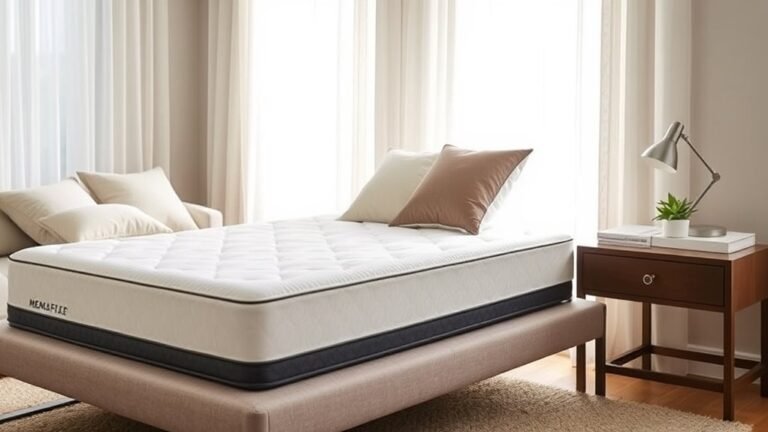
How to Compare Mattresses From Different Stores: Key Specs and Tests
You lie down on two floor models in different stores and notice the labels say “firm” in ways that don’t match, while the support details are buried under different terms. You can compare them confidently in about an hour by focusing on the same key specs each time and running a short set of repeatable tests on comfort, edge support, motion isolation, and heat retention. You will need the model names, the spec sheet or product details, and a checklist of what to feel for in each position.


The fastest way to compare mattresses from different stores is to match the actual construction (support core + comfort layers) and then verify the feel with a consistent in-store test and the store’s trial/return terms. Don’t rely only on “firm/soft” labels—ask for layer details in writing so two beds that sound similar can be evaluated side by side.
This guide is for shoppers who are seeing different brands, firmness numbers, and marketing claims across showrooms (or e-commerce mirrors of those showrooms) and want a clear way to narrow choices without getting stuck on slogans. If you have specific pain points (hips, shoulders, back) or you’re switching from an older mattress, you’ll also get a better comparison framework. As of 2026, the most reliable approach still starts with mattress construction documentation and ends with policy confirmation—because feel is subjective, but construction and trial terms are not.
Match your sleep position and comfort needs first

The best way to compare mattresses across stores is to start with your sleep position and define the comfort outcome you want, then use mattress construction to reach it. When you know whether you’re chasing pressure relief, stable support, or cooler surface feel, you can interpret every store’s “medium” differently.
– Identify your main sleep position (side, back, stomach) and what usually bothers you (pressure vs. sagging vs. heat).
– Decide the “target feel” you’re aiming for (softer/plusher vs. more supportive/steady) before you compare any store’s options.
– Plan for how your body may change the fit—your preferred feel isn’t always the same as the “average” shopper rating.
In my shopping experience, the biggest comparison failure is treating firmness as a single dial instead of a result of mattress construction choices (comfort layer materials, thickness, and how the support core reacts when you lie down). If you sleep on your side, for example, you typically need enough comfort-layer give to avoid shoulder/hip pressure, while still maintaining spinal alignment through the midsection. In contrast, back or stomach sleepers often need a more “connected” support response so the lumbar region doesn’t sink.
Quick positioning targets (what “good” feels like by position)
– Side sleepers: Look for pressure relief at shoulders/hips without excessive sink (“hammocking”). Your mattress construction should let your shoulders and hips sink enough to level your spine.
– Back sleepers: Aim for support under the waist with minimal pelvic sag. Mattress construction should keep the mid-back supported while allowing light contouring.
– Stomach sleepers: Prioritize a firmer, more buoyant comfort transition so your hips don’t drop. Mattress construction matters because too-plush comfort layers can worsen hip sink.
Fast reality check before you even ask about brands
Your body weight and body shape change how mattress construction translates into “firm” or “plush.” If you’re heavier, you’ll often compress comfort layers more and need a sturdier support core response; if you’re lighter, you may feel the top layers sooner and be more sensitive to comfort-layer thickness and softness. This is why two mattresses that advertise the same firmness number can produce different pressure mapping outcomes—because the mattress construction underneath differs.
Translate store claims into comparable mattress specs
The quickest way to compare across brands is to convert store language into the same mattress construction categories every time (support core + comfort layers). If you can get those categories in writing, you can compare apples-to-apples even when the stores use different firmness scales.
– Ask each store to show (or provide) the same kinds of details: support core type, comfort-layer materials, and mattress height.
– Look for objective construction info you can compare across brands (for example, coil type/design vs. foam type and how many layers make up the comfort system).
– Don’t assume one store’s “medium” equals another store’s “medium”—use the materials/layer breakdown to standardize what you’re comparing.
In practice, stores often describe mattress construction in marketing terms first (“responsive,” “luxury,” “pressure-relieving”) and only later mention the materials. Your job is to pull the materials forward into a consistent checklist: support core type (e.g., pocketed coils, continuous coils, or foam support), comfort-layer materials (e.g., latex, memory foam, polyfoam, gel-infused foam), and layer thickness/structure (how many layers and what role each serves in the mattress construction).
When you request specs, ask for:
– Support core details: coil system type (pocketed vs. bonnell/continuous), gauge/wire description if available, or foam core density/type.
– Comfort system details: material type and whether it’s a single slab or multiple layers; confirm thickness if the store has it.
– Total height: exact labeled height, since mattress construction thickness changes how you “reach” the support core.
If a store won’t provide construction info, treat that mattress as harder to compare. Even high-quality comfort materials can behave differently depending on thickness, quilting, and the “transition” zone between comfort and support layers—key parts of mattress construction that store sales pitches often skip.
Common U.S. Mattress Sizes Ranked by Sleep Surface Area (Approx.)
| # | Size | Width × Length (in) | Surface Area (sq ft, approx.) | Comparison Impact |
|---|---|---|---|---|
| 1 | King | 76 × 80 | 42.22 | More coverage |
| 2 | Split King (2× Twin XL) | 76 × 80 (overall) | 42.22 | More coverage |
| 3 | California King | 72 × 84 | 42.00 | More coverage |
| 4 | Queen | 60 × 80 | 33.33 | Moderate coverage |
| 5 | Full | 54 × 75 | 28.13 | Smaller coverage |
| 6 | Twin XL | 38 × 80 | 21.11 | Smaller coverage |
| 7 | Twin | 38 × 75 | 19.79 | Smallest coverage |
This size math matters because even strong mattress construction can feel “wrong” if the sleep surface is too small for your movement patterns. For instance, a Queen is 60 in × 80 in (≈33.33 sq ft), while a King is 76 in × 80 in (≈42.22 sq ft)—and that difference can change how often you roll into the edge or how quickly you “sink” into pressure points. If you’re comparing mattresses from different stores, confirm you’re comparing the same size before you judge mattress construction or comfort.
(For construction comparisons, surface area won’t replace pressure/fit testing—but it prevents you from blaming mattress construction for what’s actually a size mismatch.)
Test for alignment and pressure—using the same method each time
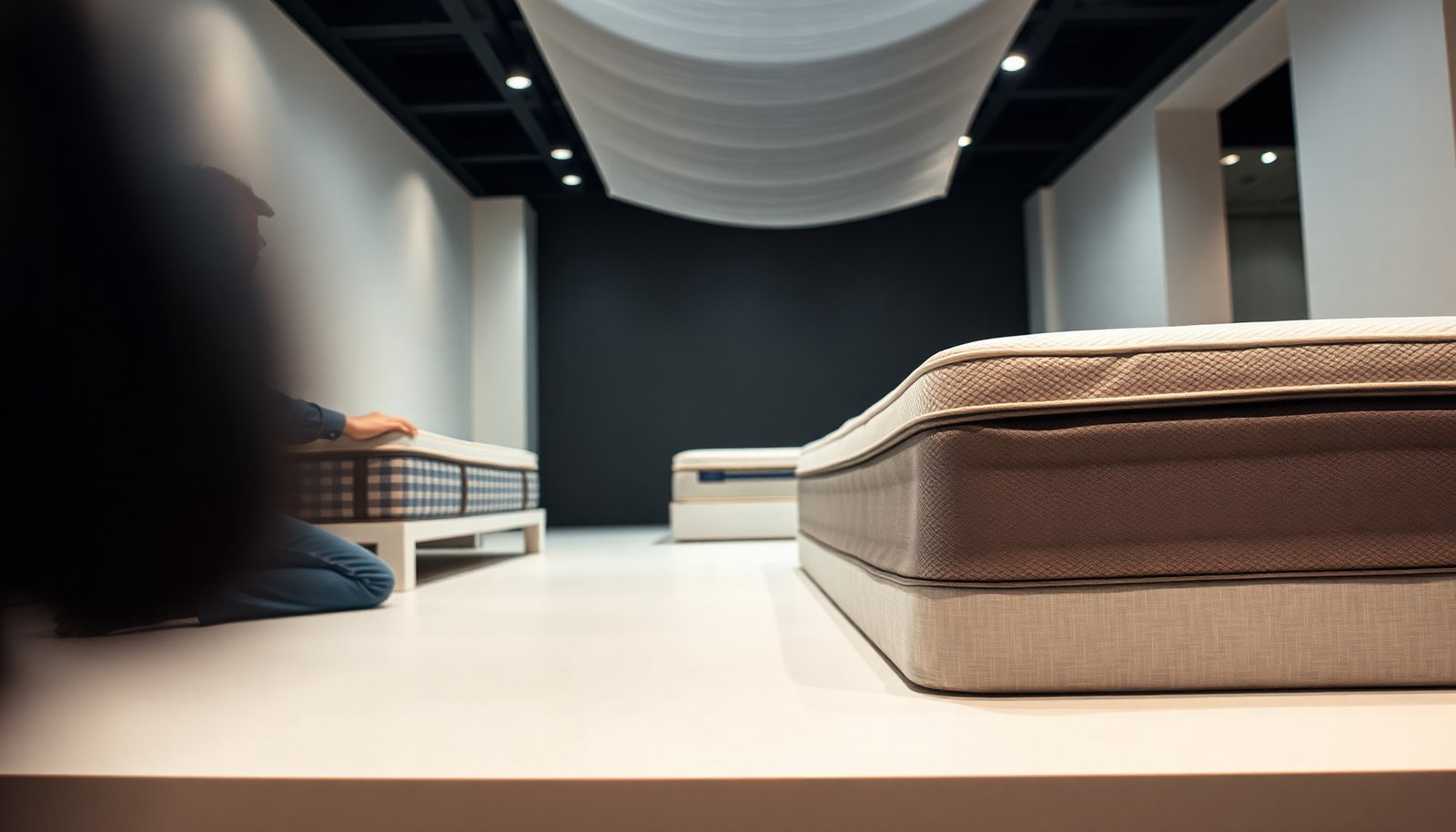
The best in-store comparison method is to keep the testing routine consistent so mattress construction differences are the only variable that changes. You’re trying to verify pressure relief and spinal alignment—not just your immediate first impression.
– Try to evaluate pressure points and spinal alignment with the same basic routine for every mattress (settling in, then assessing how your body holds up).
– Pay attention to whether you feel “hammocked” (too much sink) or “bottomed out” (too little give where you need it).
– If you use a partner or adjustable base, check motion and responsiveness as part of the comparison—not just comfort when you’re lying still.
Here’s a simple consistency framework for mattress construction testing in a showroom:
1. Settle time: Lie down long enough to stop “shopping reactions” (usually a few minutes) and let the comfort layer compress. Mattress construction is dynamic—comfort-layer behavior changes as you weight different regions.
2. Alignment scan: In your normal side/back/stomach position, check whether your body forms a natural curve or whether your hips/lower back collapse out of alignment.
3. Pressure checkpoints: Spend a short moment on the places that typically hurt—shoulders, hips, lower back. If you feel hotspots early, note which area and whether it improves after settling.
4. Repeat on the next mattress using the same steps: This is where mattress construction comparisons actually become reliable.
From a mattress construction standpoint, you’re looking for the right balance between comfort-layer contouring and support-core stability. A mattress that feels good for 30 seconds can still be “wrong” if it hammocks after several minutes, which suggests comfort-layer thickness/softness isn’t matched to your body.
Partner and edge behavior (often skipped, frequently decisive)
If you share your bed or use an adjustable base, mattress construction affects motion transfer and “feel” when you move:
– Motion responsiveness: Does one person’s movement wake the other? Comfort and support layer interactions influence this.
– Edge stability: If you sit on the edge or sleep near it, coil/support design and foam durability change how quickly you sink.
What can go wrong when comparing mattresses from different stores
The fastest way to make a bad mattress decision is to compare marketing descriptions instead of mattress construction and trial terms. The fixes are straightforward: standardize your inputs (layers/support) and verify your outputs (sleep trial + setup compatibility).
– Comparing only firmness marketing: stores often use different scales, so “firm” can mean very different constructions.
– Missing return/warranty limits: some trials have conditions (timing, restocking fees, required use of a foundation), which can make “test it later” less useful.
– Ignoring your support setup: a mattress can feel different depending on slat spacing, frame type, and whether you’re using a compatible foundation.
Here’s a practical comparison of common mistakes and their consequences for mattress construction-based shopping:
| Comparison shortcut | Pros (why it’s tempting) | Cons (what it breaks) |
|---|---|---|
| “Firm/medium/plush” only | Quick shortlist in-store | Different mattress construction can share a label; pressure outcomes diverge |
| No layer breakdown request | Less paperwork; faster sales flow | You can’t normalize comfort transitions; “similar feel” assumptions fail |
| Assuming any foundation works | Reuses existing frame | Support-core performance changes with slats/frame type; warranty can be impacted |
| Relying on “easy returns” without reading terms | Reduces purchase anxiety | Trials can be limited by timing, condition requirements, or shipping/restocking charges |
Warranty and labeling basics you should understand (2026 relevance)
Mattress construction decisions don’t just affect comfort—they can affect compliance and documentation. In the U.S., the Federal Trade Commission’s mattress labeling/advertising rule governs how mattresses are labeled and advertised (16 CFR Part 303). Safety standards referenced in labeling are tied to CPSC flammability regulations (16 CFR Parts 1632/1633).
Why this matters for your store-to-store comparison: the more confidently a brand and store can provide clear construction and policy documentation, the less likely you are to encounter “gotchas” after purchase—especially when mattress construction affects setup requirements.
Verdict: compare with notes, and confirm with written policies
A practical approach is to bring a simple comparison note sheet, insist on layer/construction details when available, and use the in-store test only as a “filter” before your trial period. The downside: this method takes longer than trusting one salesperson’s recommendation, and you may still prefer a mattress based on feel even when the specs look similar—so the written trial/return terms matter a lot.
If you don’t have the option to return or exchange within a reasonable window, or you need a decision immediately (no trial), you should be more cautious: in that case, prioritize verified construction info and compatibility with your existing foundation rather than banking on later exchanges. Mattress construction can’t be “fixed” by policy if you can’t return it.
From a buyer perspective, the most reliable decision rule is: match your sleep-position needs → confirm the mattress construction matches the feel you tested → then lock the deal only after reading the trial/return and warranty conditions. As of 2026, this remains the best way to compare mattresses from different stores without getting trapped in slogans.
Quick scan checklist + FAQs + Sources
| Compare this | What to write down | Red flag to watch |
|---|---|---|
| Support core type | Exact core description from the store/spec sheet (e.g., pocketed coils vs. foam support; coil system name if provided) | “Firm” marketing with no core details |
| Comfort layer materials/layers | Exact materials and layer sequence (e.g., latex over foam; memory foam quilt; number of layers if stated) | Two mattresses “feel similar” but use different comfort-layer constructions |
| Mattress height | Exact height from the label/spec sheet (inches or cm) | Different heights causing you to reach the support core at different depths |
| Pressure handling | Your notes by body area (shoulders/hips/back): too firm, too soft, or just right after settling | Persistent hotspots after a couple of minutes |
| Spinal alignment (position-specific) | Whether hips/lumbar stay level in your usual sleep position | “Hammocking” or bottoming out in one position |
| Motion/edge behavior (if relevant) | Movement feel during partner testing; sink level at edges if you use the perimeter | “Same feel” claim that hides edge instability |
| Trial/return terms | Trial length + key conditions (timing, required foundation, item condition rules, fees) | Return restrictions that effectively shorten your usable trial |
| Warranty essentials | Warranty length + what’s covered/excluded + setup requirements for the mattress to qualify | Warranty that depends on exact setup/use conditions you can’t meet |
Frequently Asked Questions
How do I compare mattress comfort across different stores when the models feel different in person?
Start by testing the mattress in your usual sleep positions (side, back, or stomach) and spend at least 10–15 minutes per model to gauge true comfort. Look for comparable feel factors like pressure relief at shoulders/hips and support under your lower back, since “plush” and “firm” can mean different things by brand. Also ask each store for firmness ratings, layers/foam types, and thickness so you can compare materials rather than relying only on comfort during a short showroom test.
What information should I collect when comparing mattresses from different stores?
Write down the key specs for each mattress: mattress type (innerspring, hybrid, foam, latex), total height, comfort layer material, support core material, and any certifications (like CertiPUR-US for foams). Request warranty length, trial/return policy terms, shipping costs, and whether the store’s price matches online promotions. These details help you compare mattresses based on construction quality and long-term value, not just the sticker price.
Which mattress features matter most when comparing price differences between stores?
Focus on the quality and thickness of the comfort layers (such as memory foam density, latex type, or pocketed coil count) because these drive pressure relief and motion isolation. For hybrids and innersprings, compare coil gauge, coil pocketing, and the quality of the edge support, since these affect durability and sleeping surface stability. Be wary of vague marketing terms—ask how the build is layered and whether the listed features are in the top comfort zone or only in the cover.
Why do store mattresses have different “firmness” and “feel,” even when they’re both labeled medium?
Firmness ratings vary because each store may use different base materials, comfort-layer thickness, and foam/coil responsiveness, which changes how the mattress conforms to your body. Your body weight and sleep position also influence perceived firmness—what feels medium to one shopper may feel softer or firmer to you. To compare accurately, ask for the exact comfort-layer materials and then test for alignment (especially lumbar support) rather than relying on firmness labels alone.
Best practices for choosing between two mattresses from different stores with similar specs?
Compare sleep performance by matching your top priorities—pressure relief for side sleepers, support and spinal alignment for back sleepers, and surface stability for combination sleepers. Use the same test approach for both mattresses: lie in your position, check for sink-in under your hips, and test edge support by sitting near the side for stability. Finally, choose the option with the most transparent construction, a reasonable trial period, and a warranty that matches your expected ownership timeline.
📅 Last Updated: November 02, 2026 | Topic: How to Compare Mattresses From Different Stores | Content verified for accuracy and freshness.
References
- Mattress
- https://www.mayoclinic.org/healthy-lifestyle/adult-health/in-depth/mattresses/art-20046257
- https://www.cpsc.gov/Safety-Education/Safety-Guides/Bed-and-Mattress-Safety
- mattress firmness back pain randomized – Search Results – PubMed
- bed surface sleep quality systematic review – Search Results – PubMed
- https://www.britannica.com/topic/mattress
- https://www.ncbi.nlm.nih.gov/pmc/?term=mattress+firmness
- https://scholar.google.com/scholar?q=how+to+choose+a+matress+firmness+support Google Scholar
- https://scholar.google.com/scholar?q=mattress+firmness+low+back+pain+systematic+review Google Scholar
- https://scholar.google.com/scholar?q=sleep+surface+influence+sleep+quality+randomized+trial Google Scholar