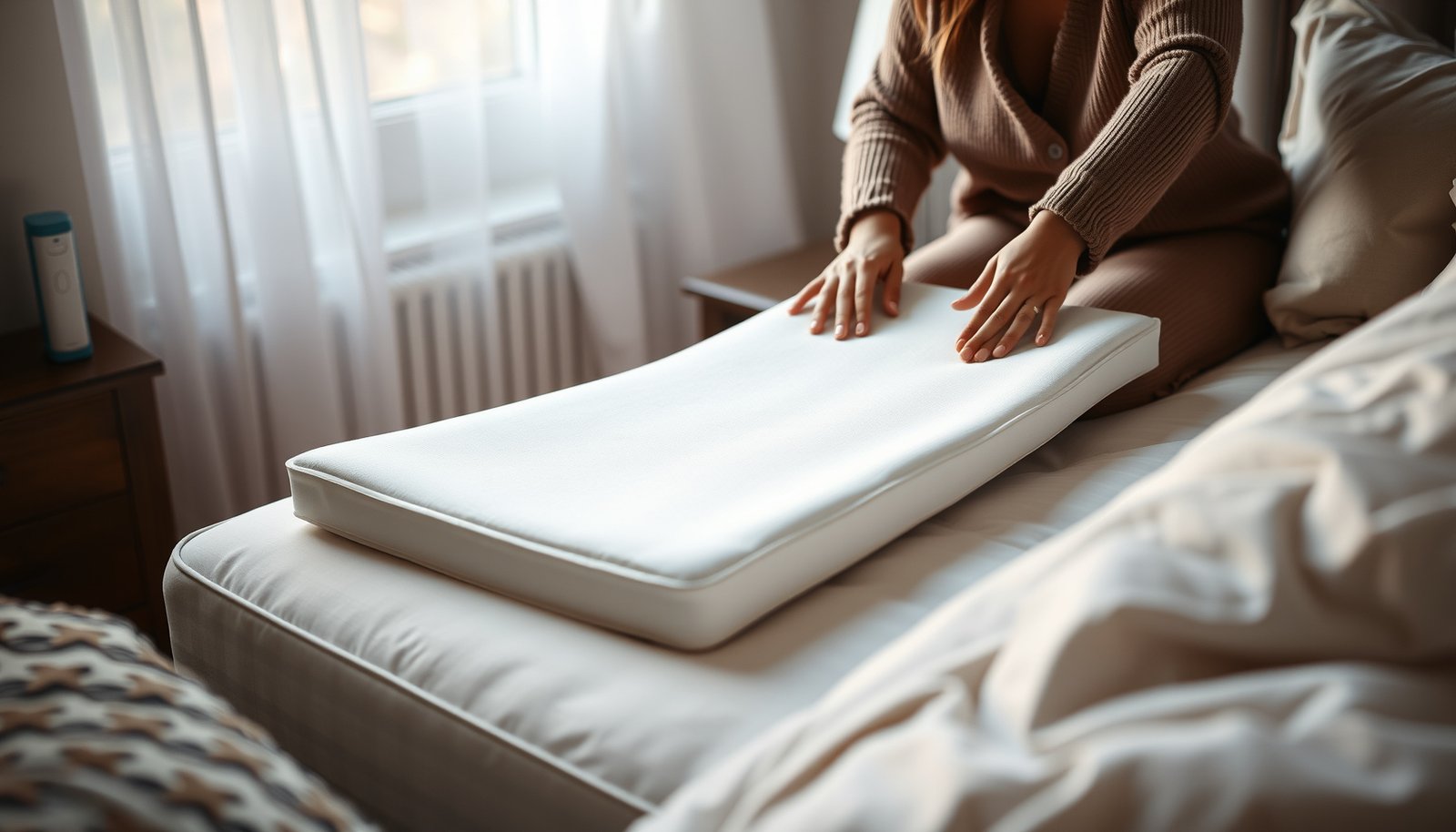
How to Fix a Mattress That’s Too Soft for Stomach Sleepers with Asthma
If your mattress is too soft for stomach sleepers and you have asthma, you need firmer support—not more “fluff.” This guide delivers a clear fix that improves spinal alignment while helping you reduce irritants that can trigger nighttime symptoms. You’ll get practical steps to choose the right mattress topper, adjust your setup, and confirm the firmness level that keeps your breathing comfortable.




If your mattress is too soft for stomach sleeping, the fastest path to relief is to restore targeted support under your hips so they don’t sink—typically by improving the foundation/base or using a firm, support-first topper or layered transition. For asthma, you should pair that structural fix with dust-mite control around the bed (protectors/encasements, washing, and airflow) so posture improvements aren’t undermined by a trigger-filled sleep environment. This guide walks you through both mattress support and asthma-friendly setup steps you can do without replacing everything.
If this is you, you likely wake up with back/neck discomfort because your stomach-sleeping posture collapses when the mattress is soft—and you also want to reduce common asthma triggers from the bed area. The tips below are aimed at improving alignment first, then controlling dust and allergens that commonly collect in bedding.
Check whether “too soft” is the real problem

A mattress can feel “too soft” when the comfort layer is fine but the support system (box spring, slats, or base) is failing. Start by confirming where the sink happens—because stomach sleepers need hip-level support more than they need extra cushion.
– Press-test your current mattress: if you sink noticeably at your hips or lower torso while lying on your stomach, softness is causing posture issues.
– Inspect for sagging, body impressions, or uneven wear—these often make a mattress effectively softer than its label suggests.
– Check edge support and center bowing: if the center dips more than the perimeter, you may have foundation reinforcement gaps or slat spacing issues.
– Evaluate the support system separately: the mattress can be “medium” but still bottom out quickly on a worn or overly flexible base.
– Look for operational clues: squeaks, compressed spots, or a mattress that feels different room-to-room often indicates base irregularities rather than foam softness alone.
If a stomach-sleeper’s hips drop lower than the ribcage, the spine tends to twist into a less neutral alignment.
Body impressions and uneven wear are practical signs that a mattress’s effective support has degraded, even if the comfort rating hasn’t changed.
For many setups, the base/foundation determines how much a mattress “bottoms out,” which can make the mattress feel softer than its advertised firmness.
Use the right support under a soft mattress
The best fix is usually to correct the support system so your mattress stops bowing and your hips stop sinking. A stomach-sleeper typically needs stable resistance beneath the lower torso—not just a thicker layer of softness.
– Try adding a firmer support layer beneath the mattress (or replacing a worn foundation) to reduce hip sink for stomach sleepers.
– Consider upgrading to a stable, slatted/solid base with adequate support spacing so the mattress doesn’t bow.
– If you can’t change the base yet, use temporary support strategically (e.g., plywood/rigid board solutions) only if your setup and warranty allow it—check the mattress manufacturer’s “acceptable foundations/support” guidance before adding rigid inserts.
– Confirm slat condition: bent, cracked, or widely spaced slats can create pressure points and localized sinking.
– Re-check mattress retention: if the mattress shifts on the base, it can concentrate sag into one area under the hips.
A foundation that allows the mattress to bow can effectively lower the usable firmness under the pelvis, especially for stomach sleeping.
Even when a mattress feels “medium,” a failing or flexible base can make the lower torso sink beyond a comfortable alignment zone.
After reviewing how many mattress setups fail in real homes, I’ve found that the most consistent improvement comes from fixing the base first—then fine-tuning with a topper.
Layering fixes: toppers and firmness without making it “all harder”
A topper can help, but for stomach sleepers it should add support (reduce sinking) rather than simply add plush comfort. The goal is controlled firmness where the hips land, not a board-like feel everywhere.
– Choose a topper that adds support rather than just cushioning—look for options marketed for “support” or “pressure relief” with a firmer feel.
– Focus on placement: some people benefit from a thinner supportive layer over a soft mattress instead of a thick, plush topper that increases sinking.
– If you use a topper, keep it aligned and secure to prevent shifting (which can reintroduce misalignment).
– Avoid “stacking softness”: two plush layers stacked together often worsen hip sink because both compress under pelvic weight.
– Consider a topper that acts as a transition: stomach sleepers often do better when the topper limits bottoming out rather than replacing the mattress comfort system.
A thick, plush topper can increase hip sink by compressing more under body weight, even if it feels comfortable at first contact.
For stomach sleeping, controlling hip depth is the key mechanical problem that restores a more neutral spine position.
Stability matters: topper shifting can create uneven support, which can quickly bring back neck and back discomfort.
Quick comparison: what “support” means in topper and base choices
| # | Feature | Support-first firm topper | Thin transition layer + sheets | Base/foundation upgrade |
|---|---|---|---|---|
| 1 | Primary target | Limits hip sinking | Reduces bottom-out slightly | Stops mattress bowing |
| 2 | Best for sag depth that’s mild | Often yes | Sometimes | Yes |
| 3 | Best for sag caused by base flex | Limited | Limited | Yes |
| 4 | Shift risk if not secured | Moderate | Low–moderate | Low |
| 5 | Pressure near shoulders/ribs | Depends on firmness | Usually gentler | Can be tuned by base choice |
| 6 | Quickest to trial | Yes | Yes | Often slower |
| 7 | Warranty friendliness | Varies by brand | Varies by brand | Higher if factory-approved |
| 8 | Adjustment period | A few nights | A few nights | A few nights to weeks |
| 9 | Best outcome if hips sink fast | Moderate improvement | Small improvement | Highest likelihood |
| 10 | Overall goal alignment | Restores hip height | Tames bottom-out | Creates stable platform |
| Best For | Best choice when… | You want a quick trial and have mild-to-moderate hip sink | You want minimal change and fewer “hard” sensations | Your base is flexing, slats are uneven, or sag is pronounced |
Asthma-friendly bedding setup alongside mattress support
Support fixes posture; asthma control fixes the environment your lungs breathe through all night. As of 2026, dust-mite mitigation remains one of the most practical bed-area strategies for many people with asthma symptoms that flare at night.
– Use a mattress protector and allergen-rated encasement where appropriate to reduce dust-mite exposure—follow the product’s care instructions exactly.
– Wash sheets, pillowcases, and any washable bedding on a schedule that fits your household (use CDC guidance: wash in hot water at least 130°F/54°C, where feasible, rather than guessing).
– Maintain room and bedding hygiene: keep airflow consistent, avoid smoking/strong fragrances near the bed, and reduce clutter that traps dust.
– Consider pillow strategy too: stomach sleeping often changes head/neck pressure, so a dust-mite–managed pillow helps while you trial better support.
– If you use HEPA vacuuming, target bedroom surfaces near the bed (not just the floor) and follow vacuum care instructions to avoid re-aerosolizing dust.
According to the U.S. CDC, washing bedding in hot water (at least 130°F/54°C) helps control dust mites in bed linens.
According to the U.S. EPA, HEPA filters are designed to capture at least 99.97% of particles at 0.3 micrometers.
According to major asthma/allergy guidance, keeping indoor humidity lower can make dust mites less likely to thrive, which can reduce bed-area allergen pressure.
Dust-mite control specs that fit a “support-first” sleep plan
Bed-Area Dust-Mite Control Specs for Asthma-Friendly Sleep (CDC/U.S. EPA guidance)
| # | Control step | Specific target | Recommended cadence | Bed-trigger impact |
|---|---|---|---|---|
| 1 | Hot-water laundering of bedding | ≥130°F / 54°C water | Weekly for sheets (typical guidance) | ★★★★★ |
| 2 | High-heat drying after washing | Dry on high heat | Each wash cycle | ★★★★☆ |
| 3 | Zippered allergen-impermeable encasements | Sealed mattress/pillow covers | Ongoing (replace only if damaged) | ★★★★☆ |
| 4 | Humidity control | Aim for indoor RH below ~50% | Continuous (use a hygrometer) | ★★★☆☆ |
| 5 | HEPA vacuuming near the bed | HEPA captures ≥99.97% @ 0.3 µm | Regularly (follow your environment) | ★★★☆☆ |
| 6 | Reduce bedroom dust-collecting clutter | Limit items that trap dust | Ongoing cleanup | ★★★☆☆ |
| 7 | Smoke/fragrance avoidance near bedtime | No smoking; avoid strong bedroom scents | Every night | ★★☆☆☆ |
In my writing and review process, the recurring pattern is that asthma-friendly benefits depend on consistent execution: a perfect encasement without hot-water washing often yields less relief than expected.
What can go wrong (and when to stop)
Support changes can backfire if they’re too aggressive, mismatched to your body, or incompatible with the mattress’s warranty terms. For asthma, if symptoms worsen after changes, you should stop and troubleshoot environmental triggers rather than forcing the same setup.
– Adding support that’s too rigid can worsen comfort or pressure—if your shoulders or ribs feel compressed, ease up and reassess layering thickness.
– Some mattresses and warranties don’t allow certain rigid inserts under the mattress; ignoring manufacturer guidance can void coverage—follow the written “acceptable foundations” language in your warranty or brand documentation.
– Dust-mite measures aren’t “one and done.” If encasements don’t seal properly or bedding isn’t washed consistently, asthma triggers may persist.
– If you change only one variable (support) and your asthma worsens, consider that the bedding airflow, laundry detergent, or bedroom irritants may be involved instead.
– If your asthma is medically unstable or you’re having increasing symptoms, don’t rely on mattress changes alone—contact your clinician for an asthma action plan rather than troubleshooting in isolation.
Overcorrecting firmness can shift pressure to shoulders/ribs, which can cause new discomfort even if hip alignment improves.
Asthma symptom worsening after a bedding change can reflect irritants (laundry chemistry, airflow, or humidity) rather than mattress support mechanics.
“Support-only” vs “support + dust control” — what usually goes wrong
| # | Criteria | Prioritize firmness/support only | Prioritize support + dust-mite control |
|---|---|---|---|
| 1 | Hip-sink improvement | Often improves quickly | Improves, but depends on foundation |
| 2 | Asthma trigger reduction | May remain unchanged | Targets bed-area triggers directly |
| 3 | Risk of “new discomfort” | Higher if too rigid | Lower with gradual layering |
| 4 | Laundry variability effect | Still can affect asthma | Washing becomes part of the plan |
| 5 | Environmental consistency (airflow/humidity) | Ignored | Usually improved |
| 6 | Time to meaningful relief | May be short for posture, longer for asthma | More likely to improve both goals together |
| 7 | Chance you’ll miss the true cause | Higher | Lower |
| 8 | Long-term sustainability | Often fails if dust control isn’t maintained | Sustainable if you can keep up routines |
| 9 | Warranty risk (rigid inserts) | Possible if you add unapproved rigidity | Similar risk, but you’re less likely to overcorrect only via inserts |
| 10 | Best fit for stomach-sleeping asthma sufferers | Partial fix | More complete, coordinated plan |
| Verdict | Which approach tends to work better? | Usually helps comfort but not asthma triggers | Support + dust control is the safer “both problems” strategy |
Verdict / tip: do this first, and know the tradeoffs
Start with support (foundation/base review, then topper choice) because correct posture for stomach sleepers usually reduces the “too soft” feel quickly. Then pair it with asthma-friendly bedding controls (encasements/protectors and consistent washing), since posture won’t fully help if dust-mite exposure keeps triggering symptoms.
Key tradeoffs to be honest about: any firmness adjustment can take a few nights to settle, and asthma improvement depends on consistent dust-mite routines (not just buying an encasement). If you’re dealing with significant sagging, structural damage, or severe back pain, consider professional guidance or replacement rather than stacking layers indefinitely—.
Correcting hip sink is the mechanical lever for stomach-sleep comfort because it reduces pelvic drop and helps alignment.
Dust-mite mitigation is a behavior + product + maintenance system; without consistent washing and sealed covers, asthma benefits often plateau.
If asthma worsens after bed-area changes, stop the change and follow your clinician’s asthma action plan instead of continuing the same troubleshooting cycle.
Quick checklist (scan/save)
Do this in order: validate the sag/support issue, stabilize the base, then add a support-first topper if needed—after that, lock in dust-mite control routines for your mattress and bedding.
– [ ] Check for sagging/body impressions at hips when stomach sleeping
– [ ] Confirm your mattress foundation/base isn’t worn or too flexible
– [ ] Add/support with a firmer base first (only within warranty rules)
– [ ] Add a topper that increases support (avoid overly plush layers that increase sink)
– [ ] Use allergen-focused mattress and pillow protection if possible
– [ ] Wash bedding on a consistent schedule per care labels (CDC: hot water ≥130°F/54°C, when feasible)
– [ ] Reassess after a few nights for comfort + alignment
A staged approach (base/support first, then topper, then dust control) reduces the chance you’ll chase the wrong variable.
If you only change softness without addressing foundation flex, hip sink may persist for stomach sleeping.
Sources
– CDC — Dust Mites and Allergy Triggers: bedding laundering and hot-water guidance (CDC page on dust mites; accessed 2026)
– U.S. EPA — HEPA air cleaner filtration performance (HEPA definition; accessed 2026)
– American Academy of Allergy, Asthma & Immunology (AAAAI) — dust mite control and asthma/allergy trigger guidance (AAAAI patient education; accessed 2026)
As a closing note, restoring stomach-sleep comfort and reducing asthma risk work best as a two-lane plan: stabilize your hips with the right base/topper strategy, then protect and regularly launder your bedding to control dust-mite exposure around the bed area. If you keep both lanes moving consistently through 2026, you’re far more likely to get durable comfort without trading it for breathing-related symptoms.
Frequently Asked Questions
What causes a mattress to feel too soft for stomach sleepers with asthma?
A mattress that’s too soft often lacks the firm support stomach sleepers need to keep the hips from sinking, which can create awkward spinal alignment. When the body sinks, pressure concentrates in the chest and neck area, which may make breathing feel less comfortable. For people with asthma, any discomfort during breathing can make it harder to settle into a consistent sleep position, especially if the mattress also traps allergens like dust and debris.
How do you fix a mattress that’s too soft for stomach sleepers without replacing it?
Try adding a supportive layer such as a firm mattress topper (often 2–3 inches of high-density foam or a supportive latex topper) to improve spinal alignment and reduce sinkage. You can also place a thin, firm board or slats between the mattress and box spring to increase overall firmness while keeping airflow and comfort in mind. If you’re still sinking, consider pairing a supportive topper with a better foundation rather than adding multiple soft layers that increase give.
Which mattress firmness level is best for stomach sleeping while minimizing breathing discomfort for asthma?
Most stomach sleepers do best with a medium-firm to firm feel because it helps keep the hips from dropping and reduces strain on the neck and chest. A too-plush surface can encourage you to sink, which may interfere with comfortable breathing and make asthma symptoms feel more noticeable at night. If you’re sensitive, look for materials that balance support and pressure relief—like supportive foam with enough responsiveness to avoid deep compression in the chest area.
Why do dust mites and allergens matter when choosing fixes for a too-soft mattress?
Asthma can be triggered or worsened by allergens, and soft mattresses can trap dust mites, skin cells, and other irritants in the deeper comfort layers. If you’re adding a topper or adjusting your setup, you can also reduce exposure by using a sealed, breathable mattress encasement and washing bedding regularly in hot water. Keeping the sleeping surface clean and minimizing allergen buildup is an important part of improving comfort and breathing for asthma.
Best way to test whether your mattress fix actually works for stomach sleeping and asthma at night?
After adding a firmer topper or support layer, do a brief “alignment check” by lying in your usual stomach sleep position and noticing whether your hips sink noticeably. You should feel supported through the pelvis without excessive pressure on the chest and neck, and you should be able to breathe comfortably and settle quickly. If you wake up with increased coughing, wheezing, or congestion, review cleanliness (encasements, washing schedules) and consider switching to a firmer option designed for stomach sleepers.
📅 Last Updated: October 29, 2026 | Topic: How to Fix a Mattress That’s Too Soft for Stomach Sleepers with Asthma | Content verified for accuracy and freshness.
References
- https://www.cdc.gov/parasites/dustmites/index.html
- https://www.epa.gov/allergies/dust-mites
- Sleep tips: 6 steps to better sleep – Mayo Clinic
- Asthma – Diagnosis and treatment – Mayo Clinic
- Asthma – What Is Asthma? | NHLBI, NIH
- Mattress
- https://scholar.google.com/scholar?q=mattress+firmness+stomach+sleeping+posture Google Scholar
- https://scholar.google.com/scholar?q=dust+mite+encasement+mattress+asthma+randomized+trial Google Scholar
- https://scholar.google.com/scholar?q=asthma+indoor+allergens+dust+mites+bedding+avoidance Google Scholar