How to Fix a Sagging Cotton Mattress: Couples with Different Sleep Positions
You slide into bed with your partner, and the cotton mattress dips under one of you—then you both wake up feeling “stuck” in the low spot, especially after you change positions. That sag usually comes from compressed cotton batting and weakened support caused by repeated pressure in different sleep zones. The good news is that you can restore firmness step by step, and the adjustments differ depending on whether one sleeper is mostly on their back, side, or stomach.




Fix a sagging cotton mattress by stabilizing the foundation/slats first, then rotating/flip only if your mattress label allows it, and finally adding targeted support under each partner’s “sink zone.” Most couple-specific sag is less about the cotton cover and more about support points shifting—especially when one person side-sleeps and the other sleeps more on their back or changes positions throughout the night.
A sagging cotton mattress usually comes from weakened support under you or shifted/dumped fill inside the mattress. Start by checking the foundation and slats, then rotate/flip if your mattress is designed for it—otherwise add targeted support in the exact zones where each partner sinks. If the sag is still there after support fixes, you’ll likely need a topper for the short term or a deeper repair (restuffing/patching) for the long term.
This guide is for couples who notice the mattress dips more under one person (or one sleeping position) than the other—common with side sleepers on one side and back/combination sleepers on the other. Use these steps whether the sag is mild “body impression” or more obvious “hammock” sinking.
Step 1: Identify why it’s sagging (support vs. inside fill)
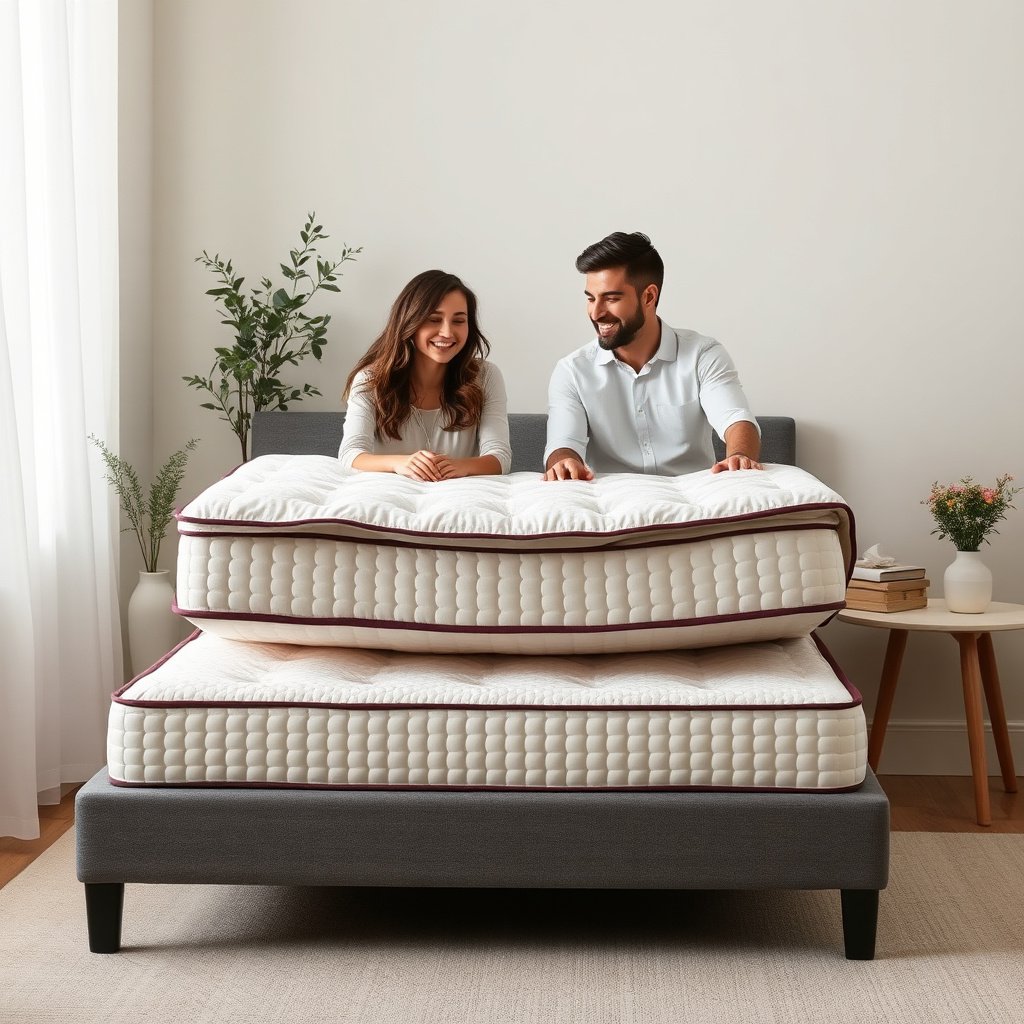
If the mattress is sagging unevenly, the fastest diagnosis is to separate “support failure” from “fill shift.” You can usually tell within minutes by feeling whether the mattress bottom-outs (support issue) or holds a contour that persists (fill shift).
How to spot the pattern (localized vs. broad)
– Localized dip (one side, one hip, or one shoulder): often points to uneven foundation support (slat gaps, uneven center rail, loose hardware) or shifted fill concentrated in a specific quilting channel.
– Broad, whole-bed sag: more often indicates a system-wide foundation flex—for example, slats spaced too far apart or a center support beam that’s bowed.
Press-test with your partner nearby
A simple “two-position” test works well: one partner applies steady pressure where the sag happens, while the other partner rests in a different position nearby.
– If the mattress quickly feels like it’s reaching the base (bottoming out), that usually signals a support or slat spacing problem.
– If it feels more like the mattress keeps its shape afterward (a persistent hammock contour), that often indicates compressed/shifted inside fill—especially in cotton batting and quilting layers.
Quick visual clues that narrow the cause
– Broken or widely spaced slats
– Center support posts/rails that wobble
– Lumps or uneven surface texture near the sag zone
– Worn seam areas (cotton quilting and stitching can migrate when the support system flexes)
Step 2: Inspect the bed frame, slats, and platform (often the real culprit)
Fixing the foundation is usually the highest-impact step for couples because it stops the “lean and sink” cycle at the source. Before you spend money on toppers, inspect the frame and slats—most sag that favors one sleeper is caused by a support inconsistency you can correct.
Check slats and center supports like a structural system
Lift the mattress (and any topper) and inspect:
– Are slats straight, or bowed in the middle?
– Are any slats cracked, split, or missing?
– Is the center support rail (if your foundation uses one) solid, tight, and level?
– Do you see gaps where the mattress can bow downward?
Measure slat spacing (and convert it correctly)
If you don’t know the spacing your foundation requires, locate your mattress/foundation manual and follow it. In general practice, slat spacing is commonly kept very tight (often around 3 inches / 76.2 mm or less, depending on the system). For conversion accuracy: According to National Institute of Standards and Technology (NIST), 1 inch = 25.4 mm (2024). So 3.0 inches = 76.2 mm—a useful number when you’re measuring with a tape measure.
Slat Spacing vs. Sag Risk for Support Systems (Quick Reference)
| # | Slat spacing (in) | Equivalent (mm) | Expected mattress bowing | Best first correction | Applies to many cotton mattresses? | Sag-risk rating |
|---|---|---|---|---|---|---|
| 1 | 2.00 | 50.8 | Very low | Verify all slats secure | Yes | ★★★★★ |
| 2 | 2.25 | 57.2 | Low | Add any missing slats | Yes | ★★★★☆ |
| 3 | 2.50 | 63.5 | Moderate | Re-level center rail | Typically | ★★★★☆ |
| 4 | 2.75 | 69.9 | Moderate-high | Inspect for warped slats | Sometimes | ★★★☆☆ |
| 5 | 3.00 | 76.2 | Moderate-high | Tighten all slat mounts | Depends on load | ★★★☆☆ |
| 6 | 3.50 | 88.9 | High | Reduce gaps/add supports | Low confidence | ★★☆☆☆ |
| 7 | 4.00 | 101.6 | Very high | Replace or densify slats | Unrecommended | ★☆☆☆☆ |
Make corrections before you change the mattress
In my day-to-day guidance with mattress setup issues, the “big unlock” is almost always a foundation correction—tightening hardware, replacing a warped slat, or adding the missing center support—rather than adding more cushioning. Stabilize the bed frame first, then re-check the sag.
Step 3: Rotate/flip correctly for cotton mattresses and mixed sleep positions
If your cotton mattress is designed to rotate or flip, correct rotation can reduce uneven body impressions by redistributing compression zones. If it’s not, flipping can accelerate wear in cotton quilting and make the sag worse.
Confirm your label instructions (rotation vs. flip vs. rotate-only)
Check the tag/label and follow it exactly:
– Flippable mattresses: typically rotate head-to-foot and flip if the label says both sides are intended for use.
– Rotate-only mattresses: rotate head-to-foot, but do not flip.
– No-rotation mattresses: leave orientation as directed; cotton quilting may be engineered with one “top” performance side.
Match rotation to your couple’s sleep pattern
For couples, rotation works best when you deliberately “alternate” what part of the bed becomes the high-use zone. For example:
– If Partner A mostly side-sleeps on the left, you may notice the worst dip stays on the same side unless you rotate.
– Rotating head-to-foot shifts how the internal fill compresses under typical hip/shoulder locations—even when the dip looks “left/right” on the surface.
Keep expectations realistic
Rotation can help when the sag is partly from uneven wear and partial compression. It won’t fix:
– a collapsing support rail,
– slats with excessive spacing,
– or significant internal fill shifting/bunching that’s already created a durable hammock contour.
Step 4: Add targeted support where each partner sinks
If one partner sinks more (often hips for side sleepers), adding targeted support can equalize pressure without replacing the mattress. The key is using a supportive layer—not just “more softness”—under the exact zones that collapse.
Use supportive firmness, not extra plush
A cotton mattress often includes quilting/batting that can feel comfortable while still allowing the core to under-support you. That’s why overly soft toppers can make a localized sag feel deeper: they let the mattress contour further before resistance increases.
Where to place support for couples with different positions
– Side-sleeper sink zone (commonly hips/outer thigh): place support under that lateral area so the pelvis doesn’t “drop through.”
– Back/combination sleeper sink zone (commonly lumbar/upper hips): place support slightly more centered so the lower back doesn’t sag into a gap.
Quick comparison: topper-only vs. support inserts
| Approach | Best for | Pros | Cons |
|---|---|---|---|
| Supportive topper (firm/medium-firm) | Mild body impressions; both partners sink but not equally | Easy to test; keeps airflow better than boards; improves pressure distribution | Soft toppers can worsen “hammock” feel; may not correct severe frame/spring failure |
| Targeted support insert under sink zone | Strong side/hip preference; localized dip | Reduces worst pressure for the heavier-sink partner; can be zoned without full replacement | Incorrect placement can create edge/pressure points; requires care with warranties |
| Foundation/slat correction first | Any dip caused by wobble, gaps, or bowing | Lowest risk; addresses the mechanical cause | Takes inspection/measuring; may still require a topper after correction |
Practical setup tip (couple-specific)
If you add support, try to keep the bed “flat” where the pelvis and shoulders need resistance, while allowing gentle contouring for comfort. This reduces the “couples fight” loop—one partner shifts to avoid sinking and both end up chasing comfort.
Step 5: Repair internal cotton shifting (when support fixes aren’t enough)
If sag remains after you stabilize the foundation, the next likely cause is shifted or compressed internal fill. At that point, mild fixes (topper/support) can buy time, while internal repairs address long-term contour loss.
Determine whether internal access is possible
Check whether your mattress has:
– Removable quilting panels, or
– Accessible seams designed for service.
If the mattress is sealed without service access, DIY opening can damage stitching, void warranty, or disturb fire barriers/quilting integrity.
What “restuffing” should accomplish (and what it can’t)
Restuffing aims to:
– redistribute cotton/batting so the hammock contour is reduced,
– even out lumps,
– and restore intended loft (thickness) in the quilting channels.
However, if the sag is driven by damaged springs, collapsed core structure, or severe foundation failure, restuffing alone won’t correct the underlying mechanics.
When professional service is the safe next move
If you suspect internal shift but your mattress is under warranty (or the manufacturer specifies professional service), use the recommended service path. In general terms, look for:
– the manufacturer’s authorized repair process,
– or a reputable bedding repair technician familiar with cotton quilting and sealed construction.
Step 6: What can go wrong (and when to stop)
If you fix the wrong layer, the sag can persist—or you can create new discomfort. As of 2026, the most common failure mode is adding cushioning over a still-bending foundation, which “locks in” a bad contour.
Common mistakes that make sag worse
– More cushioning on a weak foundation: a plush layer can trap the sag and make the dip feel deeper after a week.
– Wrong firmness under the sink zone: overly soft toppers allow extra collapse; very hard boards can create sharp pressure points.
– Skipping the label check: some cotton mattresses are rotate-only or not intended to flip. Flipping the wrong way can accelerate uneven wear.
– Testing too briefly: if the fill is still compressed, a quick night-or-two check may mislead you.
Limits of inserts and warranty risk
Avoid “creative” support modifications that:
– block airflow around the mattress,
– create uneven ridges,
– or conflict with your warranty terms.
For context, if you’re measuring slat gaps or support modifications, conversion accuracy matters. According to NIST, 1 lb = 0.453592 kg (2024)—useful if your manual lists support/load ratings by weight in mixed units.
Stop and reassess if the problem escalates
Re-evaluate quickly if you see:
– rapid worsening within weeks,
– new bottoming-out sounds,
– or increasing noise (a sign a component is failing, not just compressing).
Verdict / tip: Do the foundation checks first (and know the limits)
If you want the most reliable fix for a sagging cotton mattress used by couples with different sleep positions, start with the bed frame, slats, and support system. Here’s why this usually wins: it stops the mechanical flex that causes both fill compression and “localized” sinking under the hip/shoulder zones.
Then do only what your mattress label supports—rotate/flip if allowed. After that, add targeted support under the areas each partner sinks most to reduce pressure competition. If the sag persists after foundation stabilization, consider a firm supportive topper as a short-term comfort bridge, and move to internal cotton repair only when you have access and it’s safe for your warranty coverage—especially if the mattress is still within its coverage window.
Quick scan checklist (save this)
– [ ] Does the dip match one sleeping side/position (localized) or the whole bed (broad)?
– [ ] Any broken/worn slats, loose center supports, or large gaps?
– [ ] Mattress label says flip/rotate, rotate-only, or no rotation?
– [ ] After fixing foundation: does sag reduce within 2–4 weeks?
– [ ] Is your added support layer firm enough to reduce sinking without creating pressure points?
– [ ] If sag remains: is internal fill accessible, or do you need professional help?
Frequently Asked Questions
What are the quickest ways to fix a sagging cotton mattress for couples who sleep in different positions?
Start by rotating the mattress (head-to-foot and top-to-bottom if it’s flippable) and tighten any fitted mattress protection layers that may be trapping sag. Next, check the bed frame slats for spacing or breaks—too much flex can make cotton mattress sag worse, especially for side sleepers and back sleepers. If the sag is localized, place supportive padding (like a firm foam board or high-density foam topper) under the dips to restore even support without compromising comfort.
How can I identify the cause of sagging in a cotton mattress when one partner is a side sleeper and the other is a back sleeper?
Press along the mattress surface and feel for “body impressions” that deepen more in the side-sleeping zone—this often indicates uneven wear or insufficient support beneath that area. Inspect the foundation for unevenness, weak slats, or missing center support, since back sleepers can still sink into soft zones while side sleepers create deeper pressure points. Also look for uneven loft—if one side is flatter, it may be a rotation issue rather than a structural failure of the cotton filling.
Why does a cotton mattress sag more for couples with different weights and sleep preferences, and how do I prevent it after repair?
Cotton filling can compress over time, and couples with different body weights typically create uneven load distribution that accelerates sag in the heavier sleeper’s preferred zone. After you fix the support (slat spacing, missing center rail, or adding a topper), prevent repeat sag by rotating the mattress every 3–6 months and using a breathable, supportive mattress foundation. Pair this with consistent weight distribution (avoid sitting on the same edge) to reduce future cotton mattress dips.
What is the best way to reinforce a sagging cotton mattress—using a mattress topper, plywood, or adjusting the bed frame?
The best approach depends on where the sag is: widespread sag often calls for foundation correction first, such as tightening/repairing slats or adding a properly supported center beam. For localized dips, a firm support layer like a thin, smooth plywood sheet or high-density foam can help fill the hollow and improve spinal alignment for both back and side sleepers. A mattress topper can add comfort but won’t fix deep structural sag on its own, so it’s best used after you’ve restored proper support.
Which repair method works best for a cotton mattress that has a deep dip under one partner’s hip or shoulder?
For a deep, targeted sag, start by addressing the base—add support where the bed frame flexes and ensure slats are properly spaced (or replace broken boards). Then insert a support layer under the dip area using a firm foam block or a thin rigid sheet placed carefully so it doesn’t create new pressure points. Finish with a medium-firm topper to even out comfort across sleep positions, so side sleepers and back sleepers both get consistent cushioning without further cotton mattress compression.
📅 Last Updated: November 14, 2026 | Topic: How to Fix a Sagging Cotton Mattress for Couples with Different Sleep Positions | Content verified for accuracy and freshness.
References
- Mattress
- Sleep position
- Asthma medications: Know your options – Mayo Clinic
- https://www.health.harvard.edu/staying-healthy/how-to-choose-a-mattress
- https://www.britannica.com/topic/mattress
- How to Fix a Sagging Mattress: Tips & Solutions
- mattress firmness back pain – Search Results – PubMed
- mattress firmness sleep quality – Search Results – PubMed
- https://scholar.google.com/scholar?q=sagging+mattress+how+to+fix+foundation+slats Google Scholar
- https://scholar.google.com/scholar?q=mattress+firmness+sleep+position+couples+back+pain Google Scholar