How to Fix a Sagging Cotton Mattress for Couples
If your couples cotton mattress is sagging, the fastest, most reliable fix is to reinforce the support underneath and tighten the mattress’s internal structure so the bed stops dipping in the places you sleep. The question this guide answers is exactly how to stop that sag—without immediately replacing a perfectly good mattress. Follow the steps for diagnosing the cause, adding the right support, and re-leveling the mattress so both sleepers get a flatter, firmer surface.




If your cotton mattress is sagging, the fastest fix is to add proper under-support (like a sturdier base or center support) and rotate it to restore even wear. If the sag is from a broken-down fill, you’ll likely need to add a supportive layer (mattress topper/pad) and/or re-fluff/replace the fill—especially for couples who share the same pressure points. This guide walks you through what to check first, what to try at home, and when it’s time to replace.
If you share the bed and you’re noticing body impressions, “valleys” in the middle, or partner-seating that gets worse over time, this applies. It’s also relevant if you use a slatted frame, box spring, or a mismatched foundation that can’t fully support cotton-filled comfort layers.
Quick diagnosis: why your cotton mattress is sagging
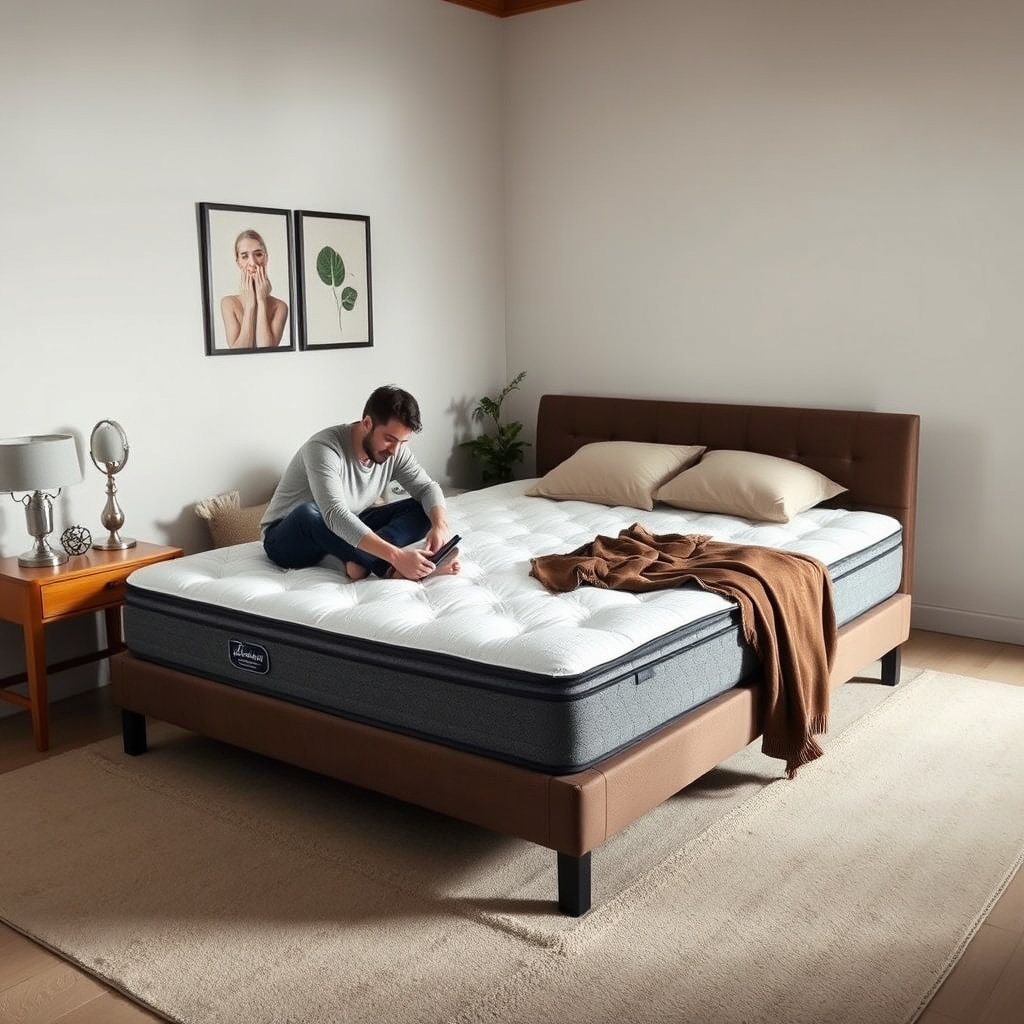
Most sagging cotton mattresses for couples are either “support failing” (the bed drops between weak points) or “comfort layer failing” (cotton compresses and won’t rebound evenly). Your first job is to figure out which type you have, because the fix is different for each.
“Center-only” sag often indicates the mattress is spanning weak support points (like wide slat gaps or missing center support) rather than a uniform comfort-layer collapse.
A cotton mattress that feels like it’s “bottoming out” under body weight is typically compressing past its intended comfort loft, which is different from a surface indentation.
If adding temporary rigid support where the dip occurs noticeably improves the cotton mattress feel, the foundation (frame/slats/box spring) is the primary cause.
– Check where the dip happens: center-only sag often points to weak support; edge sag can be a base/frame issue.
– Look for a “bottoming out” feel versus a surface indentation—cotton can compress differently than coils or foam.
– Test support by pressing a hand flat along the sag area (gently) and note whether the firmness changes with the frame/slats versus on the mattress alone.
What the “feel” usually tells you (comfort vs structure)
When you lie on a cotton mattress and the pressure releases only partially when you shift, that points to comfort-layer compression (broken-down cotton or uneven loft). When the pressure pattern stays dramatic no matter how you move—especially with one person’s weight consistently “making a valley”—that usually points to structural support problems below the mattress surface.
In couples situations, this diagnostic step matters even more: the side you usually sleep on can create a repeat load pattern, so a foundation weakness can “lock in” the same impression pattern over time. From my experience helping homeowners troubleshoot sag, the quickest wins usually come from foundation checks first, not from adding softness.
A quick measurement you can do in under 5 minutes
Grab a tape measure and check whether the lowest area is centered or distributed:
– Center dip: measure depth at the center point and compare to near the shoulder/foot zones.
– Edge dip: measure depth at the perimeter vs the middle.
– Full-length dip: often indicates the foundation lacks consistent support across the entire span.
Even if you don’t have exact brand specs for your cotton mattress, mapping where the sag occurs makes the next steps far more efficient.
Improve the foundation first (most sag is support-related)
The best first move is almost always to fix the foundation, because cotton-filled comfort layers need consistent, under-mattress support to stay level. If the base is flexing or has gaps, the cotton mattress will compress unevenly—often showing up first where couples sit and sleep most.
Slatted foundations with wide spacing can let a cotton mattress span unsupported gaps, increasing the risk of sagging impressions over time.
A center support beam or rigid board can reduce mattress “bowing,” which helps stop the comfort layer of a cotton mattress from taking repeated, uneven loads.
When a box spring is damaged or out of alignment, even a newer cotton mattress can sag because the support system below is failing.
– If you have a slatted base, ensure slats are close enough together and not warped or missing; add reinforcement if needed.
– Consider adding a rigid board or center support to stop the mattress from dropping between weak points.
– If you’re using a box spring, confirm it’s compatible and in good condition—older or damaged bases often cause sag even when the mattress is newer.
Slats: look for spacing, warping, and “frame flex”
For cotton mattresses, slat issues tend to show up as:
– Visible gaps between slats or missing slats
– Warped/slanted slats that don’t sit flush across their full length
– Squeaking or flex when you press on the bed frame
If you find slats that bow upward or downward, replace or reinforce them before changing anything about the cotton mattress. A cotton mattress can’t “out-spring” a foundation that’s not supporting it.
Center support: when couples need it most
If the dip forms mainly in the middle (where two bodies share the same general load zone), a center support rail or properly sized center board is often the turning point. For couples, this matters because the center area is commonly loaded by both partners during typical sleep and position changes.
Practical approach:
– If your frame allows it, install center support consistent with the frame’s load design.
– Use the manufacturer’s guidance if your frame came with a specific center support method.
– Avoid improvised supports that create point-loading (a small area bearing too much weight), because that can transfer stress back into the cotton mattress comfort layer.
Box spring compatibility checks
Many sagging reports come from a “mismatch” between:
– the box spring’s support height and stability,
– the frame design, and
– the cotton mattress’s comfort-layer thickness/structure.
If the cotton mattress is sitting on something that shifts, dips, or loses rigidity, the sagging you see is likely support-related, even if the comfort layer seems the culprit at first glance.
Support Options for Sagging Cotton Mattresses (Couples): Practical Sag-Risk Score
| # | Foundation/Correction Step | Primary Fix Type | Common Where-Used | Sag-Reduction Potential |
|---|---|---|---|---|
| 1 | Solid base (no slat gaps) | Structural support | Center valleys | ★★★★★ |
| 2 | Tighten/replace slats | Gap reduction | All-over dip | ★★★★☆ |
| 3 | Add center support rail | Load balancing | Couples “valley” | ★★★★☆ |
| 4 | Repair/replace warped slats | Stability restore | Side sag + bounce | ★★★☆☆ |
| 5 | Replace failing box spring | Support integrity | Edge & center drift | ★★★☆☆ |
| 6 | Add rigid board under mattress | Bridge weak points | Deep center dip | ★★☆☆☆ |
| 7 | Thick plush topper over weak base | Masks without fixing | Only mild surface indent | ★☆☆☆☆ |
Rotate and re-seat the mattress correctly for couples
Rotating and re-seating can slow uneven wear quickly, especially when your cotton mattress has started to form partner-specific pressure points. The goal isn’t to “undo” breakdown overnight—it’s to redistribute the load so the cotton comfort layer loses loft more evenly.
If a cotton mattress is flippable, flipping spreads wear across both sides; if it’s not, rotating head-to-foot is the safer alternative.
Couples typically create repeated pressure zones, so a rotation plan that changes each partner’s typical contact area can reduce recurring valleys.
When sag is deep, keeping the cotton mattress supported during movement helps avoid additional stress on already-compressed cotton regions.
– Rotate head-to-foot (and flip if your model is flippable) to spread wear across both sides.
– For couples, align the mattress so each person’s usual pressure area alternates after rotation.
– Keep the mattress supported during rotation (especially if the sag is deep) to avoid extra strain on compressed cotton areas.
A practical rotation plan for two sleepers
In couples use, rotation works best when it changes who hits the same area:
– During rotation, swap sides so Partner A’s usual shoulder/hip zone lands where Partner B previously slept (and vice versa).
– After rotation, watch for whether the “new” valley starts forming quickly in one specific zone—this can indicate ongoing foundation weakness, not just wear.
How often should you rotate?
Many manufacturers recommend periodic rotation/adjustment, but you should follow your cotton mattress care guidance first. If you don’t have your manual, start with a conservative schedule (for example, every few months) and adjust based on whether impressions stabilize or accelerate.
Add support layers (without turning it into a “hard bed”)
A supportive topper can reduce the daily feel of sagging on a cotton mattress, but it won’t fix a failing foundation. Choose layers that improve pressure distribution and stability—without adding so much plush that both partners “sink” harder into weak spots.
A topper can help when the main issue is comfort-layer compression, but it cannot compensate for a foundation that flexes or has large support gaps.
A snug, non-bunching pad matters because shifting layers can concentrate pressure and create new unevenness on a cotton mattress.
If you can feel the support system through the comfort layer (“bottoming out”), adding softness alone typically delays rather than solves the underlying problem.
– Use a topper/mattress pad designed to add cushioning and support—aim for even pressure relief rather than extra softness.
– Choose an option that won’t bunch up when both partners shift positions; smooth, snug fit matters more than thickness alone.
– If the sag is mild, a supportive topper may be enough; if the sag is structural (you feel the mattress frame/inner layers), topper alone may only mask it temporarily.
Supportive vs plush-only: what changes for couples
In couples beds, plush-only solutions can worsen “partner seating” because both sleepers compress the softer material unevenly—especially if the cotton comfort layer is already losing loft.
| Topper choice | Pros | Cons |
|---|---|---|
| Support-first (even pressure relief) | Stabilizes feel | Less dramatic “sink,” but still not a fix for flexing bases |
| Plush-only (adds softness) | May mask mild surface impressions | Can accelerate partner seating over a weak foundation |
How I’d choose a layer if I were narrowing options
I generally start by verifying foundation rigidity first (slats/center support), then use a topper only as the second lever. If the cotton mattress still feels like it’s bottoming out after the base is stabilized, a topper is mostly cosmetic—and couples often notice that quickly.
Re-stuff, redistribute, or replace: when repairs won’t hold
If the cotton fill has broken down, you may get temporary improvement—but structural sag usually returns. This is the stage where you decide between targeted comfort-layer restoration and replacement.
Redistributing degraded cotton can temporarily even out loft, but it typically won’t restore the original rebound if the fill has already compacted.
Deep “bottoming out” on a cotton mattress usually signals that comfort loft is gone or internal structures are failing, not merely a surface unevenness.
Professional servicing can be more reliable than DIY re-stuffing when a cotton mattress requires rebalancing internal chambers or sewn baffles.
– If cotton fill has broken down (persistent valley that returns quickly), redistribution may help short-term, but it may not restore long-term loft.
– For deeper sag, consider replacing the comfort layer or having the mattress serviced—DIY re-stuffing can be tricky and uneven.
– If the mattress is already “bottoming out” or the support system is failing repeatedly, replacement is often more cost-effective than repeated patching.
What “returns quickly” usually means in practice
If you reinforce the foundation and rotate correctly, but the same valley returns within a short period, you’re likely dealing with:
– lost cotton loft (fill can’t rebound),
– uneven internal distribution (baffles shifted/settled), or
– a comfort-layer that’s already too compressed to support couples’ pressure points.
Because couples share the same “middle zone,” uneven re-fill can be especially noticeable: one partner may feel the valley more in one position than the other.
DIY re-stuffing limits (especially for couples)
DIY can become a “repeat cycle” if:
– the cotton is unevenly redistributed,
– loft ends up higher in one region,
– the rebalanced feel creates a new pressure point.
That’s why, if the cotton mattress is showing significant structural collapse, many people are better served by professional restoration or replacement rather than trying to patch the comfort layer multiple times.
What can go wrong (common mistakes and limits)
The most common failure is treating a foundation problem like a comfort problem. If you fix the cotton mattress feel without fixing the support system, partner seating typically returns—often faster than you expect.
A thick topper cannot correct a foundation that flexes; it can only shift where softness feels weakest, which can worsen couples’ sink over time.
Rotating without stabilizing the foundation can spread the sag pattern rather than fix the root cause in a cotton mattress.
Improper DIY boards can create point-loading, which transfers pressure into the cotton comfort layer and can accelerate uneven wear.
– Adding only a thick topper: too much plush over weak support can worsen partner seating and accelerate breakdown.
– Ignoring the foundation: fixing the mattress without addressing slats, center support, or a failing box spring often leads to the same sag returning.
– Rotating incorrectly: if your mattress isn’t flippable, flipping it can break down layers faster or misalign construction.
– Over-tightening or unsupported DIY boards: an overly tight or poorly placed board can create new pressure points or bow the mattress.
Edge case: when the sag is actually “uneven loading”
If one partner consistently sits near the edge (reading on their side, watching TV, etc.), you can see edge impressions even when the center looks relatively fine. In that case, rotating and improving support still help, but you should also adjust habits that keep high load on the same perimeter zone.
Verdict / tip: what to try first (and when to skip)
Start with the cheapest, most reliable step: evaluate and reinforce the foundation, then rotate/re-seat to even out wear. Add a supportive topper if the sag is mild, but don’t expect a topper to fix a weak frame or broken-down structure. Skip DIY re-stuffing and mattress surgery if you’re not confident in keeping the fill even—uneven loft can create lumps and new comfort issues.
If the mattress is clearly bottoming out or sag returns within weeks despite improved support, it’s usually time to budget for replacement or professional service.
Quick checklist (scan/save)
– [ ] Identify where the sag happens (center vs edges vs full length)
– [ ] Inspect slats/box spring/foundation for warping, gaps, or failure
– [ ] Add center support or reinforcement if the middle dips
– [ ] Rotate head-to-foot (flip only if your mattress is designed to flip)
– [ ] Add a supportive topper/pad that fits snugly and stays flat
– [ ] If it bottoms out or sags returns fast, consider professional service or replacement
Frequently Asked Questions
What causes a sagging cotton mattress for couples?
A sagging cotton mattress for couples usually happens when the cotton batting compresses and loses its loft over time, often from regular body weight and uneven sleeping positions. Springs, if your mattress has them, can also wear out or weaken, leading to dips where both partners tend to sleep. Moisture, temperature changes, and heavy use on one side can speed up the breakdown and create a persistent body impression.
How can I temporarily fix a sagging cotton mattress for two people?
Place a firm, supportive foundation under the mattress—such as a new slat system with proper spacing or a plywood board—so the cotton mattress isn’t bowing through the support. You can also rotate the mattress head-to-foot (and flip it if it’s flippable) every few months to reduce uneven compression. For a quick improvement, consider adding a high-density mattress topper designed for sagging, but avoid overly soft foam that can worsen impressions.
How do I safely repair a sagging cotton mattress without replacing it?
Start by checking the foundation and mattress frame for broken slats or weak support, since fixing the base often improves sagging in a hurry. If the mattress has a removable cover, inspect cotton layers for clumping or shifting and consider re-distributing or adding replacement batting to restore loft. For deeper wear, a professional mattress shop can assess internal support and re-batting options so your couples mattress feels evenly supportive again.
What’s the best way to prevent future sagging in a cotton mattress for couples?
Use a breathable, supportive bed base and keep the mattress off the floor to reduce moisture-related deterioration of cotton materials. Rotate the mattress regularly and encourage both partners to avoid consistently sleeping in the same weighted area by using side-swapping or position changes. If you feel the mattress is losing support, replace the topper sooner rather than waiting until the cotton padding fully compresses.
Which foundation or topper works best to correct sagging in a cotton mattress for couples?
For sagging correction, choose a firm support solution like a properly spaced slatted base or rigid plywood cut to fit the bed frame, which helps reduce the dip caused by cotton compression. A supportive mattress topper—such as latex or high-density memory foam—can help distribute weight, but it should be thick enough to improve pressure points without sinking too much. If your couples mattress sags severely, prioritize strengthening the foundation first, then add a topper for comfort over the restored support.
📅 Last Updated: October 29, 2026 | Topic: How to Fix a Sagging Cotton Mattress for Couples | Content verified for accuracy and freshness.
References
- Mattress
- Box-spring
- Mattress pad
- Bed frame
- https://www.britannica.com/topic/mattress
- https://pubmed.ncbi.nlm.nih.gov/?term=mattress+firmness+low+back+pain
- https://pubmed.ncbi.nlm.nih.gov/?term=mattress+support+sagging
- https://scholar.google.com/scholar?q=mattress+sagging+repair+support Google Scholar
- https://scholar.google.com/scholar?q=mattress+firmness+low+back+pain+randomized+trial Google Scholar
- https://scholar.google.com/scholar?q=bed+frame+slats+mattress+support+spinal+alignment Google Scholar