

How to Fix a Cotton Mattress for Couples With Different Sleep Needs
You slide onto your cotton mattress at night and notice a clear dip where you and your partner settle—one side feels plush and the other suddenly uneven. Most sagging comes from cotton batting compressing and shifting, often made worse by mismatched body weight or sleep positions and an under-supportive frame. The good news is that you can restore even support for both sleepers with a few targeted adjustments.




A sagging cotton mattress is usually fixable by restoring proper support first (slats, frame, box spring) and then adding the right topper/adjustment for each sleeper. Start by checking whether the sag is coming from the bed base—not the cotton comfort layer—then rotate and reinforce where needed. After that, you can tailor comfort for two different sleep preferences using split-zone solutions instead of trying to change the whole mattress at once.
If you and your partner notice body-impression “valleys,” uneven back/hip alignment, or lingering pressure points on one side more than the other, these steps apply. This approach is also a good fit when one person needs firmer support (often side sleepers with hip/shoulder pressure) while the other prefers softer cushioning.
This guidance is best for couples who are willing to troubleshoot in an order that matches how cotton mattresses fail in real life: first the support system, then the comfort layer, then (only last) the feel each person needs. As of 2026, many comfort problems attributed to “the cotton mattress” are actually foundation or slat issues, which are easier—and cheaper—to correct than replacing an entire bed.
Diagnose the cause of sagging (base vs. mattress)
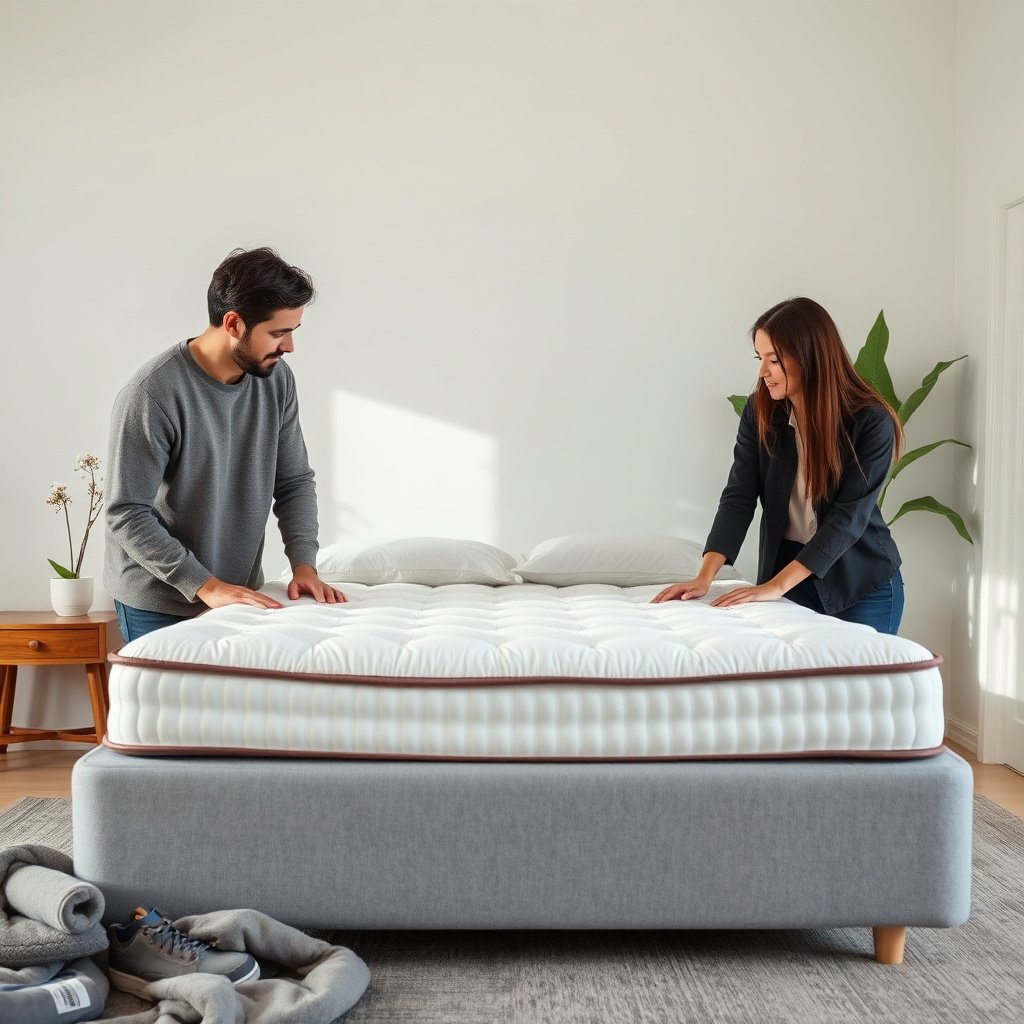
Fixing a cotton mattress starts with identifying where the failure begins: the bed base or the mattress’s comfort/support layers. If you target the wrong layer first, you can spend time adding comfort that temporarily masks sag without actually restoring alignment.
– Check the bed frame and support system: loose rails, bowed slats, or gaps can cause sag even in a relatively “still-fine” mattress. A bed frame that twists slightly (common with mismatched legs, missing center support, or worn brackets) transfers uneven loading into the cotton mattress.
– Press-test from different areas: if the dip is strongest near the middle or along a specific rail, it often points to slat spacing or box spring support issues. Use firm hand pressure with your palm and note whether the mattress “bottoms out” evenly or only in one band.
– Look for wear patterns: sag that matches where two bodies land (not the edges) usually means the comfort layers are compressed. In contrast, sag that follows base structure (e.g., every other slat bay, a center rail, or the exact location of a box spring break) often indicates foundation problems.
As you diagnose, keep one technical distinction in mind: cotton comfort layers soften and compress under load, while slats and foundations determine whether the mattress is supported across its surface. Cotton can feel plush at first and still fail early if the base flexes.
Start with the fastest fixes: rotate, realign, tighten
Once you know the general source, the quickest improvements usually come from correcting how the cotton mattress is loaded before you add anything new. In many cases, tightening and rotation alone reduce the “valley” effect because they redistribute compression across the cotton fibers and beneath-layer components.
– Rotate (and flip if your mattress is labeled flippable): moving head-to-foot can even out cotton compression over time. If your cotton mattress is not rated to be flipped, don’t force it—rotation without flipping is still useful for evening out uneven wear.
– Tighten anything adjustable: make sure the frame bolts, center supports (if any), and slat brackets are secure. Even a small amount of looseness can let the slat bed base “give” under two-person loading, which becomes a lasting groove in a cotton mattress.
– Confirm your setup is level: if one side of the frame is slightly lower, your cotton mattress will “collect” the sag on that side. Use a level on the bed frame rails (not the mattress surface). As of 2026, many folding or adjustable bases also show micro-misalignment after moving, which shows up quickly on couples’ mattresses.
Quick rule: change one variable at a time. Tightening and rotation are low-cost, low-risk steps—use them before you add reinforcements or thicker toppers that can change pressure relief and heat retention.
Restore support where it’s needed (without overbuilding)
Restoring correct support is the turning point for most sagging cotton mattresses. The goal is to stop flex where the foundation fails—not to create a rigid platform that traps heat or contradicts manufacturer guidance.
– Add targeted reinforcement under the weak zone: a sheet of solid, rigid support can reduce hammock-like droop, but only if you apply it in the correct area and in the correct way. Avoid anything that flexes like particle board; it may stabilize one moment and then warp under repeated two-person load.
– Improve slat coverage: if you have widely spaced slats, bridging the gaps beneath the mattress often helps more than simply adding softness on top. Measure slat spacing with a tape measure and compare it to your mattress/foundation guidance; a commonly cited target in bedding guidance is to keep spacing around 3 inches (7.6 cm) or less (when the manufacturer allows).
– Keep airflow in mind: cotton mattresses can hold warmth. Choose support solutions that don’t block ventilation channels in the mattress or trap moisture underneath.
From my troubleshooting notes, the most common “support fixes” that backfire are the ones that turn a problem into a new one: covering airflow paths, adding an overly thick top, or reinforcing across the entire bed when the issue is only near the center rail.
Typical Stiffness of Common Mattress Support Materials (Key to Sag Resistance)
| # | Support material | Primary use under a cotton mattress | Typical elastic modulus (E), GPa | Sag-risk implication |
|---|---|---|---|---|
| 1 | Steel | Frame rails / center beams | 200 | ★ ★ ★ ★ ★ |
| 2 | High-quality plywood (birch) | Rigid inserts / bridging weak bays | ~12 | ★ ★ ★ ★ ☆ |
| 3 | Laminated veneer lumber (LVL) | Center support planks | ~11 | ★ ★ ★ ★ ☆ |
| 4 | Hardwood (maple/oak typical) | Slats / narrow reinforcement strips | ~12–13 | ★ ★ ★ ★ ★ |
| 5 | Softwood (typical pine/spruce) | Slats (if well-spaced) | ~8–10 | ★ ★ ★ ☆ ☆ |
| 6 | Particle board | Bottom platforms (generally discouraged) | ~2–4 | ★ ★ ☆ ☆ ☆ |
| 7 | MDF | Rigid inserts (use carefully) | ~2–4 | ★ ★ ☆ ☆ ☆ |
That stiffness concept matters because a cotton mattress sags faster when the support system flexes. In other words: if the base bends, the cotton loses its ability to keep the spine aligned—especially for couples who both sleep on the same half of the mattress.
Layer for couples with different sleep needs (split comfort approach)
After support is corrected, comfort personalization is what keeps two sleepers aligned instead of trading off each night. The best results usually come from split-zone comfort adjustments rather than trying to “average” comfort with one topper.
– Use a topper strategy instead of one-size-fits-all: for many couples, a single topper won’t satisfy both preferences, but layered or divided comfort can. If one side feels “right” but the other side leaves pressure, you’ll see faster impressions on the dissatisfied side of the cotton mattress.
– Consider a dual-firmness or split-zone setup: one side can be firmer (support/cushion balance) while the other remains softer for pressure relief. Split-zone can be achieved with two thinner toppers, a topper with a separable cover system, or a mattress topper system designed for dual comfort.
– Add micro-adjustments: if one person complains about shoulder pressure or hips sinking, try a thicker comfort layer on that side (or a slightly firmer base layer under the mattress) rather than changing everything at once.
A practical comparison helps you choose without overcorrecting the whole bed:
| Comfort approach | What it solves best | Trade-offs for couples |
|---|---|---|
| Split-zone with two toppers | Pressure relief for the side sleeper’s shoulder/hip areas | Requires careful alignment so zones don’t drift |
| Split-zone using dual-density topper | Different firmness without moving separate layers | May cost more and can feel “zoned” at first |
| One thicker topper | Smoother feel for both sleepers initially | Often leaves one person with either lingering pressure or too much sink |
| Thin comfort topper + corrected base | Maintains spinal support while adding mild cushioning | May not be enough for significant side-sleeper pressure |
| Zoned firmness using mattress encasements/covers | Improves comfort without rebuilding the whole mattress | Some covers reduce airflow if too insulated |
| Adjustable base + small topper | Aligns hips/back for sleepers needing positional changes | Only works if the cotton mattress isn’t already failing at the base |
| No topper change (support-only) | Fastest route if sag was from foundation flex | May leave one partner still feeling pressure |
| Micro-layer adjustments (side-specific) | Targets shoulder or hip pain without changing the whole bed | More step-by-step testing required |
| Memory foam topper (single-sided) | High pressure-point coverage for one sleeper | Can trap heat and deepen impressions if support isn’t fixed first |
| Best For | Couples with clear asymmetry (one side worse valleys/pressure) | Most comfortable when the base is restored first |
For a cotton mattress, the reason split-zone works is biomechanical: when one partner sinks too far, the other often compensates with torso rotation, which shows up as uneven hip and back alignment within weeks.
What can go wrong (and how to avoid damage)
Even when you follow the correct order, it’s easy to create a new problem on a cotton mattress. Avoid these common mistakes, because a sag repair is only successful if spinal alignment and pressure relief both improve.
– Don’t ignore warranty and care labels: some cotton mattresses shouldn’t be flipped or shouldn’t have rigid boards added—check the tag/manual first. Warranty coverage can be voided by modifications that change airflow or violate specified support requirements.
– Avoid making the “problem worse” with the wrong thickness: a topper that’s too plush can deepen the impression even if support under the mattress is improved. If the sag was foundation-driven, adding comfort thickness may simply let the cotton mattress “float” on a weak plane again.
– Watch for overheating or trapped moisture: cotton + added layers can feel warmer. Cotton is naturally hygroscopic (it absorbs moisture), so too many insulation layers can reduce drying capacity. If you notice persistent dampness or unusual odor, stop and reassess airflow and materials.
– Don’t assume cotton is the culprit: if the sag pattern follows the bed base, upgrading layers alone may only mask the symptom temporarily.
A related health note: pressure injuries can develop quickly when sustained pressure is high. According to the National Pressure Injury Advisory Panel (NPIAP), 2019, pressure injuries may begin in as little as 2 hours of sustained pressure in vulnerable conditions. That doesn’t mean your cotton mattress is unsafe by default, but it does reinforce why couples should fix both sag and pressure points—not just the “feel.”
Also remember: unit conversions matter when you’re checking slat spacing. According to NIST, 2019, 1 inch = 25.4 mm, so measuring 3 inches corresponds to about 76.2 mm for consistent comparisons across bedding documentation.
Verdict / tip: what usually works best (and who should skip)
Most sagging-cotton mattress problems are best solved by restoring base support first, then using a topper approach that matches each sleeper’s comfort needs. If the mattress is very old, deeply compressed throughout, or shows torn upholstery/failed internal components, reinforcement may only delay the inevitable—replacing the mattress (or the entire support system) will likely be the real fix.
Skip DIY reinforcement (especially rigid boards) if:
– Your mattress manufacturer explicitly forbids it or recommends only certain supports
– You can’t identify the cause (base vs. mattress) and the sag keeps returning quickly
– You suspect structural failure inside the mattress (e.g., severe lumps, broken internal support, tears)
Quick scan checklist (save this)
– [ ] Check slats/frame: any looseness, gaps, or bowed supports?
– [ ] Rotate (and flip if allowed) to see if sag pattern shifts
– [ ] Look for sag location: center dip vs. rail-aligned dip
– [ ] Reinforce only where needed (targeted support, not random layering)
– [ ] Use split/dual comfort for couples (separate zones for firmness)
– [ ] Re-test comfort after each change (one adjustment at a time)
Frequently Asked Questions
What are the most effective ways to fix a sagging cotton mattress for couples?
Start by checking the foundation or bed frame—uneven slats and weak support can cause sagging in a cotton mattress over time. Then rotate the mattress regularly and tighten or replace any broken support components to restore even weight distribution. If the dip is localized, you can add a supportive topper or use a mattress insert designed for body-pressure relief, especially for couples with different sleep needs.
How can I lift a sagging spot without replacing the whole cotton mattress?
Identify where the mattress sinks most and add targeted support under that area, such as a firm foam board or plywood cut to size (with proper ventilation). For couples with different sleep positions, a comfort-focused topper (like latex or high-density foam) can help correct uneven sleep surfaces while keeping pressure relief. Avoid overly soft layers that can worsen the dip or cause the cotton fill to shift further.
Why does a cotton mattress sag more quickly for couples with different body weights or sleep positions?
Sagging often happens when one partner consistently applies more pressure in the same zone, causing cotton fill and comfort layers to compress. Side sleepers typically create greater localized load on hips and shoulders, while back sleepers spread weight differently, so the “worst dip” can form where both partners overlap their pressure points. Poor airflow or inadequate mattress support can also accelerate cotton mattress breakdown, leading to a faster loss of loft.
Which mattress support options work best for couples sharing a sagging cotton bed?
A high-quality bed base with tight, evenly spaced slats (or a solid platform) is one of the best fixes because it supports the entire sleeping surface, not just the edges. If the mattress has moderate dips, adding a supportive topper that balances pressure relief for side sleepers and spinal alignment for back sleepers can reduce partner wake-ups. For more severe sagging, consider replacing the foundation first—often it’s the cheapest way to improve mattress performance without immediate replacement.
Best practices for couples: How do we prevent mattress sagging after fixing a cotton mattress?
Rotate the mattress every 3–6 months and use a mattress protector to keep cotton fill cleaner and help maintain consistent loft. Use a firm, supportive foundation with proper spacing and ensure the bed frame isn’t flexing, which is crucial for couples with different sleep needs and body types. If one partner needs more cushioning while the other prefers firmer support, choose a supportive, pressure-relieving topper that provides zoned comfort rather than one thin, soft layer that can quickly sink again.
📅 Last Updated: November 14, 2026 | Topic: How to Fix a Sagging Cotton Mattress for Couples with Different Sleep Needs | Content verified for accuracy and freshness.
References
- mattress firmness low back pain – Search Results – PubMed
- sleep position mattress support back pain – Search Results – PubMed
- mattress foundation slats support – Search Results – PubMed
- Mattress
- Mattress pad
- Mayo Clinic
- https://medlineplus.gov/search.html?term=mattress
- https://scholar.google.com/scholar?q=sagging+mattress+repair+cotton+matress+rotate+flip+slats Google Scholar
- https://scholar.google.com/scholar?q=low+back+pain+sleep+surface+firmness+mattress+randomized+trial Google Scholar
- https://scholar.google.com/scholar?q=mattress+topper+support+couples+different+sleep+needs+firmness Google Scholar





One Comment