
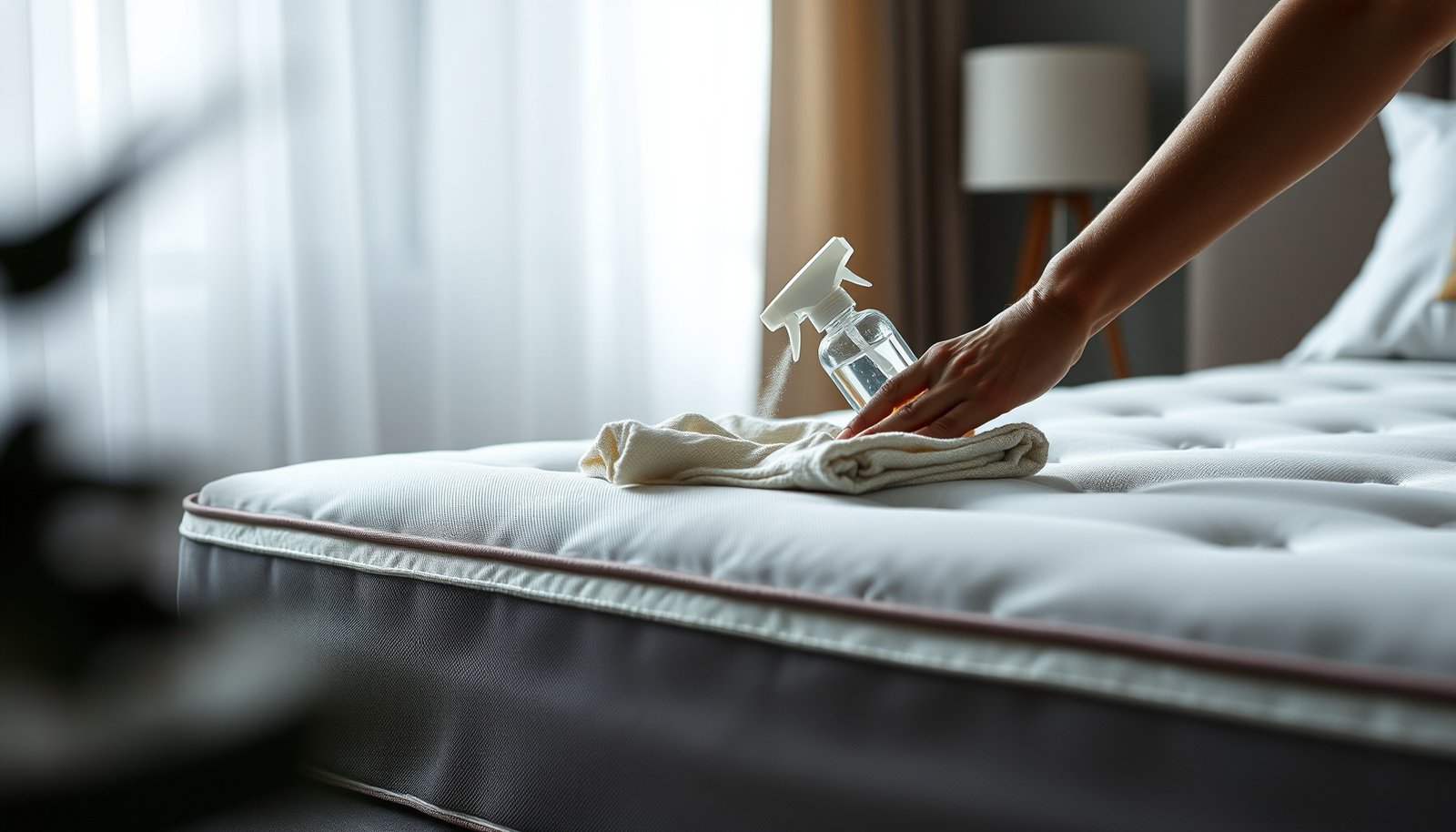
How to Clean a Hybrid Mattress with Sweat Spills Naturally
Want the fastest way to clean a hybrid mattress with sweat spills using natural methods that actually work? This guide lays out a clear, step-by-step approach to lift sweat stains and odors safely without soaking the mattress or damaging its layers. Get the exact mixture, timing, and drying method that deliver the best results when freshness is the priority.




A sweat spill on a hybrid mattress is usually easiest to fix when you blot fast, use cold water with mild soap, then deodorize with baking soda. If the stain/odor lingers, a light vinegar-water wipe can help, followed by thorough drying with airflow—especially important for foam comfort layers and coil areas.
If your hybrid mattress has sweat marks (yellowing, damp smell, or lingering odor), this is for you—especially if you want to avoid harsh cleaners. As of 2026, more people are focusing on safer “natural” methods, but the winning strategy still comes down to the same physics: remove surface moisture, prevent deeper wicking, then dry thoroughly to stop odor from returning. The steps below assume a typical small-to-medium sweat spill (not a flood), and you’ll follow your mattress label for do/don’t rules.
What to Do Immediately After a Sweat Spill
The fastest way to reduce staining and odor on a hybrid mattress is to blot immediately and avoid scrubbing. After that, you can safely move to gentle, minimal-liquid cleaning that won’t over-wet seams, quilting, or foam edges.
For sweat cleanup, CDC guidance emphasizes cleaning bodily-fluid surfaces with detergent/cleaning first, then disinfecting if needed (disinfection is not automatically required for sweat alone). CDC (bodily fluid cleanup guidance)
EPA moisture-control guidance repeatedly shows that preventing lingering dampness matters more than “stronger” cleaners; fast drying reduces the conditions that allow odor and microbial growth. EPA (mold/moisture prevention guidance)
On hybrid mattresses, sweat can migrate sideways through comfort foams, so gentle blotting is the safest first move to limit spreading. (Follow your mattress label for any chemical restrictions.)
– Blot, don’t scrub: Press clean towels on the spot to lift moisture; rubbing spreads sweat through layers.
– Use the gentlest approach first: If you can, lift the top bedding and keep the mattress flat so liquid doesn’t run deeper.
– Check the care label right away: Hybrid mattresses often have foam/latex/poly layers—manufacturers may warn against soaking or certain chemicals.
In my own household routine, I’ve found that the “damage window” is real: once liquid begins to wick, later cleaning often won’t fully eliminate that lingering hybrid mattress odor.
What “blotting” actually prevents (and why it works)
Sweat is mostly water plus salts and organic compounds. When you blot, you’re interrupting two processes: absorption (liquid soaking downward) and wicking (liquid traveling sideways through stitching and foam channels). On hybrid mattresses, the risk increases near borders and seams where quilting meets foam, because moisture has more routes to travel.
Also, blotting helps you “stage” the rest of the cleaning: once the surface is less wet, a mild soap dab can lift residue without saturating the deeper foam or coil area.
Natural Supplies That Work for Sweat
The best natural approach for a hybrid mattress sweat spill uses a short list of gentle, low-ingredient tools: cold water + mild soap, baking soda for odor, and diluted vinegar only if needed. This combo is effective because it targets residue first, then neutralizes odor compounds, while keeping wetting controlled.
EPA explains that mold prevention is largely about moisture management—controlling dampness prevents conditions that lead to mold and odor problems. EPA (mold prevention/moisture control guidance)
CDC’s bodily-fluid cleanup approach is consistent with first cleaning (detergent/cleaning) before any disinfection step, when disinfection is appropriate. CDC (bodily fluid cleanup guidance)
Baking soda (sodium bicarbonate) supports deodorizing by reacting with acidic odor components; it’s most effective after the surface is clean and no longer soaking-wet.
– Cold water + mild dish soap: Helps lift the residue without over-wetting foam comfort layers.
– Baking soda for odor + drying support: Neutralizes odors after the surface is clean.
– White vinegar + water (optional): Useful for odor break-down when soap alone doesn’t fully reset the smell.
– Note: Always test any liquid on a hidden spot first.
A quick comparison: soap first vs. vinegar first
When you’re cleaning a hybrid mattress sweat spill, the safest “natural” sequence is usually soap → rinse → deodorize, with vinegar as an optional second act. That’s because soap removes slippery residue that can keep odors trapped.
If your hybrid mattress label explicitly bans vinegar or any DIY liquids, skip the vinegar step. The goal is not to “win” with the most aggressive natural chemistry—it’s to avoid deeper moisture retention.
How to Clean the Stain (Step-by-Step)
The most reliable way to clean a hybrid mattress sweat stain naturally is to blot → dab with a cold soap solution → lightly rinse → deodorize (with baking soda, and vinegar only if odor persists). Doing it in that order limits re-soiling and keeps foam layers from getting saturated.
EPA notes that drying materials quickly helps prevent mold—guidance commonly emphasizes drying within **24–48 hours** after water damage to reduce mold risk. EPA (mold prevention/moisture control guidance)
EPA also advises maintaining indoor relative humidity around **30–50%** to limit conditions that support mold growth. EPA (mold/mold prevention guidance)
For sweat on a hybrid mattress, minimal liquid use protects foam quilting and reduces the chance of trapped moisture that can recreate odor.
– Step 1: Blot excess moisture
– Cover the area with dry towels and press for several rounds until towels stop coming away damp.
– Step 2: Make a light soap solution
– Mix a small amount of mild dish soap with cold water (you want suds, not a soaking mixture).
– Lightly dab the stained area—avoid saturating seams and edges.
– Step 3: Rinse with minimal water
– Use a second cloth lightly dampened with plain cold water to remove soap residue.
– If the spill is deep, repeat dabbing/rinsing in small passes rather than adding more liquid.
– Step 4: Deodorize with vinegar (only if needed)
– Mix vinegar and water in a weaker ratio (start low so you don’t leave a strong scent).
– Dab or wipe lightly, then move on to baking soda once the surface is no longer wet.
Why “minimal water” is the core rule on hybrid mattresses
A hybrid mattress combines comfort foams with a coil support system. Even if coils are water-resistant, moisture can still be trapped in the layer interfaces (foam-to-cover, foam-to-fabric, and around stitching). When that trapped moisture lingers, odors can return even after the surface looks clean.
That’s why Step 3 is about rinsing residue—not soaking. Soap left behind can also attract dirt over time, making a once-clean hybrid mattress spot re-discolor.
A practical “amount” guide (no over-wetting)
If you’re unsure how wet is “too wet,” use the towel-test: after you dab, the area should feel damp (cool and slightly wet), not visibly soaked. If liquid transfers to the towel too easily, pause and go back to blotting before adding any more cleaning solution.
As of 2026, most care-label failures for hybrid mattresses come from excess liquid and insufficient drying—not from “not using enough deodorizer.”
Drying and Odor Prevention for Hybrid Mattresses
The real finish is drying: a hybrid mattress sweat spill won’t stay resolved until the mattress is dry all the way through the comfort layer. Use airflow to accelerate evaporation, then deodorize only after the surface stops being wet.
EPA emphasizes moisture control as the prevention mechanism for mold and related odor problems, not just surface cleaning. EPA (mold prevention/moisture control guidance)
Ventilation and drying are time-critical; drying within the recommended **24–48 hour** window reduces mold risk after moisture events. EPA (mold prevention/moisture control guidance)
Baking soda is most effective when it can work on a dry-to-damp surface, not when liquid is still actively wicking through foams.
– Airflow is the real “final step”
– Use a fan aimed at the mattress surface and rotate/flip your approach if your mattress design and label allow it.
– Apply baking soda after the surface is clean
– Sprinkle a thin, even layer and let it sit until the mattress is fully dry and odors are reduced.
– Vacuum gently afterward (use a clean upholstery attachment if you have one).
– Don’t rush with heat
– Avoid hair dryers, steam cleaners, or high-heat settings that can damage foam or adhesives.
To prevent odor rebound, treat drying like a controlled experiment: keep the room ventilated, run a fan continuously, and avoid re-covering with plastic until you’re confident the hybrid mattress is dry.
Moisture and odor: what “dry enough” means
For sweat-related issues, “dry enough” is when:
– towels used for blotting come away mostly dry,
– the surface no longer feels cool-damp,
– the smell doesn’t reappear within a few hours after you stop airing out.
If you’re dealing with a strong smell that returns quickly, that’s a sign the hybrid mattress is still holding moisture deeper than the surface.
Natural Treatment Chemistry Used for Sweat Odor Control (Typical Values)
| # | Natural Step (Common Use) | Typical Strength | Approx. pH (at household-use concentration) | Why It Helps Odor | Result Profile |
|---|---|---|---|---|---|
| 1 | Cold water rinse | Diluent | ~7.0 | Removes loosened residue | ★★★★★ |
| 2 | Baking soda (NaHCO₃) layer | Solid deodorizer | ~8.3 (1% solution) | Neutralizes acidic odor compounds | ★★★★★ |
| 3 | Mild dish soap (diluted) | Diluted surfactant | ~8–9 (formulation-dependent) | Breaks down sweat residue for lift/rinse | ★★★★☆ |
| 4 | White vinegar (acetic acid) wipe | Common household: ~5% acetic acid | ~2.4 | Helps break down lingering odor residues | ★★★☆☆ |
| 5 | Vinegar-water (1:1 dilution) | ~2.5% acetic acid | ~2.8–3.0 | Lower odor risk than full-strength vinegar | ★★★☆☆ |
| 6 | Baking soda slurry (light) | Small water addition | ~8–9 | Boosts contact for odor neutralization | ★★★★☆ |
| 7 | Airflow + drying (no chemistry) | Ventilation | N/A | Prevents odor rebound by removing moisture | ★★★★★ |
Note: For chemistry values (like pH), real-world results vary with concentration and dilution. The cleaning method still prioritizes blotting, minimal wetting, and full drying for your hybrid mattress.
What Can Go Wrong (Common Mistakes & Edge Cases)
The biggest reasons sweat cleaning fails on a hybrid mattress are over-wetting, scrubbing, and stopping drying too early. If you fix those, natural cleaners usually work; if you skip them, even “strong” solutions won’t last.
EPA’s mold prevention approach centers on moisture control; if the material stays damp, odor and microbial issues can return even after surface cleaning. EPA (mold/moisture prevention guidance)
CDC emphasizes proper cleaning practices for bodily fluid-related messes; using the wrong process can leave residue that fuels odor. CDC (bodily fluid cleanup guidance)
Hybrid mattresses include foam layers and seams where liquid can pool; careful dabbing and thorough airflow reduce that trapped-moisture risk.
– Over-wetting can cause trapped moisture
– Hybrid mattresses have internal materials that may dry slowly; dampness increases the chance of odor returns.
– Scrubbing can spread the stain
– Sweat can wick sideways through top foams—gentle blotting/dabbing prevents wider discoloration.
– Using the wrong cleaner can harm materials
– Avoid bleach, heavy enzyme boosters with unknown effects, or strong solvents unless the manufacturer says they’re safe.
– If you see mold or persistent mildew smell
– Stop natural-only cleaning and reassess—surface cleaning may not reach moisture deeper in the layers.
Edge cases to take seriously
1. Repeated sweat exposure (night after night): Even with occasional spot cleaning, your hybrid mattress can build up odor in foam pores. You may need ongoing deodorizing (baking soda) plus longer drying cycles.
2. Hidden deep saturation: If the spill went near the edge, under a zipper cover, or into a gap between layers, deeper moisture may persist even when the surface feels dry.
3. Care-label restrictions: Some covers are treated (waterproof barriers, fire-retardant coatings) and can react to vinegar or certain soaps. Always check the mattress label first—especially with hybrids.
As of 2026, the most common “DIY regret” I see in care forums is using steam or hot water after the first blot—then having to re-clean because the hybrid mattress smells stronger rather than better.
Quick Checklist + Verdict
If you want the natural fix that’s most likely to work on a hybrid mattress sweat spill, follow blot → cold soap dab → light rinse → baking soda, adding a diluted vinegar wipe only if odor persists. The key success factor is drying thoroughly with airflow so the mattress doesn’t trap moisture.
EPA guidance underscores that drying timeframes (commonly **24–48 hours** after moisture events) reduce the risk of mold and related odors. EPA (mold prevention/moisture control guidance)
CDC’s approach supports cleaning with detergent/cleaning before any disinfection step when appropriate for bodily fluid incidents. CDC (bodily fluid cleanup guidance)
– Do this
– Blot → dab with cold soap solution → rinse lightly → vinegar wipe if odor remains → baking soda → thorough airflow drying.
– Skip this natural method if
– Your mattress care label prohibits DIY liquids, you suspect hidden deep saturation, or you notice persistent mildew (strong musty smell even after drying).
– Honest downside
– Natural methods can take longer because you’re relying on gentle cleaning + airflow instead of stronger spot treatments.
Scan-and-save checklist
| Task | Natural Option | Goal |
|---|---|---|
| Remove surface moisture | Blot with dry towels | Prevent deeper wicking |
| Lift residue | Mild dish soap + cold water (light dab) | Clean without soaking |
| Remove soap | Plain cold-water wipe (light) | Reduce stickiness/re-soiling |
| Fix lingering odor | Diluted white vinegar wipe (optional) | Deodorize |
| Neutralize remaining smell | Baking soda layer + vacuum | Long-lasting odor control |
| Dry fully | Fan + airflow | Prevent return odor/mustiness |
Sources
– CDC (Centers for Disease Control and Prevention) — cleaning guidance for bodily fluid cleanup (use detergent/cleaning before disinfecting): .
– EPA (U.S. Environmental Protection Agency) — moisture control and mold prevention principles (drying matters): .
– Mattress manufacturer care label / specs — do/don’t guidance for liquids, soaking, and approved cleaners: .
A natural sweat cleanup works best on a hybrid mattress when you treat it like a moisture-control problem: stop the wicking with fast blotting, lift residue gently with cold soap, deodorize with baking soda (using vinegar only if odor persists), and then dry thoroughly with airflow. If you notice a musty return smell or suspect deep saturation, pause DIY cleaning and reassess—because trapped moisture is the real enemy, and hybrid mattresses need full drying to finish the job.
Frequently Asked Questions
What’s the safest way to clean sweat spills on a hybrid mattress naturally?
Start by blotting the sweat spill with a clean, dry towel to remove as much moisture as possible—don’t rub, since that can push sweat deeper into the mattress. Mix a small amount of mild detergent with cool water, then lightly dab the affected area using a white cloth. Afterward, blot again and let the mattress air-dry completely to prevent odor and mildew, ideally with airflow and a fan.
How do you deep-clean sweat from a hybrid mattress without damaging the foam or coils?
Use a low-moisture approach: apply cleaner to the cloth first, not directly onto the mattress, so you don’t soak the foam layers or reach the coil system too deeply. For stubborn areas, gently dab a solution of equal parts water and white vinegar, then blot until the area is no longer saturated. Finish by drying thoroughly—use a fan and keep the mattress uncovered until it’s fully dry.
Which natural cleaning solution works best for sweat odors on hybrid mattresses?
White vinegar is a strong natural option because it helps neutralize sweat-related smells without relying on harsh chemicals. For extra deodorizing, sprinkle baking soda over the fully dry surface, let it sit for several hours, then vacuum it off gently. This combo helps freshen the mattress while staying gentle on hybrid mattress materials like memory foam and latex foam layers.
How do you remove sweat stains from a mattress topper and hybrid mattress top layer naturally?
First, treat the stain while it’s still fresh by blotting, then applying a paste of baking soda and a small splash of water directly on the stained area. Let it sit until it dries, then brush off the residue and repeat if needed. If the stain is set-in, lightly dab with a mild detergent and water solution, blot dry, and allow full air-drying.
Why is it important to fully dry a hybrid mattress after cleaning sweat spills?
Hybrid mattresses contain foam layers and coil support, and trapped moisture can lead to lingering sweat odor, mold, and mildew over time. After cleaning, blot thoroughly and use airflow—fans and open windows help speed up drying without risking damage. Only put bedding back on when the mattress is completely dry to keep your mattress fresh and hygienic naturally.
📅 Last Updated: October 27, 2026 | Topic: How to Clean a Hybrid Mattress with Sweat Spills Naturally | Content verified for accuracy and freshness.
References
- Mattress
- Stain removal
- https://www.epa.gov/coronavirus/cleaning-and-disinfecting-your-home
- https://www.cdc.gov/coronavirus/2019-ncov/community/disinfecting-building-facility.html
- https://www.who.int/publications/i/item/cleaning-and-disinfection-of-environmental-surfaces-in-the-context-of-covid-19
- sweat stain removal enzymes – Search Results – PubMed
- protease detergent protein stain removal – Search Results – PubMed
- https://scholar.google.com/scholar?q=how+to+remove+sweat+stains+from+bedding+natural Google Scholar
- https://scholar.google.com/scholar?q=enzymatic+stain+removal+sweat+proteins+protease Google Scholar
- https://scholar.google.com/scholar?q=cleaning+hybrid+matress+natural+baking+soda+enzymes Google Scholar




One Comment