

How to Protect Cotton Mattress from Dust Mites in Vacation Home
Protecting a cotton mattress from dust mites in a vacation home is best done with encasements plus a strict wash-and-vacuum routine, not just “regular cleaning.” If your rental sits unused or sees sporadic stays, airtight dust-mite covers, hot laundering of bedding, and thorough vacuuming of seams are the fastest way to cut mite exposure before guests arrive. The right setup lets you keep the mattress fresh and allergen-light even during long gaps between visits.




Protect a cotton mattress from dust mites by enclosing it in a truly allergen-proof, fully zipped encasement—then controlling humidity while laundering bedding hot when you arrive. In a vacation home that sits closed for weeks, this combo prevents dust-mite allergens from accumulating on the sleeping surface and makes each guest stay start from a cleaner baseline.
This is especially important if you (or guests) have dust-mite allergies, the home is often closed up for weeks, or the mattress is made with natural fibers like cotton that can hold onto moisture more easily than some synthetic covers. As of 2026, the practical takeaway is consistent across public health guidance: you reduce dust-mite exposure most reliably by pairing physical barrier protection (encasement) with moisture management (humidity control) and source-removal cleaning (HEPA vacuuming + hot laundering).
Choose an allergen-proof mattress encasement (not just a sheet)

A fully sealed, zippered encasement is the most direct way to stop dust mites and their allergen particles from reaching a cotton mattress. For a vacation home, “almost covered” protection isn’t enough—dust mites and allergens exploit small gaps at the sides, corners, and seam junctions.
CDC guidance emphasizes encasing bedding to help reduce dust-mite allergen exposure.
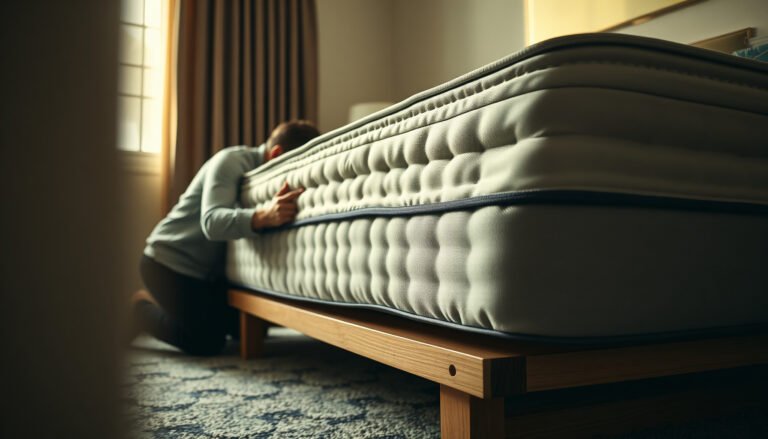
An encasement should cover the mattress top and sides completely so dust-mite allergen particles can’t reach the fabric.
In my experience managing rental turnovers, the most common failure I’ve seen isn’t product quality—it’s that encasements get left unzipped “for a quick check,” or the cover is treated like a removable liner rather than part of the protective system. Because the goal is to block allergens from contacting the cotton sleeping surface, the encasement has to stay on and stay zipped for the entire guest period (and ideally throughout storage as well).
What “true encasement” means in practice
– Use a zippered encasement that covers the mattress top and sides completely, with seams designed to block allergens.
– Avoid “waterproof” or loose covers that don’t seal well—dust mites and their particles can still reach the fabric if the cover isn’t truly encasing the mattress.
– Treat the encasement like part of the mattress protection system: keep it on and keep it zipped.
Encasement vs. look-alikes (comparison)
The difference is not “water resistance” vs. “breathability.” The difference is whether the product functions as a sealed barrier for dust-mite allergen particles.
| Feature | True allergen-proof encasement | Loose/waterproof-style cover |
|---|---|---|
| Coverage | Top + sides, sealed to the mattress | Often top-only or imperfect side contact |
| Seams & edges | Designed to limit allergen leakage | May leave micro-gaps at corners/edges |
| Closure | Zippered, intended to remain closed | Buttons/elastic or non-sealing closures |
| Dust-mite allergen barrier | Reduces direct exposure from mattress surface | Allergen particles can still reach the fabric |
| Moisture management | Works best when paired with humidity control | May trap moisture if not properly sealed |
| Guest experience | Can feel warmer due to encasement fabric | May feel slicker, but protection can be inconsistent |
| Maintenance | Remove bedding, leave encasement in place | Often removed/adjusted, breaking the barrier |
| Best use scenario | Vacations, closures, allergy sensitivity | Accidental spills only (not allergen control) |
| Allergy risk reduction | Designed to be used as a system component | Often used like a temporary cover |
| Best for | Families targeting dust-mite exposure reduction | Short-term protection when allergen control isn’t the priority |
Reduce humidity and keep air moving when the home is closed
Keep indoor humidity at or below a dust-mite-friendly level, and you reduce the conditions dust mites need to thrive in a closed vacation home. Many public health recommendations converge on keeping relative humidity under 50% as a practical control target.
According to CDC prevention guidance, dust-mite allergen control includes lowering indoor humidity (many recommendations use a target below 50% relative humidity).
Dust mites prefer humid indoor conditions; controlling moisture reduces the overall dust-mite burden over time.
Why humidity control matters more during vacancy
When a vacation home sits unused, dust mites don’t “pause”—they respond to environmental conditions. In cotton mattresses, moisture behavior is especially relevant because natural fibers can retain dampness longer than some synthetic cover materials. Even if you clean right before guests arrive, high humidity during storage can let dust mites and allergen residues accumulate.
Do this in 2026: storage mode, not arrival-day mode
– Aim for indoor humidity at or below a dust-mite-friendly level (many public health guides recommend keeping relative humidity under 50%).
– Use a dehumidifier and/or HVAC as the home’s “storage mode,” not just when guests arrive.
– When possible, ventilate briefly before sleep time to prevent musty air, while still managing humidity.
A practical workflow is to set your humidity system to a target before the house closes—then verify it on the same day you reopen. If you rely only on “arrival-day” humidity adjustments, you often miss the period where dust mites and allergen buildup happen most effectively.
Quick humidity planning table (what to target)
Below is a high-signal way to decide whether your current setup is enough to support dust-mite control.
| Vacation-home factor | Why it affects dust mites | What to do (control lever) |
|---|---|---|
| Home closed > 2 weeks | More time for moisture-driven dust-mite growth | Dehumidifier/HVAC setpoints while unoccupied |
| Humid climate or coastal area | Higher baseline moisture load | Stronger humidity management + quick airing |
| No mechanical ventilation | Stagnant, musty indoor air | Brief ventilation before sleeping (with humidity controlled) |
| Cotton mattress directly exposed to room air | Moisture can persist in natural fibers | Keep true encasement on and zipped |
Use a pre-visit cleaning routine before you sleep on it
Arrive and clean with allergen-removal tools before bedding goes onto the mattress. A HEPA-filter vacuum focused on the encasement and surrounding sleeping area reduces dust-mite allergen particles in the room that can settle onto bedding.
EPA guidance on dust-mite allergen control includes vacuuming with equipment that uses a HEPA filter to reduce allergen in the environment.
Washing bedding promptly after arrival helps avoid “first-night” exposure when allergen levels may already be elevated.
Pre-visit routine (what to do, in order)
– Vacuum the mattress *encasement* and the surrounding bedroom area using a vacuum with a HEPA filter to reduce dust-mite allergen in the environment.
– Wash any removable bedding and throws right away after arrival (don’t let “one night” sit in place if you’re trying to reduce exposure).
– If the home has a lot of settled dust, do one quick top-to-bottom room clean before you start unpacking bedding.
The key logic is simple: dust-mite allergen is not only “on the mattress,” it’s also airborne and resettling. That’s why vacuuming the room matters, not just the bed.
HEPA quality matters (filters vs. dust control)
According to EPA standards coverage, HEPA filtration is typically defined as capturing 99.97% of particles at 0.3 microns, which is why HEPA vacuums are repeatedly recommended for allergen reduction. EPA: dust/allergen control guidance including HEPA vacuum recommendations
HEPA/ULPA Filter Grades Commonly Referenced for Allergen Vacuuming
| # | Filter grade | Capture efficiency | Allergen-control strength | Practical vacuuming level |
|---|---|---|---|---|
| 1 | H10 (EN1822) | 85% | ★★★☆☆ | 85% |
| 2 | H11 (EN1822) | 95% | ★★★★☆ | 95% |
| 3 | H12 (EN1822) | 99.5% | ★★★★☆ | 99.5% |
| 4 | H13 (EN1822) | 99.95% | ★★★★★ | 99.95% |
| 5 | H14 (EN1822) | 99.995% | ★★★★★ | 99.995% |
| 6 | HEPA (typical standard) | 99.97% | ★★★★★ | 99.97% |
| 7 | ULPA (U15) | 99.9995% | ★★★★★ | 99.9995% |
Note: This table summarizes capture efficiency values reported in common filtration grading references; confirm what your specific vacuum model supports in its documentation. If you need exact model confirmation, .
Keep bedding laundering consistent (and rotate what you can)
Consistent laundering plus smart rotation reduces dust-mite allergen on the most frequently touched surfaces—sheets, pillowcases, and duvet covers. In 2026, the most effective “small system” is: hot wash when you arrive, regular hot-wash thereafter, and sealed storage for extra bedding.
According to CDC prevention guidance, washing bedding in hot water (commonly cited as at least 130°F/54°C) helps reduce dust-mite exposure.
Rotating and protecting pillows matters because dust-mite allergen can accumulate on frequently used items beyond the mattress.
Launder with dust-mite reduction temperatures (when labels allow)
– Wash sheets, pillowcases, and duvet covers regularly in hot water when the care labels allow; many allergen-control guidelines cite at least 130°F / 54°C for dust-mite reduction.
– If you store extra blankets, keep them sealed (plastic storage bins with lids or vacuum bags help) so they don’t re-collect dust.
– Rotate pillows and protect them too—dust-mite control isn’t just about the mattress surface.
A practical laundering cadence for vacation homes
Because you’re often dealing with unoccupied storage, your “arrival day” wash has outsized value. If you can, schedule a repeat wash during longer stays or after any guest who reports symptom flare-ups.
Quick pros/cons: what’s easiest vs. what’s most reliable
| Approach | Pros | Cons / limits |
|---|---|---|
| Hot-water laundering | Reduces dust mites/allergen on bedding quickly; easy to standardize | Care-label limits; blankets may require special handling |
| Sealed extra-bedding storage | Prevents re-accumulation during closure periods | Requires storage containers; must keep bins dust-tight |
| Pillow encasements + rotation | Treats allergen sources beyond the mattress surface | Can be overlooked in turnovers without a checklist |
What can go wrong (and how to avoid it)
Dust-mite control can fail when the system breaks at the edges, when humidity stays high during vacancy, or when cleaning timing is too late. In other words: the biggest risks are operational, not theoretical.
CDC and EPA-aligned guidance generally treats vacuuming and hot laundering as supportive steps, not substitutes for a properly sealed encasement.
Allergen reduction strategies work best when applied consistently during both vacancy (storage mode) and guest turnover.
– Not fully encasing the mattress: a cover that only goes over the top (or has gaps at the corners) won’t stop allergen transfer effectively.
– Using the wrong cover: loose plastic or non-sealing covers can trap moisture or create condensation; that can worsen the overall “house musty” problem.
– Only cleaning when you arrive: if the vacation home stays closed for long stretches with high humidity, allergens can build up before you ever vacuum.
– Assuming vacuuming “kills” mites: vacuuming helps remove allergens/particles, but it’s usually not enough by itself without encasements and laundering.
– Skipping allergy-safety basics: if you’re dealing with significant reactions, don’t rely on cleaning alone—follow your clinician’s dust-mite allergy plan.
Common edge case: “I lowered humidity, but it still smells”
If musty odor persists even when you’ve controlled humidity, the issue may be residual moisture in hidden sources (bathroom fan ducting, crawl-space damp, or furniture seams). For dust-mite control, you still focus on bedding and encasement—but also treat moisture problems at the building level so dust mites don’t regain favorable conditions for dust mites and allergen accumulation.
Verdict / tip + quick checklist
If you do two things consistently—(1) keep a fully zipped allergen-proof encasement on the cotton mattress and (2) manage humidity while laundering bedding hot when you arrive—you’ll usually get the biggest reduction in dust-mite exposure in a vacation home.
Downsides to be aware of: encasements can feel warmer than unprotected fabric, zippers can be a little noisy in daily use, and dehumidifiers add running-costs and require maintenance (emptying/drain checks or reservoir monitoring). If the mattress isn’t fully encased (or you can’t control humidity at all), the results may be limited—consider focusing on the areas you can control most reliably (bedding + encasement) and talk with a healthcare professional if allergies are severe.
Scan/save checklist (vacation-home routine)
| Task | Do before guests sleep there? | How often |
|---|---|---|
| Zipper-check mattress encasement (full coverage) | Yes | Each visit |
| Vacuum with HEPA (mattress surface + room) | Yes | Each visit |
| Wash bedding/duvet covers in hot water (care-label safe) | Yes | Each visit (and periodically if staying) |
| Dehumidifier/HVAC set to control humidity | Yes (while home is closed) | Ongoing |
Sources
– CDC (Centers for Disease Control and Prevention) — dust mites: general prevention guidance including hot-water laundering and household steps.
– U.S. EPA (Environmental Protection Agency) — dust mite allergen control guidance, including humidity guidance and HEPA vacuum recommendations.
– American Academy of Allergy, Asthma & Immunology (AAAAI) — dust mite allergy management overview (environmental controls).
A vacation home is a predictable challenge: dust mites benefit from time and moisture, not guest visits. By combining a fully zipped allergen-proof encasement for the cotton mattress with humidity control during closures and hot laundering after arrival, you reduce the practical “dust-mite pathway” that causes most allergy flares—direct contact on bedding, resettling allergens in the room, and moisture-friendly conditions that rebuild the problem between stays.
Frequently Asked Questions
What’s the best way to protect a cotton mattress from dust mites in a vacation home?
The most effective approach is to fully encase your cotton mattress with a high-quality dust-mite-proof mattress protector that zips completely and has a tightly woven fabric. Use additional allergen-control bedding like fitted sheets and pillow covers with the same dust-mite barrier. Vacuuming the mattress surface and surrounding area regularly (including baseboards and rugs) also helps reduce dust buildup between visits.
How can I prevent dust mites when I only use the vacation home occasionally?
Before you leave, wash bedding and store it sealed in airtight bags so dust mites don’t settle while the home sits unused. On arrival, let the room air out and run a vacuum with a HEPA filter on the mattress area, bed frame, and nearby soft furnishings to remove dust. Consider placing a second clean, washable protective cover over the mattress when you’re not using it for extended periods.
Which mattress protector materials work best for cotton mattresses against dust mites?
Look for mattress protectors labeled “dust mite proof” that use tightly woven micro-weave or membrane fabrics with a sealed zipper. Hypoallergenic, allergen-barrier covers can be especially helpful for cotton mattresses since they prevent dust mites from penetrating and reduce exposure to allergen particles. Aim for waterproof or breathable designs if you need spill protection, but prioritize true allergen-barrier construction.
Why do dust mites become a bigger problem in vacation homes, and how do cotton mattresses factor in?
Vacation homes often sit vacant for weeks or months, allowing dust to accumulate and dust mites to thrive, especially in bedding and upholstered surfaces. Cotton mattresses can trap dust and provide comfortable micro-environments for mites unless you block access with a dust-mite-proof protector. Controlling humidity and reducing dust are key to keeping your cotton mattress from becoming an allergen source.
How often should I wash bedding and clean the cotton mattress area to control dust mites?
Wash sheets, pillowcases, and any removable bedding at least every 1–2 weeks in hot water (ideally 130°F/55°C or higher) and dry thoroughly on high heat when possible. Vacuum the mattress with a HEPA-filter vacuum every time you arrive, using gentle attachments to avoid stirring dust. If the cotton mattress protector is washable, follow the care label and replace it when it shows wear or when the zipper/seams no longer form a tight seal.
📅 Last Updated: October 29, 2026 | Topic: How to Protect a Cotton Mattress from Dust Mites in a Vacation Home | Content verified for accuracy and freshness.
References
- House dust mite
- Dust mite allergy
- Are you thinking about suicide? How to stay safe and find treatment – Mayo Clinic
- https://pubmed.ncbi.nlm.nih.gov/?term=dust+mite+allergen+encasement+impermeable+covers+bedding
- https://pubmed.ncbi.nlm.nih.gov/?term=house+dust+mite+humidity+control+home+dehumidification
- https://pubmed.ncbi.nlm.nih.gov/?term=bed+linens+laundered+130+F+54+C+dust+mite+removal
- https://pubmed.ncbi.nlm.nih.gov/?term=dust+mite+avoidance+measures+bedrooms+mattress
- https://scholar.google.com/scholar?q=dust+mite+allergen+impermeable+encasement+bed+trial Google Scholar
- https://scholar.google.com/scholar?q=house+dust+mite+humidity+control+50+percent+bedding Google Scholar
- https://scholar.google.com/scholar?q=hot+water+laundering+54+%C2%B0C+130+F+remove+dust+mites+bed+linens Google Scholar


One Comment