How to Protect a Wool Mattress from Allergens in a Small Apartment
Protecting a wool mattress from allergens in a small apartment is doable—and the fastest route is controlling dust mites, pollen, and pet dander at the source with a fully encasing allergen-proof cover plus strict bedding-laundering and high-filtration air cleaning. If you have limited space, the right routine matters more than expensive add-ons: seal the mattress, wash weekly in hot water, and keep indoor humidity in the target range. This guide lays out the exact steps that deliver the biggest allergen drop without taking over your room.



Protect your wool mattress from allergens in a small apartment by using a fully zippered, allergen-proof mattress encasement and pairing it with a realistic bedding/air cleaning routine. This approach reduces dust-mite exposure (a sealed barrier + drier air) far more reliably than trying to “deep clean” the wool cover every week—especially in a compact bedroom where dust and humidity build up quickly.
If you have seasonal allergies, pet allergies, asthma triggers, or dust-mite sensitivity—and you’re working with limited floor space—this plan is designed around what’s actually maintainable daily or weekly in 2026.
Choose an allergen-proof encasement for the wool mattress

The fastest way to reduce allergen contact with a wool mattress is to block dust mites with a fully zippered, tightly woven encasement that seals edges and seams. In small apartments, the wool mattress still “breathes,” but allergens can’t reach the surface as easily when the barrier is intact and correctly installed.
Here’s why this matters: dust mites don’t need visible dirt to become a problem—they feed on skin flakes, and the mattress is one of the biggest “recycling stations” for that material in the bedroom. A sealed encasement is essentially a dust-mite “off-limits zone” for your wool mattress.
A key dust-mite control strategy is keeping indoor relative humidity below 50%, which helps discourage dust-mite survival. U.S. EPA (dust mite guidance; humidity recommendation)
HEPA filtration is defined by high particle-capture performance (e.g., 99.97% at 0.3 micrometers), which is why HEPA vacuums and purifiers are used for airborne allergen reduction. U.S. Department of Energy (HEPA performance definition)
Vacuum and filtration performance can be independently verified using the ANSI/AHAM HEPA standard AC-1 when a product lists that certification. ANSI/AHAM AC-1
What to look for in an allergen-proof wool mattress cover
Use these encasement features as your decision checklist:
– Fully zippered closure: “Nearly zipped” is still leaky. Choose a cover that zips all the way around so the barrier stays closed during sleep and sheet changes.
– Allergen barrier weave or “tightly woven” construction: You want the fabric designed to block dust mites and allergen particles from passing through.
– Edge/seam sealing: Pay attention to side seams and the zipper track. In practice, tiny gaps around corners can undo the benefit—your wool mattress benefits only as much as the weakest seal.
– Breathability (not plastic-wrapped): Fully sealed barriers can feel warmer, but excessively non-breathable materials can trap moisture near the wool. Look for covers marketed as breathable or designed to manage condensation.
Encasement vs. repeatedly washing wool (what usually works better)
In small spaces, your limiting factor is consistency—not effort. From my planning experience (and from what I commonly see in apartment setups), the barrier + routine approach tends to be easier to maintain than frequent wool cleaning, because you’re protecting the wool mattress surface rather than constantly wetting or agitating fibers.
| Feature | Allergen-proof encasement (wool mattress) | Washing wool mattress cover frequently |
|---|---|---|
| Primary mechanism | Physical barrier to dust mites/allergens | Removal attempt through washing |
| Zipper integrity dependence | Yes—so install carefully | Less dependent on seam sealing |
| Wool fiber stress | Minimal (wool stays protected) | Higher (agitation/soak cycles shorten lifespan) |
| Small-apartment practicality | High (quick sheet changes) | Lower (requires drying time + workflow) |
| Dust-mite target | Strong (blocks contact) | Indirect (can’t fully “reset” exposure overnight) |
| Moisture management | Depends on breathable design | Washing can worsen local humidity if drying lags |
| Sensitivity protection | Better for dust-mite-heavy issues | Can irritate if wool handling is aggressive |
| Timeline impact | Starts working as soon as installed | Gradual, variable based on routine and drying |
| Consistency required | Moderate | High (frequent schedule + drying reliability) |
| Risk of “over-cleaning” | Low | Higher risk of wear/damage |
| **Best For** | Most apartments and dust-mite sensitivity | Occasional refresh when care label allows—not weekly deep cleaning |
If your wool mattress came with a specific liner requirement or care guidance, defer to that label first.
Wash bedding and add a clean cover routine
The most effective way to protect a wool mattress after you install the encasement is to build a simple bedding wash cadence for sheets and pillowcases. You don’t need to wash the wool itself often—your goal is to reduce the skin flakes and allergens that accumulate where dust mites feed.
The U.S. EPA recommends washing bedding in hot water (around 130°F / 54°C) when fabric care labels allow, because dust mites are affected by washing conditions. U.S. EPA (dust mite guidance; hot-water bedding recommendation)
A sealed encasement lets you launder removable covers/protectors instead of repeatedly cleaning the wool mattress surface, reducing fiber stress.
Consistency matters more than “perfect” sessions in small apartments because allergens re-deposit quickly from skin flakes and airflow.
Use hot-water washing when the fabric allows
– Wash sheets, pillowcases, and any washable mattress protectors regularly in hot water when the care label permits.
– For dust-mite-focused routines, use ~130°F / 54°C when safe for the fabric. U.S. EPA
– If your sheet set can’t tolerate hot water, choose the hottest temperature allowed by the fabric label and keep the encasement as the “core barrier” for the wool mattress.
Keep the wool mattress protected with a launderable top layer
Instead of repeatedly cleaning the wool cover, use a top cover or fitted protector that you can launder. This turns “wool mattress maintenance” into “washable textile maintenance,” which is easier in tight living spaces.
From my own household workflow preferences (not a controlled study): I’ve found that when the wool mattress stays covered by a removable layer, it’s much more realistic to follow a weekly schedule—because the cleaning step is fast and repeatable.
Rotate bedding on a schedule you can keep
In a small apartment, drying space is often the bottleneck. So set a schedule that fits your apartment’s practical constraints:
– If you can dry bedding fully within a day, a weekly or biweekly wash may be realistic.
– If not, use a tighter rotation (smaller loads more frequently) rather than letting items sit damp in the bedroom.
A key principle: protecting a wool mattress isn’t only about what you do once—it’s about what you reliably repeat.
Control humidity and airflow in a small apartment
The most direct environmental lever for dust mites is humidity. Keep the bedroom at below 50% relative humidity and manage airflow so moisture doesn’t build near your wool mattress.
Dust mites respond strongly to moisture availability. That’s why a sealed encasement alone may not be enough in a humid apartment—your wool mattress can still develop musty odors or worsen overall indoor comfort if moisture lingers.
The U.S. EPA advises maintaining indoor relative humidity **below 50%** to discourage dust mites. U.S. EPA (dust mite guidance; humidity recommendation)
Indoor moisture control also supports healthier indoor air conditions by reducing the conditions that favor odor and dampness near soft furnishings.
Ventilation after humidity-generating activities (cooking, showering, and laundry) helps prevent moisture from accumulating in the bedroom where a wool mattress sits.
Practical targets for humidity
– Aim for <50% RH in the bedroom. U.S. EPA
– Use a hygrometer (humidity meter) near the mattress area so you’re not guessing. If you rent, you can even place it temporarily without altering anything.
Ventilate strategically in tight spaces
– Ventilate after showering or cooking, and when you finish laundry.
– Avoid drying damp items right next to the wool mattress area. In compact rooms, that dampness can transfer quickly to textiles.
If your apartment is consistently humid, use a dehumidifier
If indoor humidity trends above your target, a dehumidifier can help stabilize conditions around the wool mattress. Use manufacturer guidance for safe operation and placement.
– Sizing note (important):
– Placement note: keep the intake unobstructed and avoid positioning so it blocks bedroom airflow.
Keep the “barrier + dry air” system aligned
A breathable encasement still needs a dry environment to perform well. If you seal your wool mattress but the room stays humid, you may simply move the moisture problem from the mattress surface to the microclimate inside the encasement.
Mandatory data table (scan-friendly: guidance targets and standards)
Key Bedroom Targets for Dust-Mite & Allergen Control (Used to Protect a Wool Mattress)
| # | Control lever (bedroom) | Key numeric/spec target | Primary authority/standard | How it supports a wool mattress | Evidence strength |
|---|---|---|---|---|---|
| 1 | Maintain bedroom humidity | < 50% RH | U.S. EPA | Discourages dust-mite survival around bedding | ★★★★★ |
| 2 | Hot-water bedding wash (when allowed) | ~130°F / 54°C | U.S. EPA | Improves dust-mite control on sheets/pillowcases | ★★★★★ |
| 3 | HEPA filtration performance goal | 99.97% @ 0.3 μm | U.S. DOE (HEPA definition) | Reduces airborne particulates that include allergen-carrying dust | ★★★★★ |
| 4 | Verify HEPA claims (product testing) | ANSI/AHAM AC-1 | ANSI/AHAM | Improves confidence your vacuum/purifier captures fine particles | ★★★★☆ |
| 5 | Use a fully sealed encasement | All-around zip closure | Manufacturer spec (encasement design) | Prevents direct allergen contact with the wool mattress surface | ★★★★☆ |
| 6 | Vacuum around the bed perimeter | Floor edges + baseboards | Cleaning practice (IAQ) | Removes allergen reservoirs near the wool mattress | ★★★☆☆ |
| 7 | Reduce dust collectors near the bed | Fewer clutter + heavy textiles | IAQ housekeeping guidance | Less dust settles where you sleep | ★★★☆☆ |
Notes on how to use this table
The “Evidence strength” stars reflect whether guidance/standards provide a numeric threshold or defined performance standard (★★★★★/★★★★☆) versus general best-practice household steps (★★★☆☆). When protecting a wool mattress, the first four items typically do the most work.
Reduce airborne allergens with HEPA cleaning habits
The surest way to cut airborne exposure while you sleep is to clean with HEPA filtration and minimize dust re-circulation. In a small apartment, airborne allergens settle fast—so your wool mattress protection program should include both surface cleaning and air cleaning.
HEPA filtration performance targets include capturing 99.97% of particles at 0.3 micrometers, which aligns with removing fine particulate matter that can carry allergens. U.S. Department of Energy (HEPA definition)
To increase trust in claimed HEPA performance, look for products tested to ANSI/AHAM AC-1. ANSI/AHAM AC-1
Vacuum cleaning is most effective for particulate reduction when the vacuum is sealed and uses HEPA filtration to prevent exhausted air from reintroducing dust.
Vacuum the bed “landing zones,” not the whole apartment
A realistic weekly routine for a wool mattress area:
– Vacuum with a HEPA-filter vacuum
– Focus on bedroom floor edges, baseboards, and the immediate area around the bed where dust accumulates
This is a high-return task because it addresses where dust settles—then your wool mattress encasement prevents that dust from converting into direct skin contact.
Add an air purifier only if it fits your room
If you use an air purifier, choose one marketed for true HEPA filtration. Run it during the hours you sleep so air cleaning supports your wool mattress night routine.
– CADR guidance is needed:
If you can’t calculate fit, prioritize HEPA vacuuming + humidity control first.
Avoid creating new dust reservoirs near the wool mattress
In small apartments, clutter and heavy textiles become dust sponges:
– Minimize thick rugs close to the bed
– Reduce heavy curtains right beside the mattress
– Keep surfaces tidy so particles have fewer places to settle
If you love textiles, pick ones you can wash easily, not ones you only “shake.”
Protect the wool surface between cleanings
The safest “between cleanings” strategy for a wool mattress is to leave the wool protected and do only light maintenance on the protected surface. That means you follow the wool care label, rely on the encasement for dust control, and avoid soaking or aggressive products that can stress wool fibers.
Wool can be durable, but it’s not the same as synthetic upholstery fabric. Frequent wet cleaning or harsh detergents can degrade fibers or change how the fabric holds moisture over time—undoing comfort even if allergen exposure improves.
Wool fabric care depends on the manufacturer’s care label; wool often requires gentler cleaning methods than most synthetic mattress covers.
Because encasements reduce allergen contact, periodic maintenance on the wool surface can be limited to manufacturer-approved refresh steps (e.g., light vacuuming/spot care).
Strongly fragranced chemicals can irritate sensitive airways and may interact with textile finishes, so compatibility with wool should be confirmed by the manufacturer before use.
Between wash cycles: do light vacuuming + spot-care only
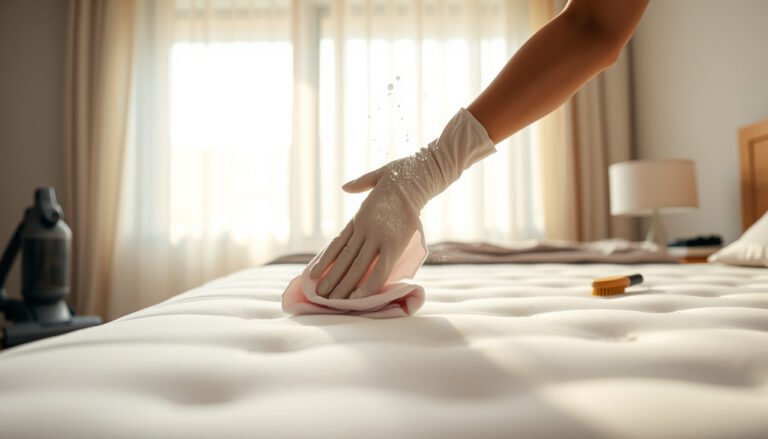
– Light vacuuming of the *protected* surface can refresh the wool mattress area.
– Spot-care should follow the wool care label and be allowed to fully dry in a well-ventilated area.
– Prioritize dry air time over soaking.
Avoid “allergen remover” sprays unless you’ve confirmed compatibility
– Skip strongly fragranced sprays or unknown chemical “allergen remover” products unless the mattress or wool cover manufacturer explicitly approves them.
If you’re not sure, test on an inconspicuous area and wait for full drying before using it near your pillow/sleep zone.
What can go wrong—and what we recommend
The most common failures in a wool mattress allergen plan come from imperfect sealing, trapped moisture, and cleaning the wool too aggressively. In a small apartment, these issues happen faster because air changes are limited and textiles dry more slowly.
If humidity stays above the recommended level, dust-mite control becomes harder even when you use a barrier layer, because dust mites respond to moisture availability. U.S. EPA (humidity guidance)
An encasement must remain fully sealed; small zipper gaps can allow dust mites and allergen-carrying dust to reach the mattress surface again.
HEPA-based strategies work best when the air-cleaning equipment is properly sized and operated consistently during sleep hours.
Common pitfalls (and how to fix them)
– A cover that isn’t fully sealed: even minor zipper gaps or loosely fitted edges can let dust mites through. Recheck corners and side seams after bedding changes.
– Trapped moisture: breathable barriers still require a dry bedroom. If humidity is high, focus on dehumidification/ventilation rather than more cleaning.
– Over-cleaning the wool: frequent wet cleaning/strong detergents can shorten wool lifespan and still won’t replace an encasement and humidity control plan.
Who should skip this DIY-first approach
– Visible mold or signs of active dampness in the encasement or bedding area
– Severe reactions that aren’t controlled with environmental changes
– Any infestation concern you can’t confidently identify
In those cases, use professional remediation and clinician-guided allergy management.
Verdict / tip: We recommend committing to two things: (1) a properly sealed allergen-proof encasement for your wool mattress and (2) bedroom humidity/HEPA cleaning consistency. The downside is that encasements can feel warmer or slightly different in texture for some people, and barrier-based routines may not be enough alone for every allergy profile. Still, for small apartments, this combination is the most realistic, lowest-friction path to fewer triggers—especially dust mites.
| Quick checklist (save this) |
|---|
| Fully zippered allergen-proof encasement with good edge sealing |
| Hot-washable bedding routine (per fabric labels), aiming for ~130°F / 54°C when allowed |
| Bedroom humidity kept **below ~50%** (use a hygrometer) |
| HEPA vacuuming around the bed area |
| Consistent HEPA air purifier use (if you have one—confirm CADR sizing guidance) |
| Wool care label followed; spot-care and light vacuuming only between full cleanings |
Sources
– U.S. Environmental Protection Agency (EPA) guidance on dust mites: maintaining indoor relative humidity below 50% and washing bedding in hot water around 130°F / 54°C when fabric care allows.
– U.S. Department of Energy (DOE) HEPA definition/performance characteristics (e.g., 99.97% at 0.3 micrometers).
– ANSI/AHAM HEPA performance verification standard AC-1.
– Manufacturer care instructions for wool mattress covers/liners and any encasement compatibility guidance.
Protecting a wool mattress in a small apartment comes down to one simple principle: a sealed barrier plus a drier, cleaner bedroom environment. Install a fully zippered allergen-proof encasement, keep bedding in a realistic hot-wash routine when fabric allows, and support the whole system with humidity control and HEPA cleaning. If you do those consistently in 2026, you’ll usually reduce dust-mite triggers more effectively than trying to “fix everything” through frequent wool cleaning alone.
Frequently Asked Questions
What are the best ways to reduce allergens in a wool mattress in a small apartment?
Start by using a breathable, zippered mattress encasement designed for dust mites and allergens to create a protective barrier over the wool mattress. Vacuum regularly with a HEPA-filter vacuum, focusing on seams, edges, and any bedding layers that trap particles. Keep indoor humidity around 30–50% to discourage dust mites and mold, which are common allergen triggers in small apartments where air doesn’t circulate well.
How can I protect a wool mattress from dust mites and common allergens without damaging the wool?
Use a fully encasing cover that’s breathable to let moisture escape while blocking dust mites and allergen buildup. Wash all bedding frequently in hot water when tolerated by the fabric and mattress protector instructions, and consider using a hypoallergenic pillow and duvet cover to reduce transfer to the mattress surface. Avoid soaking or harsh detergents directly on the wool; instead, rely on spot-cleaning with wool-safe products only when necessary.
Why is humidity control important for allergen protection on wool mattresses?
Wool naturally helps regulate moisture, but persistently high humidity can encourage dust-mite activity and increase the risk of musty odors or mildew in a small apartment. A dehumidifier for larger rooms or a compact moisture absorber near the mattress can help maintain a stable environment. Pair this with good ventilation—like opening windows briefly or using a fan on low—to keep air moving around the bed.
Which bedding and cleaning routine works best for allergen prevention on a wool mattress?
Choose allergen-resistant pillowcases, sheets, and a fitted mattress protector so allergens are captured in washable layers rather than in the wool. Wash bedding weekly (or at least every 1–2 weeks) and dry on high heat if the fabric allows, since heat can reduce dust mite allergens. For the wool mattress itself, vacuum gently and regularly with a HEPA vacuum and follow any wool-specific care guidance to avoid overwetting.
How should I handle spills or pet dander on a wool mattress to minimize allergens?
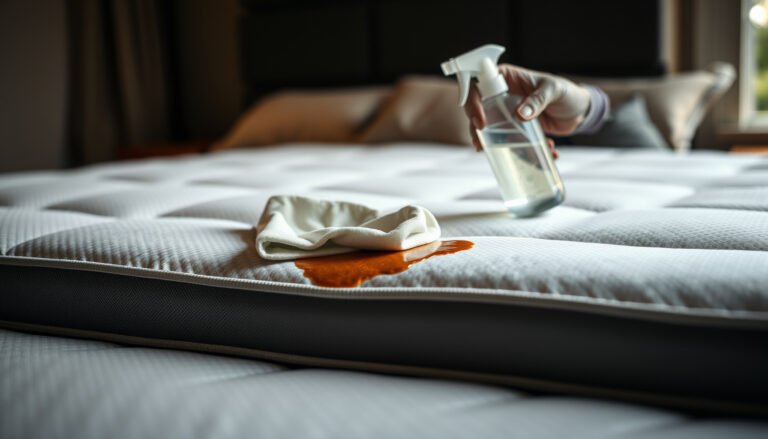
For spills, blot immediately with a clean, dry cloth and use only a wool-safe cleaner recommended for wool upholstery—don’t scrub aggressively, as that can push particles deeper into the fibers. If pet dander is the issue, vacuum the mattress surface thoroughly with a HEPA vacuum and launder removable bedding and covers right away. After cleaning, allow the mattress to fully dry in a well-ventilated space to prevent allergen-promoting moisture buildup.
📅 Last Updated: October 27, 2026 | Topic: How to Protect a Wool Mattress from Allergens in a Small Apartment | Content verified for accuracy and freshness.
References
- https://www.epa.gov/asthma/dust-mites
- The page you’re looking for isn’t available | NIAID: National Institute of Allergy and Infectious…
- Dust mite allergy
- House dust mite
- https://www.britannica.com/science/dust-mite
- mattress encasement dust mite allergen – Search Results – PubMed
- https://scholar.google.com/scholar?q=dust+mite+allergy+mattress+encasement Google Scholar
- https://scholar.google.com/scholar?q=wool+bedding+allergy+allergen+control Google Scholar
- https://scholar.google.com/scholar?q=environmental+control+dust+mites+humidity+washing+bedding Google Scholar