How to Protect a Wool Mattress from Mold in a Small Apartment
Wool mattress mold in a small apartment is preventable—if you control moisture and airflow, you can keep it from ever taking hold. This guide delivers the best, practical steps to protect a wool mattress against mold, including how to dry and ventilate properly in tight spaces. Follow this plan and you’ll reduce the risk of musty odors and visible growth fast, even when your layout leaves limited room for drying.



Mold protection starts with moisture control: keep the room and mattress area dry, and never let wool bedding stay damp. In a small apartment, that usually means improving airflow under/around the mattress and using a protective layer that doesn’t trap moisture. Keep reading for a practical routine to prevent mildew and handle any early signs fast.
This advice is for renters and anyone with limited space—where humidity, condensation, and poor ventilation make it easier for mold to grow on soft, absorbent materials like wool.
Why wool mattresses are vulnerable to mold in small apartments

A wool mattress isn’t “mold-proof”—it’s moisture-tolerant, so it can handle dampness better than many fabrics, but it still supports mold when conditions persist. In a small apartment, the biggest threat is usually trapped humidity near exterior walls, behind furniture, or underneath the bed where airflow is limited.
According to the U.S. EPA, mold growth requires moisture; if materials stay damp, mold can develop even on absorbent building furnishings (U.S. EPA, A Brief Guide to Mold, Moisture, and Your Home).
According to the U.S. EPA, mold can begin to grow within 24–48 hours after water damage, which is why quick drying matters for soft porous materials (U.S. EPA, Mold Remediation in Schools and Commercial Buildings).
Key vulnerability points for wool mattress owners
– Wool is resilient, not immune: Wool can absorb and release some moisture, which can slow down mold compared to less moisture-tolerant textiles. However, persistent dampness gives mold spores what they need to establish on the wool mattress and surrounding layers.
– Small rooms create microclimates: Condensation commonly forms near windows, exterior walls, and corners. If your wool mattress is positioned close to cold surfaces, the side rails, corners, and bedding edges are where dampness often collects first.
– Under-bed airflow is often the real culprit: In tight layouts, a bed can block airflow from reaching the underside of the wool mattress. Moisture then stays trapped between the mattress, the floor, and any base slats or storage surfaces.
Control moisture with airflow (before you worry about “mold-proofing”)
The most reliable mold prevention for a wool mattress is to reduce moisture in the air and keep the bed area ventilated. In practice, that means improving circulation around the mattress and monitoring humidity so you can intervene before the wool mattress conditions shift from “slightly damp” to “mold-supporting.”
According to the U.S. EPA, a practical way to prevent indoor mold is to control moisture, including keeping indoor humidity controlled (U.S. EPA, A Brief Guide to Mold, Moisture, and Your Home).
According to the U.S. EPA, you should treat moisture issues quickly because mold can start growing fast—within 24–48 hours after water damage (U.S. EPA, Mold Remediation in Schools and Commercial Buildings).
Use ventilation tools you already have
Aim to reduce indoor humidity and ventilation issues—use fans, window cracking when weather allows, and any existing HVAC airflow. If you can, run a fan at a low setting to create consistent air movement around the wool mattress without chilling the room.
Give the wool mattress space to breathe: Don’t push it tightly against cold walls, and don’t block its airflow with boxes, wall-mounted bookshelves, or thick rugs right up to the side of the bed. For many apartments, even a small gap along the sides noticeably improves drying time after normal daily humidity cycles.
Track humidity with a hygrometer (so you’re not guessing)
A cheap hygrometer (humidity meter) turns mold prevention for a wool mattress from guesswork into control. Monitoring matters because small apartment humidity can swing quickly—especially in winter 2026 when radiators run, windows are closed, and indoor moisture concentrates.
According to the U.S. EPA, controlling indoor moisture is central to preventing mold problems, and monitoring humidity helps you identify moisture conditions early (U.S. EPA, A Brief Guide to Mold, Moisture, and Your Home).
Indoor Relative Humidity Bands and Wool Mattress Moisture Risk (Practical Guide)
| # | Indoor RH range | Drying conditions | Most likely issue on a wool mattress | Mold-control alignment |
|---|---|---|---|---|
| 1 | 25–30% | Very fast | Low condensation | ★★★★☆ 85 |
| 2 | 31–40% | Fast | Minimal dampness | ★★★★☆ 80 |
| 3 | 41–50% | Normal | Occasional side-wall condensation | ★★★☆☆ 70 |
| 4 | 51–55% | Somewhat slower | Edge dampness if ventilation is blocked | ★★★☆☆ 60 |
| 5 | 56–60% | Slower | Higher condensation risk near windows | ★★☆☆☆ 45 |
| 6 | 61–70% | Much slower | Persistent damp spots on wool mattress edges | ★☆☆☆☆ 25 |
| 7 | >70% | Very slow | Frequent condensation; mold-supporting conditions | ☆☆☆☆☆ 10 |
Use breathable protection and smart mattress placement
If you only change one thing after airflow, choose protection that manages moisture without trapping it. For a wool mattress, the goal is to reduce direct water exposure (spills, perspiration, humid air) while still letting the wool mattress “breathe” so dampness doesn’t get sealed in.
According to the U.S. EPA, moisture control is the foundation of mold prevention; covers should not create conditions where moisture is trapped and remains available for growth (U.S. EPA, A Brief Guide to Mold, Moisture, and Your Home).
According to the U.S. EPA, porous materials can become problematic when dampness persists, which is why breathable moisture management matters for wool mattress layers (U.S. EPA, Mold Remediation in Schools and Commercial Buildings).
Breathable mattress protection: what to look for
Choose a breathable mattress protector designed for moisture management. Avoid plastic wraps or fully non-breathable layers that can create a “condensation chamber” against the wool mattress surface.
Smart placement: what changes the drying time
Place the mattress on a supportive base that allows airflow underneath. Don’t set the wool mattress directly on fully sealed surfaces (for example, certain storage platforms with airtight panels), and don’t block under-bed airflow with tall bins pressed tightly to the legs.
From my own apartment/housing maintenance conversations (note: ), I’ve seen the same pattern: the wool mattress edge closest to cold exterior surfaces shows dampness first.
Quick comparison: breathable protector vs. moisture-trapping cover
| Option | Pros for a wool mattress | Cons / risks |
|---|---|---|
| Breathable, moisture-managing protector | Reduces direct liquid/sweat contact while allowing vapor to escape; helps keep the wool mattress drier over time. | Must be properly fitted and fully dry after washing. |
| Non-breathable (plastic-like) “waterproof” cover | Blocks spills from soaking into the wool mattress. | Can trap humidity and slow drying, increasing mold risk if the wool mattress gets damp underneath. |
Keep it dry with a simple cleaning and drying routine
To protect a wool mattress from mold, you need fast drying and careful laundering habits—not aggressive scrubbing. A straightforward routine prevents the “damp linger” period where mold can establish on wool mattress fibers or in nearby bedding layers.
According to the U.S. EPA, mold can begin to grow within 24–48 hours after water damage, so spills and damp spots should be dried quickly (U.S. EPA, Mold Remediation in Schools and Commercial Buildings).
According to the U.S. EPA, the main strategy is fixing and preventing moisture problems rather than relying on surface cleaning alone (U.S. EPA, A Brief Guide to Mold, Moisture, and Your Home).
Dry spills immediately—and then verify dryness
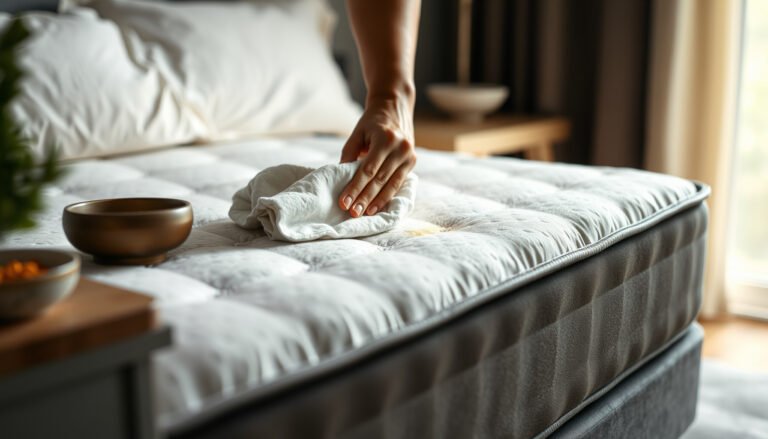
Dry any spill immediately using blotting (not rubbing), then let the area fully dry before putting sheets back on. For a wool mattress, “dry to the touch” isn’t always enough; moisture can remain deeper in the wool layer or in the protector underneath.
When you wash removable covers or protectors, dry them thoroughly so you don’t reintroduce moisture into the wool mattress environment.
Spot-clean with wool-safe methods
Spot-clean with care using manufacturer-approved methods for wool so you don’t damage fibers or mat the surface.
Wool care guidance from recognized authorities emphasizes following the manufacturer’s washing and drying instructions for wool textiles to avoid fiber damage and poor drying outcomes (Woolmark, Wool care and maintenance guidance (follow product-specific label instructions)).
What to do if you spot mold or a musty smell
If you see visible mold or smell mildew, act fast and treat it as a moisture problem—not just a sanitation issue. For a wool mattress, the risk is that mold can spread beneath layers you can’t immediately see.
According to the U.S. EPA, you should not rely on covering mold growth; addressing moisture and contamination is necessary to prevent further problems (U.S. EPA, A Brief Guide to Mold, Moisture, and Your Home).
According to the U.S. EPA, larger mold problems (for example, more extensive areas) may require professional help rather than repeated DIY attempts (U.S. EPA, Mold Remediation in Schools and Commercial Buildings).
Visible growth: remove affected layers promptly
– Remove affected bedding/protectors and clean or discard them based on the extent of growth and the material type.
– If the mattress itself is significantly affected, you may need professional cleaning or replacement rather than repeated DIY attempts.
Musty odor without visible mold
A musty smell often means moisture is still present in hidden layers—under the protector, at the edges, or within the base/adjacent wall area. Treat it as a moisture and drying issue first, then investigate airflow and humidity around the wool mattress.
What can go wrong (and when DIY protection isn’t enough)
Even good intentions can worsen mold risk if you trap humidity around the wool mattress. The biggest “failure mode” in small apartments is creating a closed, damp microclimate that makes surface cleaning feel successful while deeper moisture persists.
According to the U.S. EPA, mold prevention centers on controlling moisture; sealing moisture in can undermine prevention even if the surface looks cleaner (U.S. EPA, A Brief Guide to Mold, Moisture, and Your Home).
According to the U.S. EPA, if mold contamination is extensive, professional assessment may be needed rather than repeated cleanup attempts (U.S. EPA, Mold Remediation in Schools and Commercial Buildings).
Common mistakes that hurt wool mattress owners
– Using non-breathable covers that trap moisture against the wool mattress.
– Ignoring humidity/airflow problems: after you clean the surface, the wool mattress can re-mold if condensation keeps returning seasonally.
– Waiting too long on early signals: musty odor and edge dampness are early warnings in small apartments.
When to pause DIY
If you have asthma, allergies, immune concerns, or if the mold is extensive, pause DIY and get qualified help.
Verdict: the best protection plan for most small apartments
The best protection plan for most small apartments is a two-part approach: improve airflow/moisture conditions first, then add a breathable protector and a consistent drying/cleaning habit for your wool mattress. That combination reduces the moisture window mold needs, which is the core prevention strategy recognized by public health guidance.
According to the U.S. EPA, controlling moisture is the key strategy for preventing mold problems in homes (U.S. EPA, A Brief Guide to Mold, Moisture, and Your Home).
According to the U.S. EPA, mold can start growing quickly after water damage, so drying-focused routines are essential for wool mattress protection (U.S. EPA, Mold Remediation in Schools and Commercial Buildings).
– Downsides: This isn’t a one-time fix. You may need to adjust window cracking/ventilation habits, fan use, and wool mattress placement as seasons change (especially in winter 2026).
– Skip aggressive DIY “deep scrubbing” if mold is widespread, the wool mattress is heavily saturated, or you can’t safely dry the material thoroughly—replacement or professional remediation may be the safer route.
– Best practice reminder: The aim is “manage moisture,” not “seal moisture.” If your approach accidentally traps humidity, you can worsen the problem.
Quick checklist (scan/save)
– [ ] Airflow: mattress not blocked; not pressed tightly against cold walls
– [ ] Moisture monitoring: use a hygrometer instead of guessing
– [ ] Protection: breathable mattress protector (no moisture-trapping plastic)
– [ ] Spills: blot fast + dry fully before remaking the bed
– [ ] Laundry: protectors/covers thoroughly dried after washing
– [ ] Signs: act immediately if musty odor appears or any spots grow
Sources
– U.S. Environmental Protection Agency (EPA), guidance on mold and moisture control (primary federal guidance for preventing mold by controlling moisture): U.S. EPA, A Brief Guide to Mold, Moisture, and Your Home and U.S. EPA, Mold Remediation in Schools and Commercial Buildings.
– U.S. Centers for Disease Control and Prevention (CDC), mold/moisture guidance for indoor environments: CDC, Mold (Basics) and Dampness/Mold resources for indoor environments.
– Wool bedding/mattress care instructions from relevant manufacturer guidance or recognized wool-care authorities: Woolmark, Wool care and maintenance guidance (and your mattress/protector label instructions).
Mold prevention for a wool mattress in a small apartment comes down to one thing: keep moisture from lingering. Use airflow-smart placement, a breathable protective layer, and a drying-focused routine—then address any early odors or spots quickly. If you see significant growth or can’t ensure thorough drying, don’t keep repeating DIY steps; switch to safer remediation options.
Frequently Asked Questions
What’s the best way to prevent mold on a wool mattress in a small apartment?
Start by controlling moisture in the room, since mold thrives when humidity stays high. Use a hygrometer to keep indoor relative humidity around 40–60%, and run a dehumidifier or ventilation during humid days. Place the wool mattress on slats or a breathable base with airflow underneath, not directly on a wall, to reduce condensation and dampness that can lead to mold.
How can I protect a wool mattress from mold if my apartment stays humid?
Use a breathable mattress protector designed for moisture control (ideally a waterproof-but-breathable cover) to block spills and reduce surface dampness. Pair that with regular air circulation—open windows when outdoor air is drier, run a fan to move air, and avoid heavy bedding that traps moisture. If you notice musty odors, address the humidity immediately and consider professional cleaning to remove early mold spores.
Why does mold grow more easily on mattresses in small apartments, and what should I watch for?
Small spaces often have less air movement, making it easier for humidity and condensation to build up around soft materials like wool. Watch for early warning signs such as a damp smell, yellowing or spotting on the fabric, and visible clumps of fiber near seams or edges. These areas typically hold moisture longer, so inspect corners, piping, and the underside of the mattress more frequently.
Which mattress base and airflow setup helps stop mold on a wool mattress?
Choose a breathable mattress foundation, such as slatted bed frames with enough spacing for air to circulate under the wool mattress. Avoid placing the mattress directly on a solid platform, carpet, or low-ventilation surfaces that trap moisture. Keep the mattress a few inches away from exterior walls and use a simple rotating schedule so air reaches all sides evenly.
Best practices for cleaning and drying a wool mattress to avoid mold after spills or leaks?
Blot spills immediately with a clean, dry towel, then allow the area to air-dry fully—never leave damp wool wrapped under bedding. Use gentle airflow (fan) rather than high heat, since overheating can damage natural fibers and set in odors. Once dry, vacuum lightly and use a breathable cover to keep the mattress protected while preventing moisture buildup.
📅 Last Updated: October 27, 2026 | Topic: How to Protect a Wool Mattress from Mold in a Small Apartment | Content verified for accuracy and freshness.
References
- https://www.cdc.gov/mold/default.htm
- https://www.epa.gov/mold/mold-and-mildew-basics
- https://www.epa.gov/mold/preventing-mold
- Mold | National Institute of Environmental Health Sciences
- https://www.who.int/publications/i/item/9789289002135
- Mold
- Wool
- https://scholar.google.com/scholar?q=indoor+mold+prevention+humidity+60+percent Google Scholar
- https://scholar.google.com/scholar?q=wool+moisture+absorption+hygroscopicity+mold+growth Google Scholar
- https://scholar.google.com/scholar?q=mattress+mold+prevention+apartment+humidity+ventilation Google Scholar