How to Choose a Mattress for an RV: Fit, Comfort, and Support
Choosing the right RV mattress comes down to getting the exact fit, matching comfort to your sleep style, and ensuring the right level of support for your body. With the right measurements and a few key specs, you can narrow the options quickly—typically in about an hour—and feel confident ordering the right thickness and firmness. You’ll just need your RV bed dimensions, whether you have a bunk or slide setup, your preferred sleep position, and your tolerance for heat and motion transfer.




Choose an RV mattress by matching the exact size/height your space allows, then picking a comfort level that still supports your back when you’re sleeping on the move. Measure your current mattress opening (including frame rails and any slide-out clearance), then compare materials and firmness to what you actually need for restful sleep. This guide walks you through the main specs that matter—so you don’t end up with a mattress that fits poorly or feels great for a night and then fails on day two.
If you’re upgrading an older RV bed, replacing a sagging mattress, or dealing with uncomfortable pressure points, the steps below will help you narrow options quickly. It’s also useful if you’re converting a camper/van space and need the mattress to work with an RV frame, airflow, and movement.
Measure for True Fit (Not Just “RV Size”)
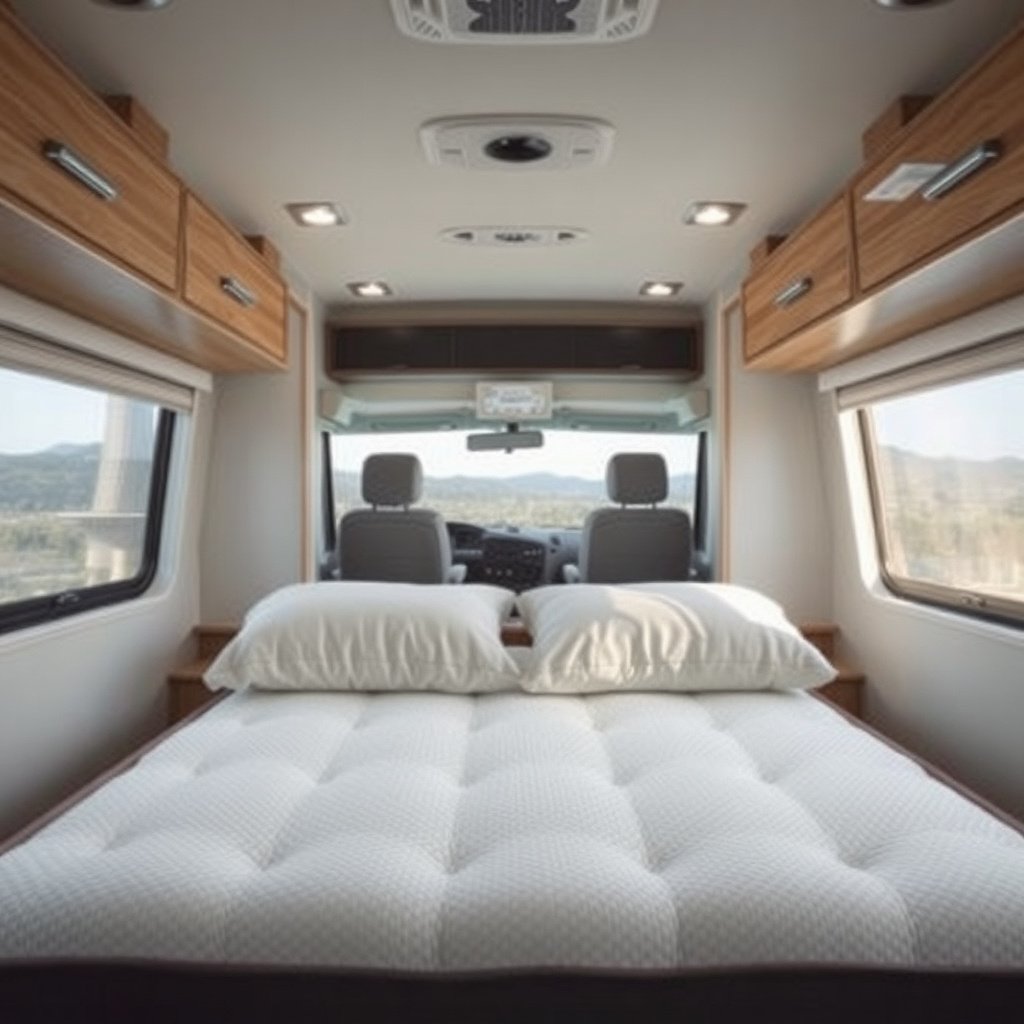
The best RV mattress starts with fit: you’re looking for the exact opening your mattress must occupy, not the marketing label on the box. If the mattress is even slightly too tall or too wide for the compartment rails, you’ll feel it immediately in closure issues, rubbing, and early sag.
– Measure your mattress compartment length and width where the mattress actually sits, plus any frame rails, trim, or corners that reduce usable space.
Start with a tape measure, then do a second pass with calipers or a rigid ruler to confirm tight spots. In many RVs, the nominal “mattress size” assumes clearance that doesn’t exist once the frame rails, corner radii, and retaining lips are considered.
– Check height limits (including thickness) so the mattress can close panels/curtains and still sit securely on the platform.
Measure the usable height from the platform surface to the lowest obstruction (panel underside, cabinet doors, or curtain track). Include the mattress cover and any topper you plan to use—RV compartments punish “just a little thicker” swaps.
– If your RV bed has a support system (slats, rails, or a platform), note the spacing—thin mattresses can feel less stable on wide gaps.
Thin mattresses on widely spaced supports can transmit motion and create uneven pressure. If you notice the bed feels “bouncy” during entry/exit, it’s often a support-to-mattress thickness mismatch rather than a “comfort” problem.
To make fit issues more concrete, here’s a quick look at the RV vs. standard dimension mismatch that causes many returns and reorders:
RV vs. Standard Mattress Sizes That Commonly Don’t Match (Inches)
| # | Sizing label | Length × Width | What people expect | Mismatch risk |
|---|---|---|---|---|
| 1 | RV Queen | 74 × 60 | Standard Queen (80 × 60) | ★☆☆☆☆ |
| 2 | RV King | 80 × 72 | Standard King (80 × 76) | ★★☆☆☆ |
| 3 | RV Full | 75 × 54 | Standard Full (75 × 54) | ★★★★★ |
| 4 | RV Twin | 75 × 38 | Standard Twin (75 × 38) | ★★★★★ |
| 5 | Standard Queen | 80 × 60 | Standard Queen (80 × 60) | ★★★★★ |
| 6 | Standard King | 80 × 76 | Standard King (80 × 76) | ★★★★★ |
| 7 | Standard Twin XL | 80 × 38 | Standard Twin XL (80 × 38) | ★★★★★ |
This mismatch is exactly why “RV size” isn’t enough. In 2026, returns still cluster around the common RV Queen (often 60″ × 74″) versus the standard Queen (60″ × 80″), a difference of 6 inches in length. RecPro RV mattress size specifications
Match Comfort + Support to How You Sleep
The right RV mattress feels comfortable and keeps your spine aligned during movement. In a moving vehicle, comfort without support tends to collapse at the hips and shoulders first—leading to pain that shows up after the first travel day.
– Choose a firmness level based on your sleep position: side sleepers usually need more pressure relief, while back/stomach sleepers often do better with firmer, more supportive feel.
Side sleeping typically concentrates pressure at the shoulder and hip. If your mattress is too firm there, you’ll get numbness or aching; if it’s too soft, your pelvis sinks and your lower back compensates.
– Don’t ignore “RV reality”: surfaces can be uneven when parked or traveling, so prioritize support that resists sagging at the hips and shoulders.
RV beds often sit on platforms with small flex points. A mattress that’s “fine” on a perfectly level showroom floor can sag noticeably once the vehicle shifts, even if you’re parked.
– If you’re replacing a mattress that’s causing pain, treat it like a clue—pressure point discomfort often points to foam softness or insufficient support rather than “needing a pillow only.”
Pillow changes help neck alignment, but mattress softness usually changes pelvic position. If your pain pattern is mainly lower back, you may be losing support depth—not pillow height.
Practical approach: test the sleep system as a unit. If you sleep hot in summer or in humid climates, cooling cover materials may improve comfort, but they won’t fix a support deficit. Conversely, a firmer mattress can reduce pressure but might feel too warm if you’re trapped in high-heat bedding layers—so you still want breathable materials.
If you’re unsure where you land, start with your current mattress’s failure mode. For example, if you feel your hips “drop” when you lie on your side, you’re likely dealing with insufficient support beneath the comfort layer.
Understand RV-Specific Mattress Materials
The “best” mattress material for an RV is the one that provides stable support on your specific platform while managing odor and moisture. In 2026, the most common material choices—foam, hybrid, and innerspring—can all work, but they succeed or fail based on construction quality and how the mattress behaves under RV conditions.
– Foam mattresses can work well in RVs, but look for supportive construction (not just “soft top”) and confirm the product is suitable for enclosed airflow conditions.
In foam designs, the comfort layer may feel plush while the support core determines whether your hips stay level. Also, RVs reduce air circulation compared with a typical home bedroom—so dense foam without breathable ventilation can contribute to odor retention.
– Innerspring/hybrid styles may offer stronger edge/support depending on the design—worth considering if you notice you sink in when getting in/out.
If your mattress compresses deeply at the perimeter, you may feel unstable during entry/exit. Hybrids typically blend a comfort layer with coils, which can improve “buoyancy” and help maintain a flatter sleep surface.
– If you’re sensitive to odor, plan for ventilation time after unboxing; avoid sleeping on it immediately if it off-gasses.
Most foam-in-a-box products release odor during initial curing/packing. Build time into your travel schedule so you’re not sleeping on volatile smells—especially in enclosed RV compartments.
To compare material behaviors in a way that’s actually useful for RV decisions, here’s a parseable pros/cons guide:
| Material type | Pros for RVs | Potential trade-offs |
|---|---|---|
| All-foam | Often strong pressure relief; good for side sleepers; quiet motion transfer. | Can sleep warm in low-airflow compartments; depends heavily on support-layer design. |
| Hybrid (foam + coils) | More “pushback” for hips; can improve edge feel; often easier entry/exit. | May require careful height/clearance; coil zones differ widely by brand. |
| Innerspring | More buoyant support; generally better airflow than dense foam. | Comfort layer thickness varies; may transfer motion if you share the bed. |
Plan for Movement, Weight, and Airflow
The mattress must handle three RV realities: shifting position while driving, repeated entry/exit, and reduced airflow in a compact enclosed space. If you choose based on fit only, you can still end up with a mattress that feels right on day one and becomes unstable or uncomfortable by day ten.
– If you travel often, consider how the mattress will stay stable: thicker mattresses and heavier builds can shift or stress frames differently than lighter ones.
Heavier constructions can stress weak base points over time, especially if slats flex or the platform has minor misalignment. Lighter designs usually shift less, but they can sag more if the support foundation is too flexible.
– Make sure the mattress can breathe—use an RV-friendly mattress cover and allow airflow underneath if your setup allows it.
Under-bed airflow is often the difference between “fresh” and “stale.” Use breathable covers instead of fully waterproof barriers that trap moisture, and verify your platform doesn’t seal the mattress against stagnant air.
– Think about maintenance access: can you remove the mattress easily for cleaning, and can you flip/rotate if the construction supports it?
RV condensation and dust accumulation build faster than many people expect. If you can’t remove or access the mattress regularly, you’re more likely to ignore early dampness—until odors become persistent.
Moisture management is where many RV mattress purchases quietly fail. According to the U.S. Centers for Disease Control and Prevention, mold can begin growing on damp surfaces within 24–48 hours (CDC). And according to the U.S. Environmental Protection Agency, maintaining indoor relative humidity between 30% and 50% helps prevent mold growth (EPA).
Indoor Humidity Bands and RV Mattress Moisture Risk (RH%)
| # | Relative humidity (RH) | Condensation likelihood | Recommended action | Moisture-friendliness |
|---|---|---|---|---|
| 1 | 25% RH | Low | Ventilate normally; monitor for dryness | ★★★★★ |
| 2 | 35% RH | Low–moderate | Stay in the EPA target range | ★★★★★ |
| 3 | 45% RH | Moderate | Use breathable cover; avoid trapped wetness | ★★★★☆ |
| 4 | 50% RH | Moderate | Keep ventilation consistent while parked | ★★★☆☆ |
| 5 | 55% RH | Moderate–high | Increase airflow; address condensation sources | ★★☆☆☆ |
| 6 | 60% RH | High | Act quickly—risk rises if damp persists | ★☆☆☆☆ |
| 7 | 70% RH | Very high | Stop ongoing moisture; dry and ventilate thoroughly | ★☆☆☆☆ |
This table is a decision aid, not a diagnosis. If you see moisture on walls, window frames, or the mattress surface, treat it as a system problem (leaks, ventilation gaps, or condensation), not a mattress-only problem.
What Can Go Wrong (Common RV Mattress Mistakes)
Most RV mattress mistakes come from optimizing one variable while ignoring the rest—fit, support mechanics, and moisture/airflow. The fastest path to disappointment is when the mattress closes “fine” but fails to support you during the second or third travel night.
– Buying by label size only: RV mattress sizes don’t always match standard home bedding perfectly; always re-measure your specific compartment.
Even if a retailer says “RV Queen,” your actual opening can be constrained by frame rails or trim that reduces usable width and length.
– Choosing the soft option for comfort, then losing support: a mattress can feel plush in a showroom/timed test but still sag under your typical sleep pressure.
RV weight distribution is dynamic; the bed can feel different after a few hours of driving, especially when you sleep off-center relative to the platform supports.
– Ignoring height and clearance: a “slightly thicker” replacement can prevent proper closure or leave the mattress rubbing on trim.
That friction matters—rubbing can damage cover material and can also change how the mattress sits on the platform.
– Forgetting moisture management: dampness from humidity can build up faster in RVs—skipping breathable covers/ventilation can shorten mattress life.
Mold risk rises quickly when humidity remains elevated; CDC notes mold can begin growing on damp surfaces within 24–48 hours (CDC).
– Overlooking warranty/return conditions: some brands require specific setup/support to stay covered; .
This is where documentation matters: if the warranty requires a certain base type (slats spacing, flat platform, or airflow clearance), an “almost compatible” RV base might invalidate coverage.
Verdict: What to Buy (and Who Should Skip This Approach)
If you want a practical, lower-risk choice, prioritize fit (exact measurements + height), then pick comfort based on your sleep position, and confirm the mattress construction supports your body on an RV frame. This is the most reliable path to a mattress that feels good and stays functional—not just one that “technically fits.”
Downsides: if your RV bed frame is unusual or has restricted airflow, you may need extra accessories (breathable topper, adjusted base support, or a different firmness), and return windows can be tight. Skip this approach (or go slower) if you can’t measure accurately, if your current base is failing badly (broken slats/uneven support), or if you’re unsure how your RV’s platform will interact with the mattress—fixing the base first can matter as much as the mattress.
Quick RV Mattress Checklist (Save + Reuse)
| What to confirm | Yes/No notes |
|---|---|
| Exact compartment width/length measured where it matters | [ ] |
| Height clearance verified (including frame/trim clearance) | [ ] |
| Mattress firmness matches your main sleep position | [ ] |
| Support seems adequate (especially hips/shoulders) | [ ] |
| Airflow plan exists (breathable cover + space to breathe) | [ ] |
| Base/slats/platform spacing won’t allow sag | [ ] |
| Warranty/return rules reviewed for your setup | [ ] |
Frequently Asked Questions
What size mattress should I choose for an RV bed?
Start by measuring your RV mattress frame length, width, and any clearance for brackets or slide-outs. Many RVs use standard sizes like twin, RV queen, or short queen, but offsets and corner radii can vary. Choose a mattress that fits the existing dimensions without forcing it into the space, and confirm thickness restrictions so it doesn’t interfere with doors, drawers, or the RV mattress platform.
How do I choose the right mattress thickness for RV comfort and fit?
RV mattress thickness affects both comfort and the ability to close cabinets, doors, and covers. In most RVs, a thinner mattress (often around 8–10 inches) helps prevent height-related clearance problems while still supporting good sleep. If you prefer a thicker RV mattress, measure vertical space carefully and consider a supportive base so you don’t sink too far or create bed roll.
Which mattress type is best for RVs—memory foam, latex, or innerspring?
The best mattress for an RV depends on your priorities for support, heat control, and motion isolation. Memory foam can contour well and reduce pressure points, but some foams retain heat—look for cooling features if you sleep warm. Latex is naturally responsive and breathable, while innerspring options offer stronger airflow and a more traditional feel; hybrids can be a balanced choice for many campers.
Why does an RV mattress feel worse than a home mattress, and how can I fix it?
RV mattresses often feel less comfortable due to a firmer surface, smaller sleep space, and lighter, flexing support systems that can exaggerate pressure points. Temperature swings and humidity can also affect mattress materials and airflow. To fix it, ensure a supportive RV mattress foundation, choose adequate firmness for your body weight, and consider an RV mattress topper designed for uneven surfaces and moisture management.
What firmness level should I choose for an RV mattress?
Choose an RV mattress firmness based on your sleep position and body weight to avoid back pain and “bottoming out.” Side sleepers generally do best with medium to medium-soft for hip and shoulder pressure relief, while back and stomach sleepers often need medium-firm to maintain spinal alignment. If you’re unsure, look for “cushion with support” designs and verify you can exchange or return the mattress after testing it in your RV.
📅 Last Updated: November 02, 2026 | Topic: How to Choose a Mattress for an RV | Content verified for accuracy and freshness.
References
- Mattress
- Memory foam
- https://www.mayoclinic.org/healthy-lifestyle/adult-health/expert-answers/mattress/faq-20057995
- https://www.britannica.com/technology/mattress
- mattress firmness back pain – Search Results – PubMed
- mattress type foam innerspring sleep pressure comfort – Search Results – PubMed
- sleep surface pressure redistribution mattress – Search Results – PubMed
- https://scholar.google.com/scholar?q=RV+mattress+choosing+size+support Google Scholar
- https://scholar.google.com/scholar?q=mattress+firmness+back+pain+randomized+trial Google Scholar
- https://scholar.google.com/scholar?q=memory+foam+versus+innerspring+pressure+relief+study Google Scholar