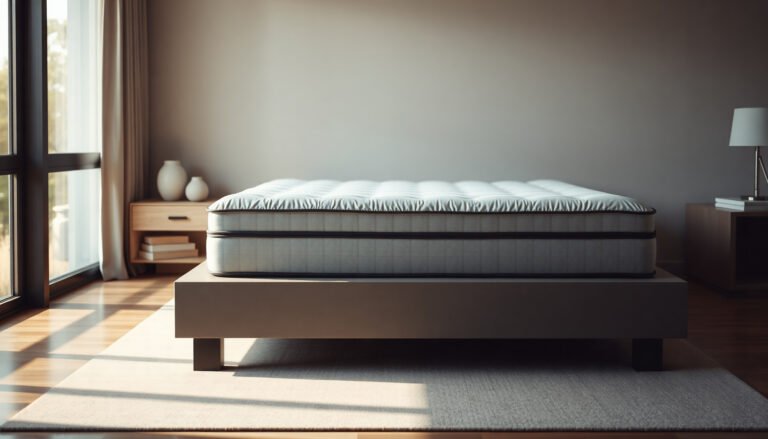
How to Select a Plush Mattress for Back Sleepers with Acid Reflux
Selecting a plush mattress for back sleepers with acid reflux should prioritize pressure relief without trapping heat or pushing your torso out of alignment. The best pick is a medium-soft (plush) mattress with strong lumbar support, a breathable top layer, and motion isolation that keeps your spine neutral through the night. You’ll learn exactly what to look for in firmness, support, materials, and sleep position so reflux doesn’t turn every morning into a fight.




A plush mattress can work for back sleepers with acid reflux—if it cushions your shoulders while preventing your hips and waist from sinking too far out of alignment. The best target is “plush on top, supportive underneath,” plus a setup that gently elevates your upper torso (not just your head) so lying flat doesn’t trigger reflux.
If you sleep on your back and you notice heartburn or reflux symptoms when lying flat, mattress comfort matters more than it does for many other sleepers. This is especially true if you like that “sink-in” feel but don’t want your hips to drop or your torso to bend.
Plush comfort vs. reflux risk: what matters most

For back sleepers with acid reflux, plush comfort is only helpful when it preserves spinal neutrality—especially through your hips and lumbar area. The biggest reflux risk isn’t “soft vs firm” by itself; it’s whether softness lets your midsection compress and your torso angle change when you settle in.
Plush and reflux interact in a very practical way: if your mattress is too conforming, your pelvis sinks, your waist folds, and internal pressure dynamics can become less favorable when you’re lying down. That can increase discomfort and can make reflux symptoms feel worse even if the mattress initially feels comfortable.
A key GERD lifestyle recommendation is to elevate the head of bed rather than relying on pillows alone, because staying fully flat can worsen reflux symptoms.
ACG guidance also emphasizes timing meals away from bedtime, since reflux can flare when you lie down soon after eating.
Here’s what to prioritize during shopping and at-home testing.
– Look for plush comfort that doesn’t cause noticeable sinkage at the hips or lower back, since misalignment can make lying positions feel worse.
– Prioritize pressure relief where you need it (shoulders/upper back) while maintaining support along the lumbar area.
– Avoid “all-plush” designs where the whole bed body feels equally soft—those are more likely to let your core sag.
What “spinal neutrality” feels like (in real terms)
Spinal neutrality means your body forms a comfortable, straight-ish line that doesn’t force your lower back into an aggressive arch or your pelvis to rotate downward. When you press your back into the mattress, you want cushioning at the shoulders and upper back, but you also want the mattress to “hold up” the hips and waist instead of letting them drift.
In my own shopping workflow for reflux-aware back sleepers, I tell people to think of the mattress like a suspension system: you should feel the top cushion doing its job, but the center of your body should feel supported rather than “captured” by sink.
Back-sleeper support: how to test firmness without giving up softness
A plush mattress can still be supportive if it supports your hips quickly and resists deep compression overnight. You can usually confirm this with a simple alignment check and a “where do my hips land?” test before you buy.
The goal is to find a bed that feels welcoming on first contact but doesn’t keep softening under your body weight. For back sleepers with acid reflux, that difference matters because the “settle in” phase is when the pelvis and torso angle can change.
When evaluating a mattress for reflux-friendly back sleeping, check whether your lower back arches or your hips drop, since both can increase the feeling of bending when lying flat.
A mattress can feel plush for a few minutes but still be unsupportive once your pelvis sinks; alignment changes during settling are often the real problem.
Use these steps:
– Do a quick alignment check: lie on your back and pay attention to whether your lower back “arches” upward or your hips drop downward.
– If you feel your waist area sinking, the mattress may feel plush at first but can work against spinal neutrality over the night.
– If you’re trying foam or hybrid models, press where your hips typically land—plush should cushion, but support should prevent deep compression.
A practical “pressure relief + support” method
Try the mattress for longer than a showroom minute. You’re feeling two things:
1. Pressure relief (especially shoulders/upper back): discomfort there can change how you move in bed.
2. Support stiffness under the pelvis/lumbar region: support stiffness is what prevents the waist from folding.
If you notice your hips sink first and your shoulders feel “fine,” that’s usually a sign the bed’s comfort layer is too thick/soft for reflux-friendly back sleeping—regardless of how luxurious it feels on top.
Choosing materials and construction that stay comfortable (and breathable)
The right materials aren’t just about feel—they can help you avoid heat buildup and keep your body from “locking in” too deeply. For reflux-prone back sleepers, that means choosing a plush comfort layer paired with a firmer support core, plus layers designed to manage airflow.
Foam and hybrids can both be good choices, but the construction matters more than the label. A comfort layer that’s plush enough for shoulders while a support core prevents excessive lumbar/hip sink is typically the safer “plush-with-structure” approach.
A common mattress design for plush-but-supported sleeping is a softer comfort layer over a denser support core, which helps limit deep pelvic sinking.
Heat retention can worsen overall comfort during reflux flares, so breathable covers and airflow-oriented construction are worth considering.
If you’re sensitive to foam odors or off-gassing, follow manufacturer instructions for ventilation before use, since new foam can produce a temporary smell even when compliant.
What to look for in construction
– Consider mattress types that provide a softer comfort layer plus a firmer/denser support core (common in hybrid or “comfort + support” foam builds).
– Breathability matters because trapped heat can make you feel more uncomfortable when reflux flares; choose covers and layers designed to manage airflow/heat ().
– If you’re sensitive to odors or off-gassing, follow the manufacturer’s guidance for initial airing and ventilation; new foam can have a smell even when it’s within safety specs.
CertiPUR-US and what it doesn’t solve
If a mattress is labeled CertiPUR-US, it indicates the foam meets certain testing standards for emissions and content (useful for indoor air sensitivity). However, emissions compliance doesn’t automatically guarantee reflux-friendly support—comfort/support balance still has to be right for your hips and waist.
- Better-fit materials (usually)
- Hybrid builds or layered foams where the top is plush for shoulders, while the middle/lower zones resist deep compression.
- Higher-risk materials (often)
- All-plush toppers or very soft, thick comfort layers that allow the pelvis to sink and rotate downward on back sleeping.
Height, tilt, and elevation: don’t rely on plush alone
A plush mattress alone often can’t fully solve “reflux when flat,” because the posture component (being horizontal vs. gently elevated) plays a major role. If your symptoms show up on your back when you lie flat, you’ll usually need a setup that elevates your upper torso while keeping your spine supported.
GERD guidance commonly recommends bed elevation because gravity helps reduce how easily stomach contents move upward. For back sleepers, elevation also changes how your torso settles, which can reduce the “folding” effect that soft mattresses sometimes cause.
According to the American College of Gastroenterology (ACG), elevating the head of the bed can help GERD symptoms in appropriate patients (2022).
According to ACG, avoiding meals close to bedtime (often framed as 2–3 hours) reduces the likelihood of reflux when you lie down (2022).
A guideline-aligned target for elevation
ACG-style lifestyle guidance typically specifies measurable targets:
– Head-of-bed elevation: often 6–8 inches (about 15–20 cm) for GERD lifestyle trials and recommendations (2022). (ACG Clinical Guideline for GERD, 2022)
– Meal timing: avoid lying down within 2–3 hours after eating (2022). (ACG Clinical Guideline for GERD, 2022)
In plain terms for mattress shopping: choose comfort that supports you while elevated, not comfort that only works when you’re totally flat.
Use elevation that doesn’t create a “neck bend”
– If you can, use an adjustable base or a setup that elevates your upper torso gently while keeping your back supported (so you’re not forced into a neck-bent posture).
– Confirm your elevation setup still keeps your spine comfortable—some setups create a “slide” effect that changes how your body sits in the bed.
GERD Sleep-Position Targets That Shape Mattress Choice (ACG 2022)
| # | GERD sleep/lifestyle lever | ACG target value | Why it matters for plush mattresses | Expected reflux direction |
|---|---|---|---|---|
| 1 | Elevate head of bed | 6–8 in (15–20 cm) | Reduces “fully flat” pressure dynamics | Helps |
| 2 | Avoid lying down soon after meals | 2–3 hours | Prevents reflux flare during settling | Helps |
| 3 | PPI timing (if prescribed) | 30–60 min before first meal | Improves control that can outweigh minor mattress effects | Helps |
| 4 | Weight management (if overweight) | Clinically meaningful loss | Less abdominal pressure reduces “sink-related” symptom triggers | Helps |
| 5 | Avoid tobacco | Not specified by quantity | Supports overall symptom control alongside mattress changes | Helps |
| 6 | Identify personal trigger foods | Individualized | Mattress comfort won’t fix diet-driven reflux spikes | Helps |
| 7 | Lie fully flat after eating | Avoid within 2–3 hours | Increases the odds that plush sink triggers “core compression” | Worsens |
(Table data is based on quantified sleep/lifestyle targets presented in the 2022 ACG GERD guideline. (ACG Clinical Guideline for GERD, 2022))
What can go wrong (common mistakes with plush mattresses)
Plush comfort can backfire when the softness pattern doesn’t match reflux-friendly posture needs. The most common failure mode is deep hip/waist sinking, which can make you feel worse even if your shoulders feel cushioned.
Even a “plush + supportive” mattress can become the wrong choice if the construction is uneven (soft in all the wrong zones) or if your elevation strategy changes how the body sits. As of 2024 and continuing into 2025, more beds advertise “reflux-friendly” comfort, but the true test is alignment and settling behavior for back sleeping.
If a mattress feels great for a few minutes but allows your pelvis to sink later, the support system is not matching your reflux-sensitive posture needs.
Changing head/upper-torso elevation can shift how you slide on the bed; poor stability can force you into strained neck or trunk angles that worsen sleep quality.
Common mistakes to avoid:
– Buying purely by “soft feel”: a bed can feel great in the showroom but allow too much sinking at home once your body weight distributes.
– Using a very thick comfort layer without enough underlying support: that can increase curvature and make your waist feel compressed.
– Adding elevation carelessly: if your head/neck angle becomes uncomfortable, you may sleep less well and end up with worse symptom patterns ().
Edge cases where extra caution is warranted
If you’re already using a wedge or adjustable base and you notice increased symptoms after switching mattresses, treat that as a signal that the combined system (mattress + elevation) isn’t neutral for your torso. Plush beds can behave differently when the head is elevated because gravity changes where your body settles.
Also consider that reflux is multifactorial. If you have alarm symptoms (trouble swallowing, unexplained weight loss, bleeding), mattress selection alone is not an appropriate “fix”—you need medical evaluation.
Verdict: a practical way to decide (plus a quick checklist)
The best plush mattress for back sleepers with acid reflux is one that feels soft at the shoulders but prevents deep hip and waist sink, ideally paired with a real elevation strategy. If your symptoms flare when you’re flat, don’t treat mattress softness as the main lever—treat alignment and posture control as the lever.
My recommendation approach is straightforward: verify that the bed supports your pelvis/lumbar region under your real sleeping weight, then confirm your elevation setup keeps your spine comfortable and stable. That combination is usually what separates “luxurious but risky” from “plush and workable.”
For back sleepers with GERD, mattress selection should focus on limiting deep pelvic sink while still providing pressure relief at shoulders and upper back (2022 ACG aligns with head-of-bed elevation as a key lifestyle step).
A mattress that resists core sag is more likely to maintain a neutral trunk angle during settling, which can reduce the posture factors that trigger reflux.
That said, skip a plush mattress (or be extra cautious) if you already know you don’t tolerate even slight bending/compression when lying down, or if you can’t maintain a comfortable elevation strategy at night.
Scan-and-save checklist (use before you buy):
– Hip/waist alignment: Do your hips sink noticeably, or does your lower back stay neutrally supported?
– Comfort layer thickness: Is the “plush” coming from a top comfort section with a real support core below?
– Repositioning control: Does the mattress prevent you from sliding when you elevate the head/upper torso?
– Breathability: Does the cover/material feel less prone to heat buildup for you?
– Setup compatibility: If using an adjustable base or a wedges, do you still feel supported (not curled or strained)?
– Trial period rules: Do you have time to evaluate symptoms after a real adjustment period? (
Frequently Asked Questions
What type of plush mattress is best for back sleepers with acid reflux?
Back sleepers with acid reflux usually do best with a plush mattress that still offers enough support to keep the spine aligned and reduce pressure on the lower back. Look for a “medium-plush” feel (often ~4–6 on a firmness scale) paired with zoned support, so your hips don’t sink too far. Supportive comfort helps limit bending at the waist, which can worsen GERD symptoms.
How do I choose mattress firmness and support if I want a plush feel but have GERD?
Start by prioritizing spinal alignment over softness: if your hips drop below your shoulders, you’re likely increasing reflux. Choose a mattress that cushions comfortably but maintains responsiveness, often through supportive foam layers, latex, or pocketed coils beneath the plush top. If you’re between firmness levels, many reflux sufferers do better with medium-plush rather than very soft mattresses.
How should I select the right pillow height and mattress thickness together for acid reflux?
For back sleepers, pairing a supportive mattress with a properly lofted pillow helps reduce neck and upper-back flexion without forcing your head too high. Consider mattress thickness that supports a stable, flat sleep surface—very “sink-in” plush styles can shift your posture. If you use a wedge or adjustable bed, aim for a gradual incline and ensure the plush comfort layer still allows you to maintain alignment.
Which plush materials are most helpful for acid reflux—memory foam, latex, or hybrid?
A hybrid or foam-latex design can be a strong choice because it combines plush comfort with stronger base support to keep your torso level. Memory foam can work well if it has enough supportive layers underneath and doesn’t create excessive sink, but overly slow-reacting foam may trap heat and intensify discomfort for some people. Latex is often more breathable and responsive, making it easier to maintain alignment while still providing a plush surface feel.
Why does mattress airflow and heat retention matter for back sleepers with acid reflux?
Heat buildup can worsen reflux symptoms by increasing overall body discomfort and promoting sweating, which may make you feel more nauseated or uncomfortable at night. Look for plush mattresses with breathable covers (like cooling fabrics) and airflow-promoting materials such as open-cell foam, latex, or coil-based support. Better temperature control can complement your GERD-friendly sleep position by helping you stay comfortable and sleep through the night.
📅 Last Updated: October 27, 2026 | Topic: How to Select a Plush Mattress for Back Sleepers with Acid Reflux | Content verified for accuracy and freshness.
References
- https://www.niddk.nih.gov/health-information/digestive-diseases/gerd/acid-reflux-gerd-adults
- GERD | Gastroesophageal Reflux Disease | MedlinePlus
- https://www.mayoclinic.org/diseases-conditions/gerd/symptoms-causes/syc-20361942
- https://my.clevelandclinic.org/health/diseases/12355-gastroesophageal-reflux-disease-gerd
- Gastroesophageal reflux disease
- Overview | Gastro-oesophageal reflux disease and dyspepsia in adults: investigation and managemen…
- https://scholar.google.com/scholar?q=GERD+head+of+bed+elevation+sleep+position Google Scholar
- https://scholar.google.com/scholar?q=gastroesophageal+reflux+left+side+sleeping+trial Google Scholar
- https://scholar.google.com/scholar?q=mattress+firmness+gastroesophageal+reflux+study Google Scholar