How to Choose a Mattress for a Tiny House: Key Buyer Checklist
A common mistake when furnishing a tiny house is ordering a mattress by guesswork, only to discover it fights your frame, loft clearance, or door openings. Use a buyer checklist to measure precisely, match firmness to your sleep position, and plan for airflow and support in a compact space. You can do the whole process in about an hour, and you’ll know exactly what to buy before you place an order.
Choosing the right mattress for a tiny house comes down to space fit + sleep support. Measure your platform and access limits first, then match mattress firmness, pressure relief, and ventilation behavior to your sleep position—because in small layouts, the “wrong” mattress can cause aches fast and trap heat longer (especially as of 2026).
If your tiny home sleeps one (or two) and you’re working around tight corners, storage cutouts, or a fold-out setup, the steps below will help you narrow options quickly. You’ll also get a short checklist to keep you from missing the “small” constraints that usually create the biggest regrets—like thickness, edge compression, and airflow gaps around the mattress.
Measure your tiny house sleep space (not just the bed size)
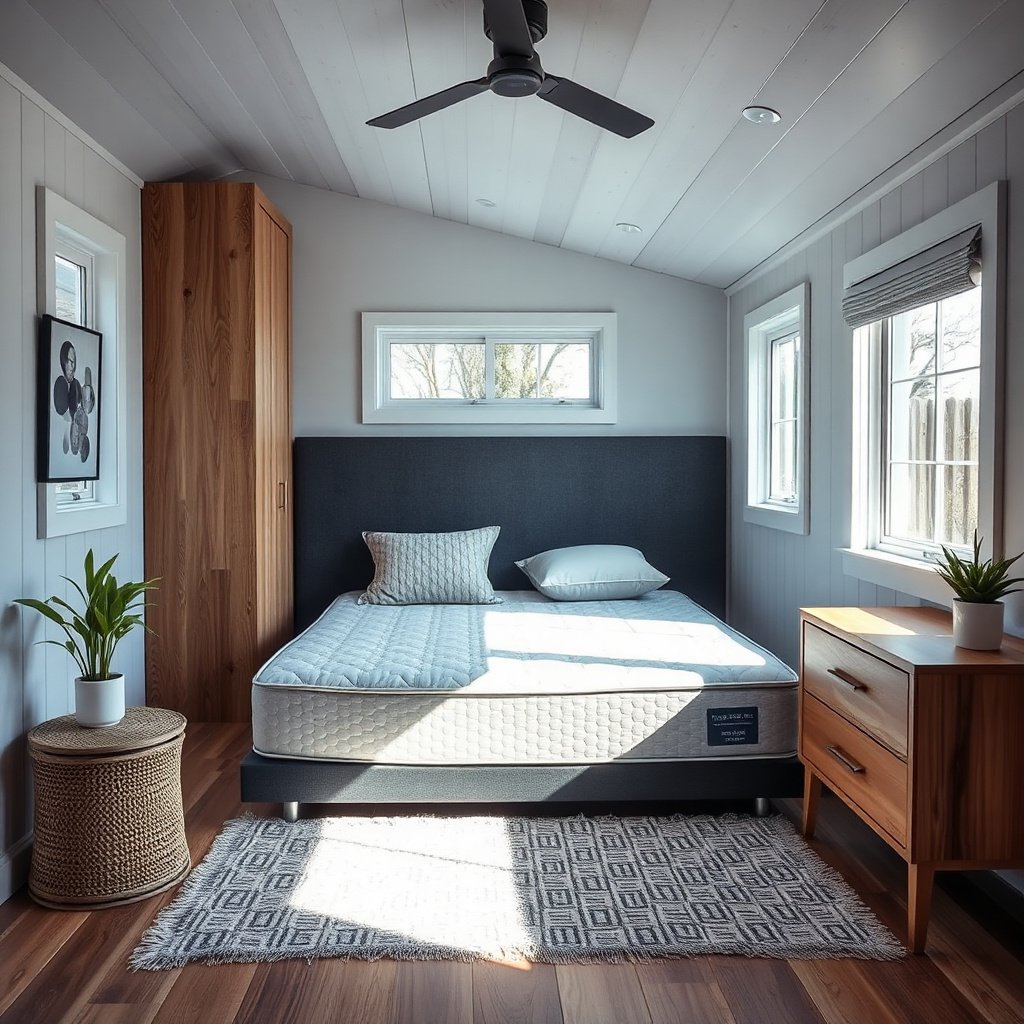
You’ll avoid most tiny-house regret by confirming the real usable sleep footprint—not the mattress label size. Start with a practical layout check: tiny house mattresses often “fit on paper” but snag on covers, platform edges, or loft structure during placement and daily use.
– Measure the exact usable footprint on the platform/floor (and confirm the mattress won’t snag in real life when you move it).
– Include any lip, trim, or rounded corners where fabric covers can catch.
– If you use a fitted sheet plus a mattress protector, measure for the combined stack height, not the bare mattress.
– Check clearance for covers, sheet thickness, and airflow gaps around the mattress so it can vent normally.
– A common tiny house mattress issue is reduced airflow: the mattress sits too tight to a wall, hatch, or storage skirt and the foam or latex can hold onto warmth.
– If you have a loft, nook, or angled ceiling, measure height limits where the head/feet will sit during sleep.
– Don’t just measure standing height—measure at the sleeping posture. When you curl on your side, your shoulder and head positioning can change the clearance by several inches.
Mattress Sizes Used in Tiny Homes: Footprint Comparison (Common Standard Dimensions)
| # | Mattress size | Dimensions (in) | Footprint (sq in) | Tiny-house fit |
|---|---|---|---|---|
| 1 | Twin | 38 × 75 | 2,850 | ★★★★★ |
| 2 | Twin XL | 38 × 80 | 3,040 | ★★★★☆ |
| 3 | Full | 54 × 75 | 4,050 | ★★★☆☆ |
| 4 | Short Queen | 60 × 75 | 4,500 | ★★☆☆☆ |
| 5 | Queen | 60 × 80 | 4,800 | ★★☆☆☆ |
| 6 | King | 76 × 80 | 6,080 | ★☆☆☆☆ |
| 7 | California King | 72 × 84 | 6,048 | ★☆☆☆☆ |
For planning, these footprint differences matter because tiny house mattresses are often paired with limited turning radius and hatch clearances. For example, Twin is commonly listed at 38 × 75 in while Queen is 60 × 80 in; those dimensions alone change floor coverage by hundreds of square inches.
Choose firmness and support for your sleep position
You get the best results when you pick a tiny house mattress that keeps your spine aligned in your usual position—rather than chasing the softest or firmest label. In cramped rooms, discomfort doesn’t just feel worse; it can also reduce your ability to change positions comfortably.
– Identify your main position (side, back, stomach) and prioritize a feel that keeps your spine aligned instead of just “soft vs firm.”
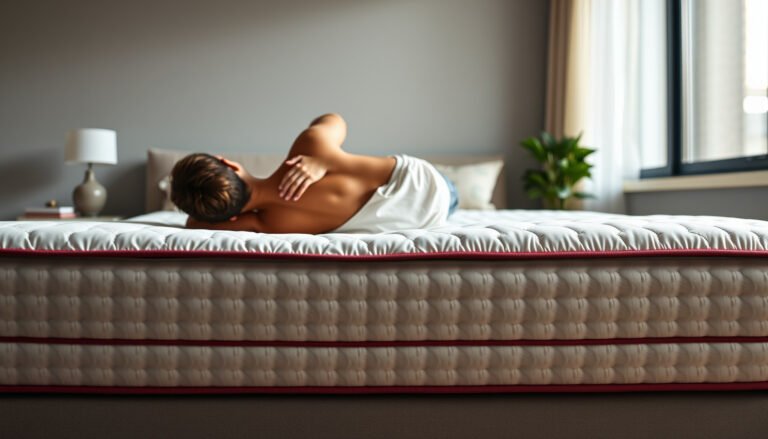
– Side sleeping usually benefits from pressure relief at shoulders and hips, while back sleeping emphasizes support under the lumbar area.
– For pressure relief (often side-sleeping), look for materials that reduce hot spots; for support, focus on how the mattress feels under your hips/shoulders.
– “Pressure relief” means the mattress conforms enough to distribute body weight without letting your hips sink below your torso line.
– If you share the bed, consider how firmness changes with movement so one person’s motion doesn’t wake the other.
– Tiny house mattresses often require lighter sleepers to compromise—so you’ll want to minimize motion transfer, especially with fold-out or platform beds where movement is more direct.
In my view, the most practical approach is to treat firmness as a stability feature. On a tiny house platform, a mattress that’s too springy can feel unstable at the edges, while a mattress that’s too soft can make it harder to roll without “dragging” into the foam.
Pick the best mattress type for tight spaces
The easiest tiny house mattress decision is to start with the build style that matches your movement pattern and heat needs. Tight access routes usually reward foam flexibility and lighter handling, while ventilation needs may steer you toward hybrids or latex depending on your climate.
– Foam (memory/comfort foam): usually easier to maneuver and can conform well, but you’ll want good ventilation and a cover that helps with heat.
– Memory foam can reduce pressure but may retain warmth if the cover and airflow are limited.
– Latex: often balances springiness and pressure relief while resisting sagging, but may cost more—compare warranties and return policies.
– Latex typically “bounces” more than many foams, which can help with turning in small spaces.
– Innerspring/hybrid: can feel “more buoyant” and sleep cooler for some people, but thicker models may be harder to fit and handle in narrow access routes.
– If you have a loft ladder or narrow hall, thickness becomes a practical constraint, not just comfort.
– For any type, plan around motion transfer, heat retention, and edge support, since tiny houses often have less “extra room” to reposition comfortably.
– Edge support matters even if you don’t sit on the edge every night—because shifting posture requires leverage.
To make mattress-type tradeoffs easier to parse, here’s a comparison you can use while evaluating a tiny house mattress:
- Foam (memory/comfort foam)
- Pros: Contours well for pressure relief; often easier to roll/ship in compact form factors.
- Cons: Can trap heat if ventilation and cover materials aren’t ideal; may feel less supportive if it lacks enough underlying support foam.
- Latex
- Pros: Responsive support with pressure relief; tends to resist sagging better than many softer foams.
- Cons: Heavier feel; price can be higher in a budget-sensitive tiny house setup.
- Hybrid/innerspring
- Pros: Often sleeps cooler due to airflow pathways; can provide strong edge support.
- Cons: Thickness and weight can complicate installation through doors/hatches.
Plan for real-world constraints: thickness, weight, and airflow
Your tiny house mattress should be chosen as a system—not just a comfort layer—because thickness, weight, and ventilation determine whether it functions in a compact build. As of 2026, many tiny homes use enclosed or semi-enclosed sleeping areas, which makes airflow planning as important as firmness.
– Mattress thickness matters because tiny homes can limit headroom and reduce the ability to make the bed “look finished” (sheeting and coverings can be affected).
– Measure clearances for not only the mattress height but also any mattress protector and fitted-sheet “pull-up” when you make the bed.
– Weight and compressibility affect installation and swaps—if you’ll move the mattress into tight corners, check whether the manufacturer allows folding/rolling (if applicable).
– If a mattress is too heavy for your access path, you may end up removing it less often than you should for cleaning/airing.
– Don’t skip smell/ventilation concerns: give the mattress time to off-gas per the manufacturer’s instructions and ensure nearby airflow.
– “Off-gassing” is the release of volatile organic compounds (VOCs) from new materials; foam and covers can release these odors until ventilation clears them.
For planning with a tiny house mattress in mind, it helps to understand safety compliance too. In the U.S., mattresses must meet the Federal mattress flammability standard requirements in 16 CFR Part 1633, which is a primary legal requirement for many residential mattresses. 16 CFR Part 1633 (U.S. Consumer Product Safety Commission)
Also, foam emissions testing is often referenced through CertiPUR-US, which evaluates foam emissions (including VOC-related testing) and material restrictions. CertiPUR-US program documentation and test methods referenced by the certification
What can go wrong (and how to avoid it)
Tiny house mattress mistakes usually come from overlooking “small constraints” that become big when you share the space with doors, storage, and airflow. If you prevent the most common failures below, you’ll reduce the odds that comfort problems force an expensive replacement.
– Buying by size alone: “Fits on the platform” can still fail if the mattress is too thick, blocks a hatch, or leaves inadequate ventilation.
– Solve this by measuring platform size, adding cover/protector thickness, and confirming lateral clearance when you slide the mattress.
– Ignoring motion transfer: if you share the bed or have frequent sleep schedule changes, consider how motion travels through the mattress.
– In tight tiny house setups, you’re less able to distance yourself from partner movement, so motion control matters.
– Overlooking returns/warranties: a mattress that’s uncomfortable for even a few nights can be a problem in a tiny house where storage space for “wrong” items is limited—confirm the return terms first.
– Also check whether the company requires pickup logistics you can actually support from your build location.
– Choosing warmth without checking climate: a mattress that sleeps great for one household can feel unbearable if your tiny home is warmer at night (or has limited air circulation).
– Plan ventilation alongside material choice and cover thickness.
– Edge support surprises: if you sit on the edge often (common in small spaces), a mattress that compresses too much can feel less supportive.
– Test it in person if possible, or confirm edge support characteristics in product specifications and reviews.
One practical note from my side: . That’s usually where the “almost fits” problem becomes obvious after setup—when returning the mattress is harder than expected.
Verdict: a practical approach (and who should skip this)
If you want a reliable starting point, narrow by fit first (measure carefully), then match sleep position + pressure relief needs, and finally select a mattress type that works with your space constraints (especially airflow and thickness). This approach is best for most tiny-house setups because it targets the issues that typically create discomfort and replacement headaches—often faster than in a full-size bedroom.
Skip or slow down if:
– you have unusual mounting systems (custom platforms, permanent built-ins) where you can’t confirm measurements,
– you’re very sensitive to foam odor or have strict indoor-air requirements (you’ll need extra attention to ventilation instructions and certifications), or
– you can’t access return support and the mattress would be hard to replace once installed.
A good tiny house mattress can improve sleep quality quickly; a mismatched one can make daily movement and temperature regulation feel harder. So treat the purchase as an engineering step—measure, validate access, then confirm comfort characteristics match how you actually sleep.
Tiny House Mattress Checklist (scan this before you buy)
| Check | Why it matters | Notes |
|---|---|---|
| Platform footprint and usable clearance measured | Prevents “almost fits” problems | |
| Doorway/hall/turns measured | Avoids delivery/placement failures | |
| Height constraints (loft/ceiling/raised floor) confirmed | Keeps head/feet placement comfortable | |
| Mattress thickness fits bedding + bed frame needs | Sheets/coverage and comfort improve | |
| Support match for your sleep position | Helps reduce aches and misalignment | |
| Heat/ventilation plan (materials + airflow) | Tiny homes can trap warmth | |
| Return + warranty terms verified | Tiny-house logistics make “wrong” choices expensive | |
| Off-gassing/ventilation steps followed per instructions | Reduces odor and discomfort |
Frequently Asked Questions
What size mattress should I choose for a tiny house?
Start by measuring your sleeping area carefully and accounting for walkway space, doors, and any built-in storage. Tiny house bedrooms often use space-saving sizes like Twin, Twin XL, Full, or even custom-width mattresses if you’re building a platform bed. Also consider the mattress thickness and whether you need room for ventilation and easy access to the bed frame. If you share the bed or frequently change positions, prioritize mattress dimensions that support your typical sleep space without forcing you into awkward alignment.
How do I choose the best mattress type for a tiny house?
The “best” mattress type depends on how you use your space—whether you need easy movement, temperature control, or low motion transfer. Memory foam can be great for pressure relief, while latex often offers a more breathable, responsive feel that works well in compact rooms. Innerspring or hybrid mattresses may provide more airflow and support for people who sleep on their stomach or prefer a firmer surface. For tiny house living, also consider ventilation and weight, since some mattresses are harder to move through tight doorways or up stairs.
Why does mattress thickness matter in tiny houses?
Mattress thickness affects both comfort and practicality, especially when your bed is built into a loft or platform. If the mattress is too tall, you may lose clearance in lofts, have trouble climbing onto the bed, or reduce airflow underneath. A mattress that’s too thin can also leave you feeling unsupported if you require extra cushioning or have joint pain. Look for a thickness that fits your height constraints while still supporting your spine alignment with an appropriate comfort layer.
Which firmness level is ideal for side sleepers in a tiny house?
Side sleepers typically do best with a medium to medium-firm mattress that cushions the shoulders and hips while keeping the spine level. In a tiny house, where you may sleep in a slightly tighter space or sit up more often, adequate support becomes even more important to prevent morning stiffness. If you’re between firmness levels, consider mattress toppers designed for pressure relief, but ensure the total stack still supports proper alignment. The goal is to reduce pressure points without allowing your hips to sink too far into the mattress.
Best practices for choosing an eco-friendly or compact mattress for a tiny house?
If you’re trying to reduce off-gassing and waste in your tiny house, look for certifications like CertiPUR-US for foam, GREENGUARD Gold for low chemical emissions, or organic/lower-impact materials when available. For compact storage and easier delivery, consider mattresses that ship rolled or compressed in a box, since they’re easier to maneuver in tight spaces. Also check warranties and durability ratings because a tiny home often has fewer replacement opportunities, and a longer-lasting mattress can be more cost-effective. Finally, prioritize temperature regulation features like breathable covers, latex foam airflow, or hybrid designs to keep your sleep environment comfortable year-round.
📅 Last Updated: November 02, 2026 | Topic: How to Choose a Mattress for a Tiny House | Content verified for accuracy and freshness.
References
- Mattress
- https://www.mayoclinic.org/healthy-lifestyle/adult-health/in-depth/mattresses/art-20046347
- https://www.ftc.gov/business-guidance/resources/mattress-and-sleep-products-labeling-rule
- About Sleep | Sleep | CDC
- https://www.britannica.com/topic/mattress
- mattress firmness back pain – Search Results – PubMed
- https://scholar.google.com/scholar?q=mattress+firmness+low+back+pain+systematic+review Google Scholar
- https://scholar.google.com/scholar?q=mattress+temperature+sleep+comfort+cooling+materials Google Scholar
- https://scholar.google.com/scholar?q=tiny+house+sleeping+setup+mattress+size+space+saving Google Scholar