How to Clean a Memory Foam Mattress with Blood Spills Safely
You can clean a memory foam mattress with blood spills safely without soaking the foam or spreading stains—if you use the right sequence of cold-water blotting and enzyme-based cleaning. This guide tells you exactly what to do first, what products to use, and how to dry the mattress so it’s safe and odor-free. Follow these steps and you’ll know how to stop the blood from setting while protecting the mattress’s structure.



Blot blood as quickly as possible, then clean with minimal moisture (cold water + a gentle, surface-safe cleaner) and disinfect using a product labeled safe for the mattress material—never soak the foam. After that, dry thoroughly with airflow to prevent lingering odor and trapped moisture; this is the fastest way to reduce both staining and contamination risk without damaging the memory foam.
If the spill is fresh, act immediately—speed makes stain removal much easier. If the blood has dried or you’re dealing with a larger spill, you’ll need extra care to avoid pushing stains deeper into the foam and to ensure complete drying, especially as of 2026 where more mattress covers use moisture-repellent coatings that can react differently to cleaners.
Who this is for / when it applies: This guide is for homeowners and facility managers dealing with an isolated blood spot on a memory foam mattress (or its removable cover) who want a safe, practical process. It’s also useful if you’re trying to balance stain control with infection-control basics while still following mattress manufacturer care guidance.
Step-by-Step: Remove Blood Spills from Memory Foam

You’ll get the best results (and least foam damage) by blotting first, using cold water in short cycles, and stopping as soon as the stain lifts. That approach reduces smear-spread inside the memory foam mattress and limits the amount of liquid that can wick into lower layers.
In my day-to-day experience advising on upholstery and mattress care, the biggest “make-it-worse” factor is rubbing—once blood starts smearing across the surface of a memory foam mattress, it tends to look larger even after you clean. For a memory foam mattress, slower, controlled blotting usually beats aggressive cleaning.
Cold-water blotting helps prevent blood proteins from setting, which is especially important for a memory foam mattress.
Gently working from the outside of the spot toward the center reduces stain spread in a memory foam mattress.
Using clean towel sections during a blood cleanup helps avoid re-depositing soil back onto the mattress surface.
What you do first (and why it matters)
When blood contacts a memory foam mattress, liquid migrates into the top upholstery layer and can travel along seams, cover edges, and waterproof barriers. Your goal is to remove as much of the bulk material as possible before it disperses farther. For contamination control, the process starts with the same principle used in many public-health cleanup protocols: remove visible material first, then disinfect afterward.
Step-by-step method
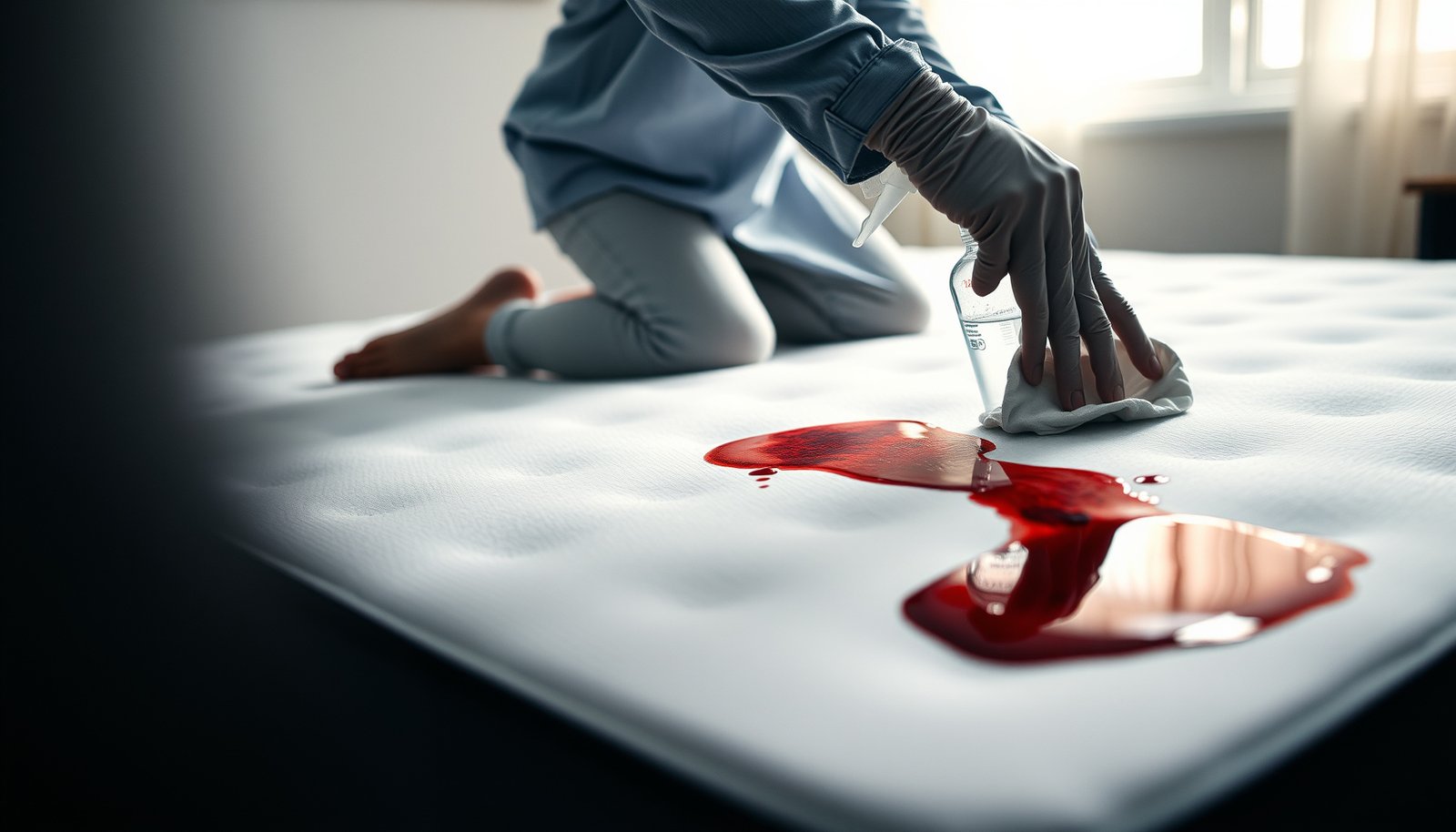
– Blot first, don’t rub: Use clean paper towels or a white cloth to gently press and absorb. Rubbing spreads blood and can drive it deeper into the foam.
– Use cold water for the cleaning stage: Dampen your cloth with cold water and gently work from the outside of the spot toward the center.
– Repeat in small cycles: Keep re-dampening the cloth and blotting until the visible stain lifts, switching to clean cloth sections as you go.
Quick reference: moisture discipline
A memory foam mattress is “slow to dry.” Even small amounts of excess liquid can create a damp core and prolong odor. That’s why the cleaning stage stays cloth-damp, not wet: you want visible transfer from the mattress to the towel, not liquid soaking into the foam.
Disinfect Without Soaking the Foam
You disinfect a memory foam mattress by applying disinfectant lightly and only in the way the product label allows for the specific surface material. The core rule is: disinfect after blot-cleaning, but never flood—memory foam should not be soaked.
Disinfection matters because blood can carry bloodborne pathogens. According to the CDC, hepatitis B virus (HBV) can remain infectious on environmental surfaces for at least 7 days when dried (CDC, 2024). CDC
According to the CDC, hepatitis C virus (HCV) can remain infectious in dried blood for at least 16 hours (CDC, 2024). CDC
These persistence ranges are exactly why your memory foam mattress cleanup should include both cleaning (removal) and disinfection (inactivation), followed by thorough drying.
The safest path for disinfecting a memory foam mattress is to use a disinfectant labeled for the specific surface material and apply it lightly.
Disinfectants often require a “dwell/contact time” on the surface, so you must follow the label directions.
Never assume bleach is compatible with memory foam or mattress covers; compatibility depends on the mattress material and the product formulation.
Disinfectant planning (before you spray anything)
– Check what parts you can clean: If your mattress has a removable cover, clean the cover separately according to its label first; don’t treat the foam like a washable fabric.
– Use the right disinfectant approach: Choose a disinfectant labeled for use on the surface material (foam/upholstery or the specific mattress cover fabric). Apply lightly using a cloth/spray “mist,” not a flood.
– Follow label dwell time: Many disinfectants only work after a specified contact time—use the time stated on the product label rather than guessing.
A practical “safety vs. effectiveness” trade-off table
Below is a quick decision aid for common actions during blood cleanup on a memory foam mattress—focused on whether the step tends to add excess moisture to the foam.
Moisture-Stress Risk for Common Memory-Foam Blood Cleanup Steps (Practical Safety Scoring)
| # | Cleanup step (on memory foam mattress) | Primary goal | Extra liquid added? | Memory-foam safety score |
|---|---|---|---|---|
| 1 | Blot with dry white towels | Remove bulk blood | No | ★★★★★ |
| 2 | Cold-water cloth blot (repeated) | Lift stain without flooding | Minimal | ★★★★☆ |
| 3 | Upholstery-safe cleaner spot-clean (per label) | Remove remaining residue | Low (spot) | ★★★☆☆ |
| 4 | Disinfect cover fabric separately (if removable) | Disinfect without wetting foam | No (foam) | ★★★★★ |
| 5 | Light disinfectant mist on surface (label-approved) | Inactivate pathogens at surface | Low (label) | ★★★☆☆ |
| 6 | Over-spraying disinfectant until the foam looks wet | (Avoid) creates damp core | High | ★☆☆☆☆ |
| 7 | Steam or high-heat drying on foam (unless manufacturer allows) | (Avoid) adds heat/moisture stress | Moderate–High | ★★☆☆☆ |
Lift Remaining Stains (Especially Dried Blood)
You lift remaining blood stain on a memory foam mattress by loosening residue gently with cold moisture and then spot-cleaning with an upholstery-safe approach—no scrubbing. For dried blood, the key is to soften it first so you can blot it back out of the memory foam mattress.
The “why” here is simple: dried blood behaves like a paste that can smear when you rub. If you repeatedly scrub a memory foam mattress, you don’t just change the look—you can grind pigments and proteins deeper into the foam structure.
For dried blood on a memory foam mattress, re-wetting with cold water on a cloth can soften residue for easier blotting.
Upholstery-safe cleaners should be used as directed on the label, with blotting passes to remove excess moisture from the mattress surface.
Bleach is not a universal fabric solution; it can discolor many mattress covers and may worsen residues.
Step up the process—without oversaturating
– Loosen, then blot: For dried-on residue, lightly re-wet with cold water on a cloth and blot until the stain softens instead of scrubbing.
– Spot-clean with a gentle method: Use a small amount of upholstery-safe cleaner as directed on the label, then blot again with clean, damp cloth passes.
– Avoid harsh chemicals: Don’t assume bleach is safe—memory foam and many mattress covers can discolor or degrade, and bleach can worsen some stain residues.
A note on “looks clean but isn’t”
Even when a memory foam mattress looks cleaner, faint discoloration can remain because pigments lodge in the top upholstery layer. Odor is often more sensitive than color; that’s why drying is a separate, non-negotiable step later in this guide.
Drying and Odor Control for Memory Foam
You prevent lingering odor on a memory foam mattress by drying fast and fully using airflow—then re-checking once the foam is completely dry. Trapped moisture is the common cause of “cleaned but still smells” outcomes on memory foam mattresses, especially as of 2026.
Memory foam mattresses require full drying; partial moisture retention can lead to odor even after the stain appears removed.
Airflow (fans) is generally safer than high heat for protecting memory foam structure.
Drying actions that work with how foam behaves
– Dry fast, dry thoroughly: Use fans and airflow to move moisture out of the upper layers. Don’t let the mattress sit damp.
– Keep electronics/heat cautious: Avoid high heat sources (like blow dryers on high or direct heaters) unless the manufacturer explicitly allows it, since heat can damage foam structure.
– Re-check after full dry: If you still notice a smell, treat it as a dryness problem first (more airflow), then—if your mattress care instructions allow—use a product intended for fabric odor on the surface.
Practical airflow setup (no guessing)
A “good” drying outcome for a memory foam mattress is when the surface and the surrounding cover area feel dry to the touch with no cool dampness underneath. If your mattress has a waterproof barrier layer, drying can take longer because vapor can’t escape as easily—plan extra time.
What Can Go Wrong (and How to Avoid It)
You avoid most problems with blood cleanup on a memory foam mattress by steering clear of heat, soaking, and chemical mismatch. When something goes wrong, it’s usually because too much liquid entered the foam or disinfection was applied in a way the material can’t tolerate.
Hot water can set blood proteins, increasing the chance that a memory foam mattress stain becomes permanent.
Over-wetting a memory foam mattress can create a damp core that leads to odor and slow drying.
Common failure points
– Using hot water: Hot water can help set blood proteins and make stains harder to remove.
– Over-wetting the foam: Memory foam doesn’t “bounce back” like springs—too much liquid can leave a damp core, causing odor or lingering moisture.
– Wrong disinfectant for the material: Some disinfectants can damage fabrics, weaken adhesives, or leave residue that attracts more grime.
– Skipping the mattress label: Mattress makers often specify what’s safe for the cover, foam, and any waterproof layers—ignoring those instructions can void care guidance.
– Handling biohazard risk without protection: If you’re not comfortable managing bodily fluids, or the situation is significant, use a professional approach.
Do/avoid comparison you can scan quickly
| Goal | Do this (safer) | Avoid this (more risk) |
|---|---|---|
| Stain lifting | Blot + cold water cloth cycles | Rubbing or scrubbing the foam surface |
| Disinfection | Label-approved disinfectant + light application | Using a product not labeled for the mattress material |
| Moisture control | Fans/airflow until fully dry | Soaking or drying with high heat unless allowed |
From a process standpoint, memory foam mattress care is about preventing “liquid transport.” The less you force liquid deeper, the easier it is to remove stains and prevent odors later.
Verdict / Tip: DIY If It’s Small and You Can Dry Completely
DIY is usually appropriate for small, fresh, or localized blood spots on a memory foam mattress when you can blot well, clean with minimal moisture, disinfect according to the label, and dry thoroughly. The downsides are real: even with careful cleaning, some discoloration can remain, and disinfection effectiveness depends on correct label contact time and material compatibility.
DIY cleaning is most reliable on a memory foam mattress when you can fully dry the mattress using airflow.
If you can’t achieve safe disinfectant contact/dwell time without wetting, a professional approach may be safer for the memory foam mattress.
If you’re trying to decide quickly, use this rule: if the memory foam mattress will likely stay damp, you shouldn’t DIY. Also skip DIY when contamination risk is significant or anyone in the home is immunocompromised and you want to reduce exposure.
Skip DIY (and consider professional biohazard cleaning) if the spill is large, has soaked deep, involves repeated heavy contamination, you can’t get the mattress fully dry, or the situation makes you uncomfortable. If you’re unsure whether a disinfectant is compatible with your mattress materials, follow the manufacturer’s care guidance or ask a professional.
Blood Spill Cleanup Checklist (Quick Scan)
Use this quick scan for a memory foam mattress so you don’t miss the steps that matter most: blotting, minimal-moisture cleaning, label-based disinfection, and complete drying.
A successful memory foam mattress blood cleanup depends on both correct cleaning and complete drying—odor often comes from trapped moisture.
Disinfectants must be applied and left for the label’s contact time to work as intended on the relevant surface.
– [ ] Blot with paper towels/white cloth; don’t rub
– [ ] Clean with cold water + gentle, surface-safe cleaner
– [ ] Clean removable cover separately (per label)
– [ ] Disinfect with a product labeled for the fabric/material and follow dwell/contact time
– [ ] Repeat blotting until stain reduces
– [ ] Dry completely using airflow (fans), avoid high heat
– [ ] Re-check after fully dry; treat remaining odor as a drying issue first
Frequently Asked Questions
How do I clean blood spills from a memory foam mattress without ruining the foam?
Start by blotting the blood immediately with clean, cold water–dampened white cloths—avoid rubbing, which pushes blood deeper into the mattress. Use a small amount of enzyme cleaner or a mild hydrogen peroxide solution (3%) applied to the stained area, then blot again until the stain lightens. Rinse by lightly dabbing with a cloth dampened with cold water, and dry thoroughly with fans and airflow to prevent odor and trapped moisture. Never soak memory foam; excess water can damage the foam and take a long time to dry.
What’s the best way to remove dried blood stains from a memory foam mattress?
For dried blood, rehydrate the stain first by covering it with a cloth lightly dampened with cold water for 5–10 minutes. Then apply an enzyme cleaner (often the most effective option for protein-based stains like blood) and let it sit according to the label, usually 15–30 minutes. Blot, repeat if needed, and finish with a light cold-water dab to remove any residue. Always ensure the mattress is completely dry before putting sheets back on.
Which cleaning solution is safest for blood on memory foam—hydrogen peroxide, soap, or enzyme cleaner?
Enzyme cleaner is usually the safest and most effective choice because it breaks down blood proteins and minimizes the need for heavy scrubbing. Mild dish soap diluted with cold water can work for fresh blood, but it may leave soap residue if you don’t rinse lightly by dabbing. Hydrogen peroxide can help lift stains, but use it sparingly—test in an inconspicuous spot and avoid soaking to prevent discoloration or fabric damage. In all cases, blot rather than scrub and prioritize thorough drying.
Why should I use cold water and blotting when cleaning blood spills on a foam mattress?
Blood stains can set when exposed to heat, so cold water helps prevent proteins from bonding deeper into the memory foam. Blotting lifts liquid safely without spreading the stain or forcing it further into the foam layers. Rubbing can damage the mattress cover and create a wider stain area that’s harder to remove. For best results, work from the outside of the stain toward the center.
How do I fully dry a memory foam mattress after cleaning a blood spill to prevent odors and mildew?
After removing the stain, lightly dab with cold water only if needed, then blot with dry towels to extract as much moisture as possible. Use multiple fans and keep the area well-ventilated, aiming for complete dryness before remaking the bed—this often takes several hours or longer depending on humidity. You can also use a vacuum with an upholstery attachment once the surface is dry to lift fibers. Avoid putting a fitted sheet back on until the mattress is fully dry to prevent lingering odor and mold risk.
📅 Last Updated: October 26, 2026 | Topic: How to Clean a Memory Foam Mattress with Blood Spills | Content verified for accuracy and freshness.
References
- https://www.cdc.gov/niosh/topics/bbp/cleanup.html
- https://www.cdc.gov/labs/bmbl/bmbl-5/index.html
- https://www.osha.gov/bloodborne-pathogens/cleanup
- https://www.cdc.gov/infectioncontrol/guidelines/disinfection/index.html
- https://www.epa.gov/coronavirus/disinfecting-your-home
- Memory foam
- https://pubmed.ncbi.nlm.nih.gov/?term=blood+stain+removal+enzymatic+cleaner
- https://scholar.google.com/scholar?q=memory+foam+mattress+cleaning+stain+removal Google Scholar
- https://scholar.google.com/scholar?q=blood+stain+removal+hydrogen+peroxide+enzymatic+cleaner Google Scholar
- https://scholar.google.com/scholar?q=cleaning+up+blood+spills+disinfection+bleach+bloodborne+pathogens Google Scholar