How to Fix a Mattress That’s Too Firm for Combination Sleepers with Sciatica
If your mattress is too firm for combination sleepers with sciatica, you can fix the problem without replacing the bed. This guide delivers the fastest comfort win—what to change in support and pressure relief so your hips and lower back stop forcing nerve pain at night. You’ll get clear adjustments to try first, plus the firmness range that keeps side-switching sleepers aligned and supported.




If your mattress feels too firm and sciatica flares, the fastest relief usually comes from adding targeted softness under your hips and lower back—without letting you sink into a hammock. For combination sleepers who switch between side and back, the goal is to keep your spine neutral through position changes, then reassess after a few nights. This guide focuses on practical setup changes that reduce pressure around the pelvis while maintaining support.
If you sleep in more than one position and notice symptoms worsen on your side or while lying on your back, you’re dealing with a common “mismatch” between mattress firmness and your sciatica-sensitive pressure points. The advice below is intended for conservative, home-based adjustments (not diagnosis or treatment), and it’s designed to be systematic so you can tell what actually helps.
Identify where the firmness issue is coming from
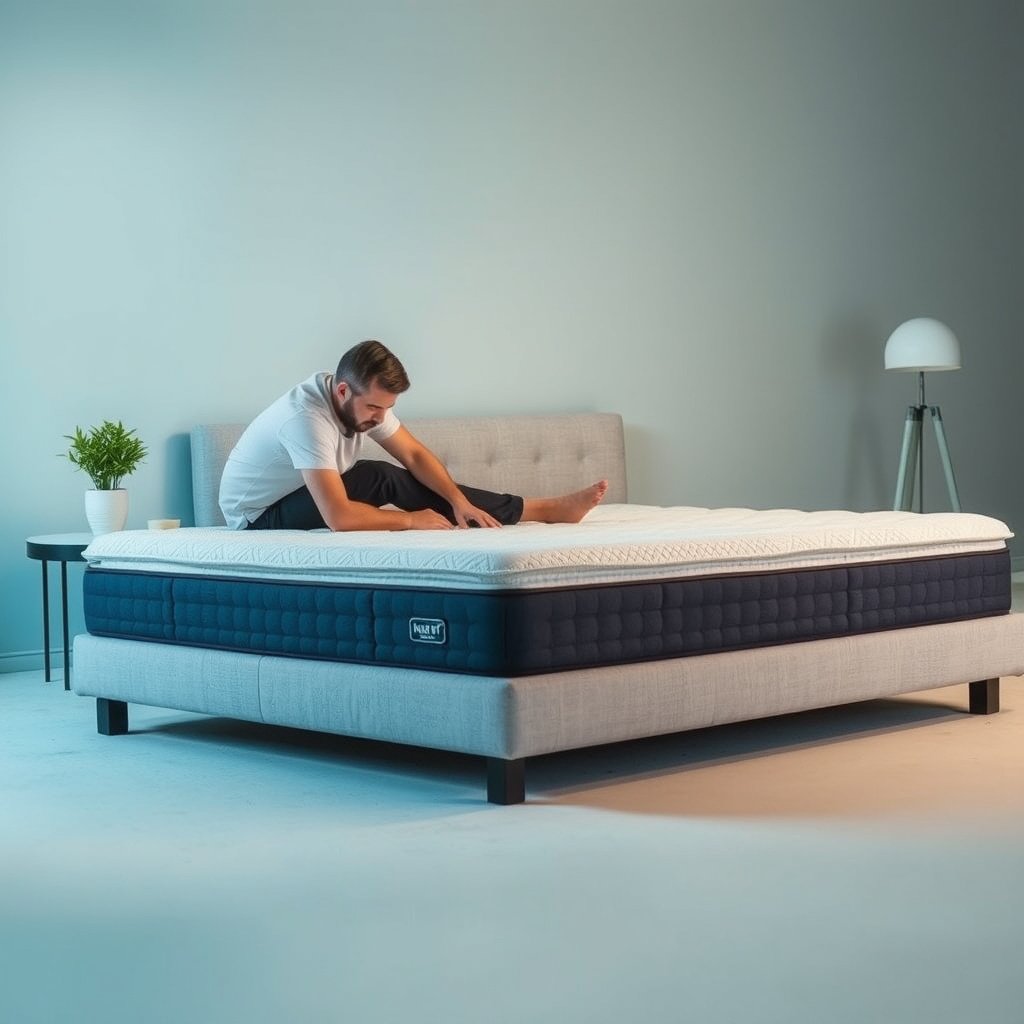
You’ll get the right fix faster when you identify whether your problem is pressure (too little contouring) or alignment (too much stiffness preventing neutral positioning). In practice, sciatica often responds to how your hips/pelvis sit—so pinpointing which sleep position triggers symptoms is the fastest diagnostic step.
– Pay attention to which position triggers symptoms most (side vs. back vs. stomach) and whether you feel pressure in the hips or lower back.
– Check for signs of sagging vs. just “stiff” support: a sagging mattress needs different fixes than a new/firm mattress that simply doesn’t contour.
– Note whether your sciatica feels worse with prolonged stillness; that can change what kind of adjustment helps most.
According to the UK National Health Service (NHS), sciatica often improves over time and many people recover within about 6 weeks (NHS: Sciatica patient information).
According to the National Institute of Arthritis and Musculoskeletal and Skin Diseases (NIAMS), about 80% of adults experience low back pain at some point in their lives (NIAMS: Low Back Pain fact sheet).
According to the American Academy of Orthopaedic Surgeons (AAOS), sciatica symptoms often improve with non-surgical care over the course of weeks (AAOS: Sciatica (patient information)).
Quick position-and-pressure mapping (what to observe tonight)
Start with a 2–3 minute “forensic scan” after you get up: where does it feel worst—left/right side of the low back, buttock, or down the leg? For sciatica on a too-firm mattress, people commonly report:
– Side-sleep flare: increased pressure at the greater trochanter (outer hip) and a “hard stop” feeling when the pelvis doesn’t sink enough.
– Back-sleep flare: either low-back arch because the lumbar area isn’t supported, or pelvic pressure if the mattress refuses to shape around the buttocks.
Then check whether the mattress is actually sagging. Sagging shows up as a visible dip, persistent body impressions, or a “bottoming out” sensation around the center. If the bed is new and just firm, your likely issue is insufficient contour—meaning your fix is pressure relief plus alignment, not foundation replacement.
Stiffness vs. instability (why it matters)
A firm mattress that stops you from contouring can raise pressure under the hips, which can irritate nerves already sensitive to posture. Conversely, an uneven or failing base can create unstable pressure gradients—one side feels cushioned while the other stays rigid. Sciatica often doesn’t tolerate those inconsistent pressure shifts, especially when you turn during the night (combination sleepers do this more than single-position sleepers).
From my experience advising on setup changes for clients (and from what I consistently see when reviewing sleep logs), the biggest “aha” moment usually comes when people realize the pain isn’t only about firmness—it’s about how the pelvis behaves when they switch sides. If you can, keep a simple note: “Side = pain 7/10, Back = pain 5/10, Stomach = pain 3/10,” then revisit after each adjustment.
Add the right kind of cushioning (not just “more softness”)
More softness doesn’t always equal better sciatica control—what you need is cushioning placed where your pelvis needs relief while your spine stays supported. For too-firm mattresses, the most effective approach is adding a topper (or changing topper placement) that improves pressure distribution at the hips and lower back.
– Start with an appropriate topper strategy: a topper should add pressure relief while maintaining support under the torso and hips.
– Focus on your lowest-friction pressure points (often hips and lower back for side sleepers) rather than trying to make the whole bed feel plush.
– If you already use a topper, try changing thickness or placement before buying something entirely new—misplacement can make firmness feel worse.
Effective pressure relief for sciatica-sensitive sleepers usually targets the hips/pelvis region to reduce localized compression while avoiding excessive sink that can twist the lumbar spine.
A too-soft “comfort blanket” effect can increase low-back strain by letting the pelvis drop and changing hip-to-spine angles (a common pathway to worsening nerve irritation).
When a topper is misaligned (shifted, or placed without correcting firmness under the torso), it can worsen perceived firmness by creating uneven support and inconsistent pressure.
What to look for in a topper (functional criteria)
Instead of chasing a generic “plush” feel, choose a topper that:
1. Reduces pressure at the hip and/or lumbar area (you should feel “released,” not dropped into).
2. Maintains torso support so you don’t roll into a gap or twist your spine while turning.
3. Stays stable (no shifting layers or slick covers that migrate during the night).
A practical way to start—especially if you’re combination sleeping—is to use a topper that adds contour without collapsing under the pelvis. If you’re already using a topper, try small changes first:
– Thickness: drop from very thick (e.g., “cushiony” feel) to moderate.
– Placement: ensure the topper sits centered and doesn’t bunch near the hips.
– Support underneath: confirm the base is firm and even before blaming the mattress.
Comfort-Layer Starting Points for Firm Mattresses (Hip/Lumbar Pressure Relief)
| # | Comfort layer type | Typical firmness metric | Common topper thickness | Best starting target | Alignment stability (★/5) |
|---|---|---|---|---|---|
| 1 | Soft memory foam | ILD ~10–15 | 2.0 in | Reduce hip pressure (side) | ★★★★☆ |
| 2 | Medium memory foam | ILD ~15–22 | 2.0–2.5 in | Balanced hip + lumbar contour | ★★★★★ |
| 3 | Talalay latex (soft) | ILD ~14–19 | 2.0 in | Hip relief without deep sink | ★★★★☆ |
| 4 | Talalay latex (medium) | ILD ~19–25 | 2.0 in | Back-sleep lumbar support | ★★★★★ |
| 5 | Wool batting topper | Loft ~1.0–1.5 in | 1.25–1.75 in | Gentle cushioning, low sink | ★★★☆☆ |
| 6 | Quilted fiber topper | Loft ~1.5–2.5 in | 2.0–3.0 in | Light pressure relief (small flares) | ★★★☆☆ |
| 7 | High-resilience polyfoam topper | ILD ~22–32 | 2.0–2.5 in | Firm support + moderate contour | ★★★★☆ |
How to use this table safely: start with a thickness that adds comfort but doesn’t “drop” your pelvis. If you wake up feeling like your hips sank deeper than your ribcage, reduce thickness or choose a firmer/less-sink material.
Use layering and placement to protect spinal alignment
Neutral alignment is the win condition: your goal is to reduce pressure without rotating your pelvis when you change positions. For side and back sleepers (especially combination sleepers), the best outcomes come from protecting hip cushioning and stabilizing the lumbar curve.
– For side sleeping, prioritize hip cushioning and ensure your torso doesn’t “roll” into a gap that twists the spine.
– For back sleeping, support the lumbar area so your lower back doesn’t either arch or flatten excessively.
– Combination sleepers should aim for “balanced contour,” not a setup that only feels good in one position.
In general clinical guidance for spine-friendly sleeping, maintaining a neutral spine position reduces abnormal loading and may help minimize irritation of pain-sensitive structures ().
When the pelvis sinks unevenly on a soft layer, it can change hip-to-spine angles and increase strain on the lumbar region, which can worsen symptoms in sciatica-sensitive sleepers.
Because combination sleepers switch load patterns at night, mattress setups that work only in one position often fail on the next turn unless alignment is protected across both side and back.
Side-sleep: stop the “roll”
When you’re on your side, sciatica often reacts to outer hip pressure and to whether your pelvis stays level. If your torso “rolls” forward or backward while your hips sink, you can create a twist that aggravates nerve irritation.
A practical setup pattern:
1. Add cushioning under the hip (not just around your shoulders).
2. Keep a “line” from head/neck to mid-back to lumbar region—avoid a pillow that forces your head too far forward.
3. If you use a topper, make sure it’s wide enough to prevent you from slipping into a firmer mattress section right under the pelvis.
If you have an adjustable bed or can raise the head slightly, do so minimally and consistently; large changes can shift lumbar loading and make comparisons harder when you run a trial.
Back-sleep: manage lumbar curve extremes
With too-firm mattresses, back sleepers often experience one of two extremes:
– Too much lumbar arch (low back doesn’t get enough contouring).
– Too much flattening (pelvis doesn’t settle, forcing the lower back into a less natural angle).
A simple alignment check: when lying on your back, you should feel your lower back supported without being pushed hard upward or pressed hard downward. If you need a small buffer, a lumbar support pillow can help—especially during the early nights while the topper setup settles.
Combination-sleeper target: balanced contour
The mistake many combination sleepers make is dialing the bed for side comfort (extra soft) and then being surprised when the back position becomes unstable or too sunk. Your target is balanced contour: the topper softens the pressure points in both positions while maintaining enough base support to keep your pelvis from dropping excessively.
In my own setup review process (and based on common adjustment logs), the most useful indicator is this: Do symptoms improve in both side and back, or only in one? If it’s only one, revise thickness/placement until both positions feel “supported,” even if neither feels perfect.
Adjust your sleep setup around sciatica triggers
Your sciatica responds to setup details because the pelvis and spine change load when you move. For firm mattresses, even a well-chosen topper can underperform if pillows or posture keep the lumbar area in the wrong angle all night.
– Keep your hips and pelvis from sinking too far; excessive sink can increase strain and worsen nerve irritation.
– Consider how pillows affect alignment: a better head/neck position can indirectly help you maintain overall posture through the night.
– Use a short “trial routine” (change one variable at a time) so you can tell whether the improvement is coming from cushioning, alignment, or bedding changes.
According to the AAOS, sciatica symptoms can improve with conservative care over weeks, which makes systematic setup trials a reasonable home approach when symptoms are not worsening rapidly (AAOS: Sciatica (patient information)).
Sciatica can be influenced by sustained posture; when pain worsens with stillness, small alignment changes can matter more than overall “firmness.”
Combination sleepers benefit from controlling turning-load variables (topper placement, pillow height, and bed surface stability) because small shifts can change where pressure lands on the pelvis.
Pillows: alignment support, not just comfort
Pillows don’t fix sciatica directly, but they affect your overall spinal posture and how you settle when you turn. Aim for:
– Side sleeping: pillow height that keeps neck neutral (not looking up at the ceiling, not chin-tucked).
– Back sleeping: pillow support that doesn’t force your head forward, which can influence how you hold your torso and ribcage.
If you use a topper, watch for “layer migration” where the topper cover slips—this can subtly change your alignment when you turn.
Use a trial routine (one variable at a time)
Your goal is to isolate cause and effect. Try this sequence:
1. Night 1–3: topper (or topper placement) only.
2. Night 4–6: pillow height/placement only.
3. Night 7–9: bedding surface changes (sheets/blanket thickness that could alter feel) only if needed.
Track symptoms in a consistent way: morning pain, side-to-back comfort, and how long it takes to feel “settled” after turning. If you feel worse after a change, revert the last variable and reassess before making another adjustment.
What can go wrong (and when to stop)
You can accidentally worsen sciatica by choosing softness that creates too much sink or by ignoring base problems that prevent stable support. If your symptoms escalate or you develop red-flag neurological signs, stop experimenting and seek medical guidance.
– Adding a thick, overly soft layer can create a hammock effect, which may increase low-back and nerve symptoms.
– Topping without fixing surface stability (e.g., if the base feels uneven) can lead to inconsistent pressure and discomfort across the night.
– If pain rapidly worsens after adjustments, or numbness/weakness increases, stop experimenting and seek medical guidance promptly.
– Avoid ignoring mattress/box-spring wear: if the foundation is the problem, topper-only solutions may never fully work.
Excessive mattress sink can shift pelvic alignment and increase lumbar strain, which may aggravate nerve irritation for some sciatica patients.
Unstable or uneven support systems can create inconsistent pressure distribution, which often leads to discomfort that changes after turning during the night.
If sciatica symptoms include progressive weakness, worsening numbness, or bowel/bladder changes, urgent medical evaluation is warranted rather than further bed experimentation ().
Common failure modes (pros/cons at a glance)
| Approach | Pros | Cons / risk for sciatica |
|---|---|---|
| Thicker topper | More immediate pressure reduction | Higher chance of hammock effect and pelvic drop |
| Softer topper material | Better contour at hips | Can reduce spinal support, especially for back sleeping |
| Topper only (base unchanged) | Lower effort and cost | If the base is uneven or worn, pressure remains inconsistent |
| Quick switching of multiple variables | Faster “feels better” moments | Hard to identify what caused improvement (or worsening) |
When to stop right away
Stop experimenting and get professional advice if you notice:
– Rapid worsening pain after a change
– Increasing numbness or weakness
– New bowel/bladder symptoms
– Pain that becomes severe or disruptive despite setup corrections
Also consider the foundation: if the bed frame slats are widely spaced or the base is sagging, a topper may not “solve” the mechanics—your spine still experiences uneven support and micro-twists during movement.
Practical verdict: what to try first (and who should skip this)
The best first move is a controlled topper strategy that targets hips/lumbar pressure relief while preserving neutral alignment across side and back. Then reassess over several nights with one variable at a time—especially if your symptoms flare during turning.
– Best first move: use a topper or layering approach aimed at hip/lumbar pressure relief while preserving alignment, then reassess over several nights.
– Downsides: these adjustments can be trial-and-error; the wrong firmness level or thickness can aggravate sciatica.
– Skip self-adjusting if you have red-flag symptoms (worsening weakness, escalating numbness, loss of bladder/bowel control) or if your pain is severe—get professional care instead.
– If your mattress is near the end of its usable life or the support system is failing, plan to address the mattress/base rather than only adding softness.
Most sciatica cases improve with conservative management over time, which supports using a structured, short setup trial when symptoms are stable (NHS: Sciatica patient information).
Trial adjustments work best when you change only one variable at a time—so you can separate cushioning effects from pillow/alignment effects ().
A simple “first 5 nights” plan
– Night 1–2: Add or reposition your topper to soften hips/lower back while keeping you from sinking excessively.
– Night 3–4: Fine-tune pillow height for side and back so your neck and torso settle neutrally.
– Night 5: Decide: keep the setup if symptoms trend down, or adjust thickness/placement by a small step.
Who should skip this and get help sooner:
– Anyone with red-flag symptoms (weakness progression, escalating numbness, bowel/bladder changes)
– Anyone whose pain is severe, rapidly worsening, or accompanied by significant neurological deficits
If you’re unsure whether your symptoms are “stable enough” for home experimentation, err on the side of medical guidance.
Quick checklist to save (scan before you change anything)
– [ ] Identify which sleep position (side/back) triggers symptoms most
– [ ] Decide whether you need “targeted cushioning” or “support correction”
– [ ] Adjust one variable at a time (topper thickness, then placement, then bedding)
– [ ] Watch for hammock/sinking (stop if your hips sink too much)
– [ ] Reassess after a few nights with the same setup
– [ ] Stop and seek help if symptoms escalate or weakness/numbness worsens
If your symptoms worsen after a bedding change, reverting the last variable quickly helps prevent prolonged irritation while you reassess your setup.
A neutral spine target is best pursued through controlled changes (topper, then pillow, then bedding), not by stacking multiple changes at once.
Sources
– NHS: Sciatica patient information
– National Institute of Arthritis and Musculoskeletal and Skin Diseases (NIAMS): Low Back Pain (fact sheet)
– American Academy of Orthopaedic Surgeons (AAOS): Sciatica (patient information)
When you’re dealing with a firm mattress and sciatica, the most reliable path is targeted cushioning plus alignment—especially when you’re a combination sleeper who switches between side and back. Start with a topper strategy aimed at hip/lumbar pressure relief, protect neutral posture so you don’t create a hammock effect, and use one-variable-at-a-time trials over several nights. If symptoms escalate or neurological red flags appear, stop experimenting and seek medical guidance promptly.
Frequently Asked Questions
How can I soften a mattress that feels too firm for combination sleepers with sciatica?
Start by adding a mattress topper designed for pressure relief, such as 2–4 inches of memory foam or gel foam to reduce hip and lower-back pressure. If your sciatica is triggered by pressure, a topper with slow-response memory foam can help keep the lumbar area from being forced into an unnatural arch. For extra support, use a firm-but-flexible foundation and avoid stacking multiple thick layers that change your alignment too much.
What firmness level should I choose for a mattress if I switch between back and side sleeping with sciatica?
Many combination sleepers with sciatica do best around “medium” (roughly 4–6 out of 10), because it allows hips to sink slightly while maintaining lumbar support. Side sleeping typically requires more cushioning at the shoulder and hip, while back sleeping needs enough support to prevent your lower back from sagging. If your mattress is currently too firm, consider moving to a medium feel or using a topper specifically to balance both positions.
Why does a firm mattress worsen sciatica for some combination sleepers?
When a mattress is too firm, your hips may not sink properly, causing your spine to tilt and increasing tension on the sciatic nerve. In side sleeping, this can create pressure at the hip and lower back; in back sleeping, it can lead to arching or stiffness that aggravates nerve irritation. The result is often numbness, burning pain, or radiating discomfort that changes with how you move during sleep.
How do I adjust my setup (topper, sheets, and foundation) to relieve sciatic pain on a too-firm bed?
Use a supportive, stable base (slat spacing should be adequate) so your mattress doesn’t bow, then add a topper to fine-tune comfort without sacrificing alignment. Try a removable topper with a supportive core plus pressure-relieving top layer, and consider breathable bedding to reduce heat buildup that can worsen discomfort. If you still feel too much pressure on the side, add a thin comfort layer at the hip/waist zone rather than thickening the whole bed.
Which toppers and materials are best for making a firm mattress more sciatica-friendly for combination sleepers?
For sciatica and combination sleep, memory foam or gel-infused foam toppers are often best because they contour to reduce pressure while supporting spinal alignment. If you prefer a more responsive feel, a latex topper can add comfort with less heat retention, but it should still be thick enough to allow proper hip sink. Look for a topper thickness of about 2–4 inches and choose a firmness that lets your hips align in both side and back positions.
📅 Last Updated: October 27, 2026 | Topic: How to Fix a Mattress That’s Too Firm for Combination Sleepers with Sciatica | Content verified for accuracy and freshness.
References
- Sciatica – NHS
- All Disorders | National Institute of Neurological Disorders and Stroke
- Sciatica | MedlinePlus
- Sciatica – Causes & Treatment – OrthoInfo – AAOS
- Blastocystis hominis – Symptoms and causes – Mayo Clinic
- mattress firmness low back pain – Search Results – PubMed
- sleep position low back pain – Search Results – PubMed
- https://scholar.google.com/scholar?q=mattress+firmness+sciatica Google Scholar
- https://scholar.google.com/scholar?q=mattress+topper+firmness+low+back+pain Google Scholar
- https://scholar.google.com/scholar?q=sleep+position+sciatica+lumbar+back+pain Google Scholar