How to Protect a Cotton Mattress from Allergens During Storage
Want to protect a cotton mattress from allergens during storage? The most reliable approach is airtight containment paired with allergen-blocking barriers and moisture control to stop dust mites, pollen, and mold from gaining a foothold. Follow these storage steps and you’ll prevent odors and irritation when the mattress is finally returned to use.




Protect your cotton mattress from allergens during storage by cleaning and drying it completely, then sealing it in a tightly zipped allergen-proof encasement. After that, focus on a cool, dry storage spot with controlled humidity—because dust mites and allergen-laden particles can become a problem again if moisture creeps in. We’ll cover the full process from prep to encasement fit to humidity control, plus the common mistakes that quietly defeat “sealed” storage.
This is for anyone storing a cotton mattress for weeks or months (moving, seasonal storage, spare bedroom/off-season use) and anyone trying to reduce dust-mite and allergen exposure—especially if you have allergies or asthma. If your mattress manufacturer gives specific storage instructions, follow those first.
Prepare the mattress before you seal anything

Cleanliness and dryness before storage are what prevent allergen buildup from getting trapped inside the mattress. If dust, skin flakes, or moisture are present before encasement, you’re essentially packaging the problem.
Vacuuming before storage removes loose dust and allergen-bearing particles from the mattress surface.
Dust mites need humidity to thrive; controlling moisture after storage is a key prevention step.
According to the U.S. CDC, dust mites are an important indoor allergen source and are influenced by indoor conditions such as humidity (CDC—dust mite/allergy prevention guidance).
Vacuum correctly (so you don’t redistribute dust)
Dust mites and allergens aren’t only “on top”—they can be in the fabric surface and seams. Vacuuming helps remove what’s sitting on the cotton ticking and quilted layers so the encasement doesn’t lock in loose debris. Use the upholstery or dusting attachment and keep suction steady without aggressive brushing that could work debris deeper into seams.
Spot-clean only when it’s truly dry-ready
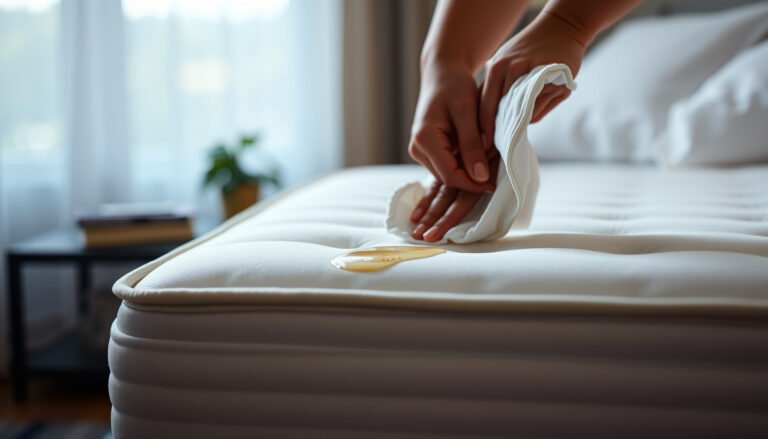
When you spot-clean, you’re trying to eliminate staining and residues without soaking the mattress. Follow the mattress label because cotton construction (and any wool/cotton blends, quilting, or adhesives) changes how liquids spread. Importantly, don’t store until the mattress fabric feels dry to the touch everywhere—including the edges and corners. In my experience following care-label guidance, the one step that most often causes lingering odors later is assuming “mostly dry” is enough; .
– Vacuum the mattress surface thoroughly (use the upholstery/dusting attachment to avoid pushing debris deeper).
– Spot-clean stains according to the mattress label, then don’t store it until the fabric is completely dry.
– Remove loose bedding, protectors, and any items stored on top of the mattress so they don’t contaminate it during storage.
Use an allergen-proof encasement (not just “any” plastic bag)
A real allergen-proof encasement works as a barrier, not just a dust cover. The goal is to prevent dust and allergen leakage through seams and sides while keeping the mattress isolated during months of storage.
According to the U.S. EPA, dust-mite control strategies emphasize managing indoor humidity and using protective covers to reduce allergen exposure (U.S. EPA—dust mites guidance).
A mattress encasement must fully cover seams and sides; gaps and unsealed edges are where allergens can bypass barriers.
CDC guidance focuses on dust-mite prevention steps that target indoor conditions and allergen sources (CDC—dust mite/allergy prevention information).
Choose “zip-sealed allergen barrier,” not loose wrapping
A loosely wrapped plastic sheet can crease and separate, leaving tiny openings that defeat the whole purpose. Look for a fully zipped, designed-for-allergens encasement (often described as dust-mite/allergen blocking). The zipper matters: if it’s partially open or the cover doesn’t lie flush, you create pathways for particulate transfer.
Fit and coverage are the real performance metrics
For cotton mattresses, seams and panel edges tend to collect dust. That’s why a snug fit and full coverage of the sides and seams is critical. If your mattress has a thicker profile (extra quilting, pillow-top feel, or deep mattress height), confirm the encasement size before you start. Ideally, you should feel minimal wrinkling once the encasement is closed.
| # | Cover approach | Barrier quality | Main risk during storage | Best for |
|---|---|---|---|---|
| 1 | Fully zipped allergen-proof encasement | High | Minimal leakage if properly fitted | Allergen-sensitive storage |
| 2 | Loose plastic sheeting (taped/loosely wrapped) | Variable | Gaps from wrinkles and shifting | Very short, low-dust scenarios |
| 3 | Thin dust cover only (non-allergen rated) | Low to moderate | Dust and fine particles can pass | Cosmetic protection, not allergen control |
– Choose a fully zipped mattress encasement designed as an allergen barrier (aim for a dust-mite/allergen-blocking style cover with minimal gaps).
– Make sure the encasement fits snugly and fully covers seams and sides—this is where allergens most often leak through.
– Avoid loosely wrapped coverings that can wrinkle and leave openings where dust and mites can get in.
Dryness is the allergen-protection strategy for cotton
For cotton mattresses, dryness is the deciding factor because moisture can support odors and make allergen conditions worse. In 2026, many storage failures we see in seasonal/off-season setups come from humidity creep rather than from the encasement itself.
According to the CDC, dust mites are associated with indoor environments and are influenced by humidity conditions (CDC—dust mites/allergy prevention information).
Cotton materials can hold moisture; storing a damp mattress increases the chance of musty odor and trapped residues.
According to U.S. EPA dust mite guidance, relative humidity targets are used to reduce dust-mite conditions (U.S. EPA—dust mites guidance).
Dry to touch—then re-check the edges
“Dry to the eye” is not the same as “dry throughout.” Quilting and cotton layers can remain cooler and slightly damp inside. Air-dry the mattress in a ventilated area until it feels fully dry to the touch, including seams, corners, and any areas that press against a frame.
Also, avoid storing right after spot-cleaning, especially if you used any amount of liquid. If you have a moisture meter, you can confirm dryness more confidently—. Without tools, your best proxy is consistent feel: no coolness, no tackiness, and no “damp fabric” sensation along the edges.
Use humidity control when the storage area is less predictable
If the mattress goes into a basement, garage, or attic, plan for humidity management rather than trusting the weather. Dust mites and allergen-laden particles become more likely when indoor moisture is elevated. EPA guidance commonly targets relative humidity below about 50% for dust-mite control (U.S. EPA—dust mites guidance)—and many CDC recommendations align with the same direction (CDC—dust mites/allergy prevention information).
– Let the mattress air-dry in a ventilated area until it feels dry to the touch—don’t rely on “looks dry.”
– If you’re storing in a basement/garage or anywhere humid, plan to control humidity in the storage area (see next section).
– Cotton can hold moisture; if humidity is high when you pack the mattress, you increase the risk of musty odors and allergen buildup.
Store it in a dry, stable environment
A dry, stable storage environment is what prevents humidity from undoing your clean-and-dry work. If your storage spot swings between warm/humid and cool/dry, moisture can migrate into the encasement over time.
Dust-mite prevention guidance emphasizes humidity control as a primary lever for reducing dust-mite conditions (U.S. EPA—dust mites guidance).
Relative humidity targets (often below about 50% in dust-mite guidance) are used to limit conditions that support dust mites (U.S. EPA/CDC—dust mites prevention).
Storing off the floor can reduce moisture transfer from concrete and damp surfaces.
Choose the storage location like it’s part of the hygiene plan
Keep the mattress in a cool, dry place with controlled humidity. If possible, store off the floor on a raised platform, shelf, or clean rack. Concrete floors and poorly sealed walls can wick moisture, and basements can run higher humidity even when the room feels “not that wet.”
Manage humidity with simple controls
For long storage in 2026, a humidity monitor is often more useful than guesswork. Aim for low relative humidity (commonly below ~50% in dust-mite guidance). EPA/CDC-aligned dust mite recommendations focus on reducing relative humidity because it changes dust-mite survival and allergen conditions (EPA—dust mites guidance, CDC—dust mites/allergy prevention information). If you must store in a humid region, consider a dehumidifier in the storage zone and ensure it’s sized appropriately for the space.
– Use a storage bin or closet area that stays dry; if possible, store off the floor (a raised platform reduces moisture transfer).
– Keep relative humidity low—EPA guidance for dust mites commonly targets humidity below about 50%.
– Avoid areas near sources of moisture (leaky walls, humid basements, unsealed exterior walls) or where the mattress will repeatedly warm/cool and “pull” moisture from the air.
What can go wrong (and how to prevent it)
Most storage failures happen from one of four issues: damp packing, a leaky barrier, humidity creep, or shortcuts on fit. If you eliminate those, you dramatically improve your allergen control outcome.
Sealing prevents new exposure, but it doesn’t remove allergens already present in fabric layers—proper cleaning/drying before storage matters most.
Tiny gaps around seams and zippers allow particles to bypass covers.
Excess fragrance or harsh chemicals can irritate sensitive individuals and may conflict with mattress care requirements (CDC—indoor allergen/irritant considerations and general guidance).
Watch for dampness that “shows up later”
If you store even slightly damp cotton, the encasement can trap that moisture and create musty odors. Those odors can be more than smell—they often coincide with conditions that make the storage environment less allergy-friendly. During longer storage periods, you may not notice the problem until you unseal the mattress months later.
Don’t rely on fragrance as a “fix”
If you’re trying to reduce allergens, stick to care-label-approved cleaning methods. Heavily scented sprays may irritate users with asthma or chemical sensitivities and can create their own residue problems.
Prevent gaps at the barrier interface
This is the practical failure mode: a zipper that’s not fully closed, or a cover that doesn’t lie flush against the mattress shape. You want full seam coverage. After you encase, inspect around edges and corners—especially if you compressed or reshaped bedding layers during installation.
Misinterpreting “sealed” storage
“Sealed” is not the same as “safe.” Encasement is a barrier, but it can’t undo allergens already embedded in the mattress. This is why the clean + dry sequence comes first every time.
– Storing while slightly damp: even small residual moisture can lead to odors and worsen allergen issues later.
– Overusing “fragrance” products: heavily scented sprays can irritate sensitive users; stick to the mattress’s care guidance.
– Leaving tiny gaps: plastic sheeting with loose edges or an encasement that doesn’t fully zip can let allergens bypass your barrier.
– Assuming “sealed” equals “safe”: sealing prevents new exposure, but it won’t undo allergens already embedded—proper cleaning/drying before storage matters most.
Verdict: the most reliable approach (with downsides)
If you want the best chance of reducing allergen exposure later, your safest combo is: clean + fully dry → allergen-proof zip encasement → dry storage with humidity control. The downside is that it takes more effort than basic bagging, and you may need extra materials (a proper encasement and possibly a humidity monitor/dehumidifier). Also, if your mattress is old, heavily stained, or has significant embedded debris, encasement helps but may not eliminate every allergen source—consider professional cleaning guidance or follow your mattress warranty/care rules. Skip or pause if you can’t confirm the mattress is fully dry or if you don’t have a reasonably dry storage spot.
EPA/CDC dust-mite prevention guidance commonly points to humidity control (often below ~50% RH) as a key strategy, alongside protective barriers.
Proper preparation—especially thorough drying—reduces the risk that moisture trapped during encasement will create new problems later (EPA/CDC dust mite guidance).
Quick checklist (save this)
| Step | What to do | Done? |
|---|---|---|
| Clean | Vacuum the mattress surface; spot-clean only per label | ☐ |
| Dry fully | Air-dry until completely dry to the touch | ☐ |
| Seal correctly | Put on a fully zipped allergen-proof encasement | ☐ |
| Prevent gaps | Ensure seams/sides are fully covered and zipper is closed | ☐ |
| Store dry | Store off the floor in a stable, low-humidity area | ☐ |
| Monitor moisture | If storage is prone to humidity, use a humidity control plan | ☐ |
Frequently Asked Questions
How can I protect a cotton mattress from allergens during storage?
Start by thoroughly cleaning the mattress surface and letting it fully dry to prevent mold and dust mites. Use an allergen-proof mattress encasement (zippered, tightly woven) before boxing or stacking it, and store it in a dry, temperature-controlled space. Avoid leaving it exposed to bedding dust; covering it promptly limits pollen, pet dander, and airborne allergens settling into the cotton.
What steps should I take before storing a cotton mattress to reduce dust mites and pollen?
Vacuum the mattress and use a fabric-safe, allergen-reducing approach such as HEPA vacuuming on seams, edges, and tufts. If the mattress was recently used, wash removable covers according to care instructions and ensure everything is completely dry before storage. To further reduce allergen risk, keep the storage area closed off from windows and use breathable protection that doesn’t trap moisture.
Why does moisture increase allergen issues in stored cotton mattresses?
Cotton is absorbent, and even small amounts of trapped moisture can encourage mold growth, which triggers allergy symptoms. Moisture also creates conditions that can make dust mites more likely to thrive in fabric materials. Keep humidity low, elevate the mattress off the floor, and choose storage space with good ventilation to protect the cotton mattress from allergens.
Which storage cover is best for allergy protection—plastic bags or breathable encasements?
For allergen control, an allergen-proof zippered mattress encasement is usually better than a loose plastic bag because it seals fabric gaps while allowing safer handling and protection. Tight plastic coverings can help against airborne dust, but if moisture is trapped during storage, they may worsen mold risk. Look for covers labeled allergen-proof, tightly woven, and designed specifically for dust mite and allergen barriers.
Best way to store a cotton mattress long-term without trapping allergens?
Store the mattress horizontally or in a stable upright position only if the manufacturer allows it, and always keep it elevated on a clean, dry platform. Use an allergen-proof cover, avoid compressing the mattress too tightly, and refrain from storing near areas with chemicals, cardboard dust, or HVAC vents. Periodically check the storage space for humidity and odors, and re-verify the mattress is dry before reinstallation.
📅 Last Updated: October 26, 2026 | Topic: How to Protect a Cotton Mattress from Allergens During Storage | Content verified for accuracy and freshness.
References
- https://www.cdc.gov/asthma/information_for_patients/dust_mites.htm
- https://www.epa.gov/indoor-air-quality-iaq/dust-mites
- The page you’re looking for isn’t available | NIAID: National Institute of Allergy and Infectious…
- https://www.mayoclinic.org/diseases-conditions/allergies/expert-answers/dust-mites/faq-20057924
- https://www.britannica.com/animal/dust-mite
- https://pubmed.ncbi.nlm.nih.gov/?term=mattress+encasement+dust+mite+allergen
- https://pubmed.ncbi.nlm.nih.gov/?term=dust+mite+control+humidity+bedding+washing
- https://scholar.google.com/scholar?q=cotton+mattress+storage+dust+mite+allergen+prevention Google Scholar
- https://scholar.google.com/scholar?q=mattress+encasement+dust+mite+allergen+exposure Google Scholar
- https://scholar.google.com/scholar?q=house+dust+mite+humidity+control+indoor+allergens+bedding+storage Google Scholar