How to Protect a Wool Mattress from Spills in a Shared Apartment
You can keep a wool mattress safe from everyday spills in a shared apartment by acting fast and using the right protectant and blotting routine. In the next few minutes, you’ll learn how to set up a spill-ready protection layer, respond to wet spots without damaging the wool fibers, and build habits that prevent repeated accidents between roommates. All you need is a waterproof mattress cover, clean towels, and mild, wool-safe cleaning supplies.




A wool mattress can handle some moisture, but spills are where you need quick action—blot fast, stop the liquid from soaking deep, and keep the mattress from staying damp. This guide shows you how to set up practical spill protection (covers, placement, and cleaning steps) in a shared apartment without ruining the wool’s comfort.
If you share a space with roommates—kids, guests, or busy schedules—your biggest risks are accidental drinks, condensation, and “I’ll clean it later” delays. We’ll focus on protection and spill response that fits real apartment life.
Shared-apartment wool mattress care comes down to three control points: (1) physically block liquid from reaching the wool, (2) catch small accidents before they spread through fibers and seams, and (3) dry quickly enough that odor and mildew never get a foothold. The wool mattress is naturally moisture-tolerant (more than many people assume), but it’s not “spill-proof,” especially when sugary drinks or greasy liquids are involved. As of 2026, many families and roommates are relying on breathable waterproof sleep-protection systems—mainly because they reduce the two big failure modes: persistent dampness and late cleanups.
Use a waterproof mattress protector (with breathable fabric)

A waterproof, breathable protector is the first defense for a wool mattress in a high-traffic apartment—because it stops most liquid from contacting the wool fibers. The second part of the answer is just as important: “waterproof” only works if the protector is breathable enough to prevent trapped moisture from sitting against the wool mattress surface.
– Choose a protector designed to be waterproof but breathable, so it blocks liquid while still letting moisture/vapor escape. Look for products that are explicitly described as breathable or that reference moisture-vapor transmission (often tested using standards such as ASTM E96). A waterproof layer without breathability can create a “condensation cup” effect on top of the wool mattress, which increases the odds of musty smells after repeated minor spills.
– Prioritize a snug fit (full encasement or secure straps/elastic) so spills don’t run to the mattress edges. In real shared homes, most “mystery stains” happen at the edges—where liquid wicks under loose corners, zips, or fitted sleeves. A well-fitted wool mattress protector reduces both spill spread and the time you spend blotting seams.
Practical guidance for roommates: assign one person the responsibility for installing the protector correctly. Even a small gap along the corner can turn a harmless splash into a wider wool mattress stain once someone bumps the bed frame.
What to look for (and what to avoid)
If you want the simplest decision framework, use this comparison table to match the protector to shared-apartment risk:
| Option | Pros for a wool mattress | Cons / failure modes in shared apartments |
|---|---|---|
| Breathable waterproof encasement | Blocks liquid, supports faster drying, better edge control for a wool mattress | Can feel slightly “structured” vs. bare wool; must be fitted properly |
| Breathable waterproof fitted protector | Often thinner, easier to wash, good for routine spills on a wool mattress | If it shifts, liquid can reach corners/side seams |
| Non-breathable plastic cover | Max liquid barrier in the moment | Traps vapor → higher odor risk; drying after a spill is slower for a wool mattress |
Add a washable top layer for everyday messes
A washable top layer is the fastest way to “buy time” during roommate life, because it absorbs and contains minor accidents before they migrate into a wool mattress. If the top layer comes off quickly, you also reduce the usual shared-apartment problem: delayed cleaning.
– Use a thin, washable mattress pad or quiltable topper that sits between you and the mattress surface to absorb minor accidents. Think of this as your first sponge for a wool mattress—especially for small drips, sweat, or “oops” spills that are still mostly water.
– Pick something you can remove and wash quickly—especially helpful in a shared household where “same-day” cleanups matter. A washable layer also helps you reset the system after a spill: blot, remove, wash, and return the wool mattress to a dry, clean state.
Roommate-friendly tip: keep a spare protector/top layer in a closet. In a shared apartment, it’s common for people to wait until laundry is convenient; having a spare means the wool mattress isn’t sitting uncovered while you wait.
Set up “spill barriers” around the bed area
A wool mattress stays safer when you reduce opportunities for liquid to reach it—so a small “barrier plan” matters as much as the protector. In shared apartments, the bed is rarely the only activity zone, and spill prevention is mostly about controlling routes.
– Create a simple buffer: a nightstand tray for drinks and keep cups/bottles off the mattress and away from the edge. This sounds basic, but it’s one of the highest-impact changes for a wool mattress because it directly prevents edge-leaks—the hardest area to fully dry after liquid penetrates.
– If the bed is near high-traffic paths (living room, kitchen entry), use placement and clear zones to reduce bump-and-spill moments. Even a gentle shoulder bump can knock a glass into the bed lip. Make the “no drinks here” rule physical: clear the nightstand surface, or move the bed slightly if your layout allows.
Condensation matters too: if the room runs cool at night, condensation can form near the bed surface. Keeping a small airflow gap around the bed frame (and not overcrowding bedding) helps the wool mattress avoid lingering dampness after humid days.
Act immediately: the right spill-cleaning sequence
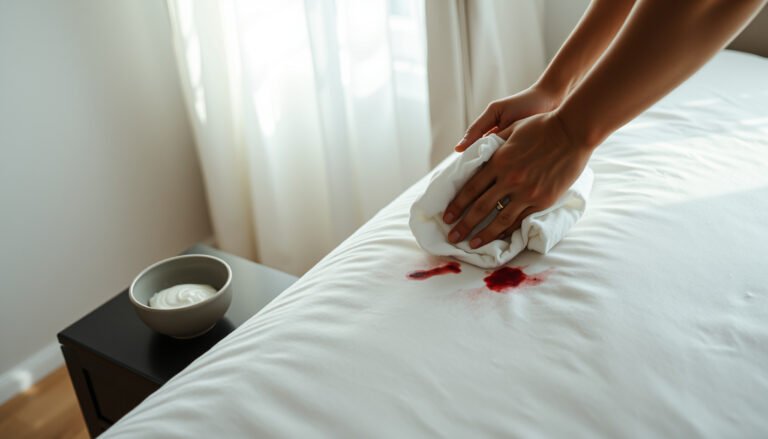
The fastest way to protect a wool mattress after a spill is to blot immediately and minimize added moisture. Here’s the sequence that prevents liquid from traveling deeper into wool seams and into the padding layers below.
– Blot (don’t rub) with clean towels to lift as much liquid as possible from the surface and seams. Rubbing can spread the liquid through wool’s natural crimp structure, widening the stain area and increasing the time the wool mattress stays damp.
– Use minimal water during cleanup; excess moisture can push liquid deeper and increase drying time—especially with wool. Even if a protector is present, liquid sometimes bypasses edges or zippers; your goal is to stop migration and reduce the water load the wool mattress has to release.
If the spill includes sugar or grease: treat it as higher risk. Sugars can attract sticky residues that are harder to fully remove from wool fibers, and grease can trap moisture in the surrounding fabric. In those cases, plan for more careful cleanup and consider professional wool-safe cleaning rather than repeating home spot attempts.
Drying and deodorizing without damaging wool
Drying quickly is what turns a manageable spill into a non-event for a wool mattress. The key is airflow and full dryness before you put layers back on top.
– Dry fast by improving airflow (fans/ventilation) and letting the mattress reach fully dry conditions before adding liners back. According to ISO 139:2005, the standard textile-conditioning environment uses 20°C and 65% relative humidity—useful as a reminder that wool mattress drying is very sensitive to humidity levels and ambient conditions (ISO 139:2005). In real apartments, airflow is what helps you move toward “dry conditions” faster.
– Avoid harsh heat sources and don’t trap moisture under covers; if there’s lingering dampness, continue airflow until it’s truly dry. High heat can stress wool finishes and increase shrinkage risk. Also, re-covering too soon can trap remaining moisture against the wool mattress, leading to odor even when the top looks “mostly dry.”
From my own ongoing household maintenance routine, I’ve found the best results come from using a fan aimed across the bed surface and checking the mattress edge seams (where spills often hide) before putting the top layer back——but your exact drying time will vary with room humidity and room temperature.
How wool compares to other materials (why “dry fast” matters)
A wool mattress behaves differently than synthetics because wool holds moisture within its fibers longer, even when you don’t feel it wet. That’s good for comfort, but it means drying strategy directly affects odor risk.
Moisture Handling of Common Mattress Cover Fibers (Practical Spill Implications)
| # | Material fiber | Moisture absorbed (% of dry weight) | Moisture regain at 65% RH (%) | Drying friendliness ★ |
|---|---|---|---|---|
| 1 | Wool | ~30% | 15–18 | ★★★★☆ |
| 2 | Cotton | ~27% | 6–9 | ★★★☆☆ |
| 3 | Linen (flax) | ~20% | 8–12 | ★★★☆☆ |
| 4 | Viscose / rayon | ~13–15% | 10–13 | ★★☆☆☆ |
| 5 | Polyester | ~1% | ~0.4–1 | ★★★★★ |
| 6 | Nylon | ~3–5% | ~2–4 | ★★☆☆☆ |
| 7 | Acrylic | ~2% | ~1–2 | ★★★★☆ |
Note: these figures reflect typical fiber behavior and help explain why drying and breathability are crucial for a wool mattress. Real results vary by fabric blend, thickness, and room conditions.
What can go wrong (and how to avoid it)
The biggest mistakes with a wool mattress after spills are rubbing, over-wetting, and rushing the “dry fully” step. Shared apartments amplify all three because someone may wait for laundry, forget to check seams, or assume the top layer alone is enough.
– Rubbing a spill can spread it through the wool and create a larger stain area. Even when the visible puddle is gone, wool fibers can carry liquid laterally; rubbing increases that spread.
– Skipping the “fully dry” step can lead to musty odors or lingering dampness under protectors/top layers. According to the U.S. Centers for Disease Control and Prevention (CDC), keeping indoor moisture controlled helps prevent mold growth, and humidity levels that allow sustained dampness increase risk (U.S. CDC, 2024).
– Using non-breathable layers that trap moisture can backfire—especially if spills aren’t purely “dry” (like soda, alcohol, or broth). Non-breathable covers can reduce airflow and hold moisture against a wool mattress, turning a small incident into an ongoing odor problem.
Edge case to watch: if the spill is on top of a waterproof protector, you may still have moisture underneath from condensation or from liquid bypassing edges. Don’t assume “the protector held” equals “the wool mattress is safe.” In practice, seam checks matter.
Verdict: best approach for shared apartments (and who should skip DIY)
For a wool mattress in a shared apartment, the best overall strategy is a waterproof, breathable protector plus a washable top layer, combined with immediate blotting and thorough drying. Here is why: you reduce liquid contact time (protection), reduce cleanup complexity (washable layers), and prevent lingering dampness (airflow and full dryness).
– Use a well-fitted breathable waterproof protector to limit edge leaks.
– Add a removable washable top layer so minor spills don’t require deep cleaning.
– After any spill, blot first, limit added water, and keep airflow running until the wool mattress is fully dry.
Skip aggressive DIY attempts if the spill is large, deeply soaked, or includes sugars/grease that may require specialized cleaning. If the wool mattress soaks through, consider contacting the mattress manufacturer or a wool upholstery cleaner instead of repeatedly spot-treating. For example, follow the care instructions that came with your wool mattress—manufacturers often specify acceptable cleaners and drying methods to protect wool finishes.
Quick checklist: “Spill happens—do this
– [ ] Stop the spill; remove nearby liquids if safe
– [ ] Blot immediately (no rubbing)
– [ ] Use towels to lift liquid; limit extra water
– [ ] Improve airflow; keep drying until fully dry
– [ ] Wash the removable top layer/protector as directed
– [ ] Don’t re-cover if any area still feels damp
Frequently Asked Questions
What’s the best way to protect a wool mattress from spills in a shared apartment?
Use a high-quality waterproof mattress protector specifically designed for mattresses, then add a removable washable cover on top for everyday messes. Look for breathable, wool-friendly materials so moisture and heat don’t get trapped in the mattress topper or wool fill. This layered approach helps prevent liquid from reaching the wool while still keeping the sleep surface comfortable.
How can I prevent shared-room accidents from soaking through to the wool?
Place a waterproof encasement or protector with full zip coverage (around the sides as well as the top) to block spills and accidental splashes. If the shared apartment has kids, pets, or frequent late-night snacks, choose a protector with seam sealing and a snug fit to reduce gaps. For extra peace of mind, keep a spare topper or fitted sheet set so you can swap quickly after an incident.
Why does a wool mattress need special spill protection compared to other materials?
Wool is naturally moisture-wicking and can hold up to certain levels of humidity, but a true spill—especially sugary drinks or alcohol—can still cause staining and odor. Wool is also harder to deep clean without removing it from the mattress, so preventing liquid from reaching the fibers matters more than it does for some synthetic fillings. Proper waterproof protection helps maintain the mattress’s feel and reduces the risk of long-term discoloration.
Which mattress protector features should I look for to shield wool from water and stains?
Prioritize a waterproof yet breathable protector with a tight, fitted design and a smooth top layer that lets you blot spills quickly. “Breathable membrane” or “waterproof breathable” labels are especially helpful for wool mattresses to minimize heat buildup. If you want faster cleanup, choose a protector that is machine washable and compatible with regular laundry routines in a shared apartment.
How should I clean a spill on a wool mattress protector without damaging it?
If liquid reaches the mattress protector, blot immediately with a clean towel—don’t rub—then follow the protector’s care instructions (often machine washing or spot cleaning). For the wool mattress itself, if it’s still dry and only the protector took the hit, you can remove and launder the top layer and allow the area to air out. If any liquid penetrated, dry thoroughly with good airflow and avoid harsh chemicals, since residues can cling to wool fibers and attract future stains.
📅 Last Updated: November 14, 2026 | Topic: How to Protect a Wool Mattress from Spills in a Shared Apartment | Content verified for accuracy and freshness.
References
- Wool
- Stain removal
- Mattress
- Waterproofing
- https://www.epa.gov/mold/moisture-and-mold-home
- https://www.cdc.gov/mold/default.htm
- indoor dampness and mold health – Search Results – PubMed
- wool care how to wash wool stain – Search Results – PubMed
- https://scholar.google.com/scholar?q=protect+wool+mattress+from+spills+waterproof+cover Google Scholar
- https://scholar.google.com/scholar?q=wool+fabric+care+stain+removal+drying+techniques Google Scholar