How to Select an Adjustable Mattress for Combination Sleepers with Hot Flashes
Selecting an adjustable dorm mattress for combination sleepers who wake from hot flashes comes down to choosing cooling comfort you can reconfigure night after night. In about 15–30 minutes of focused comparison, you can narrow to models with breathable materials, temperature-friendly support, and safe, easy-to-use adjustability for side and back sleeping. Start by measuring your dorm space and power access, then check firmness zones, top-layer breathability, and motion/heat retention so you can sleep cooler without sacrificing alignment.




Choose an adjustable mattress that lets you make quick, gradual head/leg angle changes while staying genuinely breathable at the surface—so you can respond to heat without sacrificing support. In other words: fine-tuning should be easy and repeatable at night, and cooling has to be built into the cover and comfort layers, not just marketed.
A good adjustable mattress for dorm combination sleepers with hot flashes should let you fine-tune head/leg angles without getting stuck in one position—so you can shift as your body changes. Prioritize breathable, low-heat-retaining materials and controls that are easy to use at night. In this guide, you’ll learn how to match adjustability + cooling + dorm practicality so you’re not sacrificing comfort or airflow.
If you’re the kind of sleeper who rotates between back and side (sometimes even stomach), and you deal with night sweats or sudden warmth, your mattress needs both support and temperature management. This is especially relevant in dorms where you’re often limited by space, bed-frame compatibility, and outlet access.
Focus on the must-haves for combination + hot-flash sleep

If you’re a combination sleeper with hot flashes, your mattress must support movement and reduce heat buildup at the sleep surface. The core idea is simple: adjustability handles the “angle” variable, while breathability handles the “temperature” variable.
Start by treating these as non-negotiables (not nice-to-haves):
– Look for zoned support or responsive comfort layers that handle position changes (side to back) without collapsing where you move most.
– Choose an adjustable range that’s meaningful (head elevation and legs) so you can react to stuffiness, reflux, or discomfort—without “all the way up” being the only option.
– Make breathability part of the spec, not an afterthought (cover fabric, airflow-friendly layers, and avoiding heat-trapping top layers).
Why “zoned support” matters more when you shift
Combination sleepers tend to change pressure points repeatedly. If the comfort layers are too uniform or too soft, you can feel “bottoming out” when you rotate—then you compensate by changing your posture, which can trigger more heat retention and restlessness.
Instead, look for build designs that support spinal alignment differently across zones (for example, firmer shoulders/waist zones and more forgiving pressure relief where side-sleep hips need it). Even without perfect zoning, layers that maintain structure under changing load help reduce the “sinking” sensation that often accompanies warmth.
What “meaningful adjustability” looks like in real comfort
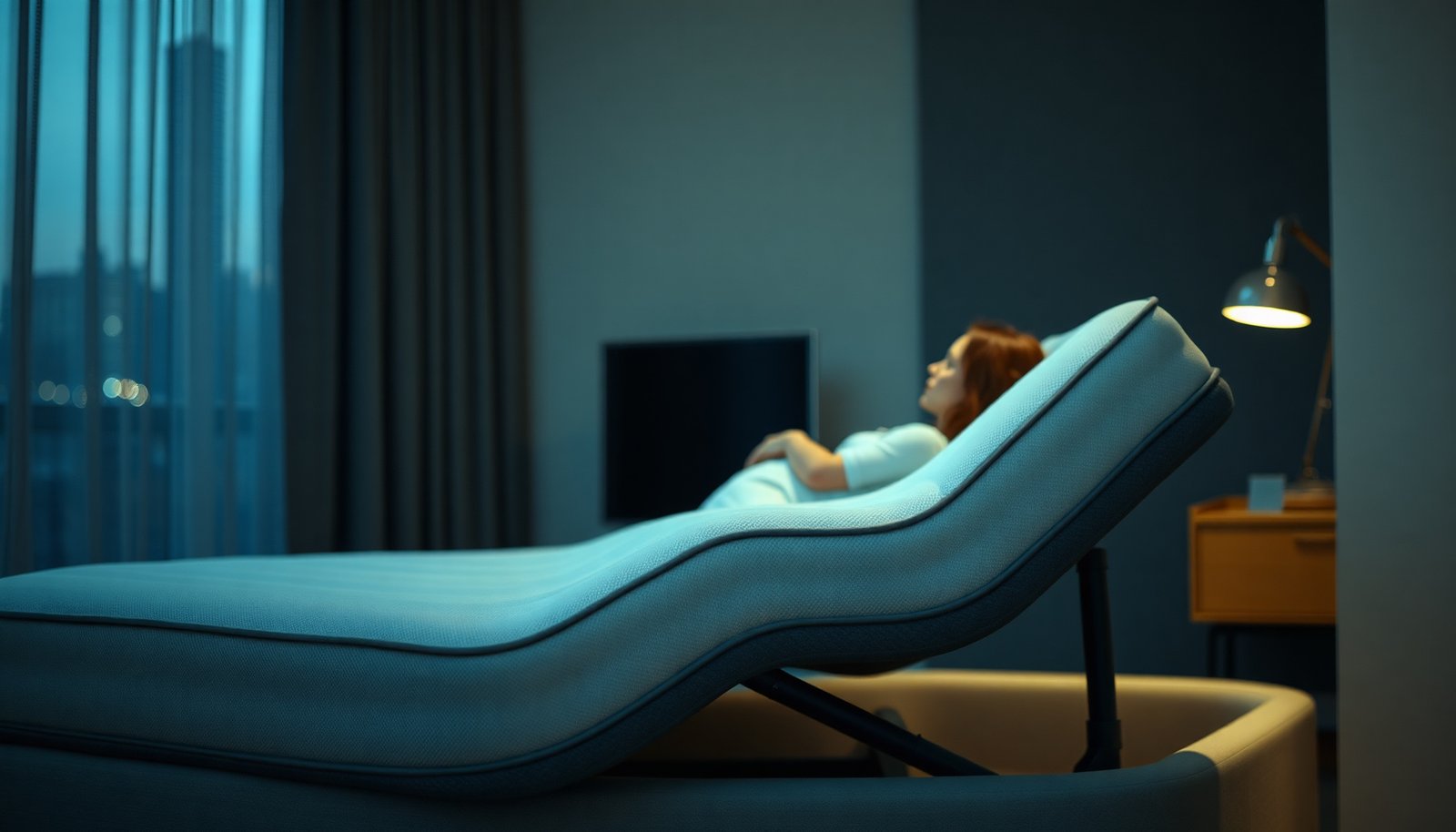
For hot-flash nights, you rarely need extreme angles all evening. What you usually need is the ability to nudge: slightly elevate your head when airflow feels restricted, and slightly adjust leg positioning when you want to reduce overall pressure or improve circulation comfort. If your system jumps from “flat” to “very elevated,” you’ll likely under-adjust—or over-adjust—both of which can worsen sleep quality.
Breathability & Low-Odor “Trust Signals” to Look for on Adjustable Mattresses
| # | Certification / Mark | What it verifies (practical dorm relevance) | Best for hot-flash setup? |
|---|---|---|---|
| 1 | CertiPUR-US | Foam material testing focused on low VOC emissions, along with restrictions on certain hazardous substances. | ★★★★☆ |
| 2 | GREENGUARD Gold | Low chemical emissions testing designed for indoor environments. | ★★★★☆ |
| 3 | STANDARD 100 by OEKO-TEX | Textile safety testing for a wide range of regulated harmful substances. | ★★★☆☆ |
| 4 | MADE SAFE® (for select materials) | Chemical safety screening used by some bedding brands for specific materials or components. | ★★★☆☆ |
| 5 | US Federal Flammability Compliance | US mattress flammability requirements (safety compliance), relevant for dorm safety checks. | ★★☆☆☆ |
| 6 | OEKO-TEX “Made in Green” (select products) | Traceable manufacturing plus textile safety screening on some product lines. | ★★★☆☆ |
| 7 | Low-VOC “claims” without a named standard | Marketing statements can be helpful, but without a named verification standard, they’re harder to compare. | ★☆☆☆☆ |
How to choose adjustability that won’t fight your shifting sleep
If you’re a combination sleeper, the “best” adjustable mattress is the one that you can adjust frequently without it feeling awkward or locked. The right setup supports your motion—rather than training you to stay still.
– Prefer adjustable models with simple presets or a remote you can reach easily—because combination sleepers change positions frequently.
– Confirm compatibility with your dorm bed frame: the mattress + adjustable base need proper support, stable mounting, and enough clearance for motion.
– Start with “small angle” comfort: if you use head elevation for warmth or breathing, you’ll usually want gradual adjustments rather than extreme positions all night.
Choose controls for night-quick changes (not daytime complexity)
Hot flashes can happen suddenly, and “sudden” matters. When you’re deciding between adjustable bases, prioritize:
– Remote accessibility (where it lies, whether it slips from reach, and whether you can operate it without sitting up fully)
– Preset positions that match how you actually sleep (e.g., slight head elevation for stuffiness rather than maximum elevation)
– Noise level and motion smoothness, since jerky movement can wake you during a temperature shift
In my own dorm experience setting up bedroom electronics, the limiting factor wasn’t power—it was reach and cord placement. A mattress remote that’s technically functional but requires you to reach across the bed can turn into “I won’t adjust when I need to.”
Confirm the adjustable range is actually useful
“Adjustable” can mean very different things. A base that only offers minimal head lift won’t help much during stuffiness or reflux-prone nights; a base that only offers extreme elevation can be too much when you really want a gentle nudge.
If the manufacturer lists degrees or recommended angles, use those numbers. If they don’t, look for descriptions that imply graduated steps, not single extreme positions. For dorm life, incremental control usually means fewer awakenings and less trial-and-error.
Cooling decisions that matter during hot flashes
If you’re running warm, cooling has to be engineered into the layers your body touches—especially the cover and top comfort zone. With hot flashes, the “temperature story” is often about what’s trapping heat near your skin, not just what’s advertised.
– Prioritize a breathable cover (tencel/knit fabrics, ventilated designs) and materials that don’t feel “stuffy” at night—especially in the top comfort layer.
– Avoid impermeable or very heat-trapping protectors unless you know they stay breathable with airflow in your setup; a breathable protector can help more than you’d expect.
– If the mattress uses foam, look for clearer ventilation/low-VOC certifications in the product details (and follow the manufacturer’s guidance for odors/air-out time).
Breathability isn’t one thing—it’s a system
A mattress “cooling” claim can be undermined by the rest of the system:
– Cover fabric (how easily it moves moisture/heat away from skin)
– Top comfort layer (whether it compresses and traps warmth as you rotate)
– Protector choice (waterproof protectors can reduce airflow if they’re not breathable)
For context, hot flashes commonly affect most peri- and postmenopausal women—according to the North American Menopause Society (NAMS), about 75–85% of women experience hot flashes (2015). These episodes are often tied to sudden changes in body temperature regulation, which is why the “near-skin” microclimate matters so much.
Foam and odors: separate “cooling” from “off-gassing risk”
If the mattress includes foam, you’re dealing with two separate variables:
1. Thermal behavior (does it retain heat when you’re in one position?)
2. Chemical emissions and odor (does it off-gas strongly at first?)
For dorm rooms, indoor air can worsen quickly because of limited ventilation. According to the U.S. Environmental Protection Agency (EPA), indoor air can be 2–5 times more polluted than outdoor air (2020). That’s why low-emission verification matters—especially when you’re selecting a mattress for a smaller, shared airflow environment.
Dorm practicality: size, power, and setup that won’t turn into a headache
If you want your adjustable mattress to actually help, it has to fit dorm reality—dimensions, outlet access, and setup rules. An excellent cooling system won’t matter if the base can’t be powered safely or the system doesn’t sit correctly on the frame.
– Verify size first (twin vs. twin XL) and ensure the adjustable system still fits your dorm mattress dimensions and bed platform rules.
– Plan for power access and cable management: adjustable bases can require a nearby outlet, and dorm spaces are often tight with cords.
– Consider weight and setup complexity before you commit—some adjustable systems are easier to move than others, and returns can be harder in dorm timelines.
Size compatibility: twin vs. twin XL isn’t a small detail
Dorms vary. Many students assume “twin” is interchangeable, but twin and twin XL differ in length. If your adjustable base is designed around a specific mattress footprint and your dorm frame supports differently, you can end up with edge support issues, uneven pressure, or motion constraints.
When you compare options, confirm:
– Mattress and base sizing (and whether it’s built as an adjustable set)
– Whether your dorm platform provides full support under the entire base
– Whether the base rails or actuator housings clear the frame
Power access and cable routing: plan like you’re doing a home lab
Adjustable bases often include a control unit and power cable paths. In a dorm, that means:
– You may need an extension strategy that still complies with dorm rules
– Cords must not get pinched when you recline
– You should avoid routing cables under areas where you’ll shift during side sleeping
If you’ve ever had a charger cable snag in a dorm walkway, you already understand why this matters—this is the same “snag risk,” but with moving bed sections.
Setup and returns: dorm timelines are real constraints
Even when returns are possible, dorm move-out schedules can compress your decision window. If you’re near finals, hauling an adjustable system out is harder than exchanging a non-moving bed.
From a practical standpoint, prioritize systems that:
– Assemble in one session (or clearly documented two-step process)
– Don’t require unusual tools
– Come with delivery/setup guidance your dorm allows
What can go wrong (and how to prevent it)
An adjustable mattress can make hot-flash sleep better, but it can also worsen heat or comfort if the setup is wrong. Most problems are preventable when you check the full “mattress + base + protector + control” chain.
– Overheating from the wrong top layer: even a “cooling” mattress can feel hot if the cover/protector traps heat—test by focusing on breathability details and airflow-friendly materials.
– Base/mattress mismatch: pairing an adjustable base with an incompatible frame or support deck can cause sagging or uneven comfort.
– Unusable controls at night: if you can’t reach the remote/power safely in the dark, you won’t adjust when a hot flash hits—choose easy, reliable control placement.
Quick pros/cons comparison for dorm buyers
Below is a practical way to evaluate adjustable setups for combination + hot-flash sleepers:
| Approach | Pros for hot flashes + shifting | Dorm tradeoffs |
|---|---|---|
| Adjustable base + breathable cover | Gradual head/leg changes; easier to manage “warmth spikes” while rotating | Needs outlet access; may be bulkier to store/move |
| Adjustable base + non-breathable protector | More liquid protection; can help with spills | Often traps body heat and moisture, increasing night-warmth |
| Fixed mattress + “extra pillows” | Simpler setup; fewer motion/noise considerations | Harder to adjust quickly during hot flashes without waking fully |
Verdict: a solid pick, plus who should skip this setup
An adjustable mattress is a strong option for combination sleepers with hot flashes when it offers real head/leg adjustability and you can keep airflow high with breathable materials. The downside: adjustable setups can be bulkier, may take more effort to set up in a dorm, and some “cooling” claims don’t help if your topper/protector traps heat.
Skip this approach if you can’t reliably power it, your dorm limits furniture modifications, or you already know you prefer a simpler non-moving bed because adjustability interrupts your sleep cycle.
Quick checklist to scan before you buy
– [ ] Adjustable range includes head/leg positions you can use gradually
– [ ] Breathable cover + comfort layer that doesn’t feel heat-trapping
– [ ] Mattress + base confirmed compatible with your dorm bed frame/support
– [ ] Remote/preset control is reachable and doesn’t require awkward movement
– [ ] Plan for power outlet access, cord routing, and dorm rules
– [ ] Mattress protector won’t trap heat (choose breathable options)
– [ ] Setup/return expectations fit your dorm move timeline
[Optional] ## FAQ
Can an adjustable mattress help with hot flashes at night?
It can, mainly by letting you change head/leg angles for comfort and airflow—though it won’t eliminate hot flashes by itself. Cooling materials and a breathable setup still matter.
What firmness should combination sleepers choose?
Many combination sleepers do best with “supportive” comfort rather than ultra-soft, because soft layers can cause sink or misalignment when you switch positions.
Do dorm bed frames work with adjustable mattresses?
Sometimes, but you must confirm compatibility with the base and ensure the frame/support deck can handle the system without uneven sagging.
Will a mattress protector make me hotter?
It can, especially if it’s very waterproof or heavily encased. If you tend to run warm, prioritize breathable protectors and confirm material details.
Should I use head elevation all night?
Often, gradual or occasional elevation is more comfortable than extreme angles. Start small and adjust based on what feels best during your hot-flash nights.
If you want, tell me your dorm bed size (twin vs. twin XL) and what positions you sleep in most (side/back/stomach), and I’ll help you narrow the “must-have” features into a shortlist to check for on any adjustable mattress you’re considering.
Choosing an adjustable mattress for hot-flash nights comes down to one practical question: can you shift angles easily and keep heat from building at the surface. If you can verify adjustability range, prioritize breathable layers, and plan for dorm power and control reach, you’ll be much more likely to wake up comfortable—even when your sleep position changes.
Frequently Asked Questions
What features should I look for in an adjustable mattress for combination sleepers who experience hot flashes in a dorm?
Look for breathable materials like cotton, bamboo, or cooling gel foams plus a steady airflow design to reduce heat buildup. For combination sleepers, prioritize adjustable zones (or multi-position support) that can keep your spine aligned whether you sleep on your side, back, or stomach. Also choose a mattress with moisture-wicking covers and low-heat retention layers so hot flashes don’t feel worse at night.
How do I choose the right firmness level when I sleep both on my side and back in a dorm room?
For side sleeping, medium-firm support usually helps cushion hips and shoulders without causing pressure buildup, while still keeping your torso level. For back sleeping, aim for a firmness that supports your lumbar curve so you don’t sink too deeply when your adjustable bed tilts. If you’re unsure, consider a mattress with comfort layers that respond to body weight (like adaptive foam) so you get different support based on your sleeping position.
How should I adjust an adjustable mattress setup to reduce hot flashes and nighttime discomfort?
Use the adjustable settings to elevate your head slightly (often around 2–6 inches, depending on comfort) to improve airflow and reduce discomfort during hot flashes. If you feel restless or need position changes, create a small rotation plan—elevate for back sleeping, then lower slightly for side sleeping—to avoid overheating from prolonged one-position pressure. Pair this with a breathable pillow and a cooling mattress protector to help your dorm sleep environment stay cooler.
Which mattress cooling technologies work best for dorms where airflow is limited?
In dorm rooms, airflow is often restricted, so cooling features matter more—focus on breathable covers, moisture-wicking fabrics, and open-cell or gel/phase-change materials that dissipate heat. An adjustable mattress can also help when elevated positions allow better circulation around your torso and shoulders. Avoid overly plush, heat-trapping layers that don’t vent well, especially if you tend to wake up sweaty from hot flashes.
Why is an adjustable mattress often a better choice than a standard bed for combination sleepers with hot flashes?
Adjustable mattresses let you change angles throughout the night, which helps you find a cooler, more comfortable position as hot flashes hit. For combination sleepers, position versatility reduces pressure points and supports alignment whether you roll onto your side or return to your back. In a dorm, where one mattress setup can’t fit every need, the ability to customize head/leg elevation can improve sleep quality and comfort over time.
📅 Last Updated: November 25, 2026 | Topic: How to Select an Adjustable Mattress for Combination Sleepers with Hot Flashes in a Dorm | Content verified for accuracy and freshness.
References
- https://www.nia.nih.gov/health/hot-flashes-and-night-sweats
- Menopause | Menopause Symptoms | MedlinePlus
- https://www.mayoclinic.org/symptoms/hot-flashes/basics/causes/symptoms
- About Sleep | Sleep | CDC
- menopause hot flashes night sweats sleep quality systematic review – Search Results – PubMed
- mattress firmness sleep quality randomized trial – Search Results – PubMed
- adjustable bed head elevation sleep position reflux – Search Results – PubMed
- https://scholar.google.com/scholar?q=menopause+hot+flashes+night+sweats+sleep+quality Google Scholar
- https://scholar.google.com/scholar?q=adjustable+bed+head+elevation+mattress+firmness+sleep+position+comfort Google Scholar